PUBLISHER: Mordor Intelligence | PRODUCT CODE: 2163599

PUBLISHER: Mordor Intelligence | PRODUCT CODE: 2163599
Water Electrolysis - Market Share Analysis, Industry Trends & Statistics, Growth Forecasts (2026 - 2031)
According to Mordor Intelligence, the water electrolysis market size is projected to expand from USD 7.23 billion in 2025 and USD 7.81 billion in 2026 to USD 11.43 billion by 2031, at a CAGR of 7.92% between 2026 and 2031.
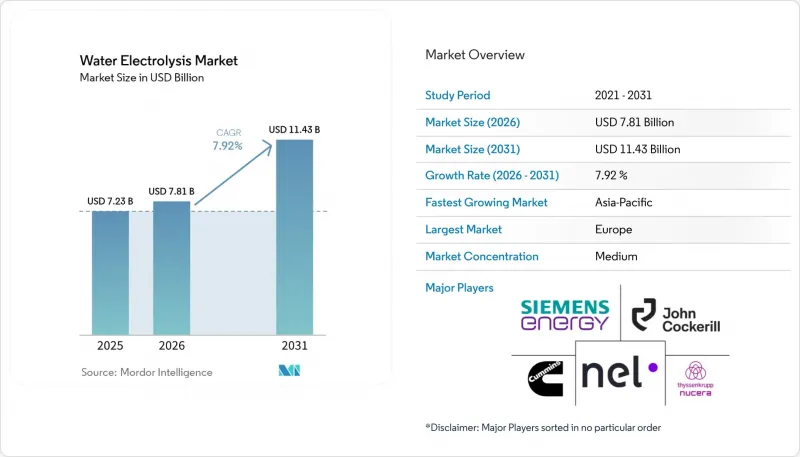
Global Water Electrolysis Market Trends and Insights
Industrial Decarbonization Driving Electrolyzer Demand Beyond the Chemicals Sector
Industrial decarbonization supports the water electrolysis market because many processes need hydrogen as a feedstock, and these users already understand hydrogen quality requirements, handling practices, and operating risks. Oil refining used 37 million tons of hydrogen in 2024, while ammonia production used 33 million tons. Most of this demand has historically been supplied through fossil-based production routes, creating a defined replacement opportunity where renewable electricity, water supply, and project finance can be brought together. The U.S. Inflation Reduction Act Section 45V credit can improve the economics of renewable hydrogen for steel and ammonia production in selected locations. The water electrolysis market, therefore, has a route into established industrial sites where hydrogen handling systems, demand patterns, technical specifications, and operating staff are already present.
Renewable-Power Integration Turning Electrolyzers Into Grid Assets
Renewable power integration is changing the role of electrolyzers within the water electrolysis market. Electrolyzers can act as flexible loads when wind and solar output would otherwise be curtailed, which can give project developers another source of value beyond hydrogen sales alone. This capability is particularly relevant where renewable additions have outpaced grid capacity and where power systems need flexible demand that can respond to changing generation conditions. Germany had 193 MW of operational electrolysis capacity in 2026, but high grid-power costs meant many projects still required public support. Developers that link electrolyzer supply with dedicated renewable assets and power agreements can present a more complete project case to lenders, customers, and public funding bodies.
Electricity Costs Limiting Green Hydrogen Competitiveness Across Most Markets
Electricity costs remain a central restraint on the water electrolysis market because they shape the cost of hydrogen production, the hours that equipment can operate, and the price that industrial customers must pay. The IEA reported that lower natural gas prices since 2025 had widened the cost difference between renewable and fossil hydrogen in several markets. This can delay final investment decisions where grants or contracted low-cost power are unavailable, particularly where developers cannot pass higher hydrogen costs through to their customers. Project development is consequently concentrated in regions with favorable renewable resources, workable offtake conditions, suitable infrastructure, and a policy environment that can reduce early project risks. The Iberian Peninsula, southern India, the Middle East, and northern Chinese wind regions have characteristics that can support lower-cost supply.
Other drivers and restraints analyzed in the detailed report include:
- Hydrogen Mandates and Carbon-Reduction Policies Anchoring Long-Term Demand
- E-Fuels, Ammonia, and Steel Creating Industrial-Scale Electrolyzer Pull
- High Capital Requirements and Project-Finance Risk Deferring Investment Decisions
For complete list of drivers and restraints, kindly check the Table Of Contents.
Segment Analysis
Alkaline electrolyzers held 54.8% of the water electrolysis market size in 2025, while PEM is expected to record a 9.4% CAGR through 2031. Alkaline technology remains widely used because it has an established industrial record, does not rely on iridium, works with nickel-based catalysts, and has been used for decades in industrial applications such as chlor-alkali production. Its lower capital requirements also support its position in large industrial projects, especially where buyers prioritize proven equipment, cost discipline, standardization, and rapid availability over the operating flexibility of newer technologies. PEM systems respond rapidly to variable renewable electricity and can deliver high-purity hydrogen, which is important when hydrogen production must follow changing wind and solar generation without compromising the quality required by specialized end users. These attributes support use in fuel-cell applications and semiconductor-related production, where compact equipment, dynamic operation, and stringent purity specifications can matter more than the lower initial cost associated with alkaline technology.
Research published in 2025 demonstrated a tunnel-structured IrOx catalyst that reduced iridium loading in PEM anodes. The result addresses a material constraint that affects wider PEM deployment because global iridium supply is limited and iridium is largely produced as a by-product of platinum mining rather than as a primary material. Nel ASA approved an investment decision in December 2025 to industrialize a pressurized alkaline platform at Heroya, Norway. SOEC technology retains an efficiency case where industrial waste heat is available, particularly in steel and ammonia settings, but it is earlier in commercialization and carries greater development, manufacturing, and customer adoption risk than established alkaline systems. AEM systems are also moving from demonstrations toward industrial applications without the same iridium exposure as PEM systems, giving developers another possible technology route where flexible operation and lower material dependency are central procurement considerations.
Complete Report Scope:
- By Technology
- Alkaline Electrolyzer
- PEM Electrolyzer
- Solid Oxide Electrolyzer Cell (SOEC)
- Anion Exchange Membrane (AEM) Electrolyzer
- By Hydrogen Production Capacity
- Below 500 L/hr
- 500-2,000 L/hr
- Above 2,000 L/hr
- By End Use
- Chemicals
- Oil & Gas and Refining
- Power & Utilities
- Transportation
- Industrial Manufacturing
- Electronics & Semiconductors
- Energy Storage
- Other End Users
- By Geography
- North America
- United States
- Canada
- Mexico
- Europe
- Germany
- France
- Italy
- Spain
- United Kingdom
- Poland
- Russia
- Rest of Europe
- Asia-Pacific
- China
- India
- Japan
- South Korea
- Australia
- Indonesia
- Vietnam
- Thailand
- Rest of Asia-Pacific
- South America
- Brazil
- Argentina
- Chile
- Rest of South America
- Middle East and Africa
- Saudi Arabia
- United Arab Emirates
- Egypt
- South Africa
- Morocco
- Rest of Middle East and Africa
- North America
Geography Analysis
Europe held 31.5% of the water electrolysis market share in 2025. The region combines industrial demand, policy support, and public funding, and European installed electrolysis capacity reached 571 MWel by mid-2025. Average project size increased from 2.9 MWel in 2023-2024 to 18 MWel in 2024-2025. This indicates a move beyond small demonstrations toward larger industrial facilities.
Germany had 193 MW of operational capacity and 993 MW under construction in mid-2026. High electricity costs make public funding and lower-cost supply routes important to the country's project pipeline. Germany's Hydrogen Acceleration Act, approved in October 2025, covered permitting across production, terminals, storage, and pipelines. The planned 9,700 km Kernnetz network is expected to connect northern production areas with industrial demand centers by 2032, while Spain is gaining relevance through Moeve's Huelva facility.
Asia-Pacific is the fastest-growing regional water electrolysis market at a 9.2% CAGR through 2031. China accounted for nearly three-quarters of new global electrolyzer installations in 2025. Its alkaline manufacturing scale supports a cost-led model but also increases competitive pressure. India is developing export-oriented hydrogen projects, including AM Green's planned 1.3 GW electrolyzer deployment in Kakinada. North America is shaped by the U.S. Section 45V credit, while Canadian projects can draw on lower-carbon electricity grids and South American port locations such as Pecem and Suape are pursuing export opportunities. The Middle East and Africa combine low-cost solar resources with ammonia export programs and large alkaline project proposals.
- Air Liquide S.A.
- Air Products and Chemicals, Inc.
- Asahi Kasei Corporation
- Bloom Energy Corporation
- Cummins Inc.
- Enapter AG
- HydrogenPro ASA
- ITM Power PLC
- John Cockerill
- Linde plc
- LONGi Green Energy Technology Co., Ltd.
- McPhy Energy S.A.
- Nel ASA
- Ohmium International, Inc.
- Plug Power Inc.
- Siemens Energy AG
- Sunfire GmbH
- Sungrow Power Supply Co., Ltd.
- thyssenkrupp nucera AG and Co. KGaA
- Topsoe A/S
- Toshiba Energy Systems and Solutions Corporation
Additional Benefits:
- The market estimate (ME) sheet in Excel format
- 3 months of analyst support
TABLE OF CONTENTS
1 INTRODUCTION
- 1.1 Study Assumptions and Market Definition
- 1.2 Scope of the Study
2 RESEARCH METHODOLOGY
3 EXECUTIVE SUMMARY
4 MARKET LANDSCAPE
- 4.1 Market Overview
- 4.2 Market Drivers
- 4.2.1 Industrial Decarbonization and Green-Hydrogen Demand
- 4.2.2 Renewable-Power Integration and Long-Duration Energy Storage
- 4.2.3 Hydrogen Mandates, Incentives and Carbon-Reduction Policies
- 4.2.4 Demand Growth from Ammonia, Methanol, Refining, Steel and E-Fuels
- 4.2.5 Co-Located Hydrogen Production in Industrial and Port Clusters
- 4.2.6 Digital Stack Monitoring and Predictive Maintenance
- 4.3 Market Restraints
- 4.3.1 High Electricity Cost and Low-Cost Renewable Availability
- 4.3.2 High Upfront Capital and Project-Finance Risk
- 4.3.3 Water, Cooling and Brine-Management Constraints in Arid Locations
- 4.3.4 Iridium, Platinum-Group Metals and Membrane Durability Bottlenecks
- 4.4 Supply-Chain Analysis
- 4.5 Porter's Five Forces Analysis
- 4.5.1 Bargaining Power of Suppliers
- 4.5.2 Bargaining Power of Buyers
- 4.5.3 Threat of New Entrants
- 4.5.4 Threat of Substitutes
- 4.5.5 Competitive Rivalry
- 4.6 Technology Outlook
- 4.7 Regulatory Landscape
- 4.8 Investment Analysis
5 MARKET SIZE AND GROWTH FORECASTS
- 5.1 By Technology
- 5.1.1 Alkaline Electrolyzer
- 5.1.2 PEM Electrolyzer
- 5.1.3 Solid Oxide Electrolyzer Cell (SOEC)
- 5.1.4 Anion Exchange Membrane (AEM) Electrolyzer
- 5.2 By Hydrogen Production Capacity
- 5.2.1 Below 500 L/hr
- 5.2.2 500-2,000 L/hr
- 5.2.3 Above 2,000 L/hr
- 5.3 By End Use
- 5.3.1 Chemicals
- 5.3.2 Oil & Gas and Refining
- 5.3.3 Power & Utilities
- 5.3.4 Transportation
- 5.3.5 Industrial Manufacturing
- 5.3.6 Electronics & Semiconductors
- 5.3.7 Energy Storage
- 5.3.8 Other End Users
- 5.4 By Geography
- 5.4.1 North America
- 5.4.1.1 United States
- 5.4.1.2 Canada
- 5.4.1.3 Mexico
- 5.4.2 Europe
- 5.4.2.1 Germany
- 5.4.2.2 France
- 5.4.2.3 Italy
- 5.4.2.4 Spain
- 5.4.2.5 United Kingdom
- 5.4.2.6 Poland
- 5.4.2.7 Russia
- 5.4.2.8 Rest of Europe
- 5.4.3 Asia-Pacific
- 5.4.3.1 China
- 5.4.3.2 India
- 5.4.3.3 Japan
- 5.4.3.4 South Korea
- 5.4.3.5 Australia
- 5.4.3.6 Indonesia
- 5.4.3.7 Vietnam
- 5.4.3.8 Thailand
- 5.4.3.9 Rest of Asia-Pacific
- 5.4.4 South America
- 5.4.4.1 Brazil
- 5.4.4.2 Argentina
- 5.4.4.3 Chile
- 5.4.4.4 Rest of South America
- 5.4.5 Middle East and Africa
- 5.4.5.1 Saudi Arabia
- 5.4.5.2 United Arab Emirates
- 5.4.5.3 Egypt
- 5.4.5.4 South Africa
- 5.4.5.5 Morocco
- 5.4.5.6 Rest of Middle East and Africa
- 5.4.1 North America
6 COMPETITIVE LANDSCAPE
- 6.1 Market Concentration
- 6.2 Strategic Moves
- 6.3 Market Share Analysis
- 6.4 Company Profiles (includes Global Level Overview, Market Level Overview, Core Segments, Financials as available, Strategic Information, Market Rank/Share, Products and Services, Recent Developments)
- 6.4.1 Air Liquide S.A.
- 6.4.2 Air Products and Chemicals, Inc.
- 6.4.3 Asahi Kasei Corporation
- 6.4.4 Bloom Energy Corporation
- 6.4.5 Cummins Inc.
- 6.4.6 Enapter AG
- 6.4.7 HydrogenPro ASA
- 6.4.8 ITM Power PLC
- 6.4.9 John Cockerill
- 6.4.10 Linde plc
- 6.4.11 LONGi Green Energy Technology Co., Ltd.
- 6.4.12 McPhy Energy S.A.
- 6.4.13 Nel ASA
- 6.4.14 Ohmium International, Inc.
- 6.4.15 Plug Power Inc.
- 6.4.16 Siemens Energy AG
- 6.4.17 Sunfire GmbH
- 6.4.18 Sungrow Power Supply Co., Ltd.
- 6.4.19 thyssenkrupp nucera AG and Co. KGaA
- 6.4.20 Topsoe A/S
- 6.4.21 Toshiba Energy Systems and Solutions Corporation
7 MARKET OPPORTUNITIES AND FUTURE OUTLOOK
- 7.1 White-Space and Unmet-Need Assessment

