PUBLISHER: Mordor Intelligence | PRODUCT CODE: 2184619

PUBLISHER: Mordor Intelligence | PRODUCT CODE: 2184619
Indonesia Whey Protein - Market Share Analysis, Industry Trends & Statistics, Growth Forecasts (2026 - 2031)
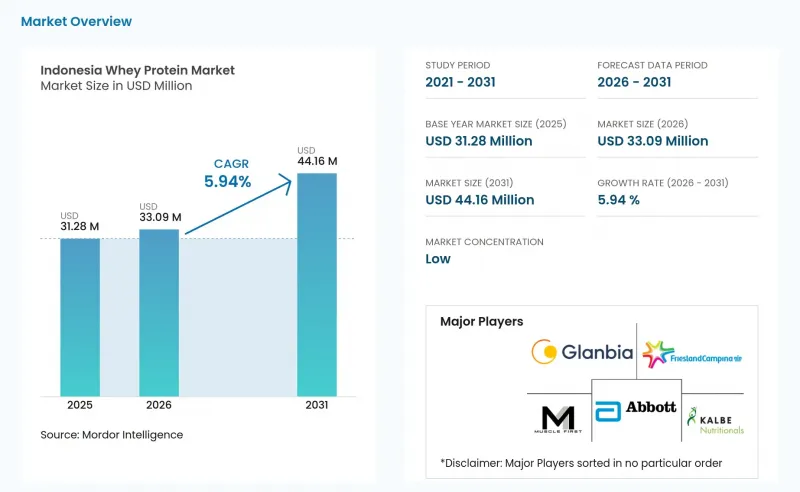
According to Mordor Intelligence, the Indonesian whey protein market size was valued at USD 31.28 million in 2025 and estimated to grow from USD 33.09 million in 2026 to reach USD 44.16 million by 2031, at a CAGR of 5.94% during the forecast period (2026-2031).
Indonesia Whey Protein Market Trends and Insights
Rising Gym Participation and Fitness Influencer Marketing
Sports participation provides a practical demand base for the Indonesian whey protein market because regular exercise supports repeat use of protein products. BPS reported that 37.27% of Indonesians aged 5 years and above participated in sports in 2025, with Jakarta at 57.27%, the highest rate among the country's 38 provinces. The gap between urban participation at 42.36% and rural participation at 29.65% also points to stronger near-term demand in large cities. Protein brands can leverage gym communities and social commerce to reach consumers when they are actively building health routines. This makes smaller package sizes and clearer nutrition claims important for buyers who are not yet committed to large supplement tubs. The Indonesian whey protein market can therefore expand through ordinary fitness routines rather than relying only on serious athletes.
Protein Fortification in Infant and Clinical Nutrition
Infant and clinical nutrition provide a separate source of demand from sports supplementation in the Indonesian whey protein market. Specialized whey fractions can be used in formula and nutrition products where parents and healthcare providers place more emphasis on ingredient quality and digestive suitability. Nestle stated that 57% of Southeast Asian teenagers want more protein-rich foods, and its Milo Pro launch provides 3 times the protein of standard Milo in a ready-to-drink product. This type of product brings protein fortification into a familiar beverage format and widens the audience beyond gym users. Whey hydrolysates are also relevant in enteral feeding and oral nutrition products, where tolerance may matter more than flavor or convenience. These use cases support a broader role for the Indonesian whey protein market in life-stage and medically guided nutrition.
Imported Whey Price Exposure to Rupiah Volatility
The Indonesian whey protein market remains exposed to imported ingredient costs because much of its raw whey supply comes from overseas dairy markets. The rupiah weakened to IDR 16,865 per USD in April 2025 before recovering to IDR 16,315 by June 30, 2025, according to the Ministry of Finance's KSSK III reporting. Currency movements affect the cost of whey purchases, packaging inputs, and freight for businesses selling imported or imported-ingredient products. The USDA observed reduced imports of whey and lactose as processors shifted toward other dairy inputs, showing that procurement behavior can change when import costs rise. Manufacturers may absorb higher costs, reformulate products, or raise retail prices, but each response has tradeoffs. Price-sensitive buyers are more likely to delay purchases when premium formats become more expensive. The risk is most relevant where brands have limited local sourcing options and narrow gross margins.
Other drivers and restraints analyzed in the detailed report include:
- Wider Availability of Halal-Certified Whey Ingredients
- Domestic Cheese Processing Expanding Whey Availability
- BPOM Registration and Label Compliance Burden
For complete list of drivers and restraints, kindly check the Table Of Contents.
Segment Analysis
Whey protein concentrate held 47.63% of the Indonesian whey protein market share in 2025. Its position reflects a balance of protein content, price, and flexibility for bakery products, dairy beverages, infant nutrition, and other food applications. Manufacturers can use concentrate where very high purity is not essential and cost control matters. The broad suitability of concentrate makes it useful for producers serving a large consumer base with varying purchasing power. The Indonesian whey protein market relies on this format for volumes because it can support both industrial formulation and retail products. Suppliers also benefit from familiar processing and application methods, which reduce the barriers to adoption by food manufacturers. FrieslandCampina Ingredients has an established production presence in Cikarang, supporting local ingredient supply for Indonesian manufacturers. This local footprint can shorten lead times compared with fully imported ingredients. The Indonesian whey protein industry, therefore, has a strong volume base in concentrate, even as premium formats receive more attention. Concentrate remains relevant because food and beverage applications are larger than the specialized sports nutrition base.
Whey protein isolate is projected to grow at a 6.72% CAGR through 2031, making it the fastest-growing product type in the Indonesia whey protein market. Urban consumers may choose isolate because it offers higher protein purity, lower lactose content, and a more premium sports nutrition profile. Its role is strongest among buyers who compare serving-level protein content and who accept a higher retail price. Isolate also gives brands a clearer premium point of difference in a crowded online supplement environment. Glanbia stated that it is investing in whey protein isolate capacity and customized premix solutions, which could support future product development by food and nutrition companies. This supports the availability of ingredients for more specialized finished products. Whey protein hydrolysate remains smaller but is important in infant and clinical nutrition because its protein is already broken into smaller peptides. The category does not replace concentrate because each form serves a different need. Instead, premiumization is adding choice within the Indonesia whey protein market. Brands that explain these differences clearly may find it easier to justify higher-priced isolate products.
Complete Report Scope:
- Product Type
- Whey Protein Concentrate
- Whey Protein Isolate
- Whey Protein Hydrolysate
- Form
- Powder
- Liquid
- Application
- Animal Feed
- Food and Beverages
- Bakery
- Beverages
- Breakfast Cereals
- Condiments/Sauces
- Dairy and Dairy Alternative Products
- Ready-to-cook/Ready-to-eat Food Products
- Snacks
- Personal Care and Cosmetics
- Supplements
- Baby Food and Infant Formula
- Elderly Nutrition and Medical Nutrition
- Sport/Performance Nutrition
List of Companies Covered in this Report:
- Lactalis Ingredients
- FrieslandCampina Ingredients
- Glanbia plc (Optimum Nutrition)
- Fonterra Co-operative Group
- Arla Foods Ingredients
- Hilmar Cheese Company
- Carbery Group Ltd
- AB Rokiskio Suris
- Davisco (Agropur)
- Abbott Nutrition Indonesia
- Kalbe Nutritionals
- Nutrifood Indonesia (HiLo)
- PT Muscle First Indonesia
- PT Dunia Protein (Universal/Ultimate)
- MyProtein (THG)
- Dymatize Enterprises
- SBH Foods Pvt Ltd
- Greenfields Indonesia
- Procal Gold (Wyeth)
- PT Indolakto (Indofood)
Additional Benefits:
- The market estimate (ME) sheet in Excel format
- 3 months of analyst support
TABLE OF CONTENTS
1 INTRODUCTION
- 1.1 Study Assumptions and Market Definition
- 1.2 Scope of the Study
2 RESEARCH METHODOLOGY
3 EXECUTIVE SUMMARY
4 MARKET DYNAMICS
- 4.1 Market Overview
- 4.2 Market Drivers
- 4.2.1 Rising Gym Participation and Fitness-Influencer Marketing
- 4.2.2 Increasing Demand for Protein Fortification in Infant and Clinical Nutrition
- 4.2.3 Wider Availability of Halal-Certified Whey Ingredients
- 4.2.4 Domestic Cheese Processing Expanding Whey Availability
- 4.2.5 Growth of Localized Flavors and Age-Specific Formulations
- 4.2.6 Expansion of E-Commerce Nutraceutical Sales
- 4.3 Market Restraints
- 4.3.1 Imported-Whey Price Exposure to Rupiah Volatility
- 4.3.2 BPOM Registration and Label-Compliance Burden
- 4.3.3 Consumer Confusion Between Concentrate, Isolate, and Hydrolysate
- 4.3.4 Tropical-Humidity and Logistics Risks in Eastern Indonesia
- 4.4 Supply Chain Analysis
- 4.5 Regulatory Landscape
- 4.6 Technological Outlook
- 4.7 Porter's Five Forces
- 4.7.1 Threat of New Entrants
- 4.7.2 Bargaining Power of Buyers/Consumers
- 4.7.3 Bargaining Power of Suppliers
- 4.7.4 Threat of Substitute Products
- 4.7.5 Intensity of Competitive Rivalry
5 MARKET SIZE AND GROWTH FORECASTS (VALUE)
- 5.1 Product Type
- 5.1.1 Whey Protein Concentrate
- 5.1.2 Whey Protein Isolate
- 5.1.3 Whey Protein Hydrolysate
- 5.2 Form
- 5.2.1 Powder
- 5.2.2 Liquid
- 5.3 Application
- 5.3.1 Animal Feed
- 5.3.2 Food and Beverages
- 5.3.2.1 Bakery
- 5.3.2.2 Beverages
- 5.3.2.3 Breakfast Cereals
- 5.3.2.4 Condiments/Sauces
- 5.3.2.5 Dairy and Dairy Alternative Products
- 5.3.2.6 Ready-to-cook/Ready-to-eat Food Products
- 5.3.2.7 Snacks
- 5.3.3 Personal Care and Cosmetics
- 5.3.4 Supplements
- 5.3.4.1 Baby Food and Infant Formula
- 5.3.4.2 Elderly Nutrition and Medical Nutrition
- 5.3.4.3 Sport/Performance Nutrition
6 COMPETITIVE LANDSCAPE
- 6.1 Market Concentration
- 6.2 Strategic Moves
- 6.3 Market Ranking Analysis
- 6.4 Company Profiles (includes Global level Overview, Market level overview, Core Segments, Financials, Strategic Information, Market Rank/Share, Products and Services, Recent Developments)
- 6.4.1 Lactalis Ingredients
- 6.4.2 FrieslandCampina Ingredients
- 6.4.3 Glanbia plc (Optimum Nutrition)
- 6.4.4 Fonterra Co-operative Group
- 6.4.5 Arla Foods Ingredients
- 6.4.6 Hilmar Cheese Company
- 6.4.7 Carbery Group Ltd
- 6.4.8 AB Rokiskio Suris
- 6.4.9 Davisco (Agropur)
- 6.4.10 Abbott Nutrition Indonesia
- 6.4.11 Kalbe Nutritionals
- 6.4.12 Nutrifood Indonesia (HiLo)
- 6.4.13 PT Muscle First Indonesia
- 6.4.14 PT Dunia Protein (Universal/Ultimate)
- 6.4.15 MyProtein (THG)
- 6.4.16 Dymatize Enterprises
- 6.4.17 SBH Foods Pvt Ltd
- 6.4.18 Greenfields Indonesia
- 6.4.19 Procal Gold (Wyeth)
- 6.4.20 PT Indolakto (Indofood)
7 MARKET OPPORTUNITIES AND FUTURE TRENDS

