PUBLISHER: Mordor Intelligence | PRODUCT CODE: 2184667

PUBLISHER: Mordor Intelligence | PRODUCT CODE: 2184667
Europe Automotive Interiors - Market Share Analysis, Industry Trends & Statistics, Growth Forecasts (2026 - 2031)
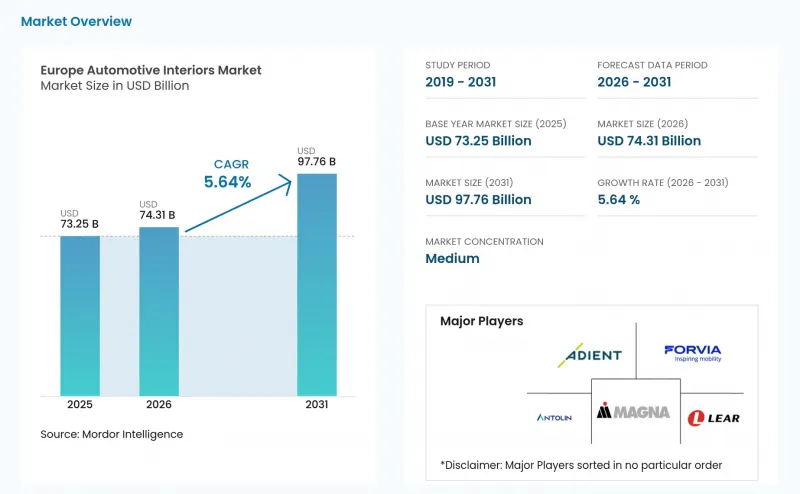
According to Mordor Intelligence, the Europe automotive interior market size was valued at USD 73.25 billion in 2025, is estimated at USD 74.31 billion in 2026, and is projected to reach USD 97.76 billion by 2031, growing at a CAGR of 5.64% from 2026 to 2031.
Europe Automotive Interiors Market Trends and Insights
EV-Led Cockpit Redesign Wave
Battery-electric skateboard platforms are reshaping automotive design in Europe. By eliminating transmission tunnels and minimizing engine-bay intrusion, these platforms grant designers significantly more cabin volume. This newfound space can be transformed into flat floors, lounge-style seating, and panoramic roofs-for instance, Volkswagen's ID.CODE showcases a shift in design philosophy: pairing curved OLED clusters with retractable steering columns. This move suggests a shift from traditional driver-centric layouts to more versatile spaces that are adaptable to autonomous driving. The industry is witnessing accelerated change cycles, with cockpit designs updated more frequently, posing challenges for suppliers, who now must amortize tooling over shorter production runs. Additionally, UN Regulation 100 has adjusted floor height standards, allowing for taller seating without incurring rollover penalties . As electrified vehicles gain a larger share of new-car registrations, the industry anticipates a standardization: modular instrument-panel carriers that seamlessly accommodate both ICE and EV interfaces. This shift is expected to streamline engineering costs, resulting in reduced per-unit spending.
Rising Demand for Connected In-Vehicle Infotainment
5G modems and over-the-air update stacks have transformed head units into gateways for recurring revenue. In-car upgrade platforms enable vehicle owners to purchase additional processing capacity or memory through integrated app stores. Digital cockpit platforms integrate navigation, voice, and driver-monitoring functions into a single system-on-chip (SoC), significantly reducing wiring mass. Data-access regulations require OEMs to provide independent repairers with access to vehicle-generated data. This requirement necessitates API layers that separate proprietary algorithms from telematics feeds, increasing software budgets. Middleware companies that secure data exchanges while complying with privacy regulations are establishing a distinct market position.
Raw-Material Price Volatility
Synthetic-leather feedstocks experienced significant fluctuations as natural-gas shortages disrupted polymer value chains. Virgin polypropylene, a key material for interior plastics, saw notable price volatility. Genuine leather prices increased due to a tighter supply of hides from South America and the EU's deforestation-traceability regulations, which added additional costs per hide. Many smaller European trim fabricators either merged or exited the market because they were unable to effectively manage price volatility . Recycled polymers offer some cost advantages but require additional sorting and compounding, which increases processing costs and reduces overall savings.
Other drivers and restraints analyzed in the detailed report include:
- EU Safety Mandates on Driver Monitoring
- Premiumization and Ambient Lighting Adoption
- GDPR-Driven Cost of Interior Sensor Data Privacy
For complete list of drivers and restraints, kindly check the Table Of Contents.
Segment Analysis
Passenger cars generated 67.34% of the revenue in 2025, the largest share of the European automotive interior market size, and this trend is expected to continue at a 9.47% CAGR, driven by growing C- and D-segment BEV volumes. As features like ambient lighting, multi-zone HVAC, and large displays become more prevalent in cabins, the content per unit is increasing. Light commercial vehicles are experiencing growth driven by parcel fleets retrofitting their hubs with ergonomic features to boost driver retention. Ford's E-Transit Custom is introducing optional driver-assist displays, while Renault's Master E-Tech is standardizing a touchscreen interface. Medium- and heavy-duty trucks are also experiencing growth, although long-haul electrification remains in its early stages. However, with Volvo's FH Electric debuting a sleeper cab with a fold-down workstation, the industry is signaling a shift toward comfort-oriented upgrades.
Passenger cars are benefiting from continued premiumization, with ambient lighting becoming increasingly prevalent in new registrations. Light commercial vehicles are enhancing their interiors with telematics, which support route optimization and proof of delivery. While medium and heavy trucks typically have longer replacement cycles, they are expected to see upgrades aligned with regulatory changes. This trend highlights a shift: as electrification reshapes cabin budgets, passenger segments are prioritizing comfort and digital interfaces, whereas commercial segments are focusing on upgrades that enhance operational efficiency.
Internal-combustion vehicles accounted for 78.27% of 2025 revenue. Electric vehicles are projected to grow at a 10.73% CAGR, increasing their contribution to the European automotive interior market size. BEV cabins, equipped with integrated displays, heat-pump HVAC, and acoustic insulation to offset the absence of engine noise, command a premium. Stellantis highlighted a significant increase in the bill of materials for BEV interiors compared to their ICE counterparts, with cockpit electronics being a major contributor to this difference. In a strategic pivot, Volkswagen is focusing more resources on electrified vehicles.
As automakers streamline trim options to reduce tooling costs, ICE interiors face shrinking margins. In a contrasting move, Renault's Scenic E-Tech capitalizes on the space freed by omitting the gear selector, introducing a front bench seat. In the Techno trim, the front seats and rear bench feature a new PET fabric made with over 95% recycled yarn, combined with a textured coated fabric containing at least 12% recycled material. Meanwhile, Valeo and Hanon Systems secure heat-pump contracts, enhancing cabin content. This division in propulsion highlights a broader trend. While ICEs focus on cost efficiency, BEV interiors are prioritizing enhanced experiences and sustainability, driving the long-term growth of Europe's automotive interior market.
Complete Report Scope:
- By Vehicle Type
- Passenger Cars
- Light Commercial Vehicles
- Medium and Heavy Commercial Vehicles
- By Propulsion Type
- Internal-Combustion Engine (ICE)
- Electric Vehicle (EV)
- By Component Type
- Instrument Panels and Cockpit Modules
- Infotainment and Connected Displays
- Seating Systems
- Interior Lighting (Ambient, Functional)
- Door and Body Trim Panels
- HVAC and Thermal Comfort
- Upholstery and Surface Materials
- Driver / Occupant Monitoring Systems
- Other Components
- By Material Type
- Synthetic Leather (PU, PVC)
- Genuine Leather
- Fabrics and Textiles
- Plastics and Composites
- Natural and Recycled Materials
- By Sales Channel
- OEM
- Aftermarket
- By Country
- Germany
- United Kingdom
- France
- Russia
- Rest of Europe
List of Companies Covered in this Report:
- Adient plc
- FORVIA (Faurecia)
- Lear Corporation
- Magna International, Inc.
- Grupo Antolin
- Yanfeng Automotive Interior Systems
- Toyota Boshoku
- Continental AG
- Visteon Corporation
- Robert Bosch GmbH
- Valeo SA
- Harman International
- ZF Friedrichshafen AG
- Grammer AG
- Novares Group
- Recaro Automotive
- Borgers SE
Additional Benefits:
- The market estimate (ME) sheet in Excel format
- 3 months of analyst support
TABLE OF CONTENTS
1 Introduction
- 1.1 Study Assumptions and Market Definition
- 1.2 Scope of the Study
2 Research Methodology
3 Executive Summary
4 Market Landscape
- 4.1 Market Overview
- 4.2 Market Drivers
- 4.2.1 EV-Led Cockpit Redesign Wave
- 4.2.2 Rising Demand for Connected In-Vehicle Infotainment
- 4.2.3 EU Safety Mandates on Driver Monitoring
- 4.2.4 Premiumization and Ambient Lighting Adoption
- 4.2.5 Subscription-Based Software-Defined Interiors
- 4.2.6 Circular-Economy Incentives for Recycled Materials
- 4.3 Market Restraints
- 4.3.1 Raw-Material Price Volatility
- 4.3.2 Semiconductor Shortages for Cockpit Electronics
- 4.3.3 Right-to-Repair Laws Curbing OEM Aftermarket
- 4.3.4 GDPR-Driven Cost of Interior Sensor Data Privacy
- 4.4 Value / Supply-Chain Analysis
- 4.5 Regulatory Landscape
- 4.6 Technological Outlook
- 4.7 Porter's Five Forces Analysis
- 4.7.1 Threat of New Entrants
- 4.7.2 Bargaining Power of Suppliers
- 4.7.3 Bargaining Power of Buyers
- 4.7.4 Threat of Substitutes
- 4.7.5 Competitive Rivalry
5 Market Size and Growth Forecasts (Value, USD)
- 5.1 By Vehicle Type
- 5.1.1 Passenger Cars
- 5.1.2 Light Commercial Vehicles
- 5.1.3 Medium and Heavy Commercial Vehicles
- 5.2 By Propulsion Type
- 5.2.1 Internal-Combustion Engine (ICE)
- 5.2.2 Electric Vehicle (EV)
- 5.3 By Component Type
- 5.3.1 Instrument Panels and Cockpit Modules
- 5.3.2 Infotainment and Connected Displays
- 5.3.3 Seating Systems
- 5.3.4 Interior Lighting (Ambient, Functional)
- 5.3.5 Door and Body Trim Panels
- 5.3.6 HVAC and Thermal Comfort
- 5.3.7 Upholstery and Surface Materials
- 5.3.8 Driver / Occupant Monitoring Systems
- 5.3.9 Other Components
- 5.4 By Material Type
- 5.4.1 Synthetic Leather (PU, PVC)
- 5.4.2 Genuine Leather
- 5.4.3 Fabrics and Textiles
- 5.4.4 Plastics and Composites
- 5.4.5 Natural and Recycled Materials
- 5.5 By Sales Channel
- 5.5.1 OEM
- 5.5.2 Aftermarket
- 5.6 By Country
- 5.6.1 Germany
- 5.6.2 United Kingdom
- 5.6.3 France
- 5.6.4 Russia
- 5.6.5 Rest of Europe
6 Competitive Landscape
- 6.1 Market Concentration
- 6.2 Strategic Moves
- 6.3 Market Share Analysis
- 6.4 Company Profiles (Includes Global level Overview, Market level overview, Core Segments, Financials as available, Strategic Information, Market Rank/Share for key companies, Products and Services, and Recent Developments)
- 6.4.1 Adient plc
- 6.4.2 FORVIA (Faurecia)
- 6.4.3 Lear Corporation
- 6.4.4 Magna International, Inc.
- 6.4.5 Grupo Antolin
- 6.4.6 Yanfeng Automotive Interior Systems
- 6.4.7 Toyota Boshoku
- 6.4.8 Continental AG
- 6.4.9 Visteon Corporation
- 6.4.10 Robert Bosch GmbH
- 6.4.11 Valeo SA
- 6.4.12 Harman International
- 6.4.13 ZF Friedrichshafen AG
- 6.4.14 Grammer AG
- 6.4.15 Novares Group
- 6.4.16 Recaro Automotive
- 6.4.17 Borgers SE
7 Market Opportunities and Future Outlook

