PUBLISHER: Mordor Intelligence | PRODUCT CODE: 2184673

PUBLISHER: Mordor Intelligence | PRODUCT CODE: 2184673
North America Automotive Interiors - Market Share Analysis, Industry Trends & Statistics, Growth Forecasts (2026 - 2031)
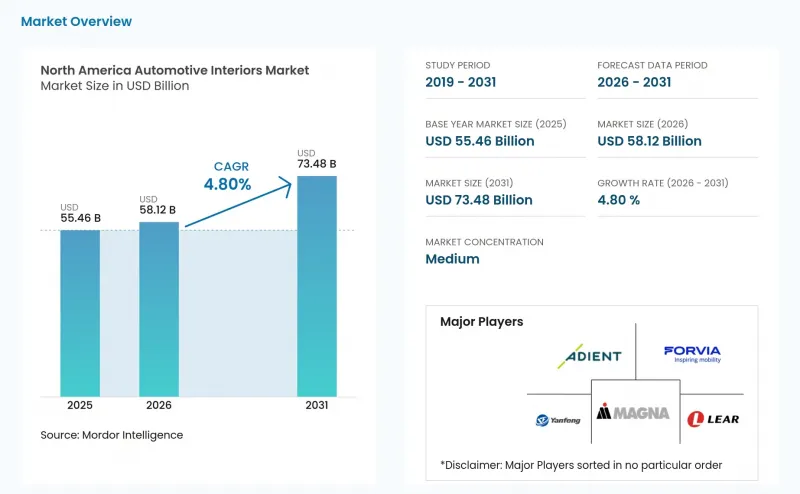
According to Mordor Intelligence, the North American automotive interiors market size was valued at USD 55.46 billion in 2025, is estimated at USD 58.12 billion in 2026, and is projected to reach USD 73.48 billion by 2031, growing at a CAGR of 4.80% from 2026 to 2031.
North America Automotive Interiors Market Trends and Insights
EV-Centric Cabin Redesigns and Packaging Freedom
Battery-electric skateboard platforms eliminate driveshafts and transmission tunnels, enabling designers to create flat floors, swiveling seats, and modular consoles. Some electric vehicles feature front passenger seats that rotate during low-speed autonomous driving modes, a feature not feasible on traditional ICE chassis. Other models use battery packs to lower the floor, increasing headroom without raising the roofline. Gear tunnels can convert unused underbody space into secure storage, while button-free dashboards reduce component requirements. These examples demonstrate how electrification enables OEMs to deliver premium cabin experiences without requiring distinct body-in-white tooling cycles.
Premium-Comfort and Infotainment Demand Surge
Larger display surfaces and immersive lighting packages have shifted from niche options to mainstream expectations. BMW's panoramic 31-inch iDrive interface delivers gesture-controlled navigation and entertainment, helping premium trims defend pricing power. Mercedes-Benz responds with its OLED-based Hyperscreen, which merges three panels under a single glass pane, simplifying wiring and cut-outs while enhancing perceived quality. Continental's Emotional Cockpit leverages eye-tracking cameras to tailor layout brightness, and the underlying software stack is being licensed to new entrants seeking rapid differentiation . Qualcomm's Snapdragon Cockpit consolidates cluster, infotainment, and rear-seat entertainment on a single system-on-chip, reducing 12 kg of harness weight and enabling post-sale feature activations. Collectively, these platforms turn interiors from cost centers into upgradeable revenue engines.
Raw-Material Price Volatility (Plastics, Leather, Foam)
Polyurethane foam and automotive hides have experienced significant price increases, putting pressure on tier-one margins. Contract structures with annual cost-down clauses hinder the immediate pass-through of costs. In response, major suppliers like Lear have pursued acquisitions of foam compounders to secure feedstock and stabilize prices. Meanwhile, smaller firms, lacking vertical integration, are relying on lower-grade substitutes. However, these substitutes face the risk of rejection by OEMs, further emphasizing the ongoing consolidation trends in the industry.
Other drivers and restraints analyzed in the detailed report include:
- Advanced Safety and Regulatory Integration
- Lightweight and Sustainable-Materials Adoption
- Semiconductor and Display Shortages
For complete list of drivers and restraints, kindly check the Table Of Contents.
Segment Analysis
Passenger cars retained a 56.34% revenue share in 2025; however, electrification mandates targeting urban logistics hubs are expected to lift light commercial vehicles to a 5.12% CAGR. Amazon's order of Rivian electric delivery vans (EDVs) drives increased demand for rugged driver-monitoring cameras and washable upholstery in vehicle cockpits, enhancing interior features compared to traditional cargo vans.
Modular delivery vans with clip-in panel architectures reduce repair downtime and improve lifecycle cost efficiency. Some carriers have standardized the inclusion of antimicrobial fabrics and HEPA filters, reflecting health-focused requirements that became more prominent during the pandemic. Certain electric vans include factory-installed bulkheads with integrated HVAC ducts, removing the need for aftermarket conversions that could void the warranty. In the medium- and heavy-duty vehicle segments, conservative interior designs and longer replacement cycles result in slower growth compared to the broader North American automotive interior market.
Electric-vehicle cabins are forecast to grow at an 8.29% CAGR, more than double the overall North America automotive interior market rate, while internal-combustion models still delivered 74.22% of 2025 revenue. As flat floors, gear tunnels, and swiveling seats become standard, EV makers can command higher sticker prices. Ford's E-Transit has replaced the traditional transmission tunnel with a spacious storage cubby and a vertical infotainment screen, gaining additional space without compromising on crash performance. GM's BrightDrop Zevo 600 has prioritized the needs of parcel fleets by installing a tablet dock on the bulkhead and omitting the glovebox. Rivian's R1T has ingeniously integrated a camp-kitchen module into its gear tunnel, transforming an otherwise unused space into a standout feature. Skoda's Vision 7S concept has taken screen orientation to the next level, rotating its 14-inch display to portrait mode for navigation, underscoring the premium value of screen positioning. These innovative layouts not only enhance vehicle functionality but also bolster the North American automotive interior market.
Thermal modules designed to extend range are now gaining significant attention. Denso's heat pump in the 2026 bZ4X, Valeo's grid-driven pre-conditioning, and Gentherm's micro-climate seating are all designed to boost winter range - a feature heavily promoted in northern states and Canada. Recognizing their value, OEMs are treating these systems as essential differentiators, securing multiyear exclusive deals with suppliers to ensure stable revenue streams.
Complete Report Scope:
- By Vehicle Type
- Passenger Cars
- Light Commercial Vehicles
- Medium and Heavy Commercial Vehicles
- By Propulsion Type
- Internal-Combustion Engine (ICE)
- Electric Vehicle (EV)
- By Component Type
- Instrument Panels and Cockpit Modules
- Infotainment and Connected Displays
- Seating Systems
- Interior Lighting (Ambient, Functional)
- Door and Body Trim Panels
- HVAC and Thermal Comfort
- Upholstery and Surface Materials
- Driver / Occupant Monitoring Systems
- Other Components
- By Material Type
- Synthetic Leather (PU, PVC)
- Genuine Leather
- Fabrics and Textiles
- Plastics and Composites
- Natural and Recycled Materials
- By Sales Channel
- OEM
- Aftermarket
- By Country
- United States
- Canada
- Rest of North America
List of Companies Covered in this Report:
- Adient plc
- Lear Corporation
- Magna International Inc.
- FORVIA (formerly Faurecia SE)
- Yanfeng Automotive Interior Systems
- Toyota Boshoku Corporation
- Grupo Antolin
- International Automotive Components (IAC)
- Visteon Corporation
- Continental AG
- Gentherm Incorporated
- Johnson Controls
- Hyosung TNC (Seat Fabrics)
- Sage Automotive Interiors
- NHK Spring Co., Ltd.
- Denso Corporation (Cockpit electronics)
- Panasonic Automotive Systems
- ZF Friedrichshafen AG
- Grammer AG
Additional Benefits:
- The market estimate (ME) sheet in Excel format
- 3 months of analyst support
TABLE OF CONTENTS
1 Introduction
- 1.1 Study Assumptions and Market Definition
- 1.2 Scope of the Study
2 Research Methodology
3 Executive Summary
4 Market Landscape
- 4.1 Market Overview
- 4.2 Market Drivers
- 4.2.1 Premium-Comfort and Infotainment Demand Surge
- 4.2.2 EV-Centric Cabin Redesigns and Packaging Freedom
- 4.2.3 Lightweight and Sustainable-Materials Adoption
- 4.2.4 Advanced Safety / Regulatory Integration (Airbags, Monitoring)
- 4.2.5 Seat-Subscription Revenue Models (OEM UX Monetization)
- 4.2.6 Cabin Thermoregulation for EV-Range Optimization
- 4.3 Market Restraints
- 4.3.1 Raw-Material Price Volatility (Plastics, Leather, Foam)
- 4.3.2 Semiconductor and Display Shortages
- 4.3.3 VOC / Chemical-Emission Compliance Costs
- 4.3.4 UAW Contract Rigidity Limiting Rapid Interior Redesigns
- 4.4 Value / Supply-Chain Analysis
- 4.5 Regulatory Landscape
- 4.6 Technological Outlook
- 4.7 Porter's Five Forces Analysis
- 4.7.1 Competitive Rivalry
- 4.7.2 Threat of New Entrants
- 4.7.3 Threat of Substitutes
- 4.7.4 Bargaining Power of Suppliers
- 4.7.5 Bargaining Power of Buyers
5 Market Size and Growth Forecasts (Value, USD)
- 5.1 By Vehicle Type
- 5.1.1 Passenger Cars
- 5.1.2 Light Commercial Vehicles
- 5.1.3 Medium and Heavy Commercial Vehicles
- 5.2 By Propulsion Type
- 5.2.1 Internal-Combustion Engine (ICE)
- 5.2.2 Electric Vehicle (EV)
- 5.3 By Component Type
- 5.3.1 Instrument Panels and Cockpit Modules
- 5.3.2 Infotainment and Connected Displays
- 5.3.3 Seating Systems
- 5.3.4 Interior Lighting (Ambient, Functional)
- 5.3.5 Door and Body Trim Panels
- 5.3.6 HVAC and Thermal Comfort
- 5.3.7 Upholstery and Surface Materials
- 5.3.8 Driver / Occupant Monitoring Systems
- 5.3.9 Other Components
- 5.4 By Material Type
- 5.4.1 Synthetic Leather (PU, PVC)
- 5.4.2 Genuine Leather
- 5.4.3 Fabrics and Textiles
- 5.4.4 Plastics and Composites
- 5.4.5 Natural and Recycled Materials
- 5.5 By Sales Channel
- 5.5.1 OEM
- 5.5.2 Aftermarket
- 5.6 By Country
- 5.6.1 United States
- 5.6.2 Canada
- 5.6.3 Rest of North America
6 Competitive Landscape
- 6.1 Market Concentration
- 6.2 Strategic Moves
- 6.3 Market Share Analysis
- 6.4 Company Profiles (Includes Global level Overview, Market level overview, Core Segments, Financials as available, Strategic Information, Market Rank/Share for key companies, Products and Services, and Recent Developments)
- 6.4.1 Adient plc
- 6.4.2 Lear Corporation
- 6.4.3 Magna International Inc.
- 6.4.4 FORVIA (formerly Faurecia SE)
- 6.4.5 Yanfeng Automotive Interior Systems
- 6.4.6 Toyota Boshoku Corporation
- 6.4.7 Grupo Antolin
- 6.4.8 International Automotive Components (IAC)
- 6.4.9 Visteon Corporation
- 6.4.10 Continental AG
- 6.4.11 Gentherm Incorporated
- 6.4.12 Johnson Controls
- 6.4.13 Hyosung TNC (Seat Fabrics)
- 6.4.14 Sage Automotive Interiors
- 6.4.15 NHK Spring Co., Ltd.
- 6.4.16 Denso Corporation (Cockpit electronics)
- 6.4.17 Panasonic Automotive Systems
- 6.4.18 ZF Friedrichshafen AG
- 6.4.19 Grammer AG
7 Market Opportunities and Future Outlook

