PUBLISHER: Mordor Intelligence | PRODUCT CODE: 2184677

PUBLISHER: Mordor Intelligence | PRODUCT CODE: 2184677
Asia-Pacific Jeans - Market Share Analysis, Industry Trends & Statistics, Growth Forecasts (2026 - 2031)
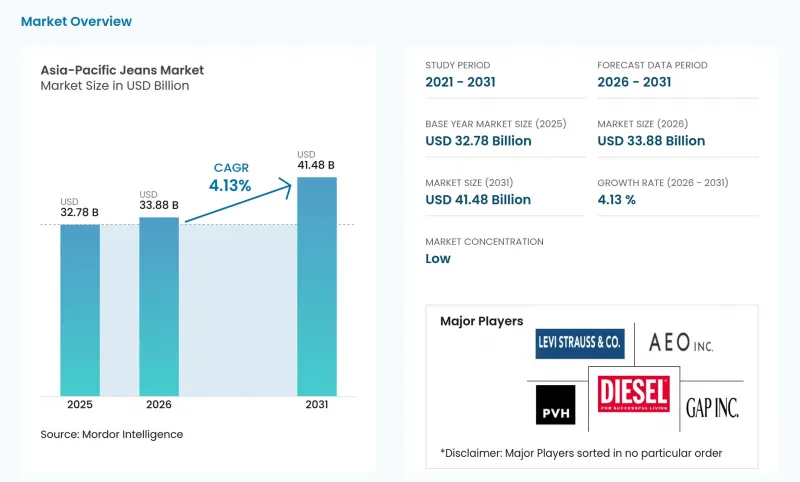
According to Mordor Intelligence, the Asia-Pacific jeans market size was valued at USD 32.78 billion in 2025 and is forecast to reach USD 33.88 billion by 2026 and USD 41.48 billion by 2031, growing at a CAGR of 4.13% during the forecast period.
Asia-Pacific Jeans Market Trends and Insights
Rising Demand for Casual and Athleisure-Style Denim
Workplace casualization is moving jeans beyond occasional social use and into regular wardrobes across the Asia-Pacific jeans market. The shift is distinct from the substitution pattern often seen in Western markets, where athleisure can displace denim. In India, casualwear represented 31% of apparel consumption in 2025, and the domestic apparel sector is expected to increase from USD 95.7 billion in 2025 to USD 146.3 billion by 2029 at a 9% CAGR, according to the Clothing Manufacturers Association of India . Men's casualwear has a strong role in first-time branded purchases in Tier-2 and Tier-3 cities. Athleisure labels entering denim have reinforced consumer expectations for garments that combine comfort, stretch, and style. Denim producers that meet these expectations can address everyday demand rather than only occasion-based purchases.
Stretch and Comfort-Fit Fabric Innovations
Fabric technology has moved from a point of differentiation to a basic product requirement in the Asia-Pacific jeans market. Kaihara Corporation and NAGASE Group commercialized EnzyBlue, a recycled indigo dye created from discarded denim fibers, for a limited-edition EDWIN model in 2025. The development combines material circularity with product performance in a single denim offering. Lenzing AG, Kaihara Denim, and Asahi Kasei also introduced the SAISEI Collection, a stretch denim range using ROICA EF yarn and pre-consumer recycled content. ROICA EF yarn has 30% lower carbon dioxide emissions than conventional yarn, according to the companies. Slim Fit benefits from these advances because its fit and performance requirements align with high-tensile stretch fabrics.
Intense Competition from Joggers and Leggings
Competition from athleisure is uneven across the Asia-Pacific jeans market. The strongest displacement is in the sub-USD 30 price tier and among women aged 18-34 in South Korea, Thailand, and Singapore. These consumers often view athleisure as a credible lifestyle choice, and performance fabrics have reduced the practical gap between athleisure and denim. The impact has been strongest in mass-tier basics rather than in premium or mid-premium denim. Brands that invest in fit technology and fabric performance therefore have some protection from direct substitution. Younger consumers who adopt joggers and leggings as default casual clothing may have a lower affinity for jeans as they enter their peak spending years.
Other drivers and restraints analyzed in the detailed report include:
- Growing Preference for Premium and Designer Jeans
- Increasing Adoption of Sustainable, Eco-Friendly Denim
- Fluctuating Cotton and Raw Material Prices
For complete list of drivers and restraints, kindly check the Table Of Contents.
Segment Analysis
Slim fit is the fastest-growing Type/Fit segment, with the Asia-Pacific jeans market size for Slim fit projected to grow at a 4.75% CAGR from 2026 to 2031. Demand is supported by fashion preferences, casual workplace clothing, and functional fabric development in South Korea, Japan, and urban India. Fast Retailing's UNIQLO supports volume growth through Slim-Straight and Skinny styles, using its Kaihara Denim partnership to provide fabric precision at mass-market price points. The segment relies on stretch materials that can maintain shape, movement, and comfort.
Regular fit held 24.37% of regional value in 2025. It remains established among middle-income consumers in China, Indonesia, and India because workwear-adjacent styling and accessible pricing make it a common first branded-jeans purchase. Stretch-cotton blends and selvedge finishes broaden its appeal in premium sub-tiers without moving too far from the needs of mass buyers. Regular fit continues to provide a stable volume base while narrower silhouettes gain momentum.
Women's jeans are projected to grow at a 5.11% CAGR from 2026 to 2031. Rising female labor force participation in India, Vietnam, and Indonesia, together with wider use of jeans as primary wardrobe apparel, supports this demand. Pepe Jeans India stated that womenswear represented 30% of its India revenue, compared with 65% in Europe, showing room for brands with women's product capabilities. This growth reflects changes in work and lifestyle rather than a short fashion cycle.
Men accounted for 46.71% of market value in 2025, making the segment the largest end user group. Longer style cycles and standardized fit requirements support inventory planning, larger-scale production, and premium lifestyle positioning. Children's jeans are also receiving more attention, and Levi's Kids entered India through Apparel Group in 2025 to address a premium children's category that international brands had historically served less extensively. The larger end user base gives brands a clear volume foundation, while women's and children's lines widen the opportunity set.
Complete Report Scope:
- By Type/Fit
- Regular Fit
- Slim Fit
- Skinny Fit
- Bootcut
- Flared
- Other Type/Fit
- By End User
- Men
- Women
- Children
- By Category
- Mass
- Premium
- By Distribution Channel
- Supermarkets/Hypermarkets
- Specialist Stores
- Online Retail Stores
- Other Distribution Channels
- By Geography
- China
- Japan
- India
- Thailand
- Singapore
- Indonesia
- South Korea
- Australia
- New Zealand
- Rest of Asia-Pacific
List of Companies Covered in this Report:
- Levi Strauss & Co.
- Kontoor Brands, Inc.
- PVH Corp.
- Gap, Inc.
- H & M Hennes & Mauritz AB
- Industria de Diseno Textil, S.A. (Inditex)
- Diesel S.p.A.
- American Eagle Outfitters, Inc.
- Fast Retailing Co., Ltd.
- G-Star RAW
- AG Adriano Goldschmied
- Mavi Giyim Sanayi ve Ticaret A.S.
- Nudie Jeans Co.
- Fashion Box S.p.A.
- Guess?, Inc.
- True Religion Apparel, Inc.
- Big John Co., Ltd.
- Pepe Jeans Group, S.L.
- Western Glove Works
- Centric Brands LLC
Additional Benefits:
- The market estimate (ME) sheet in Excel format
- 3 months of analyst support
TABLE OF CONTENTS
1 INTRODUCTION
- 1.1 Study Assumptions and Market Definition
- 1.2 Scope of the Study
2 RESEARCH METHODOLOGY
3 EXECUTIVE SUMMARY
4 MARKET LANDSCAPE
- 4.1 Market Overview
- 4.2 Market Drivers
- 4.2.1 Rising Demand for Casual and Athleisure-Style Denim
- 4.2.2 Stretch and Comfort-Fit Fabric Innovations
- 4.2.3 Growing Preference for Premium and Designer Jeans
- 4.2.4 Increasing Adoption of Sustainable, Eco-Friendly Denim
- 4.2.5 Social Media and Influencer-Driven Fashion Trends
- 4.2.6 Expanding Private-Label and Direct-to-Consumer Brand Offerings
- 4.3 Market Restraints
- 4.3.1 Intense Competition from Joggers and Leggings
- 4.3.2 Rapidly Changing Fashion Cycles Causing Inventory Risk
- 4.3.3 Fluctuating Cotton and Raw Material Prices
- 4.3.4 Strict Environmental Regulations on Dye Effluents
- 4.4 Consumer Behaviour Analysis
- 4.5 Technological Outlook
- 4.6 Regulatory Landscape
- 4.7 Pricing Analysis
- 4.8 Competitive Benchmarking
- 4.9 Porter's Five Forces Analysis
- 4.9.1 Bargaining Power of Suppliers
- 4.9.2 Bargaining Power of Buyers
- 4.9.3 Threat of New Entrants
- 4.9.4 Threat of Substitutes
- 4.9.5 Degree of Competition
5 MARKET SIZE AND GROWTH FORECASTS (VALUE)
- 5.1 By Type/Fit
- 5.1.1 Regular Fit
- 5.1.2 Slim Fit
- 5.1.3 Skinny Fit
- 5.1.4 Bootcut
- 5.1.5 Flared
- 5.1.6 Other Type/Fit
- 5.2 By End User
- 5.2.1 Men
- 5.2.2 Women
- 5.2.3 Children
- 5.3 By Category
- 5.3.1 Mass
- 5.3.2 Premium
- 5.4 By Distribution Channel
- 5.4.1 Supermarkets/Hypermarkets
- 5.4.2 Specialist Stores
- 5.4.3 Online Retail Stores
- 5.4.4 Other Distribution Channels
- 5.5 By Geography
- 5.5.1 China
- 5.5.2 Japan
- 5.5.3 India
- 5.5.4 Thailand
- 5.5.5 Singapore
- 5.5.6 Indonesia
- 5.5.7 South Korea
- 5.5.8 Australia
- 5.5.9 New Zealand
- 5.5.10 Rest of Asia-Pacific
6 COMPETITIVE LANDSCAPE
- 6.1 Market Concentration
- 6.2 Strategic Moves
- 6.3 Market Share Analysis
- 6.4 Company Profiles (Includes Global-level Overview, Market-level Overview, Core Segments, Financials, Strategic Info, Market Rank/Share, Products and Services, Recent Developments)
- 6.4.1 Levi Strauss & Co.
- 6.4.2 Kontoor Brands, Inc.
- 6.4.3 PVH Corp.
- 6.4.4 Gap, Inc.
- 6.4.5 H & M Hennes & Mauritz AB
- 6.4.6 Industria de Diseno Textil, S.A. (Inditex)
- 6.4.7 Diesel S.p.A.
- 6.4.8 American Eagle Outfitters, Inc.
- 6.4.9 Fast Retailing Co., Ltd.
- 6.4.10 G-Star RAW
- 6.4.11 AG Adriano Goldschmied
- 6.4.12 Mavi Giyim Sanayi ve Ticaret A.S.
- 6.4.13 Nudie Jeans Co.
- 6.4.14 Fashion Box S.p.A.
- 6.4.15 Guess?, Inc.
- 6.4.16 True Religion Apparel, Inc.
- 6.4.17 Big John Co., Ltd.
- 6.4.18 Pepe Jeans Group, S.L.
- 6.4.19 Western Glove Works
- 6.4.20 Centric Brands LLC
7 MARKET OPPORTUNITIES AND FUTURE OUTLOOK

