PUBLISHER: Mordor Intelligence | PRODUCT CODE: 2187300

PUBLISHER: Mordor Intelligence | PRODUCT CODE: 2187300
Jeans - Market Share Analysis, Industry Trends & Statistics, Growth Forecasts (2027 - 2032)
According to Mordor Intelligence, the jeans market size is expected to increase from USD 105.1 billion in 2026 to USD 109.1 billion in 2027 and reach USD 133.3 billion by 2032, growing at a CAGR of 4.1% over 2027-2032.
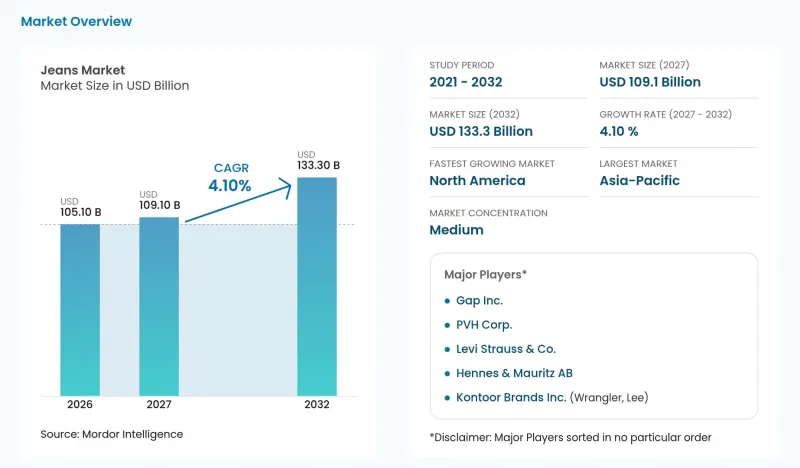
This report is segmented by Type/Fit (Regular Fit, Slim Fit, and more), End User (Men, Women, and more), Category (Mass and Premium), Distribution Channel (Supermarkets / Hypermarkets, Specialist Stores, and more), and Geography (Asia-Pacific, North America, and more). The market forecasts are provided in terms of value (USD), based on availability.
Global Jeans Market Trends and Insights
Fashion Trends and Consumer Preferences
Jeans demand depends on making a frequently worn garment comfortable enough to retain its place in everyday clothing. From March through September 2025, nearly 40% of 3,899 surveyed U.S. consumers across Waves 1-4 said jeans were the bottoms they wore most often. In the same survey, 93% rated comfort and 92% rated fit extremely important when choosing jeans. This combination gives denim brands a reason to refresh silhouettes without treating visual novelty as sufficient differentiation. A fashionable cut that compromises those attributes would work against the priorities respondents identified. Silhouette changes that keep comfort and fit intact protect the frequent-use appeal that keeps jeans in the weekly rotation.
Increasing Preference for Premium and Branded Denim
Premium denim gives a brand a way to extend its relationship with consumers across higher-priced products. Levi Strauss & Co. said Blue Tab launched in Japan in 2025 and reached the United States and Canada that May through select stores and Levi.com. In Q3 2026, it reported strong double-digit growth across the Blue Tab business, which includes denim, cashmere, and premium knitwear, with strength in men's and women's products. The company also reported U.S. share gains in its USD 100+ Blue Tab tier during that quarter. These results connect a distinct denim proposition with a broader premium assortment. Blue Tab's premium positioning extends from denim into cashmere and knitwear, giving the brand a higher-priced assortment beyond jeans.
Intense Competition from Alternative Apparel
Alternative apparel broadens a jeans supplier's competitive hurdle beyond other denim labels. In its fiscal 2025 annual report, Levi Strauss & Co. identified athletic and activewear companies, khakiwear brands, retailers' private labels, and e-commerce sites among its competitors for discretionary spending. That breadth makes rivalry within jeans only part of the commercial constraint faced by the company. A supplier can improve its position against another denim label without securing a purchase that instead goes to alternative apparel. For jeans brands, this creates pressure to justify the garment's role in the wardrobe as well as its distinction from other jeans. Denim differentiation alone cannot resolve competition for the clothing occasion itself.
Other drivers and restraints analyzed in the detailed report include:
- Technological Advancements in Fabric and Finishes
- Sustainability and Eco-Friendly Innovations
- Counterfeit and Low-Quality Products
For complete list of drivers and restraints, kindly check the Table Of Contents.
Segment Analysis
Regular fit accounted for a 21.95% share of the jeans market size in 2026. As a versatile everyday silhouette, it serves buyers replacing worn pairs who want to retain a familiar cut in their wardrobe. That replacement role links demand to the turnover of an established jeans wardrobe, giving the segment a basis for volume beyond seasonal changes in silhouette. Brands defending this core business compete through fabric, finish and price, with the next replacement purchase carrying more commercial weight than persuading an owner to change cuts.
Slim fit is the fastest-growing segment, with a forecast CAGR of 4.85% over 2027-2032. An Old Navy denim analysis found slim jeans were 43% more popular month over month in Google searches and online posts, though it did not measure purchases. U.S. menswear retailers reported in August 2025 that male customers already owned many slim-fit jeans and were not rushing to buy more. Bootcut jeans sales at Stitch Fix rose more than 200% over the 6 months beginning September 2024, with high-rise styles driving growth among its women clients aged 50 and older. Converting renewed slim-fit interest into replacement purchases is the opportunity for brands serving those existing owners.
Men's jeans held a 44.59% share of market revenue in 2026. Mavi Jeans reported that men represented 62% of its overall retail sales mix in Turkey during the first half of its 2026 fiscal year, from February 1 through July 31. This company-level mix shows the prominence of a men's retail business within a jeans-relevant apparel operator. For denim suppliers, an established men's business can provide a route to the buyer through a broader clothing offer.
Women are the fastest-growing end-user segment, with a forecast CAGR of 5.5% over 2027-2032. Levi Strauss & Co. reported strong demand for wider-leg silhouettes in its women's bottoms business in Q3 2026, while direct-to-consumer pressure was most pronounced in that same business. This separates demand for a particular silhouette from the performance of the selling channel. For women's jeans suppliers, an appealing shape does not by itself resolve the execution of the broader category. The stronger opening is to align a new fit offer with a channel capable of converting that product demand into sales.
Complete Report Scope:
- By Type/Fit
- Regular Fit
- Slim Fit
- Skinny Fit
- Bootcut
- Flared
- Others
- By End User
- Men
- Women
- Children
- By Category
- Mass
- Premium
- By Distribution Channel
- Supermarkets / Hypermarkets
- Specialist Stores
- Online Retail Stores
- Other Channels
- By Geography
- North America
- United States
- Canada
- Mexico
- Rest of North America
- South America
- Brazil
- Argentina
- Colombia
- Chile
- Rest of South America
- Europe
- United Kingdom
- Germany
- France
- Italy
- Spain
- Russia
- Sweden
- Belgium
- Poland
- Netherlands
- Rest of Europe
- Asia-Pacific
- China
- Japan
- India
- Thailand
- Singapore
- Indonesia
- South Korea
- Australia
- New Zealand
- Rest of Asia-Pacific
- Middle East and Africa
- United Arab Emirates
- South Africa
- Saudi Arabia
- Nigeria
- Egypt
- Morocco
- Turkey
- Rest of Middle East and Africa
- North America
Geography Analysis
Asia-Pacific accounted for a 32.42% jeans market share in 2026. Fast Retailing reported year-over-year UNIQLO casual-apparel revenue growth of 11.3% in Greater China and a combined 30.7% across South Korea and UNIQLO's Southeast Asia, India & Australia region in fiscal 2026, which ended August 31. Growth across these separate operating regions points to an expanding apparel-retail platform through which denim suppliers can approach several Asian buyer markets. Concentrating only on Greater China would overlook UNIQLO's stronger combined growth across South Korea and its Southeast Asia, India & Australia region.
North America is the fastest-growing region, with a forecast CAGR of 4.55% over 2027-2032. Target reported growth in its U.S. denim category in 2025. Levi Strauss & Co. reported U.S. company-wide revenue 1% below the year-earlier level in the third quarter ended August 30, 2026. These examples point to retailer category development as a commercial growth route even when an individual brand owner's wider U.S. business is broadly steady. Target's 2025 category gains show a retailer-led route to North American growth that does not depend on any single brand's U.S. revenue.
Doha Festival City's 2025 survey in Qatar found that its Millennial and Gen Z shoppers showed interest in streetwear and modest fashion. In France, apparel and textile sales value rose 2.5% online and fell 2.4% in physical stores in July 2026 compared with July 2025. Riachuelo reported that its jeans sales in Brazil rose 9.6% from January through August 2026 compared with the same period in 2025. South African real retail sales at textiles, clothing, footwear and leather goods retailers rose 2.9% year over year in July 2026 at constant 2019 prices. France's online gain against store declines favors online-ready assortments, while Riachuelo's Brazilian jeans growth and South Africa's clothing-retail growth favor suppliers selling through established retailers.
- Levi Strauss & Co.
- Kontoor Brands Inc. (Wrangler, Lee)
- PVH Corp.
- Gap Inc.
- Hennes & Mauritz AB
- Inditex (Zara)
- Diesel S.p.A.
- American Eagle Outfitters
- Fast Retailing Co. (Uniqlo)
- G-Star RAW
- AG Adriano Goldschmied
- Mavi Jeans
- Nudie Jeans
- Fashion Box S.p.A. (Replay)
- Iconix International
- Marks & Spencer Group plc
- ACON Investments (True Religion)
- Big John Co.
- Pepe Jeans London
- VF Corp. (Timberland, The North Face)
Additional Benefits:
- The market estimate (ME) sheet in Excel format
- 3 months of analyst support
TABLE OF CONTENTS
1 INTRODUCTION
- 1.1 Study Assumptions and Market Definition
- 1.2 Scope of the Study
2 RESEARCH METHODOLOGY
3 EXECUTIVE SUMMARY
4 MARKET LANDSCAPE
- 4.1 Market Overview
- 4.2 Market Drivers
- 4.2.1 Fashion Trends and Consumer Preferences
- 4.2.2 Increasing Preference for Premium and Branded Denim
- 4.2.3 Technological Advancements in Fabric and Finishes
- 4.2.4 Sustainability and Eco-Friendly Innovations
- 4.2.5 Customization and Personalization
- 4.2.6 Celebrity and Influencer Collaborations
- 4.3 Market Restraints
- 4.3.1 Intense Competition from Alternative Apparel
- 4.3.2 Counterfeit and Low-Quality Products
- 4.3.3 High Production Costs
- 4.3.4 Tariff and Trade Policy Uncertainties
- 4.4 Industry Value Chain Analysis
- 4.5 Regulatory Landscape
- 4.6 Technological Outlook
- 4.7 Porter's Five Forces Analysis
- 4.7.1 Threat of New Entrants
- 4.7.2 Bargaining Power of Suppliers
- 4.7.3 Bargaining Power of Buyers
- 4.7.4 Threat of Substitutes
- 4.7.5 Competitive Rivalry
5 MARKET SIZE AND GROWTH FORECASTS (VALUE)
- 5.1 By Type/Fit
- 5.1.1 Regular Fit
- 5.1.2 Slim Fit
- 5.1.3 Skinny Fit
- 5.1.4 Bootcut
- 5.1.5 Flared
- 5.1.6 Others
- 5.2 By End User
- 5.2.1 Men
- 5.2.2 Women
- 5.2.3 Children
- 5.3 By Category
- 5.3.1 Mass
- 5.3.2 Premium
- 5.4 By Distribution Channel
- 5.4.1 Supermarkets / Hypermarkets
- 5.4.2 Specialist Stores
- 5.4.3 Online Retail Stores
- 5.4.4 Other Channels
- 5.5 By Geography
- 5.5.1 North America
- 5.5.1.1 United States
- 5.5.1.2 Canada
- 5.5.1.3 Mexico
- 5.5.1.4 Rest of North America
- 5.5.2 South America
- 5.5.2.1 Brazil
- 5.5.2.2 Argentina
- 5.5.2.3 Colombia
- 5.5.2.4 Chile
- 5.5.2.5 Rest of South America
- 5.5.3 Europe
- 5.5.3.1 United Kingdom
- 5.5.3.2 Germany
- 5.5.3.3 France
- 5.5.3.4 Italy
- 5.5.3.5 Spain
- 5.5.3.6 Russia
- 5.5.3.7 Sweden
- 5.5.3.8 Belgium
- 5.5.3.9 Poland
- 5.5.3.10 Netherlands
- 5.5.3.11 Rest of Europe
- 5.5.4 Asia-Pacific
- 5.5.4.1 China
- 5.5.4.2 Japan
- 5.5.4.3 India
- 5.5.4.4 Thailand
- 5.5.4.5 Singapore
- 5.5.4.6 Indonesia
- 5.5.4.7 South Korea
- 5.5.4.8 Australia
- 5.5.4.9 New Zealand
- 5.5.4.10 Rest of Asia-Pacific
- 5.5.5 Middle East and Africa
- 5.5.5.1 United Arab Emirates
- 5.5.5.2 South Africa
- 5.5.5.3 Saudi Arabia
- 5.5.5.4 Nigeria
- 5.5.5.5 Egypt
- 5.5.5.6 Morocco
- 5.5.5.7 Turkey
- 5.5.5.8 Rest of Middle East and Africa
- 5.5.1 North America
6 COMPETITIVE LANDSCAPE
- 6.1 Market Concentration
- 6.2 Strategic Moves
- 6.3 Market Share Analysis
- 6.4 Company Profiles (includes Global level Overview, Market level overview, Core Segments, Financials as available, Strategic Information, Market Rank/Share for key companies, Products and Services, and Recent Developments)
- 6.4.1 Levi Strauss & Co.
- 6.4.2 Kontoor Brands Inc. (Wrangler, Lee)
- 6.4.3 PVH Corp.
- 6.4.4 Gap Inc.
- 6.4.5 Hennes & Mauritz AB
- 6.4.6 Inditex (Zara)
- 6.4.7 Diesel S.p.A.
- 6.4.8 American Eagle Outfitters
- 6.4.9 Fast Retailing Co. (Uniqlo)
- 6.4.10 G-Star RAW
- 6.4.11 AG Adriano Goldschmied
- 6.4.12 Mavi Jeans
- 6.4.13 Nudie Jeans
- 6.4.14 Fashion Box S.p.A. (Replay)
- 6.4.15 Iconix International
- 6.4.16 Marks & Spencer Group plc
- 6.4.17 ACON Investments (True Religion)
- 6.4.18 Big John Co.
- 6.4.19 Pepe Jeans London
- 6.4.20 VF Corp. (Timberland, The North Face)
7 MARKET OPPORTUNITIES AND FUTURE OUTLOOK
- 7.1 White-Space and Unmet-Need Assessment

