PUBLISHER: Mordor Intelligence | PRODUCT CODE: 2184680

PUBLISHER: Mordor Intelligence | PRODUCT CODE: 2184680
Asia-Pacific Used Car Financing - Market Share Analysis, Industry Trends & Statistics, Growth Forecasts (2026 - 2031)
According to Mordor Intelligence, the Asia-Pacific used car financing market size was valued at USD 24.11 billion in 2025, is expected to reach USD 26.07 billion in 2026, and is projected to reach USD 38.49 billion by 2031, at a CAGR of 8.11% during the forecast period (2026-2031).
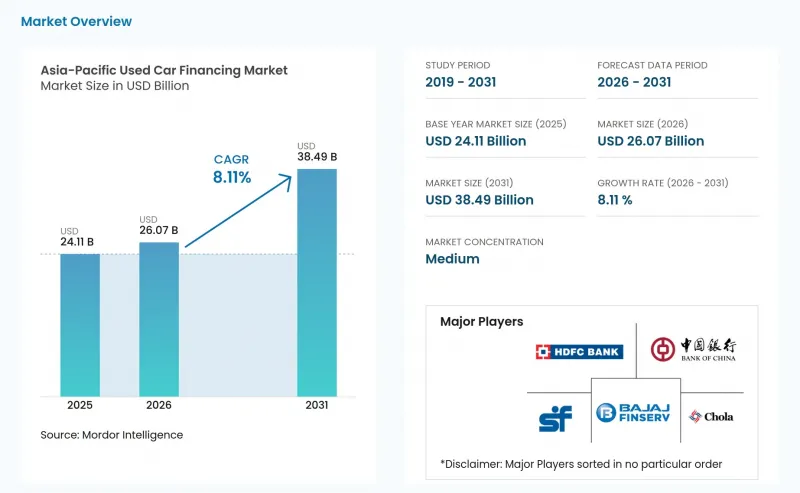
Asia-Pacific Used Car Financing Market Trends and Insights
Rising Digitization & Online Loan Approvals
API-based underwriting compresses decision cycles from days to minutes, raising conversion rates at the dealership point of sale. Platforms integrated with Malaysia's MyInfo, the Philippines' e-KYC, and Singapore's SingPass now auto-populate income and bureau data, pushing approval times below 60 seconds. CIMB, BPI, UOB, and OCBC have rolled out instant workflows that secure borrowers before they cross-shop rival offers. Thai lenders SCB and Krungsri pilot AI models that ingest utility bill and mobile-wallet histories. Speed is eclipsing marginal rate advantages; lenders failing to match sub-two-minute approvals surrender high-intent prospects to faster rivals .
Post-COVID-19 Affordability-Led Demand for Personal Mobility
The pandemic skewed consumer preference to private transport, a trend that endured even after restrictions eased. Lower-income households substitute new cars with certified pre-owned units to hedge rising fuel and food costs. India's vehicle stock is projected to more than double by 2050, with used vehicles accounting for much of the incremental volume . Gig-economy workers in Indonesia and Vietnam draw on microloans to secure second-hand cars and motorcycles for ride-hail and delivery. Regional GDP growth is near minimal in 2025, supplying macro tailwinds, though inflation keeps price sensitivity acute.
Elevated Credit-Risk Perception in SEA
Both the Philippines and Indonesia continue to report default metrics that remain elevated relative to the period before the pandemic, reflecting persistent household debt stress, constrained disposable incomes, and inadequate welfare support. These conditions continue to affect borrowers' ability to meet repayment obligations, particularly among lower- and middle-income households that remain vulnerable to economic volatility and rising living costs. As lenders tighten credit standards to manage repayment risks, first-time buyers and gig-economy drivers-key contributors to incremental volume-face greater difficulty accessing financing. The exclusion of these borrower segments reduces the total addressable demand and may constrain market expansion over the near term.
Other drivers and restraints analyzed in the detailed report include:
- OEM-Backed Certified Pre-Owned Programs
- Embedded Finance Via Super-Apps for Driver Micro-Loans
- Used Car Depreciation
For complete list of drivers and restraints, kindly check the Table Of Contents.
Segment Analysis
Sedans held 35.81% of the Asia Pacific used-car financing market in 2025, driven by their compact size and fuel economy advantages in dense urban corridors. Hatchbacks follow but cede ground as certified sedans become affordable with extended tenures. SUVs grow as status symbols among upwardly mobile households, yet higher depreciation restrains loan ratios. Electric SUVs record the fastest 9.13% CAGR through 2031, as China, South Korea, and select Indian cities expand charging grids. The shift challenges lenders to master battery-health analytics to avoid adverse selection.
Volume migration toward electric SUVs enhances the Asia Pacific used-car financing market size opportunity but burdens underwriting models reliant on historical combustion data. Financiers adopting telematics and over-the-air diagnostics can maintain approval rates while containing default risk. Failure to adapt may trap conservative lenders in shrinking sedan pools even as borrower preferences evolve.
Banks controlled 45.56% of the Asia Pacific used-car financing market share in 2025, reflecting deposit-funded cost advantages and branch reach. State Bank of India's auto book and ICICI's retail portfolio underscore scale. Yet OEM Captive Finance register an 9.21% CAGR, embedding credit in super-apps and dealership portals. Grab Financial's disbursal exemplifies traction among thin-file, high-frequency borrowers.
OEM captives such as Hyundai Capital blend rate competitiveness with loyalty programs, while NBFCs like Mahindra Finance ride a high-yield curve in semi-urban India. Competitive gaps now hinge on underwriting speed and data depth, not just pricing. Banks integrating API decision engines can defend their share; laggards risk a gradual drift of prime customers to agile newcomers.
Complete Report Scope:
- By Car Type
- Hatchback
- Sedan
- SUV
- MPV
- By Financier
- Banks
- OEM Captive Finance
- NBFC & Independent Lenders
- By Channel
- Offline Dealerships
- Online-only Platforms
- By End-User
- Individual Buyers
- Fleet / Ride-hail Operators
- By Vehicle Age
- Less than 3 Years
- 3-5 Years
- More than 5 Years
- By Country
- China
- India
- Japan
- South Korea
- Australia
- New Zealand
- Indonesia
- Malaysia
- Philippines
- Vietnam
- Rest of Asia-Pacific
List of Companies Covered in this Report:
- HDFC Bank Ltd
- State Bank of India
- ICICI Bank
- Mahindra Finance
- Bajaj Finserv
- Toyota Financial Services
- Hyundai Capital
- Grab Financial
- Shriram Finance
- Bank Mandiri
- Maybank
- Maruti Suzuki Financial Services
- Tata Motors Finance
- Sundaram Finance Ltd
- The Bank of China
- SAIC Motor Finance
- JD Auto Finance
- Cholamandalam Investment and Finance Company Limited
- Ping An Auto Finance
- Yixin Group
- Uxin Ltd
- Cars24
- Carro
- OLX Autos
Additional Benefits:
- The market estimate (ME) sheet in Excel format
- 3 months of analyst support
TABLE OF CONTENTS
1 Introduction
- 1.1 Study Assumptions & Market Definition
- 1.2 Scope of the Study
2 Research Methodology
3 Executive Summary
4 Market Landscape
- 4.1 Market Overview
- 4.2 Market Drivers
- 4.2.1 Rising Digitization & Online Loan Approvals
- 4.2.2 Post-Covid Affordability-Led Demand for Personal Mobility
- 4.2.3 Affordability and Rising Disposable Incomes
- 4.2.4 OEM-Backed Certified Pre-Owned Programs
- 4.2.5 Embedded Finance Via Super-Apps for Driver Micro-Loans
- 4.2.6 Incentive-Driven Financing for Used EVs
- 4.3 Market Restraints
- 4.3.1 Elevated Credit-Risk Perception in Sea
- 4.3.2 Used Car Depreciation
- 4.3.3 Fragmented Collateral-Valuation Standards
- 4.3.4 Stricter KYC Due to Fintech Fraud
- 4.4 Value / Supply-Chain Analysis
- 4.5 Regulatory Landscape
- 4.6 Technological Outlook
- 4.7 Porter's Five Forces Analysis
- 4.7.1 Bargaining Power of Suppliers
- 4.7.2 Bargaining Power of Buyers
- 4.7.3 Threat of New Entrants
- 4.7.4 Threat of Substitutes
- 4.7.5 Competitive Rivalry
5 Market Size & Growth Forecasts (Value (USD))
- 5.1 By Car Type
- 5.1.1 Hatchback
- 5.1.2 Sedan
- 5.1.3 SUV
- 5.1.4 MPV
- 5.2 By Financier
- 5.2.1 Banks
- 5.2.2 OEM Captive Finance
- 5.2.3 NBFC & Independent Lenders
- 5.3 By Channel
- 5.3.1 Offline Dealerships
- 5.3.2 Online-only Platforms
- 5.4 By End-User
- 5.4.1 Individual Buyers
- 5.4.2 Fleet / Ride-hail Operators
- 5.5 By Vehicle Age
- 5.5.1 Less than 3 Years
- 5.5.2 3-5 Years
- 5.5.3 More than 5 Years
- 5.6 By Country
- 5.6.1 China
- 5.6.2 India
- 5.6.3 Japan
- 5.6.4 South Korea
- 5.6.5 Australia
- 5.6.6 New Zealand
- 5.6.7 Indonesia
- 5.6.8 Malaysia
- 5.6.9 Philippines
- 5.6.10 Vietnam
- 5.6.11 Rest of Asia-Pacific
6 Competitive Landscape
- 6.1 Market Concentration
- 6.2 Strategic Moves
- 6.3 Market Share Analysis
- 6.4 Company Profiles (includes Global Level Overview, Market Level Overview, Core Segments, Financials as Available, Strategic Information, Market Rank/Share for Key Companies, Products and Services, SWOT Analysis, and Recent Developments)
- 6.4.1 HDFC Bank Ltd
- 6.4.2 State Bank of India
- 6.4.3 ICICI Bank
- 6.4.4 Mahindra Finance
- 6.4.5 Bajaj Finserv
- 6.4.6 Toyota Financial Services
- 6.4.7 Hyundai Capital
- 6.4.8 Grab Financial
- 6.4.9 Shriram Finance
- 6.4.10 Bank Mandiri
- 6.4.11 Maybank
- 6.4.12 Maruti Suzuki Financial Services
- 6.4.13 Tata Motors Finance
- 6.4.14 Sundaram Finance Ltd
- 6.4.15 The Bank of China
- 6.4.16 SAIC Motor Finance
- 6.4.17 JD Auto Finance
- 6.4.18 Cholamandalam Investment and Finance Company Limited
- 6.4.19 Ping An Auto Finance
- 6.4.20 Yixin Group
- 6.4.21 Uxin Ltd
- 6.4.22 Cars24
- 6.4.23 Carro
- 6.4.24 OLX Autos
7 Market Opportunities & Future Outlook
- 7.1 White-space & Unmet-need Assessment

