PUBLISHER: Mordor Intelligence | PRODUCT CODE: 2184755

PUBLISHER: Mordor Intelligence | PRODUCT CODE: 2184755
Desert Island Tourism - Market Share Analysis, Industry Trends & Statistics, Growth Forecasts (2026 - 2031)
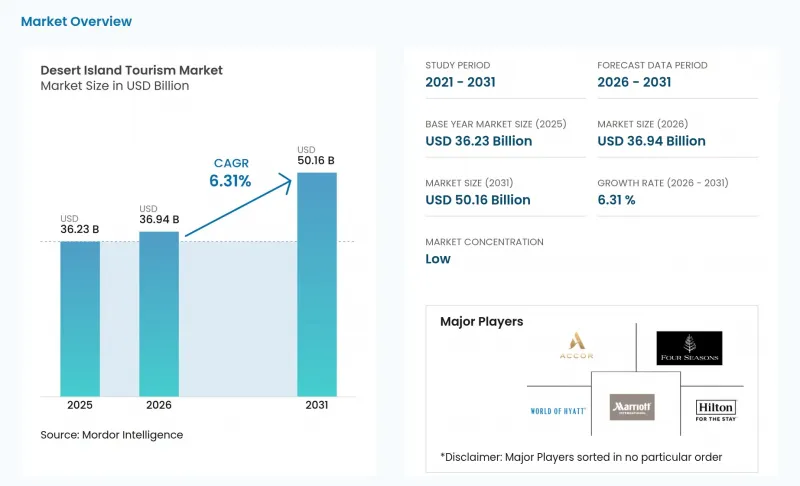
According to Mordor Intelligence, the desert island tourism market was valued at USD 36.23 billion in 2025 and estimated to grow from USD 36.94 billion in 2026 to reach USD 50.16 billion by 2031, at a CAGR of 6.31% during the forecast period (2026-2031).
Desert Island Tourism Market Trends and Insights
Rising Demand for Remote, High-Privacy Leisure Travel
The Desert Island Tourism Market continues to grow, driven by demand for remote and low-density leisure experiences. International tourist arrivals increased steadily, with destinations offering secluded experiences growing faster than the overall travel market. The Maldives exemplifies this trend, showing significant growth in visitor numbers and resort occupancy rates. This indicates that travelers are prioritizing privacy, personalized service, and isolation from crowded tourism areas. Travel from South America to the Caribbean also increased, diversifying the market's demand base, which previously relied more on North American and European visitors. This shift has broadened the geographic profile of demand, particularly for destinations that combine exclusivity with reliable access and high service standards. The Desert Island Tourism Market reflects a clear preference for unique, secluded travel experiences, underscoring its evolving dynamics and appeal to a wider audience.
Growth in Eco-Luxury and Low-Impact Resort Positioning
Eco-luxury has transitioned from a branding element to a core operational necessity in the Desert Island Tourism Market. The GSTC revised its hotel and accommodation standards, emphasizing local sourcing, emissions reduction, energy efficiency, and water management. This shift reflects growing scrutiny from travelers who demand measurable environmental practices instead of general sustainability claims. Rosewood Hotel Group obtained GSTC certification across its properties, establishing a benchmark for operators in environmentally sensitive regions. Banyan Group, after reaching a significant milestone in property expansion, outlined actionable sustainability goals in its report to address future environmental challenges. The Seychelles iCOAST Program, supported by public funding, highlights the role of policy in aligning island tourism infrastructure with circular-economy and climate-resilience objectives.
High Logistics, Utilities, and Maintenance Costs
High operating costs remain a significant challenge in the Desert Island Tourism Market. Remote properties must independently provide services that mainland resorts can outsource or source more affordably. The Maldives' one-island, one-resort model highlights how isolation drives substantial investments in power, desalination, and transport links. These requirements exert constant pressure on margins, such as energy, food, materials, and spare parts, which rely on longer, less flexible supply chains. Maintenance planning is similarly affected, with shipping delays for critical equipment disrupting guest services and increasing the risk of downtime. Dependence on small-scale diesel systems and early-stage renewable energy further elevates utility costs in many remote locations, delaying efficiency improvements. Operators with stronger logistics integration, local sourcing capabilities, or on-site generation assets are better positioned to maintain margins compared to smaller competitors in the Desert Island Tourism Market.
Other drivers and restraints analyzed in the detailed report include:
- Improved Air and Sea Connectivity to Island Destinations
- Premiumization of Wellness and Experiential Travel
- Weather Volatility and Seasonal Demand Disruption
For complete list of drivers and restraints, kindly check the Table Of Contents.
Segment Analysis
Luxury Leisure Tourism accounted for 49.94% of the market in 2025, maintaining its position as the primary demand driver for the Desert Island Tourism Market. This reflects the appeal of private villas, bespoke services, and high-privacy holiday formats across regions such as the Indian Ocean, Caribbean, and Pacific. The segment benefits from wealth concentration in North America, Europe, the GCC, and coastal Asia, where travelers prefer remote destinations over crowded resorts. This demand supports consistent pricing, as these stays are chosen for exclusivity. The segment's stability also helps the Desert Island Tourism industry during broader downturns in leisure travel.
Wellness Tourism is projected to grow at an 8.75% CAGR through 2031, making it the fastest-growing segment in the Desert Island Tourism Market. Its growth is driven by programs combining medical supervision, nature-based recovery, and longer stays in secluded locations. Official data reported USD 893.9 billion in wellness tourism spending in 2024, with 13.8% annual growth, encouraging island resorts to expand beyond traditional spa offerings. Adventure Tourism and Eco and Nature-Based Tourism remain significant, appealing to younger travelers seeking meaningful experiences alongside comfort. Policies in destinations like the Cook Islands, where the 2026-2030 destination stewardship plan promotes community-based and managed eco-tourism, highlight government efforts to shape tourism toward higher-value, lower-impact demand.
Families and group travelers accounted for 61.36% of the Desert Island Tourism Market in 2025, driven by the popularity of multi-generational resort formats in the Indian Ocean and Caribbean. Features such as connected villas, private dining, and curated marine activities supported group travel. Official data reported an Average Daily Rate (ADR) of USD 350.37 in 2025, with a 63.7% occupancy rate, reflecting steady family demand in key island destinations. Family travelers also contributed to higher spending on excursions, food packages, childcare, and private transport, ensuring their importance to the operational stability of branded and independent resorts.
Solo travelers are projected to grow at a 7.81% CAGR through 2031, making them the fastest-growing segment in the Desert Island Tourism Market. Their spending often focuses on tailored wellness, dining, and experience packages. Official data report highlighted the immense value of direct channels, revealing that hotel websites generated an average gross value of USD 516 per booking in 2025, significantly higher than OTA bookings, which averaged USD 312 per reservation. The Maldives showed expanding demand across source regions, with Asia-Pacific accounting for over 31% of arrivals in 2025, supported by 12% annual growth. This trend indicates that solo travel demand is diversifying beyond Western markets, contributing to the overall growth of the Desert Island Tourism Market.
Complete Report Scope:
- By Tourism Type
- Luxury Leisure Tourism
- Eco and Nature-Based Tourism
- Adventure Tourism
- Wellness Tourism
- By Traveler Type
- Families /Groups Travelers
- Solo Travelers
- By Accommodation Type
- Luxury Resorts
- Boutique Resorts
- Overwater Villas
- Eco-Lodges and Villas
- Cruise and Liveaboard Stays
- By Booking Channel
- Direct Bookings
- Online Travel Agencies
- Travel Agents & Tour Operators
- By Geography
- Caribbean Desert Islands
- Indian Ocean Desert Islands
- Red Sea and Arabian Gulf Desert Islands
- Mediterranean Desert Islands
- Pacific Desert Islands
- South Atlantic Desert Islands
List of Companies Covered in this Report:
- Marriott International, Inc.
- Hilton Worldwide Holdings Inc.
- Accor S.A.
- Hyatt Hotels Corporation
- IHG Hotels and Resorts
- Four Seasons Hotels and Resorts
- Aman Group S.a.r.l.
- Shangri-La Group
- Jumeirah Group
- Rosewood Hotel Group
- COMO Hotels and Resorts
- Soneva Holdings
- Banyan Tree Holdings Limited
- Atmosphere Core
- Kerzner International Holdings Limited
- Minor International Public Company Limited
- Desert Group
- Sun Resorts Ltd.
- Cenizaro Hotels & Resorts
- Delphina Hotels & Resorts
Additional Benefits:
- The market estimate (ME) sheet in Excel format
- 3 months of analyst support
TABLE OF CONTENTS
1 Introduction
- 1.1 Study Assumptions & Market Definition
- 1.2 Scope of the Study
2 Research Methodology
3 Executive Summary
4 Market Landscape
- 4.1 Market Overview
- 4.2 Market Drivers
- 4.2.1 Rising Demand for Remote, High-Privacy Leisure Travel
- 4.2.2 Growth in Eco-Luxury and Low-Impact Resort Positioning
- 4.2.3 Improved Air and Sea Connectivity to Island Destinations
- 4.2.4 Premiumization of Wellness and Experiential Travel
- 4.2.5 Digital Booking, Personalization, and Direct Revenue Capture
- 4.2.6 Climate-Adaptation Spending Supporting Asset Resilience and Premium Rates
- 4.3 Market Restraints
- 4.3.1 High Logistics, Utilities, and Maintenance Costs
- 4.3.2 Weather Volatility and Seasonal Demand Disruption
- 4.3.3 Environmental Carrying-Capacity Limits and Permitting Constraints
- 4.3.4 Labor Scarcity and Emergency Response Gaps on Remote Islands
- 4.4 Value and Supply-Chain Analysis
- 4.5 Regulatory Landscape
- 4.6 Technological Outlook
- 4.7 Porter's Five Forces Analysis
- 4.7.1 Threat of New Entrants
- 4.7.2 Bargaining Power of Buyers
- 4.7.3 Bargaining Power of Suppliers
- 4.7.4 Threat of Substitutes
- 4.7.5 Industry Rivalry
- 4.8 Demand and Traveler Behavior Analysis
5 Market Size & Growth Forecasts (Value)
- 5.1 By Tourism Type
- 5.1.1 Luxury Leisure Tourism
- 5.1.2 Eco and Nature-Based Tourism
- 5.1.3 Adventure Tourism
- 5.1.4 Wellness Tourism
- 5.2 By Traveler Type
- 5.2.1 Families /Groups Travelers
- 5.2.2 Solo Travelers
- 5.3 By Accommodation Type
- 5.3.1 Luxury Resorts
- 5.3.2 Boutique Resorts
- 5.3.3 Overwater Villas
- 5.3.4 Eco-Lodges and Villas
- 5.3.5 Cruise and Liveaboard Stays
- 5.4 By Booking Channel
- 5.4.1 Direct Bookings
- 5.4.2 Online Travel Agencies
- 5.4.3 Travel Agents & Tour Operators
- 5.5 By Geography
- 5.5.1 Caribbean Desert Islands
- 5.5.2 Indian Ocean Desert Islands
- 5.5.3 Red Sea and Arabian Gulf Desert Islands
- 5.5.4 Mediterranean Desert Islands
- 5.5.5 Pacific Desert Islands
- 5.5.6 South Atlantic Desert Islands
6 Competitive Landscape
- 6.1 Market Concentration
- 6.2 Strategic Moves
- 6.3 Market Share Analysis
- 6.4 Company Profiles (includes Overview, Market Level Overview, Core Segments, Financials as available, Strategic Information, Market Rank/Share, Products and Services, Recent Developments)
- 6.4.1 Marriott International, Inc.
- 6.4.2 Hilton Worldwide Holdings Inc.
- 6.4.3 Accor S.A.
- 6.4.4 Hyatt Hotels Corporation
- 6.4.5 IHG Hotels and Resorts
- 6.4.6 Four Seasons Hotels and Resorts
- 6.4.7 Aman Group S.a.r.l.
- 6.4.8 Shangri-La Group
- 6.4.9 Jumeirah Group
- 6.4.10 Rosewood Hotel Group
- 6.4.11 COMO Hotels and Resorts
- 6.4.12 Soneva Holdings
- 6.4.13 Banyan Tree Holdings Limited
- 6.4.14 Atmosphere Core
- 6.4.15 Kerzner International Holdings Limited
- 6.4.16 Minor International Public Company Limited
- 6.4.17 Desert Group
- 6.4.18 Sun Resorts Ltd.
- 6.4.19 Cenizaro Hotels & Resorts
- 6.4.20 Delphina Hotels & Resorts
7 Market Opportunities & Future Outlook
- 7.1 Market Opportunities
- 7.1.1 Premium Low-Impact Infrastructure on Underserved Desert Islands
- 7.1.2 Climate-Resilient Island Mobility and Microgrid Services
- 7.2 White-Space and Unmet-Need Assessment

