PUBLISHER: Mordor Intelligence | PRODUCT CODE: 2184989

PUBLISHER: Mordor Intelligence | PRODUCT CODE: 2184989
Biomass Gasification - Market Share Analysis, Industry Trends & Statistics, Growth Forecasts (2026 - 2031)
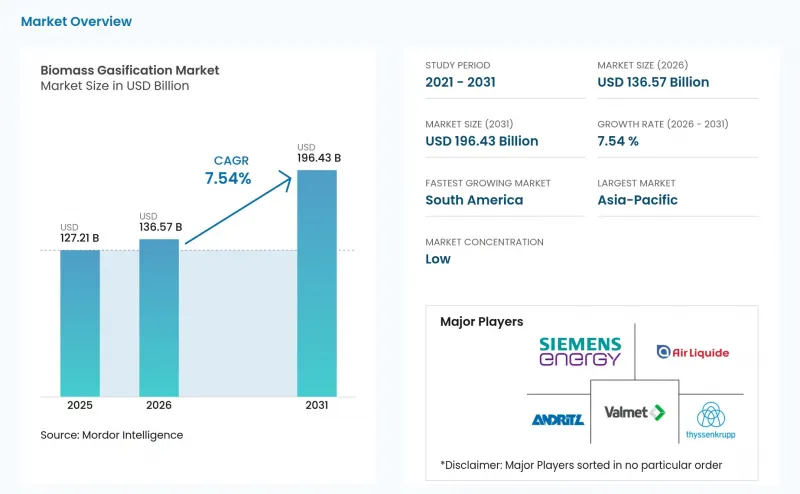
According to Mordor Intelligence, the biomass gasification market size is projected to be USD 127.21 billion in 2025, USD 136.57 billion in 2026, and reach USD 196.43 billion by 2031, at a CAGR of 7.54% from 2026 to 2031.
Global Biomass Gasification Market Trends and Insights
Renewable and Low-Carbon Energy Demand Reshapes the Market's Base Load
Governments and corporate buyers increasingly view biomass gasification as a controllable complement to variable wind and solar output. A gasifier can produce syngas when renewable electricity is not available, which can support power, heat, or fuel production. Indonesia raised its biodiesel blending mandate from B40 to B50 in July 2026, showing how policy can increase demand for agricultural biomass as an energy resource. The Biomass Gasification Market benefits when energy policy treats biomass as part of a broader domestic energy security strategy. Food processors, pulp producers, and refinery operators can use dedicated assets to reduce exposure to grid disruptions and fossil fuel costs. The value of these projects depends on lifecycle emissions compliance, feedstock contracts, and a dependable operating profile.
Industrial Decarbonization and Fossil-Fuel Substitution Consolidate Demand
Pulp and paper, metals, ceramics, and food processing need dependable high-temperature heat that direct electrification may not always provide. Biosyngas can replace conventional fuels in kilns, dryers, and steam systems where biomass residues are available nearby. The Biomass Gasification Market has a strong industrial case where producers can use their own residues and avoid transport costs. Suzano stated that its biomass-to-syngas installation at Ribas do Rio Pardo displaced petroleum-derived fuel oil in lime kilns and reduced associated energy costs. This example supports the use of biomass gasification at large forest-product facilities with consistent residues and continuous heat demand. Operators still need project structures that account for capital costs, plant downtime, and the quality requirements of industrial gas users.
High Capital Cost and Financing Risk Constrain Project Pipelines
Capital requirements remain a major barrier for small and medium biomass gasification projects. A 2025 study of a 225-kW combined heat and power plant in Italy reported a levelized cost of energy of USD 402.42 per MWh under the assessed subsidy conditions. Equipment cost increases have widened the gap between early feasibility estimates and engineering, procurement, and construction bids. Low-emissions projects also face delays when buyers do not offer firm, long-term contracts. Modular designs and structured power or gas purchase agreements can reduce these risks, but they do not remove commissioning and performance uncertainty. The Biomass Gasification Market needs financing models that reflect construction lead times, revenue stability, and the added cost of downstream gas treatment.
Other drivers and restraints analyzed in the detailed report include:
- Waste-to-Energy and Circular-Economy Investment Accelerates Feedstock Diversification
- Green Hydrogen, Sustainable Fuels, and Chemicals Demand Repositions the Technology's Value Proposition
- Feedstock Variability, Seasonality, and Logistics Undermine Plant Economics
For complete list of drivers and restraints, kindly check the Table Of Contents.
Segment Analysis
Agricultural Residues held 37.3% of the Biomass Gasification Market share in 2025, supported by large volumes of crop residues in Asia-Pacific and South America. Rice husk, sugarcane bagasse, wheat straw, and corn stover provide a broad feedstock base near agricultural processing sites. Their local availability can reduce haulage costs and connect gasification projects with existing residue collection systems. Forest Residues and Wood Biomass formed the second-largest category because their calorific value and moisture content are generally more consistent. More predictable biomass can simplify reactor configuration and lower the burden on syngas-cleaning equipment. Municipal Solid Waste and Energy Crops serve different use cases, with municipal projects concentrated in regulated urban waste systems. Energy crop projects have fewer installations but can provide more controlled feedstock quality. The Biomass Gasification Market uses these categories differently according to local land use, collection capability, and disposal regulation.
Animal Waste is forecast to grow at a 9.3% CAGR through 2031, making it the fastest-growing feedstock category. Its growth is tied to livestock methane requirements and manure management needs, not solely to the cost of the material. A 2025 study found that poultry litter gasification achieved a peak hydrogen concentration of 10.78% under optimized airflow conditions. The same research associated thermochemical manure treatment with lifecycle greenhouse gas reductions above 90% versus conventional management options. Integrated livestock and crop operations can use this route to manage waste, produce energy, and support compliance objectives. This combination can help reduce dependence on energy-price movements for projects using animal waste. Feedstock handling, odor management, ash control, and nutrient recovery remain practical considerations for developers. The Biomass Gasification Market can expand this segment where farms have enough scale and a stable collection model.
Complete Report Scope:
- By Feedstock
- Agricultural Residues
- Forest Residues and Wood Biomass
- Municipal Solid Waste
- Animal Waste
- Energy Crops
- Others
- By Technology
- Fixed-Bed Gasification
- Fluidized-Bed Gasification
- Entrained-Flow Gasification
- Plasma Gasification
- Other Technologies
- By Application
- Power Generation
- Industrial Heat and CHP
- Hydrogen Generation
- Chemicals and Methanol
- Transportation Fuels and Sustainable Aviation Fuel
- Renewable and Synthetic Gas
- Ethanol Production
- Other Applications
- By Geography
- North America
- United States
- Canada
- Mexico
- Europe
- Germany
- France
- Italy
- Spain
- United Kingdom
- Poland
- Russia
- Rest of Europe
- Asia-Pacific
- China
- India
- Japan
- South Korea
- Australia
- Indonesia
- Vietnam
- Thailand
- Rest of Asia-Pacific
- South America
- Brazil
- Argentina
- Chile
- Rest of South America
- Middle East and Africa
- Saudi Arabia
- United Arab Emirates
- Egypt
- South Africa
- Morocco
- Rest of Middle East and Africa
- North America
Geography Analysis
Asia-Pacific held 40.7% of the biomass gasification market share in 2025, making it the largest regional market. China has scale in distributed bioenergy systems, while India's compressed biogas requirements support renewable gas supply and feedstock aggregation across gas and transport applications. Vietnam, Thailand, and Indonesia have substantial agricultural residues and use small and medium fixed-bed systems in agri-food processing, linking residue management with local electricity, heat, and fuel demand. Regional deployment is largely based on fixed-bed technology, as it suits decentralized sites and established biomass types. The biomass gasification market in Asia-Pacific will remain tied to policy implementation, residue collection, and industrial users near farms.
Europe and North America support higher-value gasification projects for green hydrogen, sustainable aviation fuel, and green methanol. The European Union's Renewable Energy Directive III identifies agricultural residues, forestry residues, and biogenic municipal waste fractions for advanced fuel pathways. The Netherlands committed USD 167.92 million in SDE++ support to the EemsGas project in May 2026, while the United States has provided a framework for low-emissions energy investment. These regions have strict sustainability rules, established engineering capacity, high construction costs, and careful permitting requirements for mixed waste feedstocks. The biomass gasification market in these regions is shaped more by policy quality and product standards than by low-cost biomass alone.
South America is forecast to grow at a 12.7% CAGR through 2031. Brazil has a large sugarcane processing base that provides bagasse, vinasse, and other organic residual streams, while its Future Fuel Law requires a 1% reduction in natural gas sector greenhouse gas emissions from 2026. Forest products provide an industrial setting for biomass-based heat substitution, as illustrated by Suzano Papel e Celulose's Ribas do Rio Pardo project. The Middle East and Africa represent a smaller but growing market, where South Africa and Morocco have prospects based on waste management obligations, energy security, and limited gas grid access.
- Valmet Corporation
- EQTEC plc
- thyssenkrupp AG
- Mitsubishi Heavy Industries, Ltd.
- Andritz AG
- Siemens Energy AG
- Air Liquide S.A.
- Enerkem Inc.
- Synthesis Energy Systems Inc.
- Babcock & Wilcox Enterprises, Inc.
- Ankur Scientific Energy Technologies Pvt. Ltd.
- Bellwether Recuperative Gasification Ltd
- SynTech Bioenergy, LLC
- SHANGHAI HAIQI ENVIRONMENTAL PROTECTION TECHNOLOGY CO., LTD.
- Bio Energy Netherlands BV
- SYNCRAFT
- ReGaWatt GmbH
- BIOS BIOENERGIESYSTEME GmbH
- Chanderpur Works Private Limited
- Infinite Energy
- Fulcrum BioEnergy, Inc.
- Yosemite Clean Energy
Additional Benefits:
- The market estimate (ME) sheet in Excel format
- 3 months of analyst support
TABLE OF CONTENTS
1 INTRODUCTION
- 1.1 Study Assumptions and Market Definition
- 1.2 Scope of the Study
2 RESEARCH METHODOLOGY
3 EXECUTIVE SUMMARY
4 MARKET LANDSCAPE
- 4.1 Market Overview
- 4.2 Market Drivers
- 4.2.1 Renewable and Low-Carbon Energy Demand
- 4.2.2 Industrial Decarbonization and Fossil-Fuel Substitution
- 4.2.3 Waste-to-Energy and Circular-Economy Investment
- 4.2.4 Green Hydrogen, Sustainable Fuels, and Chemicals Demand
- 4.2.5 Feedstock-Specific Gasifier Design and Digital Process Optimization
- 4.2.6 Digital Process Control and Predictive Maintenance
- 4.3 Market Restraints
- 4.3.1 High Capital Cost and Financing Risk
- 4.3.2 Feedstock Variability, Seasonality, and Logistics
- 4.3.3 Tar Formation, Syngas Cleaning, and Skilled-Operations Requirements
- 4.3.4 Carbon-Intensity Accounting and Permitting Uncertainty for Mixed Waste Feedstocks
- 4.4 Supply-Chain Analysis
- 4.5 Porter's Five Forces Analysis
- 4.5.1 Bargaining Power of Suppliers
- 4.5.2 Bargaining Power of Buyers
- 4.5.3 Threat of New Entrants
- 4.5.4 Threat of Substitutes
- 4.5.5 Competitive Rivalry
- 4.6 Technology Outlook
- 4.7 Regulatory Landscape
- 4.8 Investment Analysis
5 MARKET SIZE AND GROWTH FORECASTS
- 5.1 By Feedstock
- 5.1.1 Agricultural Residues
- 5.1.2 Forest Residues and Wood Biomass
- 5.1.3 Municipal Solid Waste
- 5.1.4 Animal Waste
- 5.1.5 Energy Crops
- 5.1.6 Others
- 5.2 By Technology
- 5.2.1 Fixed-Bed Gasification
- 5.2.2 Fluidized-Bed Gasification
- 5.2.3 Entrained-Flow Gasification
- 5.2.4 Plasma Gasification
- 5.2.5 Other Technologies
- 5.3 By Application
- 5.3.1 Power Generation
- 5.3.2 Industrial Heat and CHP
- 5.3.3 Hydrogen Generation
- 5.3.4 Chemicals and Methanol
- 5.3.5 Transportation Fuels and Sustainable Aviation Fuel
- 5.3.6 Renewable and Synthetic Gas
- 5.3.7 Ethanol Production
- 5.3.8 Other Applications
- 5.4 By Geography
- 5.4.1 North America
- 5.4.1.1 United States
- 5.4.1.2 Canada
- 5.4.1.3 Mexico
- 5.4.2 Europe
- 5.4.2.1 Germany
- 5.4.2.2 France
- 5.4.2.3 Italy
- 5.4.2.4 Spain
- 5.4.2.5 United Kingdom
- 5.4.2.6 Poland
- 5.4.2.7 Russia
- 5.4.2.8 Rest of Europe
- 5.4.3 Asia-Pacific
- 5.4.3.1 China
- 5.4.3.2 India
- 5.4.3.3 Japan
- 5.4.3.4 South Korea
- 5.4.3.5 Australia
- 5.4.3.6 Indonesia
- 5.4.3.7 Vietnam
- 5.4.3.8 Thailand
- 5.4.3.9 Rest of Asia-Pacific
- 5.4.4 South America
- 5.4.4.1 Brazil
- 5.4.4.2 Argentina
- 5.4.4.3 Chile
- 5.4.4.4 Rest of South America
- 5.4.5 Middle East and Africa
- 5.4.5.1 Saudi Arabia
- 5.4.5.2 United Arab Emirates
- 5.4.5.3 Egypt
- 5.4.5.4 South Africa
- 5.4.5.5 Morocco
- 5.4.5.6 Rest of Middle East and Africa
- 5.4.1 North America
6 COMPETITIVE LANDSCAPE
- 6.1 Market Concentration
- 6.2 Strategic Moves
- 6.3 Market Share Analysis
- 6.4 Company Profiles (includes Global Level Overview, Market Level Overview, Core Segments, Financials as available, Strategic Information, Market Rank/Share, Products and Services, Recent Developments)
- 6.4.1 Valmet Corporation
- 6.4.2 EQTEC plc
- 6.4.3 thyssenkrupp AG
- 6.4.4 Mitsubishi Heavy Industries, Ltd.
- 6.4.5 Andritz AG
- 6.4.6 Siemens Energy AG
- 6.4.7 Air Liquide S.A.
- 6.4.8 Enerkem Inc.
- 6.4.9 Synthesis Energy Systems Inc.
- 6.4.10 Babcock & Wilcox Enterprises, Inc.
- 6.4.11 Ankur Scientific Energy Technologies Pvt. Ltd.
- 6.4.12 Bellwether Recuperative Gasification Ltd
- 6.4.13 SynTech Bioenergy, LLC
- 6.4.14 SHANGHAI HAIQI ENVIRONMENTAL PROTECTION TECHNOLOGY CO., LTD.
- 6.4.15 Bio Energy Netherlands BV
- 6.4.16 SYNCRAFT
- 6.4.17 ReGaWatt GmbH
- 6.4.18 BIOS BIOENERGIESYSTEME GmbH
- 6.4.19 Chanderpur Works Private Limited
- 6.4.20 Infinite Energy
- 6.4.21 Fulcrum BioEnergy, Inc.
- 6.4.22 Yosemite Clean Energy
7 MARKET OPPORTUNITIES AND FUTURE OUTLOOK
- 7.1 White-Space and Unmet-Need Assessment

