PUBLISHER: Mordor Intelligence | PRODUCT CODE: 2185060

PUBLISHER: Mordor Intelligence | PRODUCT CODE: 2185060
Fraud Orchestration Platform - Market Share Analysis, Industry Trends & Statistics, Growth Forecasts (2026 - 2031)
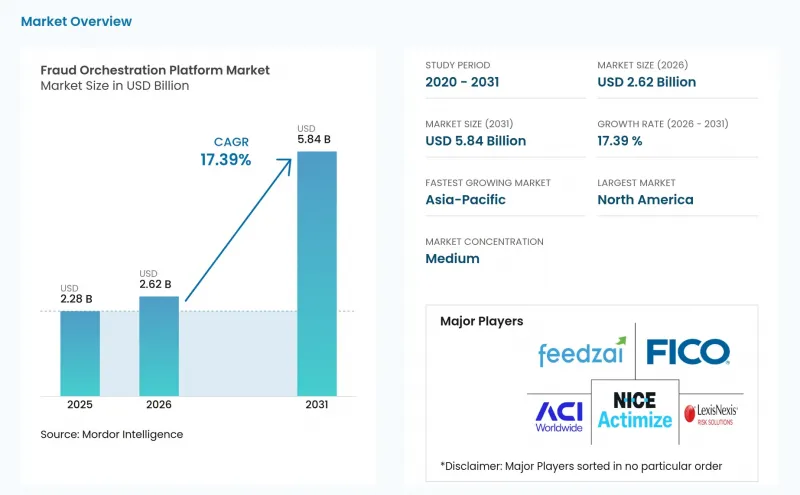
According to Mordor Intelligence, the fraud orchestration platform market size was USD 2.28 billion in 2025 and is estimated to grow from USD 2.62 billion in 2026 to reach USD 5.84 billion by 2031, at a CAGR of 17.39% during the forecast period (2026-2031).
Global Fraud Orchestration Platform Market Trends and Insights
Generative AI Deepfakes and Synthetic Identity Fraud Push Platforms Toward Multi-Signal Defense
Generative AI is making it easier for fraud rings to create synthetic identities and convincing deepfake material. FinCEN warned in November 2024 that criminals were using deepfake media to fabricate identity documents, photographs, and personal information for synthetic-identity schemes. The FBI recorded 22,364 AI-related cybercrime complaints in 2025, with adjusted losses totaling USD 893 million. Federal Reserve Governor Michael Barr stated in 2025 that deepfakes could intensify identity fraud and could challenge existing bank voice-detection practices. The fraud orchestration platform market, therefore, favors systems that evaluate behavioral biometrics, device signals, and network intelligence together instead of relying on static rules. In the fraud orchestration platform market, this approach gives investigators more context when a single identity or transaction signal appears legitimate.
Growth of Real-Time and Account-to-Account Payments Compresses Decision Windows
Real-time payments have shifted fraud prevention from a review activity to a decision that must be made before funds move. The Federal Reserve Financial Services 2026 survey found that faster payments had the largest increase in attempted fraud and reported losses among the channels surveyed. It also reported a 6% increase in attempted faster-payment fraud and a 15% rise in the number of institutions reporting persistent or increasing exposure to bank impostor scams. The Reserve Bank of India is developing the Digital Payments Intelligence Platform to identify mule accounts and suspicious payments across the national ecosystem. The fraud orchestration platform market gains a clear use case with each immediate-payment rail, which adds transactions that require low-latency scoring, clear routing, and documented action. The fraud orchestration platform market benefits because banks and payment firms need a layer that can coordinate those actions across several fraud tools.
Privacy Data Localization and Cross-Border Signal Constraints Fragment Consortium Intelligence
Network-level fraud signals can reveal patterns that are not visible to one institution acting alone. The European Payments Council identified data protection constraints on the sharing of fraud information as a barrier to cross-border scam prevention in its 2025 report. China's Personal Information Protection Law and India's Digital Personal Data Protection Act can also limit the movement of personal data used in cross-border model development. Within the fraud orchestration platform market, those restrictions require providers to localize data processing, adjust model design, or build privacy-preserving approaches. The fraud orchestration platform market faces a practical limit when a provider cannot combine useful signals across jurisdictions. Vendors with localized networks, appropriate agreements, and compliant data practices can strengthen their position in regulated markets.
Other drivers and restraints analyzed in the detailed report include:
- Enterprise Consolidation of Siloed Fraud Controls Accelerates Platform Convergence
- Regulatory Demand for Traceable Automated Decisioning Elevates Audit-Ready Architectures
- False Positives Alert Fatigue and Customer Friction Create an Efficiency Ceiling
For complete list of drivers and restraints, kindly check the Table Of Contents.
Segment Analysis
Software accounted for 68.49% of revenue from fraud orchestration platforms in 2025. Decisioning engines, rule libraries, model management tools, and case management interfaces remain central to enterprise deployments. Within the fraud orchestration platform market, the leading position reflects the practical need to configure rules, record decisions, and manage reviews in a single platform. Multi-year software contracts can remain durable once a platform is linked to payment flows, customer data, and internal review processes. The fraud orchestration platform market continues to favor suppliers that offer open interfaces, as customers rarely replace all their fraud tools at the same time.
Services are projected to expand at a 20.58% CAGR through 2031, the fastest rate among component types. Managed decisioning services allow institutions to receive model updates, threat intelligence, and operating support without building large internal teams for model tuning. Integration work remains important when firms replace isolated products with a common orchestration layer across payment rails, core banking systems, and identity providers. Consulting, implementation, training, and support become more important when organizations must document controls and train analysts on new review workflows. The Bank for International Settlements described cross-border fraud prevention as requiring coordinated tools and information sharing, which supports work that connects technology with daily operating processes.
Cloud-based deployment held 69.53% of revenue in 2025. In the fraud orchestration platform market, this model enables providers to scale processing capacity during transaction peaks and distribute approved model updates more quickly. It supports centralized administration for institutions that operate across cards, transfers, wallets, and other payment channels. Cloud delivery can also reduce the effort required to maintain hardware and core platform software within each customer location. These features make it a practical option for customers who need rapid implementation and frequent adjustments to fraud controls.
Cloud-based deployment is expected to grow at a 19.74% CAGR through 2031. Data residency rules mean customers may require regional processing locations and clear controls over where transaction data is retained. On-premises installations remain relevant for central banks, public institutions, and regulated entities operating under strict sovereignty requirements. Hybrid designs allow an organization to retain selected data or model assets locally while using cloud computing for high-volume decisioning workloads. The Association of Certified Fraud Examiners reported that adoption of cloud-native fraud technology remained limited among surveyed organizations in 2026, suggesting deployment choices will remain mixed.
Complete Report Scope:
- By Component
- Software
- Services
- Consulting and Fraud-Strategy Services
- Implementation and Integration Services
- Model, Rule, and Workflow Optimization Services
- Managed Fraud Decisioning and Orchestration Services
- Training, Support, and Maintenance Services
- By Deployment Mode
- Cloud
- On-Premises
- Hybrid
- By Organization Size
- Large Enterprises
- Small and Medium Enterprises
- By Platform Type
- Independent Fraud Orchestration Platforms
- Fraud Decisioning-Led Orchestration Platforms
- Identity Risk and Authentication Orchestration Platforms
- Integrated Enterprise Fraud Management Platforms
- By Industry Vertical
- Banking, Financial Services, and Insurance (BFSI)
- Retail and E-Commerce
- Telecommunications
- Travel, Transportation, and Hospitality
- Media and Entertainment
- Healthcare and Life Sciences
- Government and Public Administration
- Gaming and Gambling
- Other Industry Verticals
- By Geography
- North America
- United States
- Canada
- South America
- Brazil
- Mexico
- Rest of South America
- Europe
- Germany
- United Kingdom
- France
- Italy
- Rest of Europe
- Asia-Pacific
- China
- Japan
- India
- Rest of Asia-Pacific
- Middle East and Africa
- Middle East
- United Arab Emirates
- Saudi Arabia
- Rest of Middle East
- Africa
- South Africa
- Rest of Africa
- Middle East
- North America
Geography Analysis
North America held 39.72% of revenue in 2025. The region has a large concentration of major financial institutions, mature payment infrastructure, and established technology budgets. The Federal Reserve Financial Services survey found that 75% of institutions experienced debit-card fraud attempts in 2026. NACHA's fraud-monitoring rules are prompting ACH participants to document risk-based controls. Independent providers compete intensely in the United States by offering modular deployments and flexible commercial terms.
Asia-Pacific is projected to expand at a 22.61% CAGR through 2031. India's payment ecosystem needs fast decisions because UPI processed 18.3 billion transfers worth INR 24.77 lakh crore (USD 298 billion) in March 2025. The Reserve Bank of India is building a risk-scoring layer through the Digital Payments Intelligence Platform. China is another important source of demand because mobile payments are widely used, and social-engineering scams require more than transaction-pattern checks. Japan, South Korea, and Australia have mature buyer groups shaped by compliance obligations and exposure to cross-border fraud.
Europe remains a major regional market because regulatory requirements and anti-scam measures are driving technology purchases. The Banque de France reported that payment fraud in France grew by 3.8% in 2025, while manipulation fraud rose by 34% to EUR 516 million (USD 558 million). The United Kingdom reported APP fraud of GBP 576.4 million (USD 736 million) in 2025. South America is developing through Brazil's PIX payment system, while the Middle East and Africa remain earlier in adoption despite investment by the United Arab Emirates and Saudi Arabia.
- ACI Worldwide, Inc.
- NICE Actimize Limited
- LexisNexis Risk Solutions Inc.
- Fair Isaac Corporation
- Feedzai, Inc.
- Outseer, Inc.
- Alloy, Inc.
- Provenir, Inc.
- DataVisor, Inc.
- Featurespace Limited
- Experian Information Solutions, Inc.
- TransUnion LLC
- Fiserv, Inc.
- International Business Machines Corporation
- SAS Institute Inc.
- BioCatch Ltd.
- Arkose Labs Inc.
- Riskified Ltd.
- Forter, Inc.
- Sift Science, Inc.
- SardineAI Corp.
- Clari5 Fintech Private Limited
- Fraud.com Limited
- Signifyd, Inc.
- Jumio Corporation
Additional Benefits:
- The market estimate (ME) sheet in Excel format
- 3 months of analyst support
TABLE OF CONTENTS
1 INTRODUCTION
- 1.1 Study Assumptions and Market Definition
- 1.2 Scope of the Study
2 RESEARCH METHODOLOGY
3 EXECUTIVE SUMMARY
4 MARKET LANDSCAPE
- 4.1 Market Overview
- 4.2 Market Drivers
- 4.2.1 Growth of Real-Time and Account-to-Account Payments
- 4.2.2 Enterprise Consolidation of Siloed Fraud Controls
- 4.2.3 Generative-AI Deepfakes and Synthetic-Identity Fraud
- 4.2.4 Cloud-Native, Low-Code Fraud Operations
- 4.2.5 Regulatory Demand for Traceable Automated Decisioning
- 4.2.6 Agentic Investigation and Disposition Automation
- 4.3 Market Restraints
- 4.3.1 Privacy, Data Localization, and Cross-Border Signal Constraints
- 4.3.2 False Positives, Alert Fatigue, and Customer Friction
- 4.3.3 Legacy-Core Integration and Model-Governance Complexity
- 4.3.4 Adversarial Adaptation and Zero-Day Evasion
- 4.4 Impact of Macroeconomic Factors
- 4.5 Industry Value-Chain Analysis
- 4.6 Regulatory Landscape
- 4.6.1 Payment Services and Real-Time Payments Rules
- 4.6.2 AML, KYC, and Suspicious-Activity Reporting
- 4.6.3 Data Protection, Localization, and Automated Decisioning
- 4.6.4 PCI DSS and Digital Identity Standards
- 4.7 Technological Outlook
- 4.7.1 Real-Time Event Streaming and Decision Engines
- 4.7.2 Behavioral Biometrics and Device Intelligence
- 4.7.3 Consortium Intelligence and Privacy-Preserving Data Sharing
- 4.7.4 Generative AI and Agentic Fraud Operations
- 4.7.5 Low-Code Rules, Model Management, and Champion-Challenger Testing
- 4.8 Porter's Five Forces Analysis
- 4.8.1 Bargaining Power of Buyers
- 4.8.2 Bargaining Power of Suppliers
- 4.8.3 Threat of New Entrants
- 4.8.4 Threat of Substitutes
- 4.8.5 Competitive Rivalry
5 MARKET SIZE AND GROWTH FORECASTS (VALUE)
- 5.1 By Component
- 5.1.1 Software
- 5.1.2 Services
- 5.1.2.1 Consulting and Fraud-Strategy Services
- 5.1.2.2 Implementation and Integration Services
- 5.1.2.3 Model, Rule, and Workflow Optimization Services
- 5.1.2.4 Managed Fraud Decisioning and Orchestration Services
- 5.1.2.5 Training, Support, and Maintenance Services
- 5.2 By Deployment Mode
- 5.2.1 Cloud
- 5.2.2 On-Premises
- 5.2.3 Hybrid
- 5.3 By Organization Size
- 5.3.1 Large Enterprises
- 5.3.2 Small and Medium Enterprises
- 5.4 By Platform Type
- 5.4.1 Independent Fraud Orchestration Platforms
- 5.4.2 Fraud Decisioning-Led Orchestration Platforms
- 5.4.3 Identity Risk and Authentication Orchestration Platforms
- 5.4.4 Integrated Enterprise Fraud Management Platforms
- 5.5 By Industry Vertical
- 5.5.1 Banking, Financial Services, and Insurance (BFSI)
- 5.5.2 Retail and E-Commerce
- 5.5.3 Telecommunications
- 5.5.4 Travel, Transportation, and Hospitality
- 5.5.5 Media and Entertainment
- 5.5.6 Healthcare and Life Sciences
- 5.5.7 Government and Public Administration
- 5.5.8 Gaming and Gambling
- 5.5.9 Other Industry Verticals
- 5.6 By Geography
- 5.6.1 North America
- 5.6.1.1 United States
- 5.6.1.2 Canada
- 5.6.2 South America
- 5.6.2.1 Brazil
- 5.6.2.2 Mexico
- 5.6.2.3 Rest of South America
- 5.6.3 Europe
- 5.6.3.1 Germany
- 5.6.3.2 United Kingdom
- 5.6.3.3 France
- 5.6.3.4 Italy
- 5.6.3.5 Rest of Europe
- 5.6.4 Asia-Pacific
- 5.6.4.1 China
- 5.6.4.2 Japan
- 5.6.4.3 India
- 5.6.4.4 Rest of Asia-Pacific
- 5.6.5 Middle East and Africa
- 5.6.5.1 Middle East
- 5.6.5.1.1 United Arab Emirates
- 5.6.5.1.2 Saudi Arabia
- 5.6.5.1.3 Rest of Middle East
- 5.6.5.2 Africa
- 5.6.5.2.1 South Africa
- 5.6.5.2.2 Rest of Africa
- 5.6.5.1 Middle East
- 5.6.1 North America
6 COMPETITIVE LANDSCAPE
- 6.1 Market Concentration
- 6.2 Strategic Moves
- 6.3 Market Share Analysis
- 6.4 Company Profiles (includes Global Level Overview, Market Level Overview, Core Segments, Financials as available, Strategic Information, Market Rank/Share, Products and Services, Recent Developments)
- 6.4.1 ACI Worldwide, Inc.
- 6.4.2 NICE Actimize Limited
- 6.4.3 LexisNexis Risk Solutions Inc.
- 6.4.4 Fair Isaac Corporation
- 6.4.5 Feedzai, Inc.
- 6.4.6 Outseer, Inc.
- 6.4.7 Alloy, Inc.
- 6.4.8 Provenir, Inc.
- 6.4.9 DataVisor, Inc.
- 6.4.10 Featurespace Limited
- 6.4.11 Experian Information Solutions, Inc.
- 6.4.12 TransUnion LLC
- 6.4.13 Fiserv, Inc.
- 6.4.14 International Business Machines Corporation
- 6.4.15 SAS Institute Inc.
- 6.4.16 BioCatch Ltd.
- 6.4.17 Arkose Labs Inc.
- 6.4.18 Riskified Ltd.
- 6.4.19 Forter, Inc.
- 6.4.20 Sift Science, Inc.
- 6.4.21 SardineAI Corp.
- 6.4.22 Clari5 Fintech Private Limited
- 6.4.23 Fraud.com Limited
- 6.4.24 Signifyd, Inc.
- 6.4.25 Jumio Corporation
7 MARKET OPPORTUNITIES AND FUTURE OUTLOOK
- 7.1 White-Space and Unmet-Need Assessment

