PUBLISHER: Mordor Intelligence | PRODUCT CODE: 2185091

PUBLISHER: Mordor Intelligence | PRODUCT CODE: 2185091
United States Compliance Training For Financial Institutions - Market Share Analysis, Industry Trends & Statistics, Growth Forecasts (2026 - 2031)
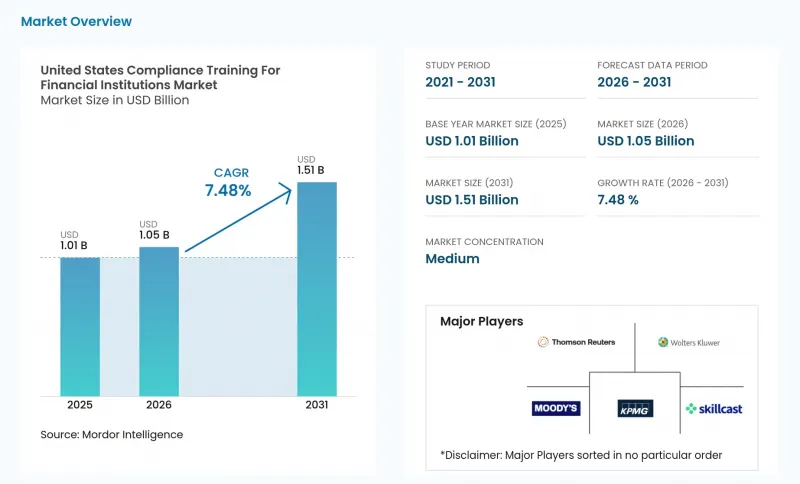
According to Mordor Intelligence, the United States compliance training market for financial institutions was valued at USD 1.01 billion in 2025 and is projected to grow from USD 1.05 billion in 2026 to USD 1.51 billion by 2031, with a CAGR of 7.48% during 2026-2031.
United States Compliance Training For Financial Institutions Market Trends and Insights
Rising Regulatory Intensity Across Banking and Capital Markets
Federal agencies are enforcing stricter standards for staff training across supervised financial institutions. A joint proposal from FinCEN, the FDIC, the OCC, and the NCUA emphasizes integrating employee training into the core framework of risk-based compliance programs. This proposal highlights the importance of structured and ongoing training. FINRA requires firms to annually assess training needs and maintain a written Firm Element plan that reflects business activities, regulatory updates, and supervisory requirements. The OCC has clarified procedures for community banks by allowing examiners to evaluate or carry forward conclusions related to the training pillar only when justified by risk conditions. Training records remain within the examination scope under this approach. These developments raise the baseline for compliance training in the financial institutions market, as organizations must now prioritize defensible training designs, proper evidence retention, and regular updates. This shift moves away from reliance on one-off awareness sessions, ensuring a more robust, repeatable compliance training framework.
Rapid Digitalization of Financial Workflows and Control Burden
The transition to digital onboarding, customer communication, transaction monitoring, and information security has significantly expanded the scope of training required for financial institutions. FINRA's e-learning catalog highlights the reliance of United States firms on a wide range of modules addressing AML, books and records, privacy, cybersecurity, electronic communications, and supervisory responsibilities. This shift reflects a greater and more diverse training demand than in traditional compliance models. The implementation of SEC Regulation S-P has further increased training needs, requiring broker-dealers and related institutions to prepare staff for incident response, customer information protection, and breach notification processes. Additionally, comments from the Bank Policy Institute on California privacy and automated decision-making proposals underscore how digital tools are reshaping governance expectations, influencing operational and training practices. As a result, the compliance training market for financial institutions in the United States is expanding not only due to regulatory changes but also because digital control environments create additional training requirements within organizations.
Training Fatigue Among Frontline Staff and Branch Employees
Training requirements are increasing faster than frontline staff can effectively manage. Community banks and institutions with extensive branch networks often require the same employees to complete annual training in areas such as AML, privacy, conduct, cybersecurity, consumer protection, and operational procedures. Research from CSBS highlights that smaller institutions face significant fixed compliance costs, limiting their ability to redesign training content or adjust delivery schedules to reduce fatigue. When training is viewed as a routine obligation, institutions become more cautious about adding new modules and focus on cost efficiency. This approach does not eliminate the need for compliance training in financial institutions across the United States, but it underscores the need for concise, role-specific, and well-timed training programs.
Other drivers and restraints analyzed in the detailed report include:
- AML and KYC Training Expansion Driven by Financial Crime Exposure
- Audit-Ready Learning Records Tied to GRC and Internal Controls
- Budget Pressure from Consolidated RegTech and L&D Procurement
For complete list of drivers and restraints, kindly check the Table Of Contents.
Segment Analysis
Large Financial Institutions accounted for 54.35% of the user-supplied 2025 revenue distribution, making them the largest organization-size segment in the United States compliance training market. Their scale enables multi-year contracts, centralized governance, and platforms that integrate content assignment with reporting and evidence retention. These institutions face significant control complexity, requiring coordination of training across business lines, geographies, and supervisory roles under recurring examination requirements. This complexity sustains high average spending per institution, even under-pricing pressures. The largest buyers use the market not only for training courses but also to ensure control consistency.
Mid-Sized Financial Institutions are projected to grow at a compound annual growth rate (CAGR) of 8.51% through 2031, making them the fastest-growing segment. Research by the Conference of State Bank Supervisors (CSBS) on fixed compliance costs shows that smaller and mid-tier institutions face a proportionally higher burden from training, audits, and information requests than their size would suggest. These organizations often lack internal resources to update content, manage learning systems, and document evidence at the pace regulators require. This creates demand for outsourced compliance training solutions that reduce manual effort without requiring enterprise-scale implementation. Growth in the United States compliance training market is shifting toward institutions too complex for manual programs but too resource-constrained to develop comprehensive internal systems.
Online learning held 63.46% of the delivery split in 2025 and remains the primary mode in the United States compliance training market for financial institutions. Digital delivery simplifies assigning annual modules, tracking completions, storing evidence, and updating content for large employee groups. FINRA's FLEX structure supports web-based course access and helps firms implement centralized training plans. For regulated learners, online delivery offers convenience, repeatability, and documentation, driving its dominant revenue share.
Online learning is the fastest-growing delivery mode, with a reported compound annual growth rate (CAGR) of 7.98% through 2031. It supports distributed staffing models, third-party oversight workflows, and quick policy updates, which are harder to manage with classroom-based formats. Online platforms efficiently integrate features like dashboards, knowledge-gap tracking, phishing simulations, and supplier training. Offline learning remains relevant for discussions, workshops, and officer-level scenario practice but is less relevant for scalable evidence production. The United States compliance training market for financial institutions is expected to remain focused on online workflows, with selective use of in-person formats for specific needs.
Complete Report Scope:
- By Organization Size
- Large Financial Institutions
- Mid-Sized Financial Institutions
- Small Financial Institutions
- By Delivery Mode
- Offline Learning
- Online Learning
- By Training Type
- Anti-Money Laundering (AML)
- Know Your Customer (KYC)
- Data Privacy
- Ethics and Conduct
- By End-User
- Banks
- Insurance Companies
- Investment Firms
- Credit Unions
- By Region
- Northeast
- Midwest
- South
- West
List of Companies Covered in this Report:
- Thomson Reuters Corporation
- NAVEX Global Inc.
- MetricStream Inc.
- Learning Pool
- Traliant LLC
- Compliance Resource LLC
- Lorman Education Services
- KPMG LLP
- Protiviti Inc.
- FORVIS LLP
- Wolters Kluwer N.V.
- Moody's Corporation
- NICE Ltd.
- Ascent Technologies Inc.
- Skillcast Group plc
- SAI360 Inc.
- LRN Corporation
- Interactive Services (Interactive Services Ltd.)
- 360training.com, Inc.
- GAN Integrity Inc.
Additional Benefits:
- The market estimate (ME) sheet in Excel format
- 3 months of analyst support
TABLE OF CONTENTS
1 Introduction
- 1.1 Study Assumptions and Market Definition
- 1.2 Scope of the Study
2 Research Methodology
3 Executive Summary
4 Market Landscape
- 4.1 Market Overview
- 4.2 Market Drivers
- 4.2.1 Rising Regulatory Intensity Across Banking and Capital Markets
- 4.2.2 Rapid Digitalization of Financial Workflows and Control Burden
- 4.2.3 AML and KYC Training Expansion Driven by Financial Crime Exposure
- 4.2.4 Audit-Ready Learning Records Tied to GRC and Internal Controls
- 4.2.5 Compliance Training Demand from Third-Party and Contractor Oversight
- 4.2.6 AI-Assisted Personalization and Learning Analytics Adoption
- 4.3 Market Restraints
- 4.3.1 Training Fatigue Among Frontline Staff and Branch Employees
- 4.3.2 Budget Pressure from Consolidated RegTech and L&D Procurement
- 4.3.3 Open-Source and Free Introductory Modules Reducing Paid Demand
- 4.3.4 Data Governance Concerns Around Learner Monitoring and Behavioral Analytics
- 4.4 Value Chain / Supply Chain Analysis
- 4.5 Regulatory Landscape
- 4.6 Technological Outlook
- 4.7 Porter's Five Forces Analysis
- 4.7.1 Threat of New Entrants
- 4.7.2 Bargaining Power of Buyers
- 4.7.3 Bargaining Power of Suppliers
- 4.7.4 Threat of Substitutes
- 4.7.5 Industry Rivalry
5 Market Size & Growth Forecasts (USD, Value)
- 5.1 By Organization Size
- 5.1.1 Large Financial Institutions
- 5.1.2 Mid-Sized Financial Institutions
- 5.1.3 Small Financial Institutions
- 5.2 By Delivery Mode
- 5.2.1 Offline Learning
- 5.2.2 Online Learning
- 5.3 By Training Type
- 5.3.1 Anti-Money Laundering (AML)
- 5.3.2 Know Your Customer (KYC)
- 5.3.3 Data Privacy
- 5.3.4 Ethics and Conduct
- 5.4 By End-User
- 5.4.1 Banks
- 5.4.2 Insurance Companies
- 5.4.3 Investment Firms
- 5.4.4 Credit Unions
- 5.5 By Region
- 5.5.1 Northeast
- 5.5.2 Midwest
- 5.5.3 South
- 5.5.4 West
6 Competitive Landscape
- 6.1 Market Concentration
- 6.2 Strategic Moves
- 6.3 Market Share Analysis
- 6.4 Company Profiles (includes Global Level Overview, Market Level Overview, Core Segments, Financials as available, Strategic Information, Market Rank/Share, Products and Services, Recent Developments)
- 6.4.1 Thomson Reuters Corporation
- 6.4.2 NAVEX Global Inc.
- 6.4.3 MetricStream Inc.
- 6.4.4 Learning Pool
- 6.4.5 Traliant LLC
- 6.4.6 Compliance Resource LLC
- 6.4.7 Lorman Education Services
- 6.4.8 KPMG LLP
- 6.4.9 Protiviti Inc.
- 6.4.10 FORVIS LLP
- 6.4.11 Wolters Kluwer N.V.
- 6.4.12 Moody's Corporation
- 6.4.13 NICE Ltd.
- 6.4.14 Ascent Technologies Inc.
- 6.4.15 Skillcast Group plc
- 6.4.16 SAI360 Inc.
- 6.4.17 LRN Corporation
- 6.4.18 Interactive Services (Interactive Services Ltd.)
- 6.4.19 360training.com, Inc.
- 6.4.20 GAN Integrity Inc.
7 Market Opportunities & Future Outlook
- 7.1 White-Space and Unmet-Need Assessment
- 7.2 Embedded Training for Contractor and Third-Party Oversight
- 7.3 Continuous Microlearning for AML, KYC, and Fraud Teams

