PUBLISHER: Mordor Intelligence | PRODUCT CODE: 2185094

PUBLISHER: Mordor Intelligence | PRODUCT CODE: 2185094
Ceramic Battery Insulation Sheets - Market Share Analysis, Industry Trends & Statistics, Growth Forecasts (2026 - 2031)
According to Mordor Intelligence, the ceramic battery insulation sheets market size was valued at USD 540.62 million in 2025 and is estimated to grow from USD 595.33 million in 2026 to reach USD 964.03 million by 2031, at a CAGR of 10.12% during the forecast period (2026-2031).
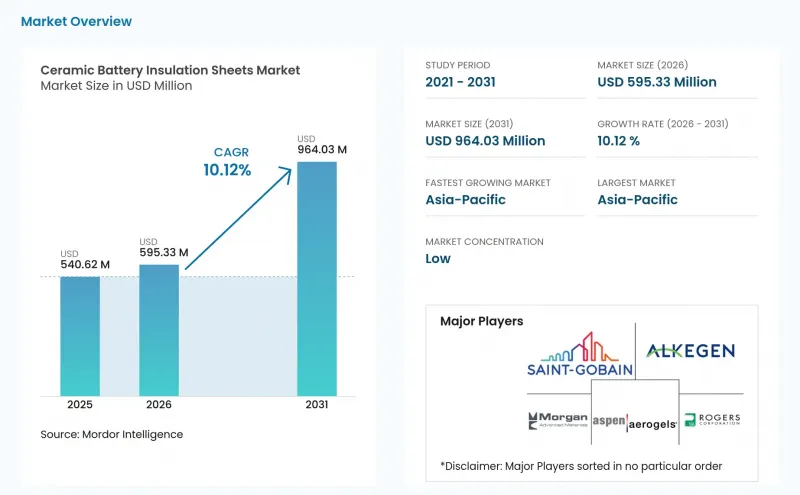
Global Ceramic Battery Insulation Sheets Market Trends and Insights
Rising Thermal-Runaway Compliance Requirements
Thermal-runaway compliance requirements are making ceramic barriers a standard procurement item in the ceramic battery insulation sheets market for many electric vehicle and Battery Energy Storage System (BESS) programs. North American BESS projects increasingly use large-scale fire testing as part of project approval, insurance, and grid interconnection work. Materials such as alumina fiber, silica aerogel, and mica sheets can maintain low thermal conductivity at elevated temperatures, supporting their use where a pack must delay heat propagation. A qualification win on a large vehicle platform can create several years of supply because replacing a validated material normally requires a new testing cycle. Research support for self-ceramicizing composite materials at Pusan National University also showed that thermal-runaway containment is receiving further development attention in Asia.
Higher Battery Energy Density and Faster Charging
The ceramic battery insulation sheets market is responding as the move from 400 V to 800 V electric vehicle designs is increasing the heat load around cells and inter-cell barriers. Fast charging and higher energy density reduce the available thermal safety margin during demanding operating conditions. A 2026 study reported a silica-alumina aerogel sheet in a dual-network composite with thermal conductivity of 0.0652 W/m*K at 1,000 °C. The result indicated that a 3 mm barrier can provide containment that previously required a substantially thicker layer in certain high-energy pack designs. This performance is strengthening interest in aerogel-containing sheets for high-density formats, where material thickness affects usable pack volume.
High Material and Manufacturing Costs of Ceramic Insulation Sheets
In the ceramic battery insulation sheets market, aerogel-based ceramic sheets require supercritical or ambient-pressure drying systems, which remain capital-intensive production methods. The cost structure slows price reductions even when output increases. A 2026 fire-safety study found that aerogel felt delivered stronger thermal isolation than ceramic fiber paper under comparable test conditions. That advantage supports use in higher-value battery packs, but it does not remove the affordability barrier in consumer and industrial applications. Additional qualification requirements for BESS-specific formats add another cost layer when suppliers move beyond electric vehicle programs.
Other drivers and restraints analyzed in the detailed report include:
- Cell-to-Pack and Cell-to-Body Battery Architectures
- Pack-Level Thermal, Mechanical and Electrical Protection Integration
- Extended OEM Qualification and Validation Cycles
For complete list of drivers and restraints, kindly check the Table Of Contents.
Segment Analysis
Alumina fiber sheets held 39.13% of the ceramic battery insulation sheets market share in 2025. Their position reflected high-temperature stability, commonly rated to 1,300 °C, and established qualification networks in Asia and Europe. Many battery manufacturers had already standardized these formats before aerogel options became commercially available at scale. Silica and aerogel sheets are projected to expand at a 10.93% CAGR through 2031. Their lower thermal conductivity supports thinner barriers that can preserve pack volume and reduce insulation weight. Research on silica aerogel composite felts reported thermal conductivity as low as 0.034 W/m*K at room temperature, which supports their use where thickness is constrained.
Mica-based sheets continue to serve the ceramic battery insulation sheets market in upper-cover isolation and busbar protection applications that place greater importance on electrical insulation and rigidity. Alumina-silica aerogel hybrids and ceramicizable silicone composites are used where flexibility and high-temperature endurance must be balanced. Research published in 2026 showed that mullite fiber-reinforced alumina-silica aerogel composites could combine 0.41 MPa compressive strength with thermal conductivity of 0.034 W/m*K at 25 °C. Supply-chain scrutiny around mica extraction is also encouraging some battery manufacturers to consider mica-free alternatives. ElringKlinger AG has positioned ElroForm TP as a mica-free thermal insulation option for commercial vehicle battery packs.
Complete Report Scope:
- By Ceramic Material
- Alumina Fiber Sheets
- Silica and Aerogel Sheets
- Mica-Based Sheets
- Other Ceramic Composites
- By Battery Type
- EV Battery Packs
- Battery Energy Storage Systems
- Consumer Battery Modules
- Industrial Battery Packs
- By Battery Chemistry
- NMC and NCA Batteries
- LFP and LMFP Batteries
- Solid-State Batteries
- Other Battery Chemistries
- By Geography
- Asia-Pacific
- China
- India
- Japan
- South Korea
- Rest of Asia-Pacific
- North America
- United States
- Canada
- Mexico
- Europe
- Germany
- United Kingdom
- France
- Italy
- Rest of Europe
- South America
- Brazil
- Argentina
- Rest of South America
- Middle East and Africa
- Saudi Arabia
- South Africa
- Rest of Middle East and Africa
- Asia-Pacific
Geography Analysis
Asia-Pacific held 44.58% of the ceramic battery insulation sheets market share in 2025 and is projected to grow at an 11.55% CAGR through 2031. China's electric vehicle production base and expanding BESS pipeline support the regional demand base. Japan contributes precision material development through Sumitomo Riko Company Limited's aerogel-based inter-cell insulation work. Denka Elastlution Co., Ltd. developed a ceramic insulation and rubber cushioning solution for lithium-ion battery cell separation in 2026. South Korea added domestic ceramic paper supply for Energy Storage System (ESS) and electric vehicle batteries in July 2025. Pusan National University's research award also pointed to the continuing development of next-generation containment materials.
In North America, demand is concentrated in the United States, where domestic battery and vehicle programs support local thermal barrier capacity. North American battery programs require qualified materials for vehicle and storage applications. Canada and Mexico support the regional supply network through manufacturing and vehicle assembly activity. Suppliers must balance safety performance, handling consistency, and dependable production capacity. These conditions reinforce the value of regional qualification and assembly support.
Europe's demand is led by premium vehicle manufacturers and commercial vehicle programs. Germany remains important because it concentrates premium automotive manufacturers. ElringKlinger AG presented ElroForm TP in September 2026 for cell, module, and pack-level protection in commercial vehicle batteries. European material selection increasingly considers traceability, recyclability, and thermal performance. South America and the Middle East and Africa remain early-stage regions. Infrastructure investment in Saudi Arabia is creating longer-term demand conditions for the ceramic battery insulation sheets market.
- 3M
- Alkegen
- Aspen Aerogels, Inc.
- BASF
- DuPont
- ElringKlinger AG
- Gore
- Isolite Insulating Products Co., Ltd.
- KULR Technology Group, Inc.
- Morgan Advanced Materials
- Rogers Corporation
- Saint-Gobain
- Sumitomo Riko Company Limited
- Von Roll Holding AG
- ZIRCAR Ceramics
Additional Benefits:
- The market estimate (ME) sheet in Excel format
- 3 months of analyst support
TABLE OF CONTENTS
1 Introduction
- 1.1 Study Assumptions and Market Definition
- 1.2 Scope of the Study
2 Research Methodology
3 Executive Summary
4 Market Landscape
- 4.1 Market Overview
- 4.2 Market Drivers
- 4.2.1 Rising Thermal-Runaway Compliance Requirements
- 4.2.2 Higher Battery Energy Density and Faster Charging
- 4.2.3 Cell-to-Pack and Cell-to-Body Battery Architectures
- 4.2.4 Pack-Level Thermal, Mechanical and Electrical Protection Integration
- 4.2.5 Growing Use of Battery Thermal Management Systems
- 4.3 Market Restraints
- 4.3.1 Extended OEM Qualification and Validation Cycles
- 4.3.2 Compression Stability, Venting and Crash-Performance Trade-Offs
- 4.3.3 High Material and Manufacturing Costs of Ceramic Insulation Sheets
- 4.4 Value Chain Analysis
- 4.5 Porter's Five Forces Analysis
- 4.5.1 Bargaining Power of Suppliers
- 4.5.2 Bargaining Power of Buyers
- 4.5.3 Threat of New Entrants
- 4.5.4 Threat of Substitutes
- 4.5.5 Competitive Rivalry
5 Market Size and Growth Forecasts (Value)
- 5.1 By Ceramic Material
- 5.1.1 Alumina Fiber Sheets
- 5.1.2 Silica and Aerogel Sheets
- 5.1.3 Mica-Based Sheets
- 5.1.4 Other Ceramic Composites
- 5.2 By Battery Type
- 5.2.1 EV Battery Packs
- 5.2.2 Battery Energy Storage Systems
- 5.2.3 Consumer Battery Modules
- 5.2.4 Industrial Battery Packs
- 5.3 By Battery Chemistry
- 5.3.1 NMC and NCA Batteries
- 5.3.2 LFP and LMFP Batteries
- 5.3.3 Solid-State Batteries
- 5.3.4 Other Battery Chemistries
- 5.4 By Geography
- 5.4.1 Asia-Pacific
- 5.4.1.1 China
- 5.4.1.2 India
- 5.4.1.3 Japan
- 5.4.1.4 South Korea
- 5.4.1.5 Rest of Asia-Pacific
- 5.4.2 North America
- 5.4.2.1 United States
- 5.4.2.2 Canada
- 5.4.2.3 Mexico
- 5.4.3 Europe
- 5.4.3.1 Germany
- 5.4.3.2 United Kingdom
- 5.4.3.3 France
- 5.4.3.4 Italy
- 5.4.3.5 Rest of Europe
- 5.4.4 South America
- 5.4.4.1 Brazil
- 5.4.4.2 Argentina
- 5.4.4.3 Rest of South America
- 5.4.5 Middle East and Africa
- 5.4.5.1 Saudi Arabia
- 5.4.5.2 South Africa
- 5.4.5.3 Rest of Middle East and Africa
- 5.4.1 Asia-Pacific
6 Competitive Landscape
- 6.1 Market Concentration
- 6.2 Strategic Moves
- 6.3 Market Share (%)/Ranking Analysis
- 6.4 Company Profiles (includes Global Overview, Market Overview, Core Segments, Financials as available, Strategic Information, Products and Services, and Recent Developments)
- 6.4.1 3M
- 6.4.2 Alkegen
- 6.4.3 Aspen Aerogels, Inc.
- 6.4.4 BASF
- 6.4.5 DuPont
- 6.4.6 ElringKlinger AG
- 6.4.7 Gore
- 6.4.8 Isolite Insulating Products Co., Ltd.
- 6.4.9 KULR Technology Group, Inc.
- 6.4.10 Morgan Advanced Materials
- 6.4.11 Rogers Corporation
- 6.4.12 Saint-Gobain
- 6.4.13 Sumitomo Riko Company Limited
- 6.4.14 Von Roll Holding AG
- 6.4.15 ZIRCAR Ceramics
7 Market Opportunities and Future Outlook
- 7.1 White-Space and Unmet-Need Assessment

