PUBLISHER: Mordor Intelligence | PRODUCT CODE: 2185095

PUBLISHER: Mordor Intelligence | PRODUCT CODE: 2185095
Pharmaceutical Processing Seals - Market Share Analysis, Industry Trends & Statistics, Growth Forecasts (2026 - 2031)
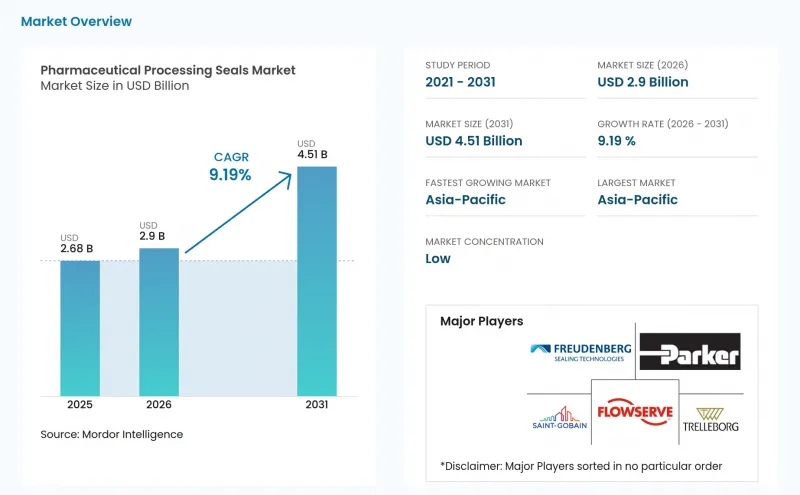
According to Mordor Intelligence, the pharmaceutical processing seals market size was valued at USD 2.68 billion in 2025 and is estimated to grow from USD 2.90 billion in 2026 to reach USD 4.51 billion by 2031, at a CAGR of 9.19% during the forecast period from 2026 to 2031.
Global Pharmaceutical Processing Seals Market Trends and Insights
Expansion of Biologics, Vaccines, and Cell and Gene Therapy Manufacturing
The shift from small-molecule products toward biologic drug pipelines is a key driver for the pharmaceutical processing seals market. Biologic and advanced therapy manufacturing requires seals that meet lower extractable and leachable limits and reduce the risk of particulate contamination from wear debris. WuXi Biologics announced the topping-out of its Singapore drug product facility in June 2026, which is designed to produce 100 million pre-filled syringes and vials annually once operational in 2027. Chugai Pharmaceutical's subsidiary completed the UT3 biopharmaceutical drug substance manufacturing building at its Utsunomiya plant in May 2026, adding capacity for clinical and early commercial biologics supply in Japan. New bioreactor vessels, sterile mixing skids, and fill-finish lines each require validated sealing components across multiple connection points. These installations support demand after commissioning, as operating equipment also requires maintenance and replacement seals.
Stringent Sterility, Contamination-Control, and Product-Integrity Requirements
Tighter contamination-control requirements are increasing demand for higher-specification materials in the pharmaceutical processing seals market. The FDA published draft guidance on container-closure systems for human drugs and biological products in August 2026, setting out a risk-based approach to the characterization and toxicological assessment of extractables and leachables from relevant materials. The European Medicines Agency issued guidance in July 2026 that extends formal contamination control strategy requirements to non-sterile medicinal product manufacturing. Facilities producing high-value biologics are more likely to specify perfluoroelastomer O-rings over standard FKM or Ethylene Propylene Diene Monomer (EPDM) where chemical inertness and low extractables are required. Trelleborg's Isolast grades are manufactured in ISO Class 5 cleanrooms, reflecting the documentation and controlled production standards expected for these applications. The resulting product mix supports higher unit values even when seal quantities do not increase at the same rate.
High Qualification and Change-Control Costs for Seal Materials
Qualification and change-control requirements slow adoption in the pharmaceutical processing seals market. FDA requirements under 21 CFR Parts 210 and 211, together with EU GMP Annex 15, require re-validation when a critical equipment component changes. For an established bioprocess, this work can take 12 to 18 months and cost hundreds of thousands of dollars per manufacturing line. This creates a strong incentive to retain an existing seal supplier for the life of a product process. Biologics license applications and new drug applications can also reference specific material specifications, making a material change subject to further regulatory submissions. These requirements reduce the pace of replacement that might otherwise be expected for a consumable component.
Other drivers and restraints analyzed in the detailed report include:
- Growth Of Pharmaceutical Manufacturing Capacity in Asia-Pacific and Emerging Markets
- Rising Use of Validated Clean-in-Place (CIP) and Sterilize-in-Place (SIP)-Compatible Sealing Systems
- Refurbished Equipment and Longer Asset-Replacement Cycles
For complete list of drivers and restraints, kindly check the Table Of Contents.
Segment Analysis
Metals accounted for 35.23% of revenue in 2025, as stainless steel and Hastelloy-grade components are used at static sealing interfaces in high-pressure reactors, large-bore valves, and flanged connections. Their dimensional stability under thermal cycling remains important in these applications. Silicone rubber is forecast to expand at a 10.02% CAGR through 2031, supported by its suitability for biopharmaceutical cell cultivation and sterile fill-finish equipment. Its low extractables and flexibility across a wide temperature range are relevant for repeated gamma sterilization and autoclave exposure. PTFE remains important for aggressive-solvent API synthesis applications. EPDM continues to serve steam-sterilization environments validated to USP Class VI at temperatures up to 121°C.
NBR faces substitution pressure in regulated bioprocessing applications due to extractable concerns. Freudenberg Sealing Technologies offers white EPDM compounds formulated without softeners for application-specific pharmaceutical requirements. FFKM and high-grade silicone are increasingly selected at process-critical positions where high purity and documented performance are required. Metals retain a broad installed base due to their use in many static and structural interfaces. The pharmaceutical processing seals market for premium-material positions is supported by higher per-unit values, even when unit counts remain lower than for basic components. Material selection in the pharmaceutical processing seals market reflects a balance between broad metal use and the adoption of premium elastomers.
Complete Report Scope:
- By Material
- Metals
- Polytetrafluoroethylene (PTFE)
- Nitrile Butadiene Rubber (NBR)
- Silicone Rubber
- Ethylene Propylene Diene Monomer (EPDM)
- Fluoroelastomer (FKM)
- Perfluoroelastomer (FFKM)
- Ultra-High-Molecular-Weight Polyethylene (UHMWPE)
- Polyurethane (PU)
- By Seal Type
- O-Ring Seals
- Gaskets
- Lip Seals
- D Seals
- Others
- By Application
- Manufacturing Equipment
- Agitators and Mixers
- Pumps and Valves
- Others
- By Geography
- Asia-Pacific
- China
- India
- Japan
- South Korea
- ASEAN Countries
- Rest of Asia-Pacific
- North America
- United States
- Canada
- Mexico
- Europe
- Germany
- United Kingdom
- France
- Italy
- NORDIC Countries
- Rest of Europe
- South America
- Brazil
- Argentina
- Rest of South America
- Middle East and Africa
- Saudi Arabia
- South Africa
- Rest of Middle East and Africa
- Asia-Pacific
Geography Analysis
Asia-Pacific accounted for 31.91% of regional revenue in 2025 and is forecast to grow at a 10.59% CAGR through 2031. China and India anchor regional output through their large populations of Contract Development and Manufacturing Organizations (CDMOs) and API manufacturers. Gerresheimer began operations at a new plant in Zhenjiang, China, in July 2026, doubling its primary glass packaging capacity for injectable pharmaceuticals. India commissioned 39 API and key starting material production lines under its Production-Linked Incentive (PLI) scheme by June 2026. These projects increase the number of reactors, purification systems, and fill-finish assets that require validated sealing components. In the Asia-Pacific region, capacity additions combined with replacement needs at operating plants drive demand in the pharmaceutical processing seals market.
Japan represents a higher-value source of demand within the region. Chugai completed its UT3 biopharmaceutical drug substance building in Utsunomiya in May 2026. Eli Lilly announced a JPY 20 billion (~USD 0.12 billion) investment at its Seishin plant in Kobe for new production lines and a warehouse through 2028. South Korea and ASEAN countries add demand through multinational subsidiaries and domestic generic drug producers that are expanding capacity. North America is the second-largest regional market due to its concentration of biopharmaceutical research and commercial manufacturing facilities. FDA Current Good Manufacturing Practice (CGMP) requirements sustain demand for documented validation of cleaning and sterilization across process-contact components. The United States is the largest country-level source of demand in North America, while Canada and Mexico contribute through generic production, API sites, and nearshoring activity.
Europe has high per-unit specification requirements due to the combined effect of EU GMP Annex 1, Annex 15, and the European Medicines Agency (EMA)'s 2026 contamination-control guidance. Vetter Pharma began construction of a EUR 480 million (~USD 540.10 million) production facility in Saarlouis in 2026, with operations targeted for 2031. CordenPharma committed EUR 80 million (~USD 90.01 million) to sterile injectable fill-finish capacity at its Latina site, adding 30-40 million units annually. Freudenberg Medical opened an ISO Class 5 CleanAssure cleanroom in Kaiserslautern in April 2026 for the pre-sterilization of single-use assemblies. South America, the Middle East, and Africa remain smaller markets, with Brazil supported by its generic drug sector and Saudi Arabia adding early demand through domestic pharmaceutical production under Vision 2030.
- Datwyler Holding Inc.
- EagleBurgmann
- Flowserve Corporation
- Freudenberg Sealing Technologies
- Garlock
- Greene Tweed
- IDEX
- James Walker Group
- John Crane
- Morgan Advanced Materials
- PARKER HANNIFIN CORP
- Precision Polymer Engineering
- Saint-Gobain
- Technetics Group
- Trelleborg AB
Additional Benefits:
- The market estimate (ME) sheet in Excel format
- 3 months of analyst support
TABLE OF CONTENTS
1 Introduction
- 1.1 Study Assumptions and Market Definition
- 1.2 Scope of the Study
2 Research Methodology
3 Executive Summary
4 Market Landscape
- 4.1 Market Overview
- 4.2 Market Drivers
- 4.2.1 Expansion of Biologics, Vaccines, and Cell and Gene Therapy Manufacturing
- 4.2.2 Stringent Sterility, Contamination-Control, and Product-Integrity Requirements
- 4.2.3 Growth of Pharmaceutical Manufacturing Capacity in Asia-Pacific and Emerging Markets
- 4.2.4 Increasing Adoption of Automated and High-Throughput Processing Equipment
- 4.2.5 Rising Use of Validated CIP and SIP-Compatible Sealing Systems
- 4.3 Market Restraints
- 4.3.1 High Qualification and Change-Control Costs for Seal Materials
- 4.3.2 Refurbished Equipment and Longer Asset-Replacement Cycles
- 4.3.3 Material Compatibility Trade-Offs Across Chemicals, Temperature, and Sterilization
- 4.4 Value Chain Analysis
- 4.5 Porter's Five Forces Analysis
- 4.5.1 Bargaining Power of Suppliers
- 4.5.2 Bargaining Power of Buyers
- 4.5.3 Threat of New Entrants
- 4.5.4 Threat of Substitutes
- 4.5.5 Competitive Rivalry
5 Market Size and Growth Forecasts (Value)
- 5.1 By Material
- 5.1.1 Metals
- 5.1.2 Polytetrafluoroethylene (PTFE)
- 5.1.3 Nitrile Butadiene Rubber (NBR)
- 5.1.4 Silicone Rubber
- 5.1.5 Ethylene Propylene Diene Monomer (EPDM)
- 5.1.6 Fluoroelastomer (FKM)
- 5.1.7 Perfluoroelastomer (FFKM)
- 5.1.8 Ultra-High-Molecular-Weight Polyethylene (UHMWPE)
- 5.1.9 Polyurethane (PU)
- 5.2 By Seal Type
- 5.2.1 O-Ring Seals
- 5.2.2 Gaskets
- 5.2.3 Lip Seals
- 5.2.4 D Seals
- 5.2.5 Others
- 5.3 By Application
- 5.3.1 Manufacturing Equipment
- 5.3.2 Agitators and Mixers
- 5.3.3 Pumps and Valves
- 5.3.4 Others
- 5.4 By Geography
- 5.4.1 Asia-Pacific
- 5.4.1.1 China
- 5.4.1.2 India
- 5.4.1.3 Japan
- 5.4.1.4 South Korea
- 5.4.1.5 ASEAN Countries
- 5.4.1.6 Rest of Asia-Pacific
- 5.4.2 North America
- 5.4.2.1 United States
- 5.4.2.2 Canada
- 5.4.2.3 Mexico
- 5.4.3 Europe
- 5.4.3.1 Germany
- 5.4.3.2 United Kingdom
- 5.4.3.3 France
- 5.4.3.4 Italy
- 5.4.3.5 NORDIC Countries
- 5.4.3.6 Rest of Europe
- 5.4.4 South America
- 5.4.4.1 Brazil
- 5.4.4.2 Argentina
- 5.4.4.3 Rest of South America
- 5.4.5 Middle East and Africa
- 5.4.5.1 Saudi Arabia
- 5.4.5.2 South Africa
- 5.4.5.3 Rest of Middle East and Africa
- 5.4.1 Asia-Pacific
6 Competitive Landscape
- 6.1 Market Concentration
- 6.2 Strategic Moves
- 6.3 Market Share (%)/Ranking Analysis
- 6.4 Company Profiles (includes Global Overview, Market Overview, Core Segments, Financials as available, Strategic Information, Products and Services, and Recent Developments)
- 6.4.1 Datwyler Holding Inc.
- 6.4.2 EagleBurgmann
- 6.4.3 Flowserve Corporation
- 6.4.4 Freudenberg Sealing Technologies
- 6.4.5 Garlock
- 6.4.6 Greene Tweed
- 6.4.7 IDEX
- 6.4.8 James Walker Group
- 6.4.9 John Crane
- 6.4.10 Morgan Advanced Materials
- 6.4.11 PARKER HANNIFIN CORP
- 6.4.12 Precision Polymer Engineering
- 6.4.13 Saint-Gobain
- 6.4.14 Technetics Group
- 6.4.15 Trelleborg AB
7 Market Opportunities and Future Outlook
- 7.1 White-Space and Unmet-Need Assessment

