PUBLISHER: Mordor Intelligence | PRODUCT CODE: 2185151

PUBLISHER: Mordor Intelligence | PRODUCT CODE: 2185151
Cross-Border B2B Payments - Market Share Analysis, Industry Trends & Statistics, Growth Forecasts (2026 - 2031)
According to Mordor Intelligence, the cross-border B2B payments market size is projected to expand from USD 187.12 trillion in 2025 and USD 198.47 trillion in 2026 to USD 266.42 trillion by 2031, registering a CAGR of 6.1% between 2026 and 2031.
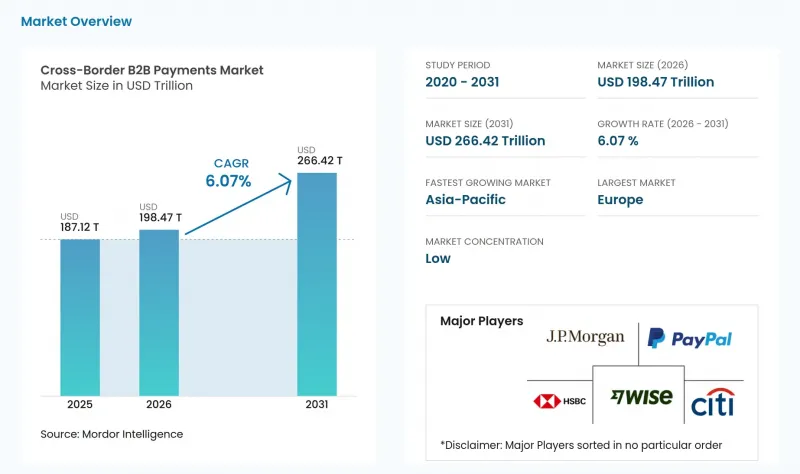
The cross-border B2B payments market is being reshaped by wider use of ISO 20022 messaging, regulated stablecoin frameworks, and links between domestic instant payment systems. This report is Segmented by Payment Method (Credit Transfers and More), Ticket Size (Wholesale, Retail, and B2B), Enterprise Size (Large Enterprises and SMEs), Industry Vertical (Manufacturing and More), Economic Purpose (Third-Party Goods Settlement and More), and Geography (North America and More). The Market Forecasts are Provided in Terms of Value (USD).
Global Cross-Border B2B Payments Market Trends and Insights
Real-Time Payment Rail Interlinking: Corridor Expansion Compresses Corporate Settlement Windows
The Group of Twenty has placed a fast payment system interlinking within its Cross-Border Payments Roadmap. More than 100 jurisdictions operate or are developing domestic real-time payment systems, making domestic instant settlement more widely available than in earlier payment modernization cycles. Project Nexus set out a multilateral approach in 2024 for connecting fast payment systems across several jurisdictions, rather than requiring separate technical arrangements for every bilateral corridor. The European Central Bank began the realization phase for linking TARGET Instant Payment Settlement with India's Unified Payments Interface in November 2025. Corporate payments can benefit when these links reduce the time between payment initiation, confirmation, and the availability of funds. Providers that can route transactions through real-time, gross settlement, and correspondent banking rails can respond more effectively to the differing speed, cost, and currency needs of each corridor.
Embedded Payments in B2B Marketplaces and ERP Platforms: Finance Stack Consolidation Rewires AP and AR Workflows
Payment execution is moving closer to enterprise resource planning and procure-to-pay workflows. This approach allows invoice information, foreign exchange conversion, payment approval, and reconciliation to operate within a connected process rather than being transferred manually between systems. Finexio and MassPay launched an embedded cross-border accounts payable service in July 2026 for vendor payments in 180 countries and 80 currencies. The offering included identity verification, multi-rail routing, and stablecoin options within the payment process. The cross-border B2B payments market benefits when payment instructions are initiated where payable records, approvals, and invoice documentation are already managed. Positions within enterprise resource planning ecosystems can create recurring payment volumes because companies are less likely to change essential operating workflows once settlement and reconciliation are embedded.
Fragmented AML, KYC, Sanctions and Licensing Requirements: Compliance Architecture Compounds Multi-Corridor Costs
Anti-money laundering, know-your-customer, sanctions, and licensing requirements differ across jurisdictions. Each additional corridor can introduce separate verification thresholds, documentation standards, and screening requirements. The European Union's Anti-Money Laundering Directive 6 creates criminal liability for legal persons, while the United States Bank Secrecy Act requirements follow different rules. Financial Action Task Force Recommendation 16 requires originator and beneficiary information to accompany qualifying virtual-asset transfers, but national implementation remains uneven. Data localization rules in countries such as India and Brazil can require separate infrastructure and limit the use of shared compliance systems. The cross-border B2B payments market favors providers that can interpret local rules through centralized but jurisdiction-aware compliance operations.
Other drivers and restraints analyzed in the detailed report include:
- Tokenized Deposits and Regulated Stablecoin Settlement: Institutional Infrastructure Moves Beyond Pilot Phase
- AI-Enabled Treasury, Payables and Payment Routing: Machine Speed Redefines the Compliance-Cost Trade-Off
- Payment Fraud, Business Email Compromise and Account Takeover: AI-Augmented Threats Outpace Defense Adoption
For complete list of drivers and restraints, kindly check the Table Of Contents.
Segment Analysis
Credit transfers accounted for 91.2% of transaction value in 2025, making them the established foundation for high-value corporate settlements. This portion of the cross-border B2B payments market share reflects the continuing role of bank-to-bank correspondent networks in international treasury operations. Corporate treasury teams rely on credit transfers where settlement finality, compliance controls, and complete audit trails are essential. The method also fits intercompany settlements and trade payments that require clear records for multiple internal and external parties. ISO 20022 adoption has improved the ability of credit transfer systems to carry structured remittance and reference data. This change helps banks and corporate users match payments to invoices with less manual intervention, particularly when the payment reference, remittance record, and underlying payable data are retained in a consistent format across the systems used by the sending bank, receiving bank, and corporate treasury team.
E-money and closed-loop business wallets are forecast to expand at a 12.5% CAGR through 2031. Their growth is linked to marketplace operators, platform-based small and medium-sized enterprises, and payment needs that extend outside normal banking hours. These tools can provide programmable settlement features that fit high-frequency commercial payments. Direct debits, commercial cards, and virtual cards hold smaller portions of value, yet they remain important for recurring and specialized business workflows. Virtual cards can support greater payment control where businesses need specific approval rules or supplier-level visibility. The cross-border B2B payments market is likely to see wallet adoption strengthen in mid-value corridors where integrated foreign exchange and rapid reconciliation are useful. Their role does not displace credit transfers in wholesale flows, but it expands the number of viable payment options for firms with different operating needs, including businesses that require payment release outside banking hours, a direct connection to platform records, or a method that is easier to use for repetitive supplier and marketplace payments.
Wholesale transactions of at least USD 100,000 accounted for 92.6% of transaction value in 2025. This cross-border B2B payments market size concentration is consistent with corporate treasury transfers, intercompany funding, and large trade invoices. These transactions frequently involve several legal entities, currencies, and approval steps before funds can be released. They often require credit facilities, currency hedging, and compliance processes that are supported by established banking relationships. The high value of these payments increases the need for dependable execution and clear exception handling. Such requirements make these flows difficult for providers without banking capabilities or deep liquidity access to serve at scale, since a provider must manage settlement risk, currency availability, operational exceptions, and regulatory checks while also maintaining the service standards expected by multinational corporate customers.
Retail B2B transactions below USD 100,000 are forecast to grow at a 9.2% CAGR through 2031. Small and medium-sized enterprise internationalization, online marketplace activity, and broader access to instant payment systems support this growth. These businesses often need a simpler way to initiate foreign payments and determine the exchange rate before approval. Smaller payments can produce higher fee margins for providers because the cost of processing does not decline in proportion to transaction size. Payment tracking and invoice matching are also important because small businesses usually have limited treasury resources. The cross-border B2B payments market offers an opportunity for providers that make foreign exchange, payment initiation, and status information easier to manage. Better service conditions could encourage businesses to reconsider traditional provider relationships in suitable corridors, especially where a provider can present an exchange rate before payment approval, confirm transaction status promptly, and reduce the administrative work that normally falls on finance staff with limited specialist support.
Complete Report Scope:
- By Payment Method
- Credit Transfers
- Direct Debits
- Commercial Cards and Virtual Cards
- E-money / Closed-Loop Business Wallets
- Other Instruments
- By Ticket Size
- Wholesale (>= USD 100,000)
- Retail B2B (< USD 100,000)
- By Enterprise Size
- Large Enterprises
- Small and Medium-Sized Enterprises
- By Industry Vertical
- Manufacturing
- Wholesale and Retail Trade
- Transportation and Logistics
- Information Technology and Telecommunications
- Energy, Utilities and Resources
- Healthcare and Life Sciences
- Professional and Business Services
- Construction and Real Estate
- Other Industries
- By Economic Purpose
- Third-Party Goods Settlement
- Third-Party Services Settlement
- Intra-group Treasury and Intercompany Funding
- Others
- By Geography
- North America
- United States
- Canada
- Mexico
- South America
- Brazil
- Argentina
- Rest of South America
- Europe
- United Kingdom
- Germany
- France
- Italy
- Spain
- Rest of Europe
- Asia-Pacific
- China
- Japan
- India
- South Korea
- Australia
- Indonesia
- Thailand
- Malaysia
- Singapore
- Vietnam
- Rest of Asia-Pacific
- Middle East and Africa
- Saudi Arabia
- United Arab Emirates
- Turkey
- South Africa
- Egypt
- Rest of Middle East and Africa
- North America
Geography Analysis
Europe held 37.3% of transaction value in 2025, making it the largest regional component of the cross-border B2B payments market. Supply chain integration in the euro area and the Single Euro Payments Area support this position. The European Union Instant Payments Regulation requires full reachability for Single Euro Payments Area instant credit transfers. France's September 1, 2026, deadline for mandatory electronic invoice reception supports more standardized accounts payable data. Germany, the United Kingdom, and France remain important anchors for intra-European B2B payment flows.
Asia-Pacific is forecast to grow at a 7.7% CAGR through 2031. China, India, Southeast Asia, and Northeast Asian manufacturing centers support growth through dense goods-trade corridors. The region combines bilateral payment links, including Unified Payments Interface and PayNow, with institutional tokenized settlement networks. Singapore has an important regional role as an Asian banking hub in the SWIFT distributed ledger core design group. The cross-border B2B payments market has opportunities in the Asia-Pacific because corridor demand is rising across manufacturing and digital trade.
North America, South America, and the Middle East and Africa have different corridor needs. North American B2B flows are supported by deep United States-Canada and United States-Mexico trade ties, while FedNow and CHIPS have upgraded domestic payment foundations. Brazil's PIX and Mexico's SPEI support domestic instant payments, but cross-border interoperability remains limited. Saudi Arabia's trade digitization plans, the United Arab Emirates' gateway role, and expanding African fintech infrastructure support activity across the Middle East and Africa.
- J.P. Morgan
- Citibank
- HSBC Holdings plc
- PayPal Holdings, Inc.
- Wise plc
- Visa Inc.
- Mastercard Incorporated
- American Express Company
- Fiserv, Inc.
- Fidelity National Information Services, Inc.
- Stripe, Inc.
- Payoneer Inc.
- Airwallex
- Adyen N.V.
- Rapyd Financial Network Ltd.
- Currencycloud
- Nium Pte. Ltd.
- Thunes
- dLocal Limited
- Ripple Labs Inc.
Additional Benefits:
- The market estimate (ME) sheet in Excel format
- 3 months of analyst support
TABLE OF CONTENTS
1 INTRODUCTION
- 1.1 Study Assumptions and Market Definition
- 1.2 Scope of the Study
2 RESEARCH METHODOLOGY
3 EXECUTIVE SUMMARY
4 MARKET LANDSCAPE
- 4.1 Market Overview
- 4.2 Market Drivers
- 4.2.1 Real-Time Payment Rail Interlinking
- 4.2.2 Embedded Payments in B2B Marketplaces and ERP Platforms
- 4.2.3 Digital Trade, E-Invoicing and Automated VAT Reporting
- 4.2.4 Virtual Cards and Working-Capital Optimization
- 4.2.5 Tokenized Deposits and Regulated Stablecoin Settlement
- 4.2.6 AI-Enabled Treasury, Payables and Payment Routing
- 4.3 Market Restraints
- 4.3.1 Fragmented AML, KYC, Sanctions and Licensing Requirements
- 4.3.2 Payment Fraud, Business Email Compromise and Account Takeover
- 4.3.3 ERP Integration and Legacy Reconciliation Complexity
- 4.3.4 Interoperability Gaps Between Tokenized-Money Rails and Legacy Systems
- 4.4 Value and Supply-Chain Analysis
- 4.4.1 Originating Bank, PSP and Payment Orchestration Layer
- 4.4.2 Correspondent Banking, Local Clearing and Fast-Payment Rails
- 4.4.3 FX Liquidity, Hedging and Treasury Management
- 4.4.4 Compliance, Screening and Transaction Monitoring
- 4.4.5 Reconciliation, Reporting and Accounts Payable Integration
- 4.4.6 End-User, Marketplace and Supplier Settlement Layer
- 4.5 Regulatory Landscape
- 4.5.1 G20 Roadmap for Enhancing Cross-Border Payments
- 4.5.2 ISO 20022 Data Harmonization and Structured Payment Information
- 4.5.3 FATF Recommendation 16 and Payment Transparency
- 4.5.4 EU Instant Payments Regulation and Verification of Payee
- 4.5.5 PSD3, Open Banking and Payment Initiation
- 4.5.6 E-Invoicing, Digital VAT and Real-Time Tax Reporting
- 4.5.7 Data Localization, Privacy and Cross-Border Data Transfers
- 4.5.8 Stablecoin, Digital Asset and Tokenized Deposit Regulation
- 4.6 Technological Outlook
- 4.6.1 Real-Time Payment Systems and FPS Interlinking
- 4.6.2 Payment Orchestration APIs
- 4.6.3 ISO 20022-Native Processing
- 4.6.4 Artificial Intelligence for Fraud, Compliance and Routing
- 4.6.5 Distributed Ledger Technology and Tokenized Settlement
- 4.6.6 Multi-Currency Wallets and Virtual Accounts
- 4.6.7 Embedded Finance and Banking-as-a-Service
- 4.6.8 Digital Identity, Confirmation of Payee and Payment Pre-Validation
- 4.7 Porter's Five Forces Analysis
- 4.7.1 Threat of New Entrants
- 4.7.2 Bargaining Power of Buyers
- 4.7.3 Bargaining Power of Suppliers
- 4.7.4 Threat of Substitutes
- 4.7.5 Competitive Rivalry
- 4.8 Investment and Funding Analysis
5 MARKET SIZE AND GROWTH FORECASTS
- 5.1 By Payment Method
- 5.1.1 Credit Transfers
- 5.1.2 Direct Debits
- 5.1.3 Commercial Cards and Virtual Cards
- 5.1.4 E-money / Closed-Loop Business Wallets
- 5.1.5 Other Instruments
- 5.2 By Ticket Size
- 5.2.1 Wholesale (>= USD 100,000)
- 5.2.2 Retail B2B (< USD 100,000)
- 5.3 By Enterprise Size
- 5.3.1 Large Enterprises
- 5.3.2 Small and Medium-Sized Enterprises
- 5.4 By Industry Vertical
- 5.4.1 Manufacturing
- 5.4.2 Wholesale and Retail Trade
- 5.4.3 Transportation and Logistics
- 5.4.4 Information Technology and Telecommunications
- 5.4.5 Energy, Utilities and Resources
- 5.4.6 Healthcare and Life Sciences
- 5.4.7 Professional and Business Services
- 5.4.8 Construction and Real Estate
- 5.4.9 Other Industries
- 5.5 By Economic Purpose
- 5.5.1 Third-Party Goods Settlement
- 5.5.2 Third-Party Services Settlement
- 5.5.3 Intra-group Treasury and Intercompany Funding
- 5.5.4 Others
- 5.6 By Geography
- 5.6.1 North America
- 5.6.1.1 United States
- 5.6.1.2 Canada
- 5.6.1.3 Mexico
- 5.6.2 South America
- 5.6.2.1 Brazil
- 5.6.2.2 Argentina
- 5.6.2.3 Rest of South America
- 5.6.3 Europe
- 5.6.3.1 United Kingdom
- 5.6.3.2 Germany
- 5.6.3.3 France
- 5.6.3.4 Italy
- 5.6.3.5 Spain
- 5.6.3.6 Rest of Europe
- 5.6.4 Asia-Pacific
- 5.6.4.1 China
- 5.6.4.2 Japan
- 5.6.4.3 India
- 5.6.4.4 South Korea
- 5.6.4.5 Australia
- 5.6.4.6 Indonesia
- 5.6.4.7 Thailand
- 5.6.4.8 Malaysia
- 5.6.4.9 Singapore
- 5.6.4.10 Vietnam
- 5.6.4.11 Rest of Asia-Pacific
- 5.6.5 Middle East and Africa
- 5.6.5.1 Saudi Arabia
- 5.6.5.2 United Arab Emirates
- 5.6.5.3 Turkey
- 5.6.5.4 South Africa
- 5.6.5.5 Egypt
- 5.6.5.6 Rest of Middle East and Africa
- 5.6.1 North America
6 COMPETITIVE LANDSCAPE
- 6.1 Market Concentration
- 6.2 Strategic Moves
- 6.2.1 Partnerships and Banking Integrations
- 6.2.2 Acquisitions and Capability Expansion
- 6.2.3 Real-Time Rail Connectivity
- 6.2.4 Stablecoin and Tokenized-Money Initiatives
- 6.2.5 Embedded Finance and Vertical Solutions
- 6.3 Market Share Analysis
- 6.4 Company Profiles
- 6.4.1 J.P. Morgan
- 6.4.2 Citibank
- 6.4.3 HSBC Holdings plc
- 6.4.4 PayPal Holdings, Inc.
- 6.4.5 Wise plc
- 6.4.6 Visa Inc.
- 6.4.7 Mastercard Incorporated
- 6.4.8 American Express Company
- 6.4.9 Fiserv, Inc.
- 6.4.10 Fidelity National Information Services, Inc.
- 6.4.11 Stripe, Inc.
- 6.4.12 Payoneer Inc.
- 6.4.13 Airwallex
- 6.4.14 Adyen N.V.
- 6.4.15 Rapyd Financial Network Ltd.
- 6.4.16 Currencycloud
- 6.4.17 Nium Pte. Ltd.
- 6.4.18 Thunes
- 6.4.19 dLocal Limited
- 6.4.20 Ripple Labs Inc.
7 MARKET OPPORTUNITIES AND FUTURE OUTLOOK
- 7.1 White-Space and Unmet-Need Assessment
- 7.1.1 Cross-Border Payment Infrastructure for Underserved SMEs
- 7.1.2 Multi-Rail Routing Across Bank, Instant-Payment and Digital-Asset Networks
- 7.1.3 Automated Compliance for Low-Value, High-Volume Transactions
- 7.1.4 Embedded FX and Treasury for B2B Marketplaces
- 7.1.5 Structured Data Remediation for ISO 20022 and Tax Compliance
- 7.1.6 Local-Currency Settlement in Emerging-Market Corridors
- 7.1.7 AI-Based Payment Exception Management

