PUBLISHER: Mordor Intelligence | PRODUCT CODE: 2185152

PUBLISHER: Mordor Intelligence | PRODUCT CODE: 2185152
United States Property Insurance - Market Share Analysis, Industry Trends & Statistics, Growth Forecasts (2026 - 2031)
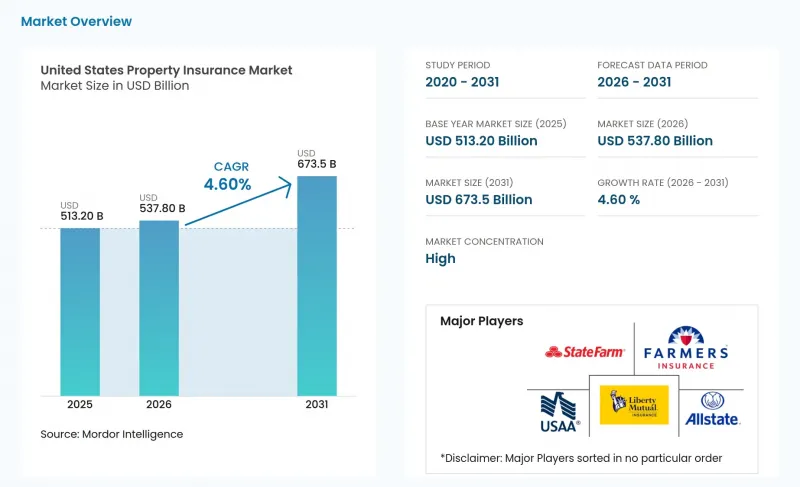
According to Mordor Intelligence, the United States property insurance market size is projected to expand from USD 513.20 billion in 2025 and USD 537.80 billion in 2026 to USD 673.5 billion by 2031, registering a CAGR of 4.60% between 2026 and 2031.
United States Property Insurance Market Trends and Insights
Rising Property Values and Replacement-Cost Insured Limits
Reconstruction costs remained elevated through 2025, even as materials inflation eased from earlier levels. Higher replacement costs have continued to increase insured limits and premiums across the United States property insurance market. Stanford University found that average California homeowner premiums increased 84% between the end of 2020 and March 2026, reflecting higher asset values and reconstruction exposure. The Western Zone recorded 107,600 policies per company in 2024, above its 2018 level, indicating that remaining insurers carried larger and higher-value policy books. The difference between adequate replacement-cost limits and nominal insured values continues to create demand for deeper coverage. This supports premium expansion even where policyholder counts remain stable.
Mortgage and Lender-Mandated Property Insurance Requirements
Mortgage requirements provide a stable basis for homeowners' coverage demand in the United States property insurance market. The Federal Housing Finance Agency requires hazard insurance on mortgages backed by government-sponsored enterprises, linking coverage demand to housing finance and property ownership. These requirements reduce the role of discretionary consumer spending in the purchase of standard homeowners coverage. They also create a continuing need for lenders to monitor policy limits and coverage gaps. Flood, earthquake, and excess-liability exclusions can lead borrowers to seek supplemental protection where the lender requirement does not fully address property risk. This pattern is most visible in coastal and wildfire-exposed locations with higher property values and wider protection gaps.
Catastrophe Loss Volatility and Reinsurance-Cost Pressure
Catastrophe volatility remains a central constraint on underwriting results in the United States property insurance market. Reinsurance capital reached USD 790 billion in March 2026, supporting favorable pricing for primary insurers in the current soft market cycle. Swiss Re stated that insured catastrophe losses could reach USD 148 billion in 2026 if losses follow the long-term trend. A major event can quickly reduce available capacity and change reinsurance pricing. Allstate reported property catastrophe reinsurance costs of USD 1.23 billion in 2025 and USD 308 million during the first quarter of 2026. These costs show why aggregate protection can remain material even when market capacity is ample.
Other drivers and restraints analyzed in the detailed report include:
- Growing Wildfire, Hurricane, and Severe Convective Storm Exposure
- Expansion of Private Flood and Underserved Property Perils
- Property Insurance Affordability and Coverage Availability Constraints
For complete list of drivers and restraints, kindly check the Table Of Contents.
Segment Analysis
Commercial property insurance captured 56.8% of the United States property insurance market share in 2025. Its scale reflects the breadth of commercial real estate, manufacturing, and business interruption exposures that require structured coverage. Commercial property rates declined 10% in the first quarter of 2026, while business interruption values increased 2.5% during the same period. Higher insured values partly offset rate compression for many commercial policyholders. Homeowners and landlord products remained important product categories during 2025. Homeowners' direct premiums written reached USD 188.69 billion, supported by replacement-cost inflation.
Renters insurance is forecast to expand at a 6.9% CAGR through 2031, the strongest product growth rate in the United States property insurance market. The United States had an estimated 44 million renter-occupied households, but only 55% held coverage. This gap creates room for insurers to expand adoption through property managers and digital channels. Chubb completed a renters program rollout to 44 states in May 2026, targeting multi-family operators and managed rental portfolios through embedded, institutional, and digital retail distribution. Embedded distribution can place coverage within lease-signing workflows. That approach can simplify acquisition for renters and property managers.
Building and structural coverage held 60.7% of the United States property insurance market size in 2025. It is the foundational property layer across most personal and commercial policies. Contents and business personal property coverage formed the next coverage tier. Its demand in the United States property insurance market moves with inventory values and the amount of equipment held by insured businesses. Policyholders continue to review their coverage limits as replacement costs and business asset values change. This keeps building, and content protection is central to the United States property insurance market.
Business interruption and loss-of-income coverage is forecast to grow at a 5.9% CAGR through 2031. Supply-chain disruption has encouraged commercial buyers to examine income protection and contingent business interruption limits. A softer commercial pricing environment can allow buyers to redirect savings toward broader protection. Business interruption premiums declined at the start of 2026, creating an opportunity for buyers to consider higher limits. Cyber-linked supply-chain disruptions and active-assailant events are also broadening the risks discussed in commercial coverage planning. The resulting demand is based on coverage scope as well as the value of physical property.
Complete Report Scope:
- By Insurance Product
- Homeowners Insurance
- Renters Insurance
- Landlord Insurance
- Commercial Property Insurance
- By Coverage Type
- Building / Structural Property Coverage
- Contents / Business Personal Property Coverage
- Business Interruption / Loss of Income Coverage
- By Property Type
- Residential Properties
- Commercial Properties
- Industrial / Manufacturing
- Public and Institutional
- Agricultural Buildings
- By Policyholder
- Households (Owner-Occupiers and Tenants)
- Private Residential Landlords
- Small and Medium-Sized Enterprise (SME) Occupiers
- Large Enterprise Occupiers
- Professional Real-Estate Owners
- Public Sector / SOE
- By Distribution Channel
- Agents & Brokers
- Direct / Insurer-Owned Channels
- Bancassurance & Other Financial Institutions Channels
- Embedded / Affinity
- By Geography
- Northeast
- Midwest
- South
- West
List of Companies Covered in this Report:
- State Farm Mutual Automobile Insurance Company
- Allstate Corporation
- United Services Automobile Association (USAA)
- Liberty Mutual Holding Company Inc.
- Farmers Group, Inc.
- American Family Insurance Group
- The Travelers Companies, Inc.
- Chubb Limited
- Nationwide Mutual Insurance Company
- Auto-Owners Insurance Group
- Erie Insurance Group
- Berkshire Hathaway Inc.
- American International Group, Inc.
- The Hartford Financial Services Group, Inc.
- Zurich Insurance Group Ltd.
- CNA Financial Corporation
- W. R. Berkley Corporation
- Tokio Marine Holdings, Inc.
- Universal Insurance Holdings, Inc.
- American Modern Insurance Group, Inc.
Additional Benefits:
- The market estimate (ME) sheet in Excel format
- 3 months of analyst support
TABLE OF CONTENTS
1 INTRODUCTION
- 1.1 Study Assumptions and Market Definition
- 1.2 Scope of the Study
2 RESEARCH METHODOLOGY
3 EXECUTIVE SUMMARY
4 MARKET LANDSCAPE
- 4.1 Market Overview
- 4.2 Market Drivers
- 4.2.1 Rising Property Values and Replacement-Cost-Based Insured Limits
- 4.2.2 Mortgage and Lender-Mandated Property Insurance Requirements
- 4.2.3 Growing Wildfire, Hurricane, Severe Convective Storm, and Other Secondary-Peril Exposure
- 4.2.4 Expansion of Private Flood and Other Previously Underserved Property Perils
- 4.2.5 Digital Property Insurance Distribution, Underwriting, and Claims Automation
- 4.2.6 Property Resilience Measures and Risk-Based Coverage Adoption
- 4.3 Market Restraints
- 4.3.1 Catastrophe Loss Volatility and Reinsurance-Cost Pressure
- 4.3.2 Property Insurance Affordability and Coverage Availability Constraints
- 4.3.3 Claims-Severity Inflation and Repair/Replacement-Cost Pressure
- 4.3.4 State-Level Rate-Filing and Regulatory Constraints
- 4.4 Value Chain Analysis
- 4.4.1 Policyholders, Agents/Brokers, MGAs, and Insurers
- 4.4.2 Property Risk Data, Geospatial Intelligence, and Catastrophe-Model Providers
- 4.4.3 Claims Adjusters, Repair/Restoration Networks, and Loss-Mitigation Providers
- 4.4.4 Reinsurers, Insurance-Linked Securities, and Alternative Risk Capital
- 4.5 Regulatory Landscape
- 4.5.1 State-Based Rate, Form, Solvency, and Market-Conduct Regulation
- 4.5.2 State Catastrophe-Modeling, Rate Adequacy, and Risk-Based Pricing Rules
- 4.5.3 Residual-Market and Property-Insurance Availability Programs
- 4.5.4 Federal Flood-Insurance and Climate-Risk Reporting Frameworks
- 4.6 Technological Outlook
- 4.6.1 AI-Enabled Property Underwriting, Pricing, and Risk Selection
- 4.6.2 Aerial Imagery, Satellite Data, Drones, and Computer Vision for Property Risk Assessment
- 4.6.3 Digital Claims, Automated FNOL, Fraud Detection, and Claims Triage
- 4.6.4 IoT, Smart-Home Sensors, and Predictive Loss-Prevention Technologies
- 4.7 Porter's Five Forces Analysis
- 4.7.1 Threat of New Entrants
- 4.7.2 Bargaining Power of Suppliers
- 4.7.3 Bargaining Power of Buyers
- 4.7.4 Threat of Substitutes
- 4.7.5 Intensity of Competitive Rivalry
5 MARKET SIZE AND GROWTH FORECASTS
- 5.1 By Insurance Product
- 5.1.1 Homeowners Insurance
- 5.1.2 Renters Insurance
- 5.1.3 Landlord Insurance
- 5.1.4 Commercial Property Insurance
- 5.2 By Coverage Type
- 5.2.1 Building / Structural Property Coverage
- 5.2.2 Contents / Business Personal Property Coverage
- 5.2.3 Business Interruption / Loss of Income Coverage
- 5.3 By Property Type
- 5.3.1 Residential Properties
- 5.3.2 Commercial Properties
- 5.3.3 Industrial / Manufacturing
- 5.3.4 Public and Institutional
- 5.3.5 Agricultural Buildings
- 5.4 By Policyholder
- 5.4.1 Households (Owner-Occupiers and Tenants)
- 5.4.2 Private Residential Landlords
- 5.4.3 Small and Medium-Sized Enterprise (SME) Occupiers
- 5.4.4 Large Enterprise Occupiers
- 5.4.5 Professional Real-Estate Owners
- 5.4.6 Public Sector / SOE
- 5.5 By Distribution Channel
- 5.5.1 Agents & Brokers
- 5.5.2 Direct / Insurer-Owned Channels
- 5.5.3 Bancassurance & Other Financial Institutions Channels
- 5.5.4 Embedded / Affinity
- 5.6 By Geography
- 5.6.1 Northeast
- 5.6.2 Midwest
- 5.6.3 South
- 5.6.4 West
6 COMPETITIVE LANDSCAPE
- 6.1 Market Concentration
- 6.2 Strategic Moves
- 6.3 Market Share Analysis (Top 5-6 players)
- 6.4 Company Profiles (includes Global Level Overview, Market Level Overview, Core Segments, Financials as available, Strategic Information, Market Rank/Share, Products and Services, Recent Developments)
- 6.4.1 State Farm Mutual Automobile Insurance Company
- 6.4.2 Allstate Corporation
- 6.4.3 United Services Automobile Association (USAA)
- 6.4.4 Liberty Mutual Holding Company Inc.
- 6.4.5 Farmers Group, Inc.
- 6.4.6 American Family Insurance Group
- 6.4.7 The Travelers Companies, Inc.
- 6.4.8 Chubb Limited
- 6.4.9 Nationwide Mutual Insurance Company
- 6.4.10 Auto-Owners Insurance Group
- 6.4.11 Erie Insurance Group
- 6.4.12 Berkshire Hathaway Inc.
- 6.4.13 American International Group, Inc.
- 6.4.14 The Hartford Financial Services Group, Inc.
- 6.4.15 Zurich Insurance Group Ltd.
- 6.4.16 CNA Financial Corporation
- 6.4.17 W. R. Berkley Corporation
- 6.4.18 Tokio Marine Holdings, Inc.
- 6.4.19 Universal Insurance Holdings, Inc.
- 6.4.20 American Modern Insurance Group, Inc.
7 MARKET OPPORTUNITIES AND FUTURE OUTLOOK
- 7.1 White-Space and Unmet-Need Assessment
- 7.1.1 Affordable Catastrophe Coverage and Deductible Solutions
- 7.1.2 Private Flood and Inland-Flood Coverage Expansion
- 7.1.3 Underinsured Small-Business, Multifamily, and Aging-Property Segments
- 7.2 Future Outlook
- 7.2.1 Mitigation-Informed Underwriting and Resilience-Based Pricing
- 7.2.2 Alternative Catastrophe Risk Capital and Public-Private Capacity Expansion
- 7.2.3 AI-Enabled Underwriting, Claims, and Property-Risk Management

