PUBLISHER: Mordor Intelligence | PRODUCT CODE: 2185158

PUBLISHER: Mordor Intelligence | PRODUCT CODE: 2185158
South America Pre-Engineered Building Construction - Market Share Analysis, Industry Trends & Statistics, Growth Forecasts (2026 - 2031)
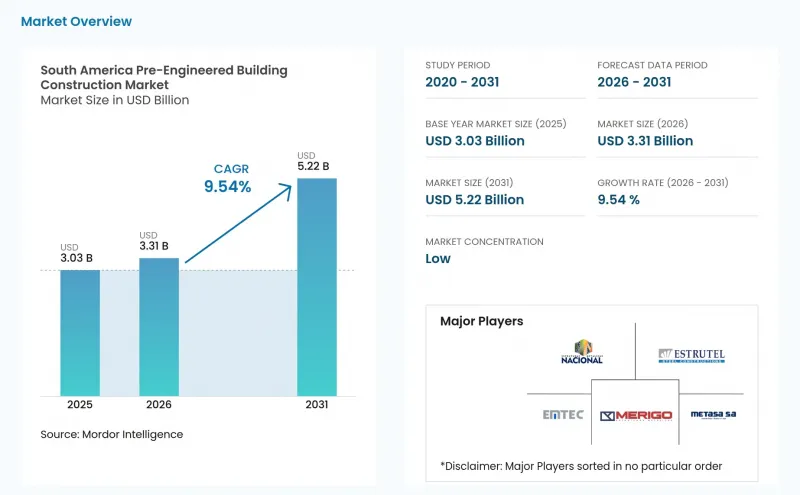
According to Mordor Intelligence, the South America pre-engineered building construction market size is projected to expand from USD 3.03 billion in 2025 and USD 3.31 billion in 2026 to USD 5.22 billion by 2031, registering a CAGR of 9.54% between 2026 and 2031.
South America Pre-Engineered Building Construction Market Trends and Insights
Mining-Linked Processing, Renewable-Energy Equipment, and Regional Nearshoring
Mining, renewable energy, and nearshoring projects are supporting demand for the South America pre-engineered building construction market. Latin America had attracted USD 45 billion in greenfield copper and lithium mining investment since 2015, with Chile, Peru, and Argentina receiving much of that capital. Mines need sorting sheds, maintenance workshops, electrical rooms, and worker facilities before production can begin. These structures are often required in remote locations where concrete work takes longer and needs larger site crews. Tecno Fast completed its 786,734-square-foot camp at the Collahuasi copper mine in Chile in 394 days, according to the Modular Building Institute. Colombia also benefits from nearshoring investment that needs industrial buildings designed for the country's seismic requirements.
Copper, Lithium, Oil, Gas, and Renewable-Energy Project Infrastructure
Resource and energy projects create repeat demand for workshops, substations, equipment rooms, and camps in the South America pre-engineered building construction market. Chile's mining project portfolio for 2024 through 2033 totaled USD 83.1 billion across 51 initiatives. Codelco and SQM established their Salar de Atacama public-private partnership in 2024, which supports long-term lithium processing needs rather than short-term facilities. Atlas Renewable Energy closed USD 475 million in financing in October 2025 for the Copiapo Solar hybrid project in Chile. The project includes 357 MWp of solar capacity and a 320 MW battery energy storage system, and supplies power to CAP Group mining operations. Argentina's Vaca Muerta oil and gas area provides another source of demand for quickly deployed processing modules and accommodation buildings.
Currency Depreciation, Inflation, and Imported Steel Price Volatility
Currency movements make pricing and project approvals less predictable in the South America pre-engineered building construction market. Argentina produced 808,600 tons of steel in 2025, 38% more than in 2024, but construction demand remained below earlier levels. Imported kits become more expensive when the contract is priced in USD, but the project earns revenue in pesos or reais. Brazilian fabricators also face long lead times for steel coils purchased under international benchmark contracts. Procurement teams may wait for exchange rates to stabilize before approving a building package. This delay favors local fabricators when they can offer locally sourced sections and shorter price-validity periods.
Other drivers and restraints analyzed in the detailed report include:
- Grain, Meat, Food-Processing, and Temperature-Controlled Storage Expansion
- Urban Delivery Hubs and E-Commerce Warehousing in Sao Paulo and Santiago
- Mercosur Duties, Port Bottlenecks, and Long Inland Transport Distances
For complete list of drivers and restraints, kindly check the Table Of Contents.
Segment Analysis
Single-story buildings held 64% of the South America pre-engineered building construction market share in 2025. Industrial and agricultural buyers favor them because portal-frame systems support clear spans, crane access, and heavy floor loads. Warehouses, ore-handling sheds, and food-processing halls commonly need layouts without interior columns. Brazilian grain cooperatives and mining contractors in Chile and Peru are major users of these buildings. Their designs also allow owners to add roof-only or partial mezzanines when operations need more internal capacity.
Multi-story buildings are forecast to grow at a 10.4% CAGR through 2031. Land constraints in Sao Paulo and Santiago encourage developers to create vertical picking floors rather than purchase new sites. Mezzanine additions can be completed faster than a new warehouse development in supply-constrained locations. Brazil's ABNT NBR 8800:2024 standard added requirements for joint classification and seismic load combinations in multi-story steel buildings. This change supports suppliers with in-house structural engineering and detailed approval processes in the South America pre-engineered building construction industry
Complete Report Scope:
- By Structure
- Single-Story
- Multi-Story
- By Product Type
- Modular Buildings
- Panelized and Componentized Systems
- Other Prefabricated Building Types
- By Application
- Residential
- Commercial
- Industrial
- Institutional
- Others
- By Country
- Brazil
- Argentina
- Chile
- Peru
- Colombia
- Rest of South America
List of Companies Covered in this Report:
- Merigo Estruturas Metalicas
- Metasa
- Estrutel (Estruturas Metalicas Estrutel)
- EMTEC Construcoes Metalicas
- Nacional Estruturas Metalicas
- Grupo Salvatore
- HORMETAL
- Miller Building International (Millerbi)
- Steelplex Construccion
- Habitar Modular
- Grupo Cintac
- Maestranza Belga
- Allied Steel Buildings
- MIC SAS (Montajes, Ingenieria y Construccion)
- Metavo Estruturas Metalicas
- SEDEMI
Additional Benefits:
- The market estimate (ME) sheet in Excel format
- 3 months of analyst support
TABLE OF CONTENTS
1 Introduction
- 1.1 Study Assumptions & Market Definition
- 1.2 Scope of the Study
2 Research Methodology
3 Executive Summary
4 Market Landscape
- 4.1 Market Overview
- 4.2 Market Drivers
- 4.2.1 Grain, Meat, Food-Processing, and Temperature-Controlled Storage Expansion
- 4.2.2 Mining-Linked Processing, Renewable-Energy Equipment, and Regional Nearshoring
- 4.2.3 Urban Delivery Hubs and E-Commerce Warehousing in Sao Paulo and Santiago
- 4.2.4 Copper, Lithium, Oil, Gas, and Renewable-Energy Project Infrastructure
- 4.2.5 Fast-Deployable Camps and Processing Buildings for Remote Resource Projects
- 4.3 Market Restraints
- 4.3.1 Currency Depreciation, Inflation, and Imported Steel Price Volatility
- 4.3.2 Mercosur Duties, Port Bottlenecks, and Long Inland Transport Distances
- 4.3.3 Shortage of Certified Erectors in Andean, Amazonian, and Remote Mining Regions
- 4.3.4 Environmental Licensing, Seismic Design, and Public-Works Approval Delays
- 4.4 Value / Supply-Chain Analysis
- 4.5 Regulatory Landscape
- 4.6 Technological Outlook
- 4.7 Cost Structure Analysis
- 4.8 Replacement Market Dynamics
- 4.9 Industry Attractiveness - Porter's Five Forces Analysis
- 4.9.1 Threat of New Entrants
- 4.9.2 Bargaining Power of Suppliers
- 4.9.3 Bargaining Power of Buyers
- 4.9.4 Threat of Substitutes
- 4.9.5 Intensity of Competitive Rivalry
5 Market Size & Growth Forecasts (Value)
- 5.1 By Structure
- 5.1.1 Single-Story
- 5.1.2 Multi-Story
- 5.2 By Product Type
- 5.2.1 Modular Buildings
- 5.2.2 Panelized and Componentized Systems
- 5.2.3 Other Prefabricated Building Types
- 5.3 By Application
- 5.3.1 Residential
- 5.3.2 Commercial
- 5.3.3 Industrial
- 5.3.4 Institutional
- 5.3.5 Others
- 5.4 By Country
- 5.4.1 Brazil
- 5.4.2 Argentina
- 5.4.3 Chile
- 5.4.4 Peru
- 5.4.5 Colombia
- 5.4.6 Rest of South America
6 Competitive Landscape
- 6.1 Market Concentration
- 6.2 Strategic Moves
- 6.3 Company Profiles (Includes Global Level Overview, Market Level Overview, Core Segments, Financials as Available, Strategic Information, Products & Services, and Recent Developments)
- 6.3.1 Merigo Estruturas Metalicas
- 6.3.2 Metasa
- 6.3.3 Estrutel (Estruturas Metalicas Estrutel)
- 6.3.4 EMTEC Construcoes Metalicas
- 6.3.5 Nacional Estruturas Metalicas
- 6.3.6 Grupo Salvatore
- 6.3.7 HORMETAL
- 6.3.8 Miller Building International (Millerbi)
- 6.3.9 Steelplex Construccion
- 6.3.10 Habitar Modular
- 6.3.11 Grupo Cintac
- 6.3.12 Maestranza Belga
- 6.3.13 Allied Steel Buildings
- 6.3.14 MIC SAS (Montajes, Ingenieria y Construccion)
- 6.3.15 Metavo Estruturas Metalicas
- 6.3.16 SEDEMI
7 Market Opportunities & Future Outlook
- 7.1 White-space & unmet-need assessment

