PUBLISHER: Mordor Intelligence | PRODUCT CODE: 2185160

PUBLISHER: Mordor Intelligence | PRODUCT CODE: 2185160
Green Finance - Market Share Analysis, Industry Trends & Statistics, Growth Forecasts (2026 - 2031)
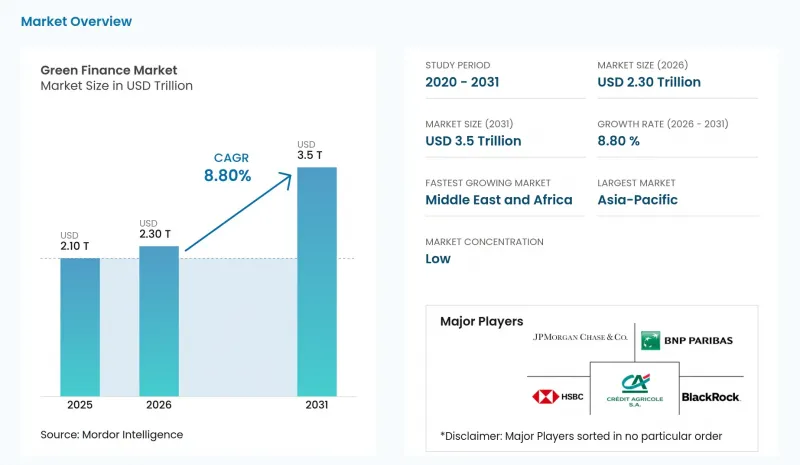
According to Mordor Intelligence, the green finance market is projected to grow from USD 2.1 trillion in 2025 to USD 3.5 trillion by 2031, at a CAGR of 8.8% during 2026-2031.
Global Green Finance Market Trends and Insights
Expansion of Green Taxonomies and Sustainable-Finance Regulations
The European Union Green Bond Standard became an active infrastructure for the green finance market in 2026. The European Securities and Markets Authority external-reviewer register became operational on June 22, 2026, under Regulation (EU) 2023/2631. Commission Delegated Regulation (EU) 2026/73 also simplified technical screening criteria for taxonomy-aligned activities. Mandatory external review is raising verification requirements for issuers and increasing the value of providers with established review capacity. China's Green Finance Support Project Catalogue, 2025 version, took effect in October 2025 and created a single identification standard across 9 domains with activity-level eligibility and greenhouse-gas reduction fields. These parallel frameworks support cross-border product recognition, including Panda and Dim Sum bond issuance, although issuers still need to meet separate local requirements.
Institutional Demand for Green Investment Products
Institutional demand is extending the green finance market beyond traditional bond issuance. The Asset Management Association of China issued guidelines in June 2026 that require sustainable investment funds to invest at least 80% of assets in line with stated sustainability objectives. This requirement gives sustainability objectives a more formal role in fund construction and portfolio monitoring. Global clean-energy capital expenditure reached USD 2.2 trillion in 2025, equal to 65% of total energy capital expenditure. Goldman Sachs Asset Management launched a dedicated biodiversity bond fund in February 2025, structured as a Sustainable Finance Disclosure Regulation Article 9 product aligned with United Nations Sustainable Development Goals 6, 12, 14, and 15. Such products broaden the investor base for thematic assets and support demand for new forms of environmental finance.
Greenwashing Risk and Higher Verification Requirements
Greenwashing risk restrains the green finance market because issuers must demonstrate that their use of proceeds, reporting practices, and sustainability claims align with the applicable framework. External review requirements increase compliance costs for issuers without established reporting systems. They also increase the importance of reliable use-of-proceeds reporting and impact measurement. Regulatory responsibilities may be divided between oversight of external reviewers and issuer-level enforcement by national authorities. Differences in national enforcement can create uneven outcomes across jurisdictions and add complexity for cross-border issuers.
Other drivers and restraints analyzed in the detailed report include:
- Rising Financing Requirements for Low-Carbon Infrastructure
- Growth and Standardization of Green Bond and Green Loan Markets
- Fragmentation of Green Taxonomies and Environmental, Social, and Governance Data Standards
For complete list of drivers and restraints, kindly check the Table Of Contents.
Segment Analysis
Green loans and green credit held 61.4% of the green finance market in 2025, making bank credit the largest financial instrument category. China's green loan balance reached RMB 43.51 trillion (USD 6.2 trillion) by the third quarter of 2025, increasing 17.5% year over year. This lending base gives bank channels a substantially larger volume platform than the bond market. European and North American banks also use green credit to fund energy, buildings, transport, and corporate transition programs. Green bonds remained the leading capital market instrument in the second quarter of 2026, accounting for 69% of labeled sustainable bond issuance during the quarter.
Other green debt and financing instruments are forecast to grow at a CAGR of 11.5% through 2031, representing the fastest growth among financial instruments. This category includes sustainability-linked bonds, transition bonds, and green securitizations. Sustainability-linked debt is expected to stabilize above 10% of total issuance as frameworks for hard-to-abate sectors mature. Transition bond growth is expanding beyond its earlier concentration in Asia. These instruments provide additional options for borrowers whose assets or transition plans do not align with conventional green bond use-of-proceeds structures. Their expansion also highlights the importance of clear standards, as investor confidence depends on credible targets and transparent reporting.
Energy efficiency, storage, networks, and green buildings accounted for 29.8% of the green finance market size by environmental theme in 2025. Building decarbonization mandates, deep retrofits, and grid modernization programs support this position. These uses have identifiable assets and clear funding needs across advanced and developing economies. Renewable energy and low-carbon power are the second-largest environmental themes. Transport and buildings still require 3 to 4 times the current annual finance flows to close the mitigation gap. This finance gap maintains demand for lending and bond programs linked to physical infrastructure.
Climate-change adaptation and resilience are forecast to grow at a 12.6% CAGR through 2031, the fastest rate among environmental themes. Its pace reflects the difference between high adaptation needs and a limited supply of investable projects. The green finance industry is also expanding into biodiversity, carbon capture, the circular economy, sustainable agriculture, water, pollution prevention, and clean transportation. Goldman Sachs Asset Management introduced a biodiversity bond fund in February 2025 to support a dedicated environmental thematic product. The Food and Agriculture Organization published guidance in May 2026 on mobilizing private capital for agrifood systems through green bonds. The fund launch and guidance support broader thematic coverage while maintaining the need for credible project selection and reporting.
Complete Report Scope:
- By Financial Instrument
- Green Bonds
- Green Loans and Green Credit
- Other Green Debt and Financing Instruments
- By Environmental Theme
- Renewable Energy and Low-Carbon Power
- Energy Efficiency, Storage, Networks, and Green Buildings
- Clean Transportation
- Sustainable Water, Wastewater and Flood Management
- Pollution Prevention and Control
- Circular Economy, Resource Efficiency, and Eco-Efficient Products / Processes
- Sustainable Agriculture, Forestry, Fisheries and Land Use
- Terrestrial and Aquatic Biodiversity and Ecosystem Conservation
- Climate-change Adaptation and Resilience
- Carbon Capture, Utilisation, Removal and Storage
- By Issuer / Borrower
- Sovereigns, Sub-Sovereigns and Public Agencies
- Development Banks and Other Official Financial Institutions
- Commercial Financial Institutions
- Large Non-Financial Corporates
- SMEs
- Households and Individuals
- By Capital Source
- Public Finance
- Private Finance
- Public-Private / Blended Finance
- By Financing Purpose
- New Financing
- Refinancing
- By Geography
- North America
- United States
- Canada
- Mexico
- South America
- Brazil
- Argentina
- Rest of South America
- Europe
- United Kingdom
- Germany
- France
- Italy
- Spain
- Rest of Europe
- Asia-Pacific
- China
- Japan
- India
- South Korea
- Australia
- Indonesia
- Thailand
- Malaysia
- Singapore
- Vietnam
- Rest of Asia-Pacific
- Middle East and Africa
- Saudi Arabia
- United Arab Emirates
- Turkey
- South Africa
- Egypt
- Rest of Middle East and Africa
- North America
Geography Analysis
Asia-Pacific accounted for 54.1% of the green finance market in 2025, making it the leading regional market. China was the main contributor, supported by its large green lending system and expanding sustainable debt activity. China issued USD 111.1 billion in green, social, sustainability, and sustainability-linked bonds in 2025, representing a 56.5% increase from 2024. By the end of the first half of 2026, China had accumulated USD 729 billion in aligned green, social, and sustainability-linked bond issuances. Hong Kong accounted for 40% of regional green and sustainable bond arranging volume, while its sustainable debt instruments exceeded USD 76 billion in 2025.
The Middle East and Africa are forecast to grow at a CAGR of 11.0% through 2031, the fastest rate among regions. Europe remains a regulatory hub, as the European Union Green Bond Standard has established a formal framework for issuers and external reviewers. Global sustainable bond issuance is projected to reach EUR 870 billion (USD 948.3 billion) in 2026, supported by the refinancing of EUR 425 billion (USD 463.3 billion) in maturing green, social, and sustainability bonds. The United States remains a major origination market, with Goldman Sachs, JPMorgan Chase, and Bank of America underwriting significant green bond issuances. Freddie Mac's GreenCHOICE Mortgages program also supports household-level financing through agency channels.
Egypt issued JPY 80 billion (USD 500 million) in sustainability samurai bonds with a partial credit guarantee from the African Development Bank in 2026. The country also issued its inaugural USD 1 billion sovereign social bond in May 2026, which received a final order book of USD 3.9 billion. The International Fund for Agricultural Development and Equity Group launched a USD 200 million adaptation finance mechanism in September 2026. The facility is designed to provide financing to micro, small, and medium-sized enterprises and smallholder farmers in East Africa. Nasdaq Dubai also supports cross-border issuance by connecting Gulf Cooperation Council issuers with international investors.
- BNP Paribas
- HSBC Holdings plc
- JPMorgan Chase & Co.
- BlackRock, Inc.
- Credit Agricole S.A.
- Societe Generale S.A.
- Banco Santander, S.A.
- ING Groep N.V.
- UBS Group AG
- Deutsche Bank AG
- Barclays PLC
- Mitsubishi UFJ Financial Group, Inc.
- Mizuho Financial Group, Inc.
- Bank of America Corporation
- Citigroup Inc.
- Goldman Sachs Group, Inc.
- Amundi Asset Management
- International Finance Corporation (IFC)
- European Investment Bank (EIB)
- World Bank Group
Additional Benefits:
- The market estimate (ME) sheet in Excel format
- 3 months of analyst support
TABLE OF CONTENTS
1 INTRODUCTION
- 1.1 Study Assumptions and Market Definition
- 1.2 Scope of the Study
2 RESEARCH METHODOLOGY
3 EXECUTIVE SUMMARY
4 MARKET LANDSCAPE
- 4.1 Market Overview
- 4.2 Market Drivers
- 4.2.1 Expansion of Green Taxonomies and Sustainable-Finance Regulations
- 4.2.2 Institutional Demand for Green Investment Products
- 4.2.3 Rising Financing Requirements for Low-Carbon Infrastructure
- 4.2.4 Growth and Standardization of Green Bond and Green Loan Markets
- 4.2.5 Integration of Climate Risk into Financial Institutions' Capital Allocation
- 4.2.6 Expansion of Green Finance Instruments in Emerging Markets
- 4.3 Market Restraints
- 4.3.1 Greenwashing Risk and Higher Verification Requirements
- 4.3.2 Fragmentation of Green Taxonomies and ESG Data Standards
- 4.3.3 Limited Pipeline of Investment-Ready Green Projects
- 4.3.4 High Risk and Long Payback Periods of Green Infrastructure Projects
- 4.4 Value Chain Analysis
- 4.4.1 Project Origination and Green-Eligibility Screening
- 4.4.2 Green Finance Structuring, Underwriting and Issuance
- 4.4.3 External Review, Certification and Assurance
- 4.4.4 Distribution, Investment, Impact Reporting and Post-Issuance Monitoring
- 4.5 Regulatory Landscape
- 4.5.1 EU Taxonomy, SFDR and European Green Bond Standard
- 4.5.2 China Green Finance Standards and Green Bond Framework
- 4.5.3 ASEAN Taxonomy and Singapore Sustainable Finance Frameworks
- 4.5.4 India Sustainable Finance and Green Debt Frameworks
- 4.6 Technological Outlook
- 4.6.1 AI-Enabled ESG Data, Climate-Risk and Green-Finance Analytics
- 4.6.2 Digital Green Bond Issuance and Tokenization
- 4.6.3 Carbon Accounting and Financed-Emissions Measurement
- 4.6.4 Satellite and Geospatial Climate-Risk and Impact Monitoring
- 4.7 Porter's Five Forces Analysis
- 4.7.1 Bargaining Power of Insurers and Reinsurers
- 4.7.2 Bargaining Power of Buyers
- 4.7.3 Threat of New Entrants
- 4.7.4 Threat of Substitutes
- 4.7.5 Competitive Rivalry
5 MARKET SIZE AND GROWTH FORECASTS
- 5.1 By Financial Instrument
- 5.1.1 Green Bonds
- 5.1.2 Green Loans and Green Credit
- 5.1.3 Other Green Debt and Financing Instruments
- 5.2 By Environmental Theme
- 5.2.1 Renewable Energy and Low-Carbon Power
- 5.2.2 Energy Efficiency, Storage, Networks, and Green Buildings
- 5.2.3 Clean Transportation
- 5.2.4 Sustainable Water, Wastewater and Flood Management
- 5.2.5 Pollution Prevention and Control
- 5.2.6 Circular Economy, Resource Efficiency, and Eco-Efficient Products / Processes
- 5.2.7 Sustainable Agriculture, Forestry, Fisheries and Land Use
- 5.2.8 Terrestrial and Aquatic Biodiversity and Ecosystem Conservation
- 5.2.9 Climate-change Adaptation and Resilience
- 5.2.10 Carbon Capture, Utilisation, Removal and Storage
- 5.3 By Issuer / Borrower
- 5.3.1 Sovereigns, Sub-Sovereigns and Public Agencies
- 5.3.2 Development Banks and Other Official Financial Institutions
- 5.3.3 Commercial Financial Institutions
- 5.3.4 Large Non-Financial Corporates
- 5.3.5 SMEs
- 5.3.6 Households and Individuals
- 5.4 By Capital Source
- 5.4.1 Public Finance
- 5.4.2 Private Finance
- 5.4.3 Public-Private / Blended Finance
- 5.5 By Financing Purpose
- 5.5.1 New Financing
- 5.5.2 Refinancing
- 5.6 By Geography
- 5.6.1 North America
- 5.6.1.1 United States
- 5.6.1.2 Canada
- 5.6.1.3 Mexico
- 5.6.2 South America
- 5.6.2.1 Brazil
- 5.6.2.2 Argentina
- 5.6.2.3 Rest of South America
- 5.6.3 Europe
- 5.6.3.1 United Kingdom
- 5.6.3.2 Germany
- 5.6.3.3 France
- 5.6.3.4 Italy
- 5.6.3.5 Spain
- 5.6.3.6 Rest of Europe
- 5.6.4 Asia-Pacific
- 5.6.4.1 China
- 5.6.4.2 Japan
- 5.6.4.3 India
- 5.6.4.4 South Korea
- 5.6.4.5 Australia
- 5.6.4.6 Indonesia
- 5.6.4.7 Thailand
- 5.6.4.8 Malaysia
- 5.6.4.9 Singapore
- 5.6.4.10 Vietnam
- 5.6.4.11 Rest of Asia-Pacific
- 5.6.5 Middle East and Africa
- 5.6.5.1 Saudi Arabia
- 5.6.5.2 United Arab Emirates
- 5.6.5.3 Turkey
- 5.6.5.4 South Africa
- 5.6.5.5 Egypt
- 5.6.5.6 Rest of Middle East and Africa
- 5.6.1 North America
6 COMPETITIVE LANDSCAPE
- 6.1 Market Concentration
- 6.2 Strategic Moves
- 6.3 Market Share Analysis (Top 5-6 players)
- 6.4 Company Profiles (includes Global Level Overview, Market Level Overview, Core Segments, Financials as available, Strategic Information, Market Rank/Share, Products and Services, Recent Developments)
- 6.4.1 BNP Paribas
- 6.4.2 HSBC Holdings plc
- 6.4.3 JPMorgan Chase & Co.
- 6.4.4 BlackRock, Inc.
- 6.4.5 Credit Agricole S.A.
- 6.4.6 Societe Generale S.A.
- 6.4.7 Banco Santander, S.A.
- 6.4.8 ING Groep N.V.
- 6.4.9 UBS Group AG
- 6.4.10 Deutsche Bank AG
- 6.4.11 Barclays PLC
- 6.4.12 Mitsubishi UFJ Financial Group, Inc.
- 6.4.13 Mizuho Financial Group, Inc.
- 6.4.14 Bank of America Corporation
- 6.4.15 Citigroup Inc.
- 6.4.16 Goldman Sachs Group, Inc.
- 6.4.17 Amundi Asset Management
- 6.4.18 International Finance Corporation (IFC)
- 6.4.19 European Investment Bank (EIB)
- 6.4.20 World Bank Group
7 MARKET OPPORTUNITIES AND FUTURE OUTLOOK
- 7.1 White-Space and Unmet-Need Assessment
- 7.1.1 SME Green-Finance Aggregation
- 7.1.2 Climate Adaptation and Resilience Finance
- 7.1.3 Emerging-Market Local-Currency Green Finance
- 7.1.4 Biodiversity and Nature-Positive Finance
- 7.1.5 Green Securitization and Project Aggregation

