PUBLISHER: Mordor Intelligence | PRODUCT CODE: 2185193

PUBLISHER: Mordor Intelligence | PRODUCT CODE: 2185193
Inspection Equipment - Market Share Analysis, Industry Trends & Statistics, Growth Forecasts (2027 - 2032)
According to Mordor Intelligence, the inspection equipment market size is projected to expand from USD 31.34 billion in 2026 and USD 33.84 billion in 2027 to USD 49.95 billion by 2032, registering a CAGR of 8.10% between 2027 and 2032.
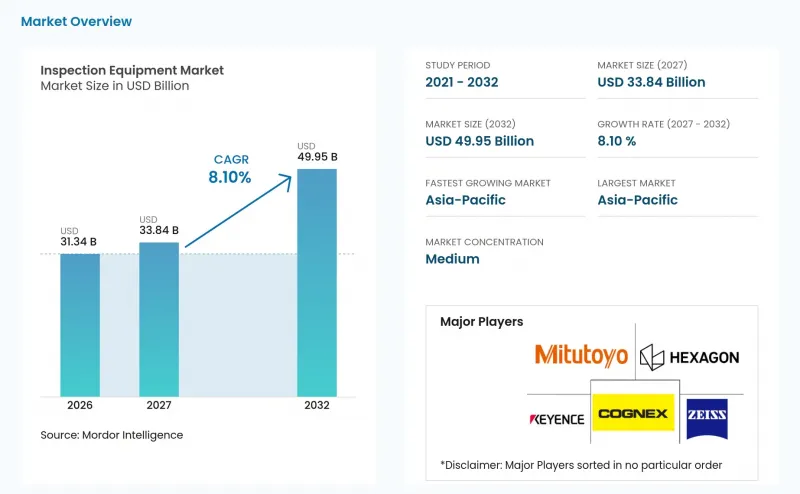
Global Inspection Equipment Market Trends and Insights
Stringent Quality, Safety, and Regulatory Compliance Requirements
Updated rules are making inspection a recurring operating requirement rather than a discretionary purchase in many facilities. ISO 17635:2025 sets general rules for non-destructive testing of welds in metallic materials and influences the equipment and documented procedures used by manufacturers. ASME Section XIII-2025 increases the value of traceable inspection records for pressure-retaining equipment in the United States. Pipeline integrity requirements also extend inspection activity beyond traditional energy assets into water and other public infrastructure. These conditions support replacement spending in the inspection equipment market because certified systems must remain current and auditable. Once a buyer has validated a platform and its documentation, changing suppliers can require further qualification work, which strengthens incumbent relationships.
Rising Industrial Automation and Manufacturing Quality Standards
Inspection is moving into production lines as manufacturers reduce manual checks at the end of a process. Automated systems must recognize defects that experienced operators previously identified during visual review. Cognex introduced OneVision in June 2025 as a cloud platform for building, training, and scaling AI-powered machine-vision applications across distributed sites. Hexagon launched its Autonomous Metrology Suite in 2025 to remove coding from coordinate measuring machine workflows. Rockwell Automation reported that AI-enabled robots and drones can improve inspection precision and reduce safety risks in industrial settings. This is shifting inspection equipment market demand from isolated capital projects toward upgrades that are aligned with software releases and line modernization.
High Capital Costs of Advanced Inspection Equipment
Industrial CT systems, multi-sensor coordinate measuring machines, and electron-beam platforms can exceed the annual capital budgets of smaller manufacturers. The ASNT Foundation has stated that sustained investment in people, research, and education is necessary to support the non-destructive testing field. ISO/IEC 17025 requires testing and calibration laboratories to establish competence, traceability, and documented calibration processes. These requirements add service, calibration, and record-management costs after installation. Integration can also be difficult where older control architectures were not built to exchange data with modern inspection systems. In response, leasing and inspection-as-a-service models can spread fixed costs across users, although this can shift spending from direct equipment purchases to service providers.
Other drivers and restraints analyzed in the detailed report include:
- Expansion of Semiconductor, Electronics, and Advanced Manufacturing Industries
- Increasing Demand for Precision Inspection and Defect Detection
- Shortage of Skilled Inspection and Equipment Operation Personnel
For complete list of drivers and restraints, kindly check the Table Of Contents.
Segment Analysis
Optical and visual inspection equipment held 33.8% of the inspection equipment market share in 2026. The segment is supported by machine vision and automated optical inspection systems used in electronics assembly, automotive production, and semiconductor packaging. Its broad installed base reflects long-term improvements in cameras, illumination, software, and defect classification. Standardized camera interfaces have helped reduce installation risk for many users. Hexagon introduced the ATLASCAN Pro handheld 3D scanner in 2025 to make professional scanning more accessible to a wider group of users. The company also expanded its quality-station offer for manufacturers managing cost and skills constraints. Optical equipment remains the main entry point for buyers that need high throughput and repeatable visual checks. This position gives the inspection equipment market a large base of applications that can adopt additional software and automation features over time.
Electron-beam inspection equipment has the fastest projected expansion at a 10.6% CAGR through 2032. The inspection equipment market size for this segment rises as chipmakers move toward 3nm and 2nm nodes that require very high-resolution inspection. KLA stated in its fiscal 2025 annual report that EUV use in logic and DRAM high-volume manufacturing creates process-control requirements beyond traditional yield-learning applications. Dimensional and geometric tools, including coordinate measuring machines, laser scanners, and 3D measurement systems, remain important in automotive and aerospace production. Ultrasonic, acoustic, radiographic, CT, electromagnetic, and magnetic systems serve core non-destructive testing needs across infrastructure and industrial assets. Thermal and infrared systems are increasingly used in power-grid diagnostics and building-energy work. Other specialized equipment covers leak testing, pressure integrity, and automated checkweighing in food and pharmaceutical settings. These categories reduce dependence on a single inspection method and support demand across diverse manufacturing conditions.
Complete Report Scope:
- By Equipment Type
- Optical and Visual Inspection Equipment
- Machine Vision and Automated Optical Inspection Systems
- Borescopes and Remote Visual Inspection Systems
- Other Optical and Surface Inspection Equipment
- Dimensional and Geometric Inspection Equipment
- Coordinate Measuring Machines
- Laser Scanning and 3D Measurement Systems
- Other Dimensional and Surface Profiling Inspection Systems
- Ultrasonic and Acoustic Inspection Equipment
- Conventional Ultrasonic Inspection Systems
- Phased-Array and Advanced Ultrasonic Inspection Systems
- Acoustic Emission and Acoustic Imaging Systems
- Radiographic and Computed Tomography Inspection Equipment
- Conventional and Digital Radiography Systems
- Industrial Computed Tomography Systems
- Cargo and Consignment X-Ray Inspection Systems
- Electromagnetic and Magnetic Inspection Equipment
- Eddy-Current Inspection Systems
- Magnetic Particle and Magnetic Flux Leakage Inspection Systems
- Ground-Penetrating Radar and Other Electromagnetic Inspection Systems
- Thermal and Infrared Inspection Equipment
- Handheld Thermal Imaging Systems
- Fixed and Integrated Thermal Inspection Systems
- Electron-Beam Inspection Equipment
- Electron-Beam Defect Inspection and Review Systems
- Other Charged-Particle Inspection Systems
- Other Specialized Inspection Equipment
- Leak and Pressure-Integrity Inspection Systems
- Automated Checkweighing and Other Physical Conformity Inspection Systems
- Other Dedicated Inspection Instruments and Systems
- Optical and Visual Inspection Equipment
- By Primary Inspection Application
- Building and Property Inspection
- Civil Infrastructure Inspection
- Industrial Facilities and Fixed Asset Inspection
- Manufactured Product and Production-Process Inspection
- Transportation Vehicle and Mobile Asset Inspection
- Commodity, Cargo and Trade Inspection
- Other Operational Site and Process Inspection
- By End-Use Industry
- Oil and Gas, Including Refining and Petrochemicals
- Power Generation, Renewable Energy and Utilities
- Automotive and Automotive Component Manufacturing
- Aerospace and Defense Manufacturing
- Electronics, Semiconductor and Electrical Equipment Manufacturing
- Other Manufacturing and Industrial Processing
- Construction, Real Estate and Civil Infrastructure
- Transportation and Logistics Operations
- Mining and Quarrying
- Agriculture, Food and Beverage
- Healthcare, Pharmaceuticals and Life Sciences
- Wholesale, Retail and Commodity Trading
- Government, Regulatory and Border Inspection Agencies
- Other End Users
- By Geography
- North America
- United States
- Canada
- Mexico
- Europe
- Germany
- United Kingdom
- France
- Italy
- Spain
- Netherlands
- Poland
- Turkey
- Rest of Europe
- Asia-Pacific
- China
- Japan
- India
- South Korea
- Taiwan
- Australia
- ASEAN
- Rest of Asia-Pacific
- Middle East and Africa
- Saudi Arabia
- United Arab Emirates
- Qatar
- South Africa
- Egypt
- Nigeria
- Rest of Middle East
- Rest of Africa
- South America
- Brazil
- Argentina
- Chile
- Colombia
- Peru
- Rest of South America
- North America
Geography Analysis
Asia-Pacific held 53.2% of the inspection equipment market share in 2026 and is forecast to expand at a 9.2% CAGR through 2032. China, Taiwan, South Korea, Japan, India, and ASEAN economies combine semiconductor fabrication, electronics assembly, and automotive-component production. China's Yangtze River Delta and Taiwan's advanced-logic foundry ecosystem support regular purchases of process-control equipment. South Korean memory production adds parallel demand for wafer and package inspection tools. Japan is supporting semiconductor capacity through initiatives that include Rapidus and TSMC Kumamoto. India is building first-wave process-control demand through semiconductor manufacturing incentives under the India Semiconductor Mission. The regional concentration of advanced and high-volume production gives Asia-Pacific a broad equipment customer base. This makes the inspection equipment market especially responsive to factory investment decisions in the region.
North America is the second-largest regional market. ASCE linked the IIJA and Inflation Reduction Act to USD 580 billion in new infrastructure investment in its 2025 report, supporting spending across water, transport, energy, and civil assets. Semiconductor projects in Arizona and Ohio add domestic demand for process-control systems. These projects place inspection closer to new fabrication capacity that has historically been concentrated in Asia. Europe ranks third, supported by industrial production in Germany, France, and Italy. ISO 17635:2025 and EN ISO 15708-4:2025 raise the importance of documented weld testing and industrial CT qualification. European pressure-equipment and CE-related compliance also support inspection in energy, chemicals, and process manufacturing. The inspection equipment market size in these mature regions depends on both new capital projects and replacement spending for established assets.
Middle East and Africa demand is concentrated in oil and gas, construction, and security inspection. OSI Systems received a USD 36 million contract for airport screening solutions in the Middle East during 2025. Saudi Arabia and the UAE are key locations because infrastructure programs and industrial localization support equipment adoption. South America remains the smallest regional area. Brazil, Argentina, and Chile provide baseline demand through agriculture, mining, and commodity exports. Energy and infrastructure spending is supporting gradual use of modern non-destructive testing and safety systems. Port and border screening also gains importance as trade-compliance needs expand. Together, these regions offer smaller but varied growth opportunities for the inspection equipment market.
- Hexagon AB
- Carl Zeiss AG
- KEYENCE Corporation
- Cognex Corporation
- Mitutoyo Corporation
- Nikon Corporation
- AMETEK, Inc. (Including FARO and Creaform)
- Renishaw plc
- Wabtec Corporation (Evident Inspection Technologies)
- Waygate Technologies
- ESAB Corporation (Eddyfi Technologies)
- Teledyne Technologies Incorporated (Including FLIR)
- Fortive Corporation (Fluke)
- Testo SE & Co. KGaA
- Sonatest Ltd.
- Illinois Tool Works Inc. (Magnaflux)
- SICK AG
- OMRON Corporation
- KLA Corporation
- Applied Materials, Inc.
- Lasertec Corporation
- Onto Innovation Inc.
- Camtek Ltd.
- METTLER-TOLEDO International Inc.
- Anritsu Corporation
- Smiths Group plc (Smiths Detection)
- OSI Systems, Inc. (Rapiscan Systems)
- NUCTECH Company Limited
- Screening Eagle Technologies (Proceq)
- FUJIFILM Holdings Corporation
- Shimadzu Corporation
- Dr. Schenk GmbH
Additional Benefits:
- The market estimate (ME) sheet in Excel format
- 3 months of analyst support
TABLE OF CONTENTS
1 INTRODUCTION
- 1.1 Study Assumptions and Market Definition
- 1.2 Scope of the Study
2 RESEARCH METHODOLOGY
3 EXECUTIVE SUMMARY
4 MARKET LANDSCAPE
- 4.1 Market Overview
- 4.1.1 Global Inspection Equipment Industry Structure
- 4.1.2 Equipment Applications Across Major Industries
- 4.1.3 Inspection Equipment Purchasing and Replacement Dynamics
- 4.2 Market Drivers
- 4.2.1 Stringent Quality, Safety and Regulatory Compliance Requirements
- 4.2.2 Rising Industrial Automation and Manufacturing Quality Standards
- 4.2.3 Aging Infrastructure and Industrial Asset Inspection Requirements
- 4.2.4 Increasing Demand for Precision Inspection and Defect Detection
- 4.2.5 Expansion of Semiconductor, Electronics and Advanced Manufacturing Industries
- 4.2.6 Growth in Infrastructure, Energy and Transportation Investments
- 4.2.7 Increasing Adoption of Non-Invasive and Automated Inspection Technologies
- 4.3 Market Restraints
- 4.3.1 High Capital Costs of Advanced Inspection Equipment
- 4.3.2 Shortage of Skilled Inspection and Equipment Operation Personnel
- 4.3.3 Equipment Integration and Technology Compatibility Challenges
- 4.3.4 Calibration, Maintenance and Lifecycle Ownership Costs
- 4.3.5 Budget Constraints Among SMEs and Cost-Sensitive Industries
- 4.3.6 Regulatory Approvals and Operational Restrictions for Specialized Equipment
- 4.4 Value and Supply-Chain Analysis
- 4.4.1 Sensors, Detectors and Electronic Component Suppliers
- 4.4.2 Inspection Equipment Manufacturers and System Integrators
- 4.4.3 Software and Inspection Analytics Providers
- 4.4.4 Distributors, Channel Partners and OEM Integrators
- 4.4.5 Equipment Calibration, Maintenance and Aftermarket Service Providers
- 4.4.6 End Users and Independent Inspection Service Providers
- 4.5 Key Market Trends
- 4.5.1 Shift Toward Automated and In-Line Inspection Systems
- 4.5.2 Growing Adoption of AI-Based Defect Detection and Machine Vision
- 4.5.3 Increasing Demand for Portable and Handheld Inspection Equipment
- 4.5.4 Integration of Inspection Systems with Industry 4.0 Platforms
- 4.5.5 Expansion of Robotic and Remote Inspection Technologies
- 4.5.6 Growing Adoption of High-Resolution Imaging and Advanced NDT Systems
- 4.5.7 Development of Multi-Sensor and Integrated Inspection Platforms
- 4.6 Regulatory and Standards Landscape
- 4.6.1 International Equipment Safety and Electromagnetic Compatibility Standards
- 4.6.2 Industrial NDT Equipment and Inspection Procedure Standards
- 4.6.3 Dimensional Metrology and Measurement Accuracy Standards
- 4.6.4 Manufacturing Quality and Product Inspection Requirements
- 4.6.5 Radiation Safety and Industrial X-Ray Equipment Regulations
- 4.6.6 Building and Infrastructure Inspection Equipment Requirements
- 4.6.7 Aviation, Automotive and Semiconductor Inspection Standards
- 4.6.8 Regional Equipment Certification and Market Access Requirements
- 4.7 Technological Outlook
- 4.7.1 Machine Vision and Automated Optical Inspection
- 4.7.2 Precision Metrology and 3D Scanning Technologies
- 4.7.3 Ultrasonic, Acoustic and Electromagnetic Inspection Technologies
- 4.7.4 Digital Radiography and Industrial Computed Tomography
- 4.7.5 Thermal Imaging and Infrared Inspection
- 4.7.6 Electron-Beam and Advanced Semiconductor Inspection
- 4.7.7 Drone-Based, Robotic and Remote Inspection Platforms
- 4.7.8 AI-Enabled Inspection Analytics and Edge Computing
- 4.7.9 Multi-Sensor Inspection and Digital Twin Integration
- 4.8 Equipment Procurement and Commercial Models
- 4.8.1 Capital Equipment Procurement and Leasing Models
- 4.8.2 Standalone Equipment versus Integrated Inspection Systems
- 4.8.3 Equipment Pricing and Total Cost of Ownership
- 4.9 Macroeconomic and Capital Investment Cycle Impact
- 4.9.1 Impact of Industrial Capital Expenditure and Manufacturing Activity
- 4.9.2 Impact of Infrastructure Development and Energy Investments
- 4.9.3 Impact of Semiconductor and Electronics Investment Cycles
- 4.9.4 Impact of Supply-Chain Localization and Trade Restrictions
5 MARKET SIZE AND GROWTH FORECASTS
- 5.1 By Equipment Type
- 5.1.1 Optical and Visual Inspection Equipment
- 5.1.1.1 Machine Vision and Automated Optical Inspection Systems
- 5.1.1.2 Borescopes and Remote Visual Inspection Systems
- 5.1.1.3 Other Optical and Surface Inspection Equipment
- 5.1.2 Dimensional and Geometric Inspection Equipment
- 5.1.2.1 Coordinate Measuring Machines
- 5.1.2.2 Laser Scanning and 3D Measurement Systems
- 5.1.2.3 Other Dimensional and Surface Profiling Inspection Systems
- 5.1.3 Ultrasonic and Acoustic Inspection Equipment
- 5.1.3.1 Conventional Ultrasonic Inspection Systems
- 5.1.3.2 Phased-Array and Advanced Ultrasonic Inspection Systems
- 5.1.3.3 Acoustic Emission and Acoustic Imaging Systems
- 5.1.4 Radiographic and Computed Tomography Inspection Equipment
- 5.1.4.1 Conventional and Digital Radiography Systems
- 5.1.4.2 Industrial Computed Tomography Systems
- 5.1.4.3 Cargo and Consignment X-Ray Inspection Systems
- 5.1.5 Electromagnetic and Magnetic Inspection Equipment
- 5.1.5.1 Eddy-Current Inspection Systems
- 5.1.5.2 Magnetic Particle and Magnetic Flux Leakage Inspection Systems
- 5.1.5.3 Ground-Penetrating Radar and Other Electromagnetic Inspection Systems
- 5.1.6 Thermal and Infrared Inspection Equipment
- 5.1.6.1 Handheld Thermal Imaging Systems
- 5.1.6.2 Fixed and Integrated Thermal Inspection Systems
- 5.1.7 Electron-Beam Inspection Equipment
- 5.1.7.1 Electron-Beam Defect Inspection and Review Systems
- 5.1.7.2 Other Charged-Particle Inspection Systems
- 5.1.8 Other Specialized Inspection Equipment
- 5.1.8.1 Leak and Pressure-Integrity Inspection Systems
- 5.1.8.2 Automated Checkweighing and Other Physical Conformity Inspection Systems
- 5.1.8.3 Other Dedicated Inspection Instruments and Systems
- 5.1.1 Optical and Visual Inspection Equipment
- 5.2 By Primary Inspection Application
- 5.2.1 Building and Property Inspection
- 5.2.2 Civil Infrastructure Inspection
- 5.2.3 Industrial Facilities and Fixed Asset Inspection
- 5.2.4 Manufactured Product and Production-Process Inspection
- 5.2.5 Transportation Vehicle and Mobile Asset Inspection
- 5.2.6 Commodity, Cargo and Trade Inspection
- 5.2.7 Other Operational Site and Process Inspection
- 5.3 By End-Use Industry
- 5.3.1 Oil and Gas, Including Refining and Petrochemicals
- 5.3.2 Power Generation, Renewable Energy and Utilities
- 5.3.3 Automotive and Automotive Component Manufacturing
- 5.3.4 Aerospace and Defense Manufacturing
- 5.3.5 Electronics, Semiconductor and Electrical Equipment Manufacturing
- 5.3.6 Other Manufacturing and Industrial Processing
- 5.3.7 Construction, Real Estate and Civil Infrastructure
- 5.3.8 Transportation and Logistics Operations
- 5.3.9 Mining and Quarrying
- 5.3.10 Agriculture, Food and Beverage
- 5.3.11 Healthcare, Pharmaceuticals and Life Sciences
- 5.3.12 Wholesale, Retail and Commodity Trading
- 5.3.13 Government, Regulatory and Border Inspection Agencies
- 5.3.14 Other End Users
- 5.4 By Geography
- 5.4.1 North America
- 5.4.1.1 United States
- 5.4.1.2 Canada
- 5.4.1.3 Mexico
- 5.4.2 Europe
- 5.4.2.1 Germany
- 5.4.2.2 United Kingdom
- 5.4.2.3 France
- 5.4.2.4 Italy
- 5.4.2.5 Spain
- 5.4.2.6 Netherlands
- 5.4.2.7 Poland
- 5.4.2.8 Turkey
- 5.4.2.9 Rest of Europe
- 5.4.3 Asia-Pacific
- 5.4.3.1 China
- 5.4.3.2 Japan
- 5.4.3.3 India
- 5.4.3.4 South Korea
- 5.4.3.5 Taiwan
- 5.4.3.6 Australia
- 5.4.3.7 ASEAN
- 5.4.3.8 Rest of Asia-Pacific
- 5.4.4 Middle East and Africa
- 5.4.4.1 Saudi Arabia
- 5.4.4.2 United Arab Emirates
- 5.4.4.3 Qatar
- 5.4.4.4 South Africa
- 5.4.4.5 Egypt
- 5.4.4.6 Nigeria
- 5.4.4.7 Rest of Middle East
- 5.4.4.8 Rest of Africa
- 5.4.5 South America
- 5.4.5.1 Brazil
- 5.4.5.2 Argentina
- 5.4.5.3 Chile
- 5.4.5.4 Colombia
- 5.4.5.5 Peru
- 5.4.5.6 Rest of South America
- 5.4.1 North America
6 COMPETITIVE LANDSCAPE
- 6.1 Market Concentration and Competitive Structure
- 6.2 Competitive Positioning by Equipment Type and Application
- 6.3 Inspection Equipment Market Share Analysis
- 6.4 Strategic Developments
- 6.5 Company Profiles (includes Global Level Overview, Market Level Overview, Core Segments, Financials as available, Strategic Information, Products and Services, Recent Developments)
- 6.5.1 Hexagon AB
- 6.5.2 Carl Zeiss AG
- 6.5.3 KEYENCE Corporation
- 6.5.4 Cognex Corporation
- 6.5.5 Mitutoyo Corporation
- 6.5.6 Nikon Corporation
- 6.5.7 AMETEK, Inc. (Including FARO and Creaform)
- 6.5.8 Renishaw plc
- 6.5.9 Wabtec Corporation (Evident Inspection Technologies)
- 6.5.10 Waygate Technologies
- 6.5.11 ESAB Corporation (Eddyfi Technologies)
- 6.5.12 Teledyne Technologies Incorporated (Including FLIR)
- 6.5.13 Fortive Corporation (Fluke)
- 6.5.14 Testo SE & Co. KGaA
- 6.5.15 Sonatest Ltd.
- 6.5.16 Illinois Tool Works Inc. (Magnaflux)
- 6.5.17 SICK AG
- 6.5.18 OMRON Corporation
- 6.5.19 KLA Corporation
- 6.5.20 Applied Materials, Inc.
- 6.5.21 Lasertec Corporation
- 6.5.22 Onto Innovation Inc.
- 6.5.23 Camtek Ltd.
- 6.5.24 METTLER-TOLEDO International Inc.
- 6.5.25 Anritsu Corporation
- 6.5.26 Smiths Group plc (Smiths Detection)
- 6.5.27 OSI Systems, Inc. (Rapiscan Systems)
- 6.5.28 NUCTECH Company Limited
- 6.5.29 Screening Eagle Technologies (Proceq)
- 6.5.30 FUJIFILM Holdings Corporation
- 6.5.31 Shimadzu Corporation
- 6.5.32 Dr. Schenk GmbH
7 MARKET OPPORTUNITIES AND FUTURE OUTLOOK
- 7.1 White-Space and Unmet-Need Assessment
- 7.1.1 Affordable Inspection Equipment for SMEs
- 7.1.2 Automated Inspection for Labor-Intensive Applications
- 7.1.3 Specialized Equipment for Emerging Energy Assets
- 7.1.4 Advanced Inspection of Batteries and Semiconductor Components
- 7.1.5 Portable and Remote Inspection in Underserved Markets
- 7.1.6 Multi-Sensor Integration and Data Interoperability
- 7.1.7 Inspection Equipment Modernization and Retrofit Opportunities
- 7.2 Future Outlook
- 7.2.1 Evolution of Inspection Equipment Demand
- 7.2.2 AI-Enabled and Autonomous Inspection Systems
- 7.2.3 Advanced Imaging and Non-Destructive Inspection Technologies
- 7.2.4 Miniaturization and Portable Equipment Adoption
- 7.2.5 Integration with Smart Manufacturing and Asset Management
- 7.2.6 Equipment Pricing and Lifecycle Cost Trends
- 7.2.7 Industry Consolidation and Technology Partnerships

