PUBLISHER: Mordor Intelligence | PRODUCT CODE: 2185195

PUBLISHER: Mordor Intelligence | PRODUCT CODE: 2185195
Asia-Pacific Inspection Equipment - Market Share Analysis, Industry Trends & Statistics, Growth Forecasts (2027 - 2032)
According to Mordor Intelligence, the Asia-Pacific inspection equipment market size is projected to expand from USD 16.65 billion in 2026 and USD 18.20 billion in 2027 to USD 28.20 billion by 2032, registering a CAGR of 9.15% between 2027 and 2032.
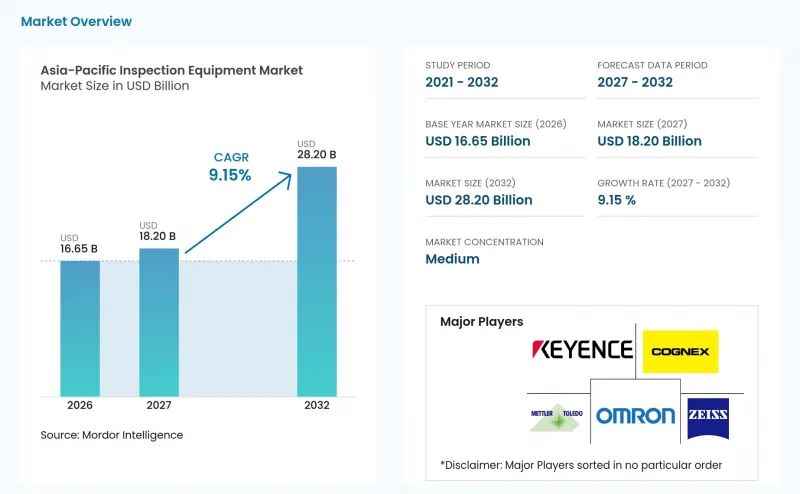
Asia-Pacific Inspection Equipment Market Trends and Insights
Expansion of Smart Manufacturing and Automated Quality Control
The Asia-Pacific inspection equipment market benefits as automated quality control becomes a standard capital item within smart factories. The regional smart manufacturing base was valued at USD 58.5 billion in 2025 and is projected to reach USD 92.6 billion by 2031. Manufacturers increasingly need documented traceability when supplying automotive and electronics original equipment manufacturers. Inspection systems can capture production evidence while identifying defects before final assembly. Private 5G pilots in Chinese and Japanese factories support the use of mobile inspection equipment where fixed wired cells are unsuitable. ISO 9001 requirements, Chinese GB standards, and Indian BIS certification schemes reinforce procurement across quality-sensitive operations.
Semiconductor, Electronics, and Battery Manufacturing Expansion
The Asia-Pacific inspection equipment market is gaining from concentrated investment in semiconductors, electronics, and battery production. Global semiconductor equipment revenue reached USD 135.1 billion in 2025, up 15% from 2024. China, Taiwan, and South Korea accounted for 79% of global equipment investment during 2025. Taiwan recorded USD 31.5 billion in investment, while South Korea recorded USD 25.8 billion. Advanced nodes require more frequent process-control measurements, which supports electron-beam and hybrid optical inspection systems. New battery lines in China, South Korea, and Thailand also require CT and X-ray inspection during cell production and qualification. These investments are expanding demand for inspection equipment across wafer fabrication, advanced packaging, printed circuit board assembly, and battery manufacturing, where small defects can affect production yields and product reliability. Manufacturers are increasingly integrating automated optical inspection, dimensional measurement, and non-destructive testing into production lines to identify defects earlier and reduce dependence on end-of-line sampling.
High Capital Cost and Integration Complexity
The Asia-Pacific inspection equipment market faces slower adoption among small and medium-sized manufacturers with limited capital budgets. A fully integrated AI vision cell can require USD 250,000 to more than USD 1 million for sensors, computing hardware, robotic handling, and commissioning. The installation process can also involve connecting systems with existing MES, ERP, and SCADA environments. These integrations may require six to eighteen months before inspection data can be used in operations. Smart manufacturing subsidies and production-linked incentive programs can reduce acquisition costs for eligible companies. Many micro-enterprises and informal businesses remain outside those programs, and maintenance, calibration, and software fees can extend the payback period.
Other drivers and restraints analyzed in the detailed report include:
- Tightening Product-Safety and Export-Quality Requirements
- AI-Enabled Inspection for High-Mix, Low-Volume Production
- Shortage of Skilled Inspection and Data-Engineering Personnel
For complete list of drivers and restraints, kindly check the Table Of Contents.
Segment Analysis
Optical and visual inspection equipment held 42.3% of the Asia-Pacific inspection equipment market share in 2026. Its scale reflects extensive machine-vision use in electronics assembly, food and beverage packaging, and automotive body-panel manufacturing. Machine vision and automated optical inspection systems form the largest part of this equipment category. Their use is widening because they can examine repeatable production tasks at line speed. KEYENCE introduced its IV4-H Series AI Vision Sensor in September 2026 to automate vision parameter setup and reduce training demands in high-mix manufacturing. Optical tools remain suitable for many surface, packaging, and assembly inspection tasks, which preserve their broad installed base.
Electron-beam inspection equipment is projected to grow at a 10.9% CAGR through 2032. The Asia-Pacific inspection equipment market size for this category is supported by demand for defect detection in advanced logic, HBM, and 3D-NAND production. Electron-beam systems can identify defect classes that optical systems cannot reliably resolve at sub-10nm dimensions. Dimensional and geometric equipment, including coordinate measuring machines and laser scanners, continues to serve aerospace and precision automotive requirements. Hexagon released OPTIV S 4.4.3 in September 2026 with AI Edge Detection and AI Illumination capabilities. Ultrasonic, acoustic, radiographic CT, electromagnetic, and thermal equipment remain relevant where energy, aerospace, food safety, and infrastructure requirements call for specialized inspection methods.
Complete Report Scope:
- By Equipment Type
- Optical and Visual Inspection Equipment
- Machine Vision and Automated Optical Inspection Systems
- Borescopes and Remote Visual Inspection Systems
- Other Optical and Surface Inspection Equipment
- Dimensional and Geometric Inspection Equipment
- Coordinate Measuring Machines
- Laser Scanning and 3D Measurement Systems
- Other Dimensional and Surface Profiling Inspection Systems
- Ultrasonic and Acoustic Inspection Equipment
- Conventional Ultrasonic Inspection Systems
- Phased-Array and Advanced Ultrasonic Inspection Systems
- Acoustic Emission and Acoustic Imaging Systems
- Radiographic and Computed Tomography Inspection Equipment
- Conventional and Digital Radiography Systems
- Industrial Computed Tomography Systems
- Cargo and Consignment X-Ray Inspection Systems
- Electromagnetic and Magnetic Inspection Equipment
- Eddy-Current Inspection Systems
- Magnetic Particle and Magnetic Flux Leakage Inspection Systems
- Ground-Penetrating Radar and Other Electromagnetic Inspection Systems
- Thermal and Infrared Inspection Equipment
- Handheld Thermal Imaging Systems
- Fixed and Integrated Thermal Inspection Systems
- Electron-Beam Inspection Equipment
- Electron-Beam Defect Inspection and Review Systems
- Other Charged-Particle Inspection Systems
- Other Specialized Inspection Equipment
- Leak and Pressure-Integrity Inspection Systems
- Automated Checkweighing and Other Physical Conformity Inspection Systems
- Other Dedicated Inspection Instruments and Systems
- Optical and Visual Inspection Equipment
- By Primary Inspection Application
- Building and Property Inspection
- Civil Infrastructure Inspection
- Industrial Facilities and Fixed Asset Inspection
- Manufactured Product and Production-Process Inspection
- Transportation Vehicle and Mobile Asset Inspection
- Commodity, Cargo and Trade Inspection
- Other Operational Site and Process Inspection
- By End-Use Industry
- Oil and Gas, Including Refining and Petrochemicals
- Power Generation, Renewable Energy and Utilities
- Automotive and Automotive Component Manufacturing
- Aerospace and Defense Manufacturing
- Electronics, Semiconductor and Electrical Equipment Manufacturing
- Other Manufacturing and Industrial Processing
- Construction, Real Estate and Civil Infrastructure
- Transportation and Logistics Operations
- Mining and Quarrying
- Agriculture, Food and Beverage
- Healthcare, Pharmaceuticals and Life Sciences
- Wholesale, Retail and Commodity Trading
- Government, Regulatory and Border Inspection Agencies
- Other End Users
- By Geography
- China
- Japan
- India
- South Korea
- Taiwan
- Australia
- ASEAN
- Rest of Asia-Pacific
List of Companies Covered in this Report:
- KEYENCE CORPORATION
- Cognex Corporation
- OMRON Corporation
- Mettler-Toledo International Inc.
- ZEISS
- Hexagon AB
- Olympus Corporation
- Nikon Corporation
- Nikon Metrology Inc.
- Baker Hughes Company
- Waygate Technologies
- Basler AG
- SICK AG
- Teledyne Technologies Incorporated
- Intertek Group plc
- Bureau Veritas S.A.
- SGS Societe Generale de Surveillance SA
- MISTRAS Group, Inc.
- Viscom AG
- Koh Young Technology Inc.
- Shimadzu Corporation
- Anritsu Corporation
- Nordson Corporation
- MinebeaMitsumi Inc.
Additional Benefits:
- The market estimate (ME) sheet in Excel format
- 3 months of analyst support
TABLE OF CONTENTS
1 Introduction
- 1.1 Study Assumptions and Market Definition
- 1.2 Scope of the Study
- 1.3 Key Questions the Study Answers
2 Research Methodology
3 Executive Summary
4 Market Landscape
- 4.1 Market Overview
- 4.2 Market Drivers
- 4.2.1 Expansion of Smart Manufacturing and Automated Quality Control
- 4.2.2 Semiconductor, Electronics, and Battery Manufacturing Expansion
- 4.2.3 Tightening Product-Safety and Export-Quality Requirements
- 4.2.4 AI-Enabled Inspection for High-Mix, Low-Volume Production
- 4.2.5 Inspection Traceability for Multi-Site Asian Supply Chains
- 4.2.6 Growing Renewable Energy Infrastructure and Grid Asset Inspection Demand
- 4.3 Market Restraints
- 4.3.1 High Capital Cost and Integration Complexity
- 4.3.2 Shortage of Skilled Inspection and Data-Engineering Personnel
- 4.3.3 Cybersecurity Exposure from Connected Inspection Systems
- 4.3.4 Fragmented Metrology and Calibration Standards Across Asia-Pacific Jurisdictions
- 4.4 Value and Supply-Chain Analysis
- 4.4.1 Component and Sensor Suppliers
- 4.4.2 Inspection Equipment Manufacturers
- 4.4.3 System Integrators and Automation Partners
- 4.4.4 Distributors, Calibration Providers, and Service Companies
- 4.4.5 End-User Manufacturing Sites
- 4.5 Regulatory Landscape
- 4.5.1 Product Safety and Quality Regulations
- 4.5.2 Non-Destructive Testing Standards
- 4.5.3 Radiation, Laser, and Workplace Safety Requirements
- 4.5.4 Food, Pharmaceutical, and Medical-Device Compliance
- 4.5.5 Data, Cybersecurity, and Industrial Connectivity Requirements
- 4.6 Key Market Trends
- 4.6.1 Shift Toward Automated and In-Line Inspection Systems
- 4.6.2 Growing Adoption of AI-Based Defect Detection and Machine Vision
- 4.6.3 Increasing Demand for Portable and Handheld Inspection Equipment
- 4.6.4 Integration of Inspection Systems with Industry 4.0 Platforms
- 4.6.5 Expansion of Robotic and Remote Inspection Technologies
- 4.6.6 Growing Adoption of High-Resolution Imaging and Advanced NDT Systems
- 4.6.7 Development of Multi-Sensor and Integrated Inspection Platforms
- 4.7 Technological Outlook
- 4.7.1 Machine Vision and Automated Optical Inspection
- 4.7.2 Precision Metrology and 3D Scanning Technologies
- 4.7.3 Ultrasonic, Acoustic and Electromagnetic Inspection Technologies
- 4.7.4 Digital Radiography and Industrial Computed Tomography
- 4.7.5 Thermal Imaging and Infrared Inspection
- 4.7.6 Electron-Beam and Advanced Semiconductor Inspection
- 4.7.7 Drone-Based, Robotic and Remote Inspection Platforms
- 4.7.8 AI-Enabled Inspection Analytics and Edge Computing
- 4.7.9 Multi-Sensor Inspection and Digital Twin Integration
- 4.8 Equipment Procurement and Commercial Models
- 4.8.1 Capital Equipment Procurement and Leasing Models
- 4.8.2 Standalone Equipment versus Integrated Inspection Systems
- 4.8.3 Equipment Pricing and Total Cost of Ownership
- 4.9 Macroeconomic and Capital Investment Cycle Impact
- 4.9.1 Impact of Industrial Capital Expenditure and Manufacturing Activity
- 4.9.2 Impact of Infrastructure Development and Energy Investments
- 4.9.3 Impact of Semiconductor and Electronics Investment Cycles
- 4.9.4 Impact of Supply-Chain Localization and Trade Restrictions
5 Market Size and Growth Forecasts
- 5.1 By Equipment Type
- 5.1.1 Optical and Visual Inspection Equipment
- 5.1.1.1 Machine Vision and Automated Optical Inspection Systems
- 5.1.1.2 Borescopes and Remote Visual Inspection Systems
- 5.1.1.3 Other Optical and Surface Inspection Equipment
- 5.1.2 Dimensional and Geometric Inspection Equipment
- 5.1.2.1 Coordinate Measuring Machines
- 5.1.2.2 Laser Scanning and 3D Measurement Systems
- 5.1.2.3 Other Dimensional and Surface Profiling Inspection Systems
- 5.1.3 Ultrasonic and Acoustic Inspection Equipment
- 5.1.3.1 Conventional Ultrasonic Inspection Systems
- 5.1.3.2 Phased-Array and Advanced Ultrasonic Inspection Systems
- 5.1.3.3 Acoustic Emission and Acoustic Imaging Systems
- 5.1.4 Radiographic and Computed Tomography Inspection Equipment
- 5.1.4.1 Conventional and Digital Radiography Systems
- 5.1.4.2 Industrial Computed Tomography Systems
- 5.1.4.3 Cargo and Consignment X-Ray Inspection Systems
- 5.1.5 Electromagnetic and Magnetic Inspection Equipment
- 5.1.5.1 Eddy-Current Inspection Systems
- 5.1.5.2 Magnetic Particle and Magnetic Flux Leakage Inspection Systems
- 5.1.5.3 Ground-Penetrating Radar and Other Electromagnetic Inspection Systems
- 5.1.6 Thermal and Infrared Inspection Equipment
- 5.1.6.1 Handheld Thermal Imaging Systems
- 5.1.6.2 Fixed and Integrated Thermal Inspection Systems
- 5.1.7 Electron-Beam Inspection Equipment
- 5.1.7.1 Electron-Beam Defect Inspection and Review Systems
- 5.1.7.2 Other Charged-Particle Inspection Systems
- 5.1.8 Other Specialized Inspection Equipment
- 5.1.8.1 Leak and Pressure-Integrity Inspection Systems
- 5.1.8.2 Automated Checkweighing and Other Physical Conformity Inspection Systems
- 5.1.8.3 Other Dedicated Inspection Instruments and Systems
- 5.1.1 Optical and Visual Inspection Equipment
- 5.2 By Primary Inspection Application
- 5.2.1 Building and Property Inspection
- 5.2.2 Civil Infrastructure Inspection
- 5.2.3 Industrial Facilities and Fixed Asset Inspection
- 5.2.4 Manufactured Product and Production-Process Inspection
- 5.2.5 Transportation Vehicle and Mobile Asset Inspection
- 5.2.6 Commodity, Cargo and Trade Inspection
- 5.2.7 Other Operational Site and Process Inspection
- 5.3 By End-Use Industry
- 5.3.1 Oil and Gas, Including Refining and Petrochemicals
- 5.3.2 Power Generation, Renewable Energy and Utilities
- 5.3.3 Automotive and Automotive Component Manufacturing
- 5.3.4 Aerospace and Defense Manufacturing
- 5.3.5 Electronics, Semiconductor and Electrical Equipment Manufacturing
- 5.3.6 Other Manufacturing and Industrial Processing
- 5.3.7 Construction, Real Estate and Civil Infrastructure
- 5.3.8 Transportation and Logistics Operations
- 5.3.9 Mining and Quarrying
- 5.3.10 Agriculture, Food and Beverage
- 5.3.11 Healthcare, Pharmaceuticals and Life Sciences
- 5.3.12 Wholesale, Retail and Commodity Trading
- 5.3.13 Government, Regulatory and Border Inspection Agencies
- 5.3.14 Other End Users
- 5.4 By Geography
- 5.4.1 China
- 5.4.2 Japan
- 5.4.3 India
- 5.4.4 South Korea
- 5.4.5 Taiwan
- 5.4.6 Australia
- 5.4.7 ASEAN
- 5.4.8 Rest of Asia-Pacific
6 Competitive Landscape
- 6.1 Market Concentration and Competitive Structure
- 6.2 Competitive Positioning by Equipment Type and Application
- 6.3 Inspection Equipment Market Share Analysis
- 6.4 Strategic Developments
- 6.5 Company Profiles (Includes Global Level Overview, Market Level Overview, Core Segments, Financials as available, Strategic Information, Products and Services, Recent Developments)
- 6.5.1 KEYENCE CORPORATION
- 6.5.2 Cognex Corporation
- 6.5.3 OMRON Corporation
- 6.5.4 Mettler-Toledo International Inc.
- 6.5.5 ZEISS
- 6.5.6 Hexagon AB
- 6.5.7 Olympus Corporation
- 6.5.8 Nikon Corporation
- 6.5.9 Nikon Metrology Inc.
- 6.5.10 Baker Hughes Company
- 6.5.11 Waygate Technologies
- 6.5.12 Basler AG
- 6.5.13 SICK AG
- 6.5.14 Teledyne Technologies Incorporated
- 6.5.15 Intertek Group plc
- 6.5.16 Bureau Veritas S.A.
- 6.5.17 SGS Societe Generale de Surveillance SA
- 6.5.18 MISTRAS Group, Inc.
- 6.5.19 Viscom AG
- 6.5.20 Koh Young Technology Inc.
- 6.5.21 Shimadzu Corporation
- 6.5.22 Anritsu Corporation
- 6.5.23 Nordson Corporation
- 6.5.24 MinebeaMitsumi Inc.
7 Market Opportunities and Future Outlook
- 7.1 White-Space and Unmet-Need Assessment
- 7.1.1 Affordable Modular Inspection for Small and Mid-Sized Manufacturers
- 7.1.2 Inspection Systems for Battery Recycling and Second-Life Batteries
- 7.1.3 Localized AI Models for Asian Defect Libraries
- 7.1.4 Remote Inspection for Aging Infrastructure and Harsh Environments
- 7.1.5 Unified Quality Data Across Multi-Supplier Production Networks
- 7.2 Future Outlook
- 7.2.1 AI-Native Inspection Platforms
- 7.2.2 Autonomous Inspection Cells
- 7.2.3 Inspection Software and Recurring Revenue Models
- 7.2.4 Regionalization of Service and Calibration Networks

