PUBLISHER: Mordor Intelligence | PRODUCT CODE: 2185198

PUBLISHER: Mordor Intelligence | PRODUCT CODE: 2185198
Middle East and Africa Data Center Technical Workforce - Market Share Analysis, Industry Trends & Statistics, Growth Forecasts (2027 - 2032)
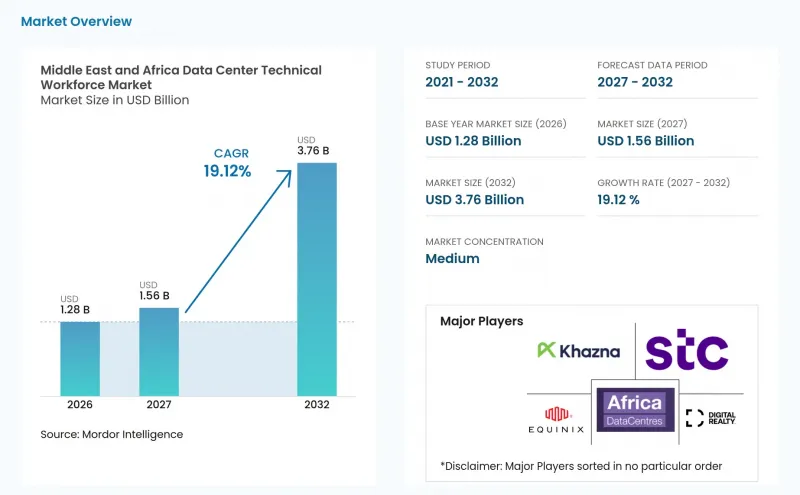
According to Mordor Intelligence, the Middle East and Africa data center technical workforce market size is projected to expand from USD 1.28 billion in 2026 to USD 3.76 billion by 2032, registering a CAGR of 19.12% between 2027 and 2032.
Middle East and Africa Data Center Technical Workforce Market Trends and Insights
Government-Led Digital Transformation and Sovereign Cloud Programs
Saudi Arabia and the UAE are moving from policy commitments to major infrastructure programs. Saudi Data and AI Authority targets 1.5 GW of sovereign capacity by 2030. In January 2026, SDAIA began work on the 480 MW Hexagon facility in Riyadh, which it describes as the world's largest government Tier IV data center. Saudi Arabia's operational data center capacity increased from 68 MW in 2021 to 467 MW in the first quarter of 2026. Its broader ICT technical workforce reached 426,000 personnel in 2025, compared with 150,000 in 2018. The Middle East and Africa data center technical workforce market benefits because public-sector facilities require locally available teams for construction, operation, security, and compliance.
AI and Hyperscale Capacity Build-Out
AI infrastructure is changing both the scale of facilities and the skills required to support them. NEOM and DataVolt signed a USD 5 billion agreement in February 2025 for a 1.5 GW AI data center campus at Oxagon. Alfanar Group committed USD 1.4 billion for 4 high-density Saudi facilities designed for AI and compute workloads. These projects require GPU cluster management, liquid-cooling engineering, and commissioning capabilities alongside conventional electrical and mechanical disciplines. NVIDIA has announced regional partnerships to train engineers in accelerated-computing workflows. The Middle East and Africa data center technical workforce market, therefore, needs a broader mix of technical capabilities as AI deployments move from planning into delivery.
Scarcity of Mission-Critical Technical Talent
The most acute shortages are in roles that support critical facilities and complex commissioning work. The Africa Data Centers Association reported that more than 60% of African operators considered skills shortages their leading growth barrier in its 2025 Insider Survey. The same survey recorded worker retention as the leading concern for 39% of respondents and limited access to specialized training for 22.6%. Uptime Institute reported that nearly 2 out of 3 operators globally had difficulty hiring and retaining qualified staff in 2025. AI-ready facilities add requirements in software-defined networking, data pipelines, and automation. These gaps can slow deployment and increase the risk of configuration errors across the Middle East and Africa data center technical workforce market.
Other drivers and restraints analyzed in the detailed report include:
- Demand for Data Sovereignty and Localized Cloud Infrastructure
- Expansion of 5G, Edge Computing, and Interconnection
- High Cost and Limited Access to Specialized Training
For complete list of drivers and restraints, kindly check the Table Of Contents.
Segment Analysis
Project development held 38.19% of revenue in 2026. This position reflects a regional pipeline centered on design, construction, installation, and site delivery in the Middle East and Africa data center technical workforce market. The GCC has 4 GW of data center capacity under development, which requires engineers and field teams throughout the project cycle. Project development staff coordinate electrical, mechanical, civil, and systems work before a facility can be handed to an operator. Testing and commissioning is projected to record the highest CAGR at 20.41% through 2032. These specialists validate redundant power, precision cooling, and dense network configurations before facilities enter service.
Commissioning requirements are becoming more demanding as AI-ready systems are deployed. Operators increasingly seek personnel who can test high-density equipment, record results, and verify resilience requirements before handover. A commissioning team must understand how power, cooling, controls, and network systems interact under operational conditions. Facility operations and maintenance staffing expand as completed sites move into regular operation. IT and digital infrastructure teams also need AI infrastructure and cybersecurity knowledge. The Middle East and Africa data center technical workforce industry increasingly depends on functions that combine physical-facility knowledge with software and network skills.
Complete Report Scope:
- By Workforce Function
- Project Development Workforce
- Design and Engineering Workforce
- Construction and Installation Workforce
- Testing and Commissioning Workforce
- Facility Operations and Maintenance Workforce
- Data Center Operations Workforce
- Facility Management Workforce
- Maintenance and Reliability Workforce
- IT and Digital Infrastructure Workforce
- IT Hardware and Cloud Infrastructure Workforce
- Network Infrastructure Workforce
- Cybersecurity and Technical Security Workforce
- AI Infrastructure Workforce
- Project Development Workforce
- By Employment Model
- In-house Workforce
- External Workforce Services
- By Data Center Type
- Hyperscale Data Centers
- Colocation Data Centers
- Enterprise, Edge and Modular Data Centers
- By Geography
- Saudi Arabia
- United Arab Emirates
- South Africa
- Nigeria
- Egypt
- Rest of Middle East and Africa
List of Companies Covered in this Report:
- Khazna Data Centers
- Digital Realty
- Equinix
- Africa Data Centres
- Saudi Telecom Company
- Gulf Data Hub
- Teraco Data Environments
- G42 Cloud Computing
- Vantage Data Centers
- Pure Data Centers
- Rack Centre
- Raxio Group
- Wingu Group
- N+ONE Datacenters
- Open Access Data Centres
- MainOne
- Telecom Egypt
- Oman Data Park
- Ooredoo
- Injazat
- Schneider Electric
- Vertiv
- Johnson Controls
- Jacobs Solutions Inc.
- AECOM
- NTT DATA Group Corporation
- Cisco Systems, Inc.
- NVIDIA Corporation
Additional Benefits:
- The market estimate (ME) sheet in Excel format
- 3 months of analyst support
TABLE OF CONTENTS
1 INTRODUCTION
- 1.1 Study Assumptions and Market Definition
- 1.2 Scope of the Study
2 RESEARCH METHODOLOGY
3 EXECUTIVE SUMMARY
4 MARKET LANDSCAPE
- 4.1 Market Overview
- 4.2 Impact of Macroeconomic Factors on the Market
- 4.3 Market Drivers
- 4.3.1 Government-Led Digital Transformation and Sovereign Cloud Programs
- 4.3.2 AI and Hyperscale Capacity Build-Out
- 4.3.3 Demand for Data Sovereignty and Localized Cloud Infrastructure
- 4.3.4 Expansion of 5G, Edge Computing, and Interconnection
- 4.3.5 Submarine Cable and Regional Connectivity Investment
- 4.3.6 Employer-Led Technical Training and Certification Ecosystems
- 4.4 Market Restraints
- 4.4.1 Scarcity of Mission-Critical Technical Talent
- 4.4.2 High Cost and Limited Access to Specialized Training
- 4.4.3 Grid Instability and Diesel-Dependent Operations
- 4.4.4 Water and Thermal Management Constraints in Arid Markets
- 4.5 Industry Value Chain Analysis
- 4.6 Regulatory Landscape
- 4.7 Technological Outlook
- 4.8 Porter's Five Forces Analysis
- 4.8.1 Threat of New Entrants
- 4.8.2 Bargaining Power of Suppliers
- 4.8.3 Bargaining Power of Buyers
- 4.8.4 Threat of Substitutes
- 4.8.5 Rivalry Among Existing Competitors
5 MARKET SIZE AND GROWTH FORECASTS (VALUE)
- 5.1 By Workforce Function
- 5.1.1 Project Development Workforce
- 5.1.1.1 Design and Engineering Workforce
- 5.1.1.2 Construction and Installation Workforce
- 5.1.1.3 Testing and Commissioning Workforce
- 5.1.2 Facility Operations and Maintenance Workforce
- 5.1.2.1 Data Center Operations Workforce
- 5.1.2.2 Facility Management Workforce
- 5.1.2.3 Maintenance and Reliability Workforce
- 5.1.3 IT and Digital Infrastructure Workforce
- 5.1.3.1 IT Hardware and Cloud Infrastructure Workforce
- 5.1.3.2 Network Infrastructure Workforce
- 5.1.3.3 Cybersecurity and Technical Security Workforce
- 5.1.3.4 AI Infrastructure Workforce
- 5.1.1 Project Development Workforce
- 5.2 By Employment Model
- 5.2.1 In-house Workforce
- 5.2.2 External Workforce Services
- 5.3 By Data Center Type
- 5.3.1 Hyperscale Data Centers
- 5.3.2 Colocation Data Centers
- 5.3.3 Enterprise, Edge and Modular Data Centers
- 5.4 By Geography
- 5.4.1 Saudi Arabia
- 5.4.2 United Arab Emirates
- 5.4.3 South Africa
- 5.4.4 Nigeria
- 5.4.5 Egypt
- 5.4.6 Rest of Middle East and Africa
6 COMPETITIVE LANDSCAPE
- 6.1 Market Concentration
- 6.2 Strategic Moves
- 6.3 Market Share Analysis
- 6.4 Company Profiles (includes Global Level Overview, Market Level Overview, Core Segments, Financials as available, Strategic Information, Market Rank/Share, Products and Services, Recent Developments)
- 6.4.1 Khazna Data Centers
- 6.4.2 Digital Realty
- 6.4.3 Equinix
- 6.4.4 Africa Data Centres
- 6.4.5 Saudi Telecom Company
- 6.4.6 Gulf Data Hub
- 6.4.7 Teraco Data Environments
- 6.4.8 G42 Cloud Computing
- 6.4.9 Vantage Data Centers
- 6.4.10 Pure Data Centers
- 6.4.11 Rack Centre
- 6.4.12 Raxio Group
- 6.4.13 Wingu Group
- 6.4.14 N+ONE Datacenters
- 6.4.15 Open Access Data Centres
- 6.4.16 MainOne
- 6.4.17 Telecom Egypt
- 6.4.18 Oman Data Park
- 6.4.19 Ooredoo
- 6.4.20 Injazat
- 6.4.21 Schneider Electric
- 6.4.22 Vertiv
- 6.4.23 Johnson Controls
- 6.4.24 Jacobs Solutions Inc.
- 6.4.25 AECOM
- 6.4.26 NTT DATA Group Corporation
- 6.4.27 Cisco Systems, Inc.
- 6.4.28 NVIDIA Corporation
7 MARKET OPPORTUNITIES AND FUTURE OUTLOOK
- 7.1 White-Space and Unmet-Need Assessment

