PUBLISHER: Mordor Intelligence | PRODUCT CODE: 2185202

PUBLISHER: Mordor Intelligence | PRODUCT CODE: 2185202
South America Data Center Technical Workforce - Market Share Analysis, Industry Trends & Statistics, Growth Forecasts (2027 - 2032)
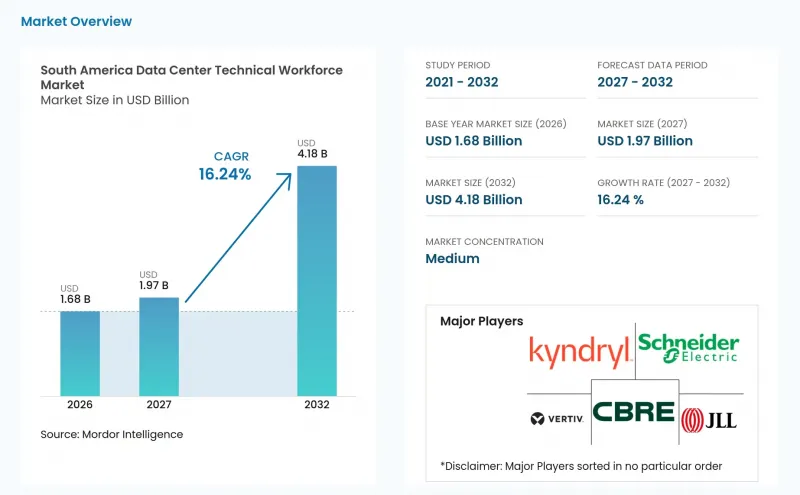
According to Mordor Intelligence, the South America data center technical workforce market size is valued at USD 1.68 billion in 2026 and is forecast to reach USD 4.18 billion by 2032, registering a CAGR of 16.24% during 2027-2032.
South America Data Center Technical Workforce Market Trends and Insights
Cloud Region and Hyperscale Capacity Expansion
The rollout of cloud regions in Brazil and Chile is the largest demand driver for the South America data center technical workforce market. Brazil is adding a significant volume of capacity, and projects need design engineers, installers, commissioning staff, and operations teams before they can enter service. Each large campus also raises demand at nearby colocation and interconnection sites, so staffing needs extend beyond the facility that initially receives the investment. Staffing requirements also persist after construction because critical facilities require continuous operations. This makes the South America data center technical workforce market sensitive to overlapping construction schedules in major hubs.
AI Workload Growth and High-Density Infrastructure Deployment
AI workloads are changing the skills required in the South America data center technical workforce market. Operators need specialists in liquid cooling, high-density power systems, and GPU cluster management rather than only general facilities technicians. Ascenty signed 150 MW of AI contracts in 2026 and linked them to USD 1.2 billion of investment in 4 hyperscale facilities in the Sao Paulo region. Vertiv expanded its Barueri training center in November 2025 with liquid-cooling equipment for AI-centered data center training. Liquid-cooled environments require mechanical, electrical, and IT teams to work together during installation and operations. The shift makes the South America data center technical workforce market more dependent on specialist technical skills.
Shortage of Mission-Critical Electrical and Mechanical Specialists
The shortage of electrical, mechanical, and cooling specialists limits the pace at which new facilities can be staffed and operated. Uptime Institute reported continued recruiting and retention pressure among data center owners and operators in its 2026 global survey. The issue is more difficult in emerging hubs because vocational training systems are smaller than in major cities. Chile also faces a recurring shortage of technology workers, including precision-cooling technicians needed across the operating chain. As new projects compete for the same people, labor costs and project risk increase. This pressure is reshaping the South America data center technical workforce market toward specialist external services.
Other drivers and restraints analyzed in the detailed report include:
- Data Sovereignty and Local Processing Requirements
- Training Pipeline Lag for AI Infrastructure and Liquid-Cooling Skills
For complete list of drivers and restraints, kindly check the Table Of Contents.
Segment Analysis
Project Development Workforce held 34.16% of the South America data center technical workforce market size in 2026 and is projected to expand at a 17.29% CAGR through 2032. The combination of a leading position and the highest growth rate reflects the large number of concurrent greenfield projects across the region. Design and engineering teams are needed early because AI-ready facilities must be planned for liquid cooling, high-voltage power delivery, and dense computing loads. Ada Infrastructure began construction of its GRU10 campus in Sao Paulo in June 2026, with the full project designed for 300 MW across 2 onsite substations. The first phase was expected to employ as many as 1,000 workers during an 18-24 month construction period.
Facility Operations and Maintenance Workforce is the second-largest function and includes data center operations, facility management, and maintenance and reliability roles. Its expansion is limited by the same talent shortage that affects project delivery. A facility can be physically complete but still face delayed revenue if qualified operations staff are not available at handover. The IT and Digital Infrastructure Workforce is advancing because cloud migration and AI deployment require stronger network, cybersecurity, and infrastructure capabilities. The AI Infrastructure sub-segment is gaining importance as teams manage dense computing clusters while monitoring environmental conditions.
Complete Report Scope:
- By Workforce Function
- Project Development Workforce
- Design and Engineering Workforce
- Construction and Installation Workforce
- Testing and Commissioning Workforce
- Facility Operations and Maintenance Workforce
- Data Center Operations Workforce
- Facility Management Workforce
- Maintenance and Reliability Workforce
- IT and Digital Infrastructure Workforce
- IT Hardware and Cloud Infrastructure Workforce
- Network Infrastructure Workforce
- Cybersecurity and Technical Security Workforce
- AI Infrastructure Workforce
- Project Development Workforce
- By Employment Model
- In-house Workforce
- External Workforce Services
- By Data Center Type
- Hyperscale Data Centers
- Colocation Data Centers
- Enterprise, Edge and Modular Data Centers
- By Geography
- Brazil
- Chile
- Argentina
- Rest of South America
List of Companies Covered in this Report:
- Kyndryl, Inc.
- Schneider Electric SE
- Vertiv Holdings Co
- CBRE Group, Inc.
- JLL (Jones Lang LaSalle Incorporated)
- Accenture plc
- Equinix, Inc.
- Digital Realty Trust, Inc.
- Ascenty Data Centers e Telecomunicacoes S.A.
- Scala Data Centers S.A.
- ODATA Brasil S.A.
- Amazon Web Services, Inc.
- Microsoft Corporation
- Google LLC
- NTT Global Data Centers Holding Pte. Ltd.
- Cirion Technologies, LLC
- Sonda S.A.
- TIVIT Terceirizacao de Processos, Servicos e Tecnologia S.A.
- DPR Construction
- Uptime Institute, LLC
- EPI Equipamentos e Servicos Ltda.
- Huawei Technologies Co., Ltd.
- NVIDIA Corporation
- Cisco Systems, Inc.
Additional Benefits:
- The market estimate (ME) sheet in Excel format
- 3 months of analyst support
TABLE OF CONTENTS
1 INTRODUCTION
- 1.1 Study Assumptions and Market Definition
- 1.2 Scope of the Study
2 RESEARCH METHODOLOGY
3 EXECUTIVE SUMMARY
4 MARKET LANDSCAPE
- 4.1 Market Overview
- 4.2 Impact of Macroeconomic Factors on the Market
- 4.3 Market Drivers
- 4.3.1 Cloud Region and Hyperscale Capacity Expansion
- 4.3.2 AI Workload Growth and High-Density Infrastructure Deployment
- 4.3.3 Submarine Cable Landings and Interconnection-Led Facility Expansion
- 4.3.4 Data Sovereignty and Local Processing Requirements
- 4.3.5 Renewable Power Procurement and Sustainable Data Center Development
- 4.3.6 Outsourcing and Certification Demand for 24/7 Critical-Facility Operations
- 4.4 Market Restraints
- 4.4.1 Shortage of Mission-Critical Electrical and Mechanical Specialists
- 4.4.2 Training Pipeline Lag for AI Infrastructure and Liquid-Cooling Skills
- 4.4.3 High Attrition from Shift Work, On-Call Burden, and Cross-Industry Competition
- 4.4.4 Fragmented Certification Recognition and Uneven Labor Standards Across Countries
- 4.5 Industry Value Chain Analysis
- 4.6 Regulatory Landscape
- 4.7 Technological Outlook
- 4.8 Porter's Five Forces
- 4.8.1 Bargaining Power of Workforce Suppliers
- 4.8.2 Bargaining Power of Data Center Operators and End Users
- 4.8.3 Threat of New Entrants
- 4.8.4 Threat of Substitutes
- 4.8.5 Competitive Rivalry
5 MARKET SIZE AND GROWTH FORECASTS
- 5.1 By Workforce Function
- 5.1.1 Project Development Workforce
- 5.1.1.1 Design and Engineering Workforce
- 5.1.1.2 Construction and Installation Workforce
- 5.1.1.3 Testing and Commissioning Workforce
- 5.1.2 Facility Operations and Maintenance Workforce
- 5.1.2.1 Data Center Operations Workforce
- 5.1.2.2 Facility Management Workforce
- 5.1.2.3 Maintenance and Reliability Workforce
- 5.1.3 IT and Digital Infrastructure Workforce
- 5.1.3.1 IT Hardware and Cloud Infrastructure Workforce
- 5.1.3.2 Network Infrastructure Workforce
- 5.1.3.3 Cybersecurity and Technical Security Workforce
- 5.1.3.4 AI Infrastructure Workforce
- 5.1.1 Project Development Workforce
- 5.2 By Employment Model
- 5.2.1 In-house Workforce
- 5.2.2 External Workforce Services
- 5.3 By Data Center Type
- 5.3.1 Hyperscale Data Centers
- 5.3.2 Colocation Data Centers
- 5.3.3 Enterprise, Edge and Modular Data Centers
- 5.4 By Geography
- 5.4.1 Brazil
- 5.4.2 Chile
- 5.4.3 Argentina
- 5.4.4 Rest of South America
6 COMPETITIVE LANDSCAPE
- 6.1 Market Concentration
- 6.2 Strategic Moves
- 6.3 Market Share Analysis
- 6.4 Company Profiles (includes Global Level Overview, Market Level Overview, Core Segments, Financials as available, Strategic Information, Market Rank/Share, Products and Services, Recent Developments)
- 6.4.1 Kyndryl, Inc.
- 6.4.2 Schneider Electric SE
- 6.4.3 Vertiv Holdings Co
- 6.4.4 CBRE Group, Inc.
- 6.4.5 JLL (Jones Lang LaSalle Incorporated)
- 6.4.6 Accenture plc
- 6.4.7 Equinix, Inc.
- 6.4.8 Digital Realty Trust, Inc.
- 6.4.9 Ascenty Data Centers e Telecomunicacoes S.A.
- 6.4.10 Scala Data Centers S.A.
- 6.4.11 ODATA Brasil S.A.
- 6.4.12 Amazon Web Services, Inc.
- 6.4.13 Microsoft Corporation
- 6.4.14 Google LLC
- 6.4.15 NTT Global Data Centers Holding Pte. Ltd.
- 6.4.16 Cirion Technologies, LLC
- 6.4.17 Sonda S.A.
- 6.4.18 TIVIT Terceirizacao de Processos, Servicos e Tecnologia S.A.
- 6.4.19 DPR Construction
- 6.4.20 Uptime Institute, LLC
- 6.4.21 EPI Equipamentos e Servicos Ltda.
- 6.4.22 Huawei Technologies Co., Ltd.
- 6.4.23 NVIDIA Corporation
- 6.4.24 Cisco Systems, Inc.
7 MARKET OPPORTUNITIES AND FUTURE OUTLOOK
- 7.1 White-Space and Unmet-Need Assessment

