PUBLISHER: Mordor Intelligence | PRODUCT CODE: 2185208

PUBLISHER: Mordor Intelligence | PRODUCT CODE: 2185208
Asia-Pacific Data Center Testing, Inspection, and Certification - Market Share Analysis, Industry Trends & Statistics, Growth Forecasts (2027 - 2032)
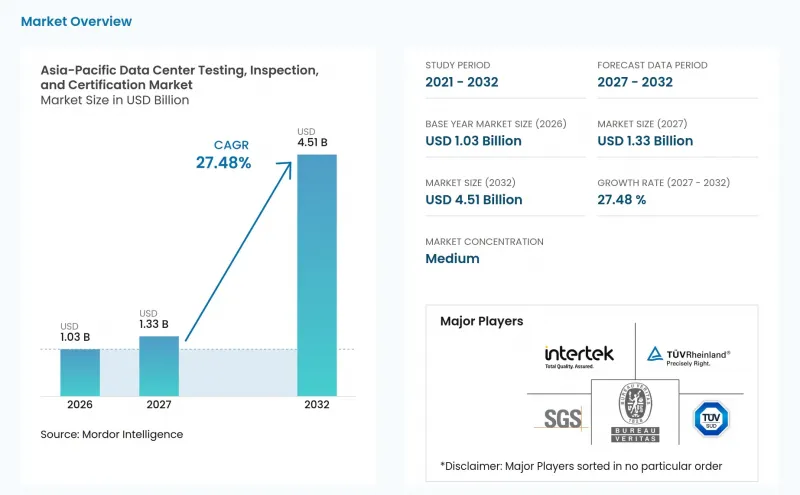
According to Mordor Intelligence, the Asia-Pacific data center testing, inspection, and certification market size was valued at USD 1.03 billion in 2026 and is estimated to expand from USD 1.33 billion in 2027 to reach USD 4.51 billion by 2032, at a CAGR of 27.48% during the forecast period from 2027 to 2032.
Asia-Pacific Data Center Testing, Inspection, and Certification Market Trends and Insights
AI-Ready Hyperscale Capacity Expansion
The Asia-Pacific data center Testing, Inspection, and Certification market is supported by a large pipeline of AI-ready capacity that requires validation before facilities accept live workloads. New sites require defined checks for power systems, cooling equipment, fire safety, and IT infrastructure. High-density AI racks operate at 50-120 kW per rack, compared with 5-15 kW in conventional designs. This changes the requirements for factory acceptance testing, integrated system tests, and load-bank validation. TCS HyperVault announced a 264-acre AI data center campus in Hyderabad with a capacity of up to 1 GW and direct-to-chip liquid cooling in September 2026. The project scale increases the value of providers that have AI-specific validation methods and experienced commissioning teams.
Accelerating Colocation Development in Power-Advantaged Markets
Power availability and public digital economy programs are directing colocation construction toward Malaysia, Vietnam, Thailand, and Indonesia. These locations can absorb demand that is more difficult to place in power-constrained hubs such as Singapore and Tokyo. AirTrunk committed MYR 12 billion (USD 2.8 billion) to develop the JHB3 and JHB4 campuses in Johor Bahru during 2025. The company stated that its existing JHB1 and JHB2 campuses, totaling more than 420 MW of IT load, were almost fully contracted. New colocation campuses need design verification, factory acceptance testing, site acceptance testing, and integrated system testing before handover. The Asia-Pacific data center TIC market, therefore, has an opportunity in projects where operators use independent certification to support customer confidence.
Shortage of Qualified Data Center Commissioning and Cybersecurity Specialists
The supply of engineers qualified to validate mission-critical systems is not keeping pace with the data center construction schedule. Commissioning managers, high-voltage electrical engineers, and cybersecurity specialists are required across design, installation, testing, and operations. This shortage is more acute in markets with compressed construction timelines and limited local training capacity. The result can be longer commissioning backlogs and delayed third-party validation. Operators may also proceed with insufficient external verification, which can increase operational defect risk. The Asia-Pacific data center TIC market favors providers that can retain certified specialists and deploy them quickly across multiple countries.
Other drivers and restraints analyzed in the detailed report include:
- Rising Sustainability and Energy-Efficiency Certification Requirements
- Increasing Cybersecurity and Digital-Trust Assurance Requirements
- Fragmented National Accreditation and Compliance Regimes
For complete list of drivers and restraints, kindly check the Table Of Contents.
Segment Analysis
Testing held 39.22% of the Asia-Pacific data center Testing, Inspection, and Certification market in 2026. It remains necessary because each new facility must verify electrical, mechanical, cooling, and fire-safety systems before receiving live workloads. Factory acceptance testing and site acceptance testing are recurring requirements for power distribution units, UPS systems, and cooling equipment. Integrated system testing and load-bank validation add further work during commissioning. Testing demand is particularly strong where AI-ready designs increase system density and operating complexity. The Asia-Pacific data center TIC industry relies on these services as the basic assurance layer across new capacity additions.
Compliance and Assurance Services is projected to expand at a CAGR of 27.82% from 2027 to 2032. The service benefits from expanding obligations related to energy performance, data localization, cybersecurity, and operational governance. Australia, Singapore, India, and Indonesia apply different requirements, but each adds recurring assurance needs for operators. Bureau Veritas reported 30% organic growth in data center commissioning globally in 2025 and identified sustainability and cybersecurity assurance as important activity areas. Inspection supports construction quality verification and independent design review. Certification also creates multi-year revenue through TIA-942, ISO 50001, ISO/IEC 27001, and Uptime Institute programs.
Construction, Installation and Commissioning held 59.24% of the Asia-Pacific data center Testing, Inspection, and Certification market size in 2026. The segment includes factory acceptance testing, site acceptance testing, integrated systems tests, and load-bank validation. Each activity represents a distinct engagement before a facility enters service. High-density AI racks increase the need for liquid-cooling and power-system validation. This concentration reflects the amount of greenfield capacity under development across the region. The Asia-Pacific data center TIC market is, therefore, closely connected to project mobilization and commissioning schedules.
Operations, Maintenance and Recertification is projected to expand at a CAGR of 28.16% from 2027 to 2032. Demand rises as sites move from initial commissioning into regular operating cycles. Operational programs include CQC 8302 L3 certification in China, ISO 41001:2018 facility management accreditation in Singapore, and recertification activities in Japan. Surveillance audits can be required in the third and fourth operational years. This work is less dependent on the start of new construction than initial commissioning assignments. Pre-construction design review and modernization also remain relevant when operators assess power readiness, retrofit cooling systems, or upgrade cybersecurity controls.
Complete Report Scope:
- By Service Type
- Testing
- Inspection
- Certification
- Compliance and Assurance Services
- By Data Center Lifecycle
- Pre-Construction and Design
- Construction, Installation and Commissioning
- Operations, Maintenance and Recertification
- Retrofit and Modernization
- By Infrastructure System
- Electrical Infrastructure
- Mechanical, Cooling and Fire-Safety Infrastructure
- Structural, Building and Physical Security Systems
- IT, Network and Cybersecurity Infrastructure
- By Data Center Type
- Hyperscale and Cloud Service Provider Data Centers
- Colocation Data Centers
- Enterprise Data Centers
- Edge and Modular Data Centers
- By Tier Type
- Tier 1 and Tier 2
- Tier 3
- Tier 4
- By Asia-Pacific
- China
- India
- Japan
- Australia
- Singapore
- Malaysia
- Thailand
- Vietnam
- Taiwan
- Hong Kong
- Philippines
- Rest of Asia-Pacific
List of Companies Covered in this Report:
- SGS SA
- Bureau Veritas SA
- Intertek Group plc
- TUV SUD AG
- TUV Rheinland AG
- DEKRA SE
- DNV AS
- UL Solutions Inc.
- ALS Limited
- Eurofins Scientific SE
- TUV NORD AG
- Applus Services SA
- MISTRAS Group, Inc.
- Element Materials Technology Group Limited
- BSI Group
- Lloyd's Register Group Limited
- China Certification and Inspection Group Co., Ltd.
- Centre Testing International Group Co., Ltd.
- QIMA Limited
- Japan Quality Assurance Organization
Additional Benefits:
- The market estimate (ME) sheet in Excel format
- 3 months of analyst support
TABLE OF CONTENTS
1 INTRODUCTION
- 1.1 Study Assumptions and Market Definition
- 1.2 Scope of the Study
2 RESEARCH METHODOLOGY
3 EXECUTIVE SUMMARY
4 MARKET LANDSCAPE
- 4.1 Market Overview
- 4.2 Market Dynamics
- 4.2.1 Market Drivers
- 4.2.1.1 AI-Ready Hyperscale Capacity Expansion
- 4.2.1.2 Accelerating Colocation Development in Power-Advantaged Markets
- 4.2.1.3 Rising Sustainability and Energy-Efficiency Certification Requirements
- 4.2.1.4 Increasing Cybersecurity and Digital-Trust Assurance Requirements
- 4.2.1.5 Liquid-Cooling Validation for High-Density AI Racks
- 4.2.1.6 Power-Quality Assurance for Grid-Constrained Campuses
- 4.2.2 Market Restraints
- 4.2.2.1 Shortage of Qualified Data Center Commissioning and Cybersecurity Specialists
- 4.2.2.2 Fragmented National Accreditation and Compliance Regimes
- 4.2.2.3 Limited Standardization for Liquid Cooling and AI Infrastructure Testing
- 4.2.2.4 Delays in Power, Permitting and Construction Readiness
- 4.2.1 Market Drivers
- 4.3 Impact of Macroeconomic Factors on the Market
- 4.4 Industry Trends
- 4.5 Industry Ecosystem
- 4.6 Industry Value Chain Analysis
- 4.7 Regulatory Landscape
- 4.7.1 International Standards and Frameworks
- 4.7.2 National and Regional Compliance Requirements
- 4.8 Technological Outlook
- 4.9 Customer Landscape and Buyer Behavior
- 4.10 Investment and Funding Scenario
- 4.11 Case Study Analysis
- 4.12 Impact of Artificial Intelligence and Generative AI on the Market
- 4.13 Porter's Five Forces Analysis
- 4.13.1 Bargaining Power of Suppliers
- 4.13.2 Bargaining Power of Buyers
- 4.13.3 Threat of New Entrants
- 4.13.4 Threat of Substitutes
- 4.13.5 Competitive Rivalry
5 MARKET SIZE AND GROWTH FORECASTS (VALUE)
- 5.1 By Service Type
- 5.1.1 Testing
- 5.1.2 Inspection
- 5.1.3 Certification
- 5.1.4 Compliance and Assurance Services
- 5.2 By Data Center Lifecycle
- 5.2.1 Pre-Construction and Design
- 5.2.2 Construction, Installation and Commissioning
- 5.2.3 Operations, Maintenance and Recertification
- 5.2.4 Retrofit and Modernization
- 5.3 By Infrastructure System
- 5.3.1 Electrical Infrastructure
- 5.3.2 Mechanical, Cooling and Fire-Safety Infrastructure
- 5.3.3 Structural, Building and Physical Security Systems
- 5.3.4 IT, Network and Cybersecurity Infrastructure
- 5.4 By Data Center Type
- 5.4.1 Hyperscale and Cloud Service Provider Data Centers
- 5.4.2 Colocation Data Centers
- 5.4.3 Enterprise Data Centers
- 5.4.4 Edge and Modular Data Centers
- 5.5 By Tier Type
- 5.5.1 Tier 1 and Tier 2
- 5.5.2 Tier 3
- 5.5.3 Tier 4
- 5.6 By Asia-Pacific
- 5.6.1 China
- 5.6.2 India
- 5.6.3 Japan
- 5.6.4 Australia
- 5.6.5 Singapore
- 5.6.6 Malaysia
- 5.6.7 Thailand
- 5.6.8 Vietnam
- 5.6.9 Taiwan
- 5.6.10 Hong Kong
- 5.6.11 Philippines
- 5.6.12 Rest of Asia-Pacific
6 COMPETITIVE LANDSCAPE
- 6.1 Market Concentration
- 6.2 Strategic Moves
- 6.3 Market Share Analysis
- 6.4 Company Profiles (includes Global Level Overview, Market Level Overview, Core Segments, Financials as available, Strategic Information, Market Rank/Share, Products and Services, Recent Developments)
- 6.4.1 SGS SA
- 6.4.2 Bureau Veritas SA
- 6.4.3 Intertek Group plc
- 6.4.4 TUV SUD AG
- 6.4.5 TUV Rheinland AG
- 6.4.6 DEKRA SE
- 6.4.7 DNV AS
- 6.4.8 UL Solutions Inc.
- 6.4.9 ALS Limited
- 6.4.10 Eurofins Scientific SE
- 6.4.11 TUV NORD AG
- 6.4.12 Applus Services SA
- 6.4.13 MISTRAS Group, Inc.
- 6.4.14 Element Materials Technology Group Limited
- 6.4.15 BSI Group
- 6.4.16 Lloyd's Register Group Limited
- 6.4.17 China Certification and Inspection Group Co., Ltd.
- 6.4.18 Centre Testing International Group Co., Ltd.
- 6.4.19 QIMA Limited
- 6.4.20 Japan Quality Assurance Organization
7 MARKET OPPORTUNITIES AND FUTURE OUTLOOK
- 7.1 White-Space and Unmet-Need Assessment
- 7.2 Future Outlook

