PUBLISHER: Mordor Intelligence | PRODUCT CODE: 2187294

PUBLISHER: Mordor Intelligence | PRODUCT CODE: 2187294
Testing, Inspection, and Certification - Market Share Analysis, Industry Trends & Statistics, Growth Forecasts (2027 - 2032)
According to Mordor Intelligence, the testing, inspection, and certification market size was valued at USD 275.6 billion in 2026 and estimated to grow from USD 288.3 billion in 2027 to reach USD 358.4 billion by 2032, at a CAGR of 4.45% during the forecast period (2027-2032).
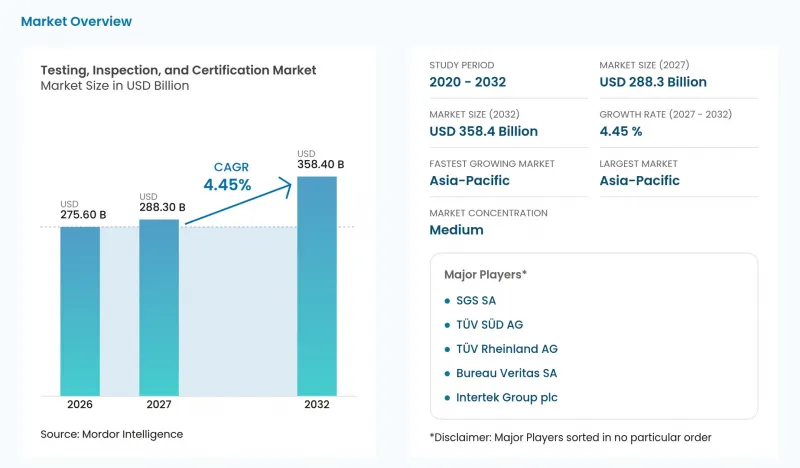
This report is segmented by Service Type (Testing and more), Sourcing Type (Outsourced and more), Industry Vertical (Consumer Goods and Retail and more), Mode of Service Delivery (On-site and more), and Geography (Asia-Pacific and more). The market forecasts are provided in terms of value (USD), based on availability.
Global Testing, Inspection, and Certification Market Trends and Insights
Increasing regulatory compliance and product-safety mandates
Product-safety mandates give manufacturers a defined need for evidence supporting the safety of goods sold in the European Union. Since December 13, 2024, the General Product Safety Regulation has required manufacturers to assess risks and prepare technical documentation before placing covered products on that market. These obligations apply to products within its scope regardless of where they were produced. Where appropriate to possible product risks, the documentation includes risk analysis and mitigation that may incorporate test reports from manufacturers or parties acting on their behalf. Manufacturers retaining the internal analysis can therefore buy external testing to substantiate an identified risk in the required technical file. The commercial opening is risk-specific evidence, so laboratory work must answer the documented safety question to contribute to that file.
Expansion of global supply chains demanding third-party assurance
As supply chains extend across operating locations, accredited management-system certification can give buyers a common basis for assessing distributed suppliers. At December 31, 2025, Global ACI's survey counted more than 3.28 million valid accredited management-system certificates across the included standards. Those certificates covered more than 5.25 million associated sites worldwide and were issued by bodies accredited by Global ACI Multilateral Recognition Arrangement signatories. Site coverage therefore matters alongside the certificate itself when suppliers design assurance services for distributed operations. Network expansion offers a way to broaden an existing assurance engagement beyond its original locations, rather than depend solely on winning new certificate holders.
Margin squeeze from price competition
Price competition narrows the earnings available from specialized security assessments. In the first half of 2026, Xinjiang Xiling Information Technology reported a year-over-year gross-margin decline at its wholly owned subsidiary Guping Security. The affected services were network security assessment and information-security risk assessment in China, where industry quotations faced pressure. The company's risk disclosure also described price wars, service homogeneity, and constraints on innovation and research investment in China's cybersecurity sector. This creates a commercial risk because lower fees leave less room to develop the capabilities that distinguish an assessment.
Other drivers and restraints analyzed in the detailed report include:
- Surge in consumer electronics and IoT product launches
- AI-enabled remote and continuous monitoring platforms
- Trade frictions and divergent national standards
For complete list of drivers and restraints, kindly check the Table Of Contents.
Segment Analysis
Testing accounted for a 61.28% share of the testing, inspection, and certification market size in 2026, making it the largest segment. Intertek Group plc reported testing as its largest assurance, testing, inspection, and certification service by revenue in 2025. Its testing work evaluates how products and services meet quality, safety, sustainability, and performance standards. That breadth brings several buyer requirements within the same service category and gives laboratory capability a wide commercial application. A laboratory able to address those different evaluation needs can pursue more of the assessment work associated with a customer's product requirements.
Certification is forecast to be the fastest-growing segment, with a 4.74% CAGR during 2027-2032. Bureau Veritas SA reported 7.9% organic revenue growth in its Certification business in 2025. SGS SA's Business Assurance division recorded 4.2% organic sales growth that year. These results show commercial expansion within 2 established certification businesses, giving the growth opportunity an operating basis beyond a single provider's experience. The differing organic readings show that expansion in these certification businesses varied by provider in 2025, rather than following a uniform pace.
Outsourced services represented a 74.68% testing, inspection, and certification market share in 2026, making them the largest segment, and are forecast to grow fastest at a 4.51% CAGR during 2027-2032. In February 2025, SGS SA reported a 38-month European Commission contract for soil laboratory analysis across the EU through the Joint Research Centre and LUCAS Survey. More than 35,000 soil samples had been collected across the EU for the program. This procurement model connects a public buyer's analytical requirement with an external provider's laboratory capability. Executing a defined analytical program lets the provider serve an assessment need spread across the buyer's many collection locations.
In-house quality control connects inspection evidence directly to the manufacturer's decision to release a pharmaceutical product. In its 2025 reporting, 3SBIO described manufacturing bases where products could leave the factory only after internal quality inspection and verification and approval by quality-control managers. Its system also included procedures for inspection data, audit trails, and reporting inspection results. That combination places evidence management alongside the physical inspection within the manufacturer's release process. External providers serving such manufacturers need findings that can pass through the buyer's internal inspection and release controls, making the fit with that retained decision process commercially relevant.
Complete Report Scope:
- By Service Type
- Testing
- Inspection
- Certification
- By Sourcing Type
- In-house
- Outsourced
- By Industry Vertical
- Consumer Goods and Retail
- ICT and Telecom
- Automotive and Transportation
- Aerospace and Defense
- Oil, Gas and Petrochemicals
- Energy and Utilities
- Industrial Manufacturing and Machinery
- Chemicals and Materials
- Construction and Infrastructure
- Life Sciences and Healthcare
- Food, Agriculture and Beverage
- Others (Environment, Sustainability, etc.)
- By Mode of Service Delivery
- On-site
- Off-site/Laboratory
- Remote / Digital
- By Geography
- North America
- United States
- Canada
- Mexico
- South America
- Brazil
- Argentina
- Rest of South America
- Europe
- Germany
- United Kingdom
- France
- Italy
- Spain
- Russia
- Rest of Europe
- Asia-Pacific
- China
- Japan
- India
- South Korea
- South-East Asia
- Rest of Asia-Pacific
- Middle East and Africa
- Middle East
- Saudi Arabia
- United Arab Emirates
- Turkey
- Rest of Middle East
- Africa
- South Africa
- Nigeria
- Rest of Africa
- Middle East
- North America
Geography Analysis
Asia-Pacific represented 47.35% of the testing, inspection, and certification market size in 2026 and is forecast to be the fastest-growing geography, with a 5.1% CAGR during 2027-2032. China's qualified inspection and testing institutions issued 571 million inspection and testing reports in 2025. China had 54,340 qualified inspection and testing institutions that year, providing a substantial delivery base. Separately in Asia-Pacific, on February 9, 2026, New Zealand's Ministry of Business, Innovation and Employment published 54 notices recognizing selected Australian WaterMark-certified plumbing and drainage products against specific New Zealand Building Code clauses. China's qualified inspection and testing institutions also reported 8.76% revenue growth in 2025, indicating commercial expansion among those qualified institutions in China.
In North America, U.S. manufacturers and importers of children's wearing apparel covered by federal flammability standards in 16 CFR parts 1610 and 1611 must certify compliance using Consumer Product Safety Commission-accredited third-party tests. In Europe, Poland's Legnica district sanitary and epidemiological station performs physicochemical and microbiological water testing, food and production-environment microbiological testing, and medical microbiology work. The public laboratory combines sampling and testing within accreditation AB 636 with sampling and testing outside that accredited scope. Selecting a laboratory therefore requires matching the particular test's accreditation status to the compliance task, even when the institution handles several different kinds of samples.
In South America, Chile's National Standardization Institute awarded DAVIS S.A. the first geodimensional-measurement accreditation for a calibration laboratory in 2025. For instrument users, this opens an accredited calibration option in a measurement field receiving its first such recognition. In Saudi Arabia, the Saudi Standards, Metrology and Quality Organization's platform lets establishments select an appropriate assessment body to register certificates for technically regulated imported or locally manufactured products. Within the Middle East and Africa, the Standards Organisation of Nigeria began operating separate departments for certification of locally manufactured and imported products in September 2025. A supplier serving both markets files imported and locally manufactured products through the same SASO platform in Saudi Arabia, while in Nigeria the product's origin decides which Standards Organisation department handles certification.
- SGS SA
- Bureau Veritas SA
- Intertek Group plc
- TUV SUD AG
- TUV Rheinland AG
- TUV NORD GROUP
- DEKRA SE
- UL Solutions Inc.
- DNV AS
- Applus Servicios Tecnologicos, S.L.
- Eurofins Scientific SE
- ALS Limited
- Kiwa N.V.
- Lloyd's Register Group Limited
- RINA S.p.A.
- Element Materials Technology Group
- Centre Testing International Group Co. Ltd.
- SAI Global Pty Ltd
- MISTRAS Group Inc.
- NSF International
- BSI Group (The British Standards Institution)
- Cotecna Inspection SA
- SOCOTEC Group SA
- FLOCERT GmbH
- Perry Johnson Registrars Inc.
Additional Benefits:
- The market estimate (ME) sheet in Excel format
- 3 months of analyst support
TABLE OF CONTENTS
1 INTRODUCTION
- 1.1 Study Assumptions and Market Definition
- 1.2 Scope of the Study
2 RESEARCH METHODOLOGY
3 EXECUTIVE SUMMARY
4 MARKET LANDSCAPE
- 4.1 Market Overview
- 4.2 Market Drivers
- 4.2.1 Increasing regulatory compliance and product-safety mandates
- 4.2.2 Expansion of global supply chains demanding third-party assurance
- 4.2.3 Surge in consumer electronics and IoT product launches
- 4.2.4 AI-enabled remote and continuous monitoring platforms
- 4.2.5 CBAM verification of actual embedded emissions for covered exports to the EU
- 4.2.6 Cyber-physical security certification for connected products
- 4.3 Market Restraints
- 4.3.1 Margin squeeze from price competition
- 4.3.2 Trade frictions and divergent national standards
- 4.3.3 OEM self-certification via digital twins
- 4.3.4 Talent shortages in niche test domains (battery, 5G, biotech)
- 4.4 Industry Value Chain Analysis
- 4.5 Regulatory Landscape
- 4.6 Technological Outlook
- 4.7 Porter's Five Forces Analysis
- 4.7.1 Threat of New Entrants
- 4.7.2 Bargaining Power of Suppliers
- 4.7.3 Bargaining Power of Buyers
- 4.7.4 Threat of Substitutes
- 4.7.5 Competitive Rivalry
- 4.8 Impact of Macroeconomic Factors
5 MARKET SIZE AND GROWTH FORECASTS (VALUE)
- 5.1 By Service Type
- 5.1.1 Testing
- 5.1.2 Inspection
- 5.1.3 Certification
- 5.2 By Sourcing Type
- 5.2.1 In-house
- 5.2.2 Outsourced
- 5.3 By Industry Vertical
- 5.3.1 Consumer Goods and Retail
- 5.3.2 ICT and Telecom
- 5.3.3 Automotive and Transportation
- 5.3.4 Aerospace and Defense
- 5.3.5 Oil, Gas and Petrochemicals
- 5.3.6 Energy and Utilities
- 5.3.7 Industrial Manufacturing and Machinery
- 5.3.8 Chemicals and Materials
- 5.3.9 Construction and Infrastructure
- 5.3.10 Life Sciences and Healthcare
- 5.3.11 Food, Agriculture and Beverage
- 5.3.12 Others (Environment, Sustainability, etc.)
- 5.4 By Mode of Service Delivery
- 5.4.1 On-site
- 5.4.2 Off-site/Laboratory
- 5.4.3 Remote / Digital
- 5.5 By Geography
- 5.5.1 North America
- 5.5.1.1 United States
- 5.5.1.2 Canada
- 5.5.1.3 Mexico
- 5.5.2 South America
- 5.5.2.1 Brazil
- 5.5.2.2 Argentina
- 5.5.2.3 Rest of South America
- 5.5.3 Europe
- 5.5.3.1 Germany
- 5.5.3.2 United Kingdom
- 5.5.3.3 France
- 5.5.3.4 Italy
- 5.5.3.5 Spain
- 5.5.3.6 Russia
- 5.5.3.7 Rest of Europe
- 5.5.4 Asia-Pacific
- 5.5.4.1 China
- 5.5.4.2 Japan
- 5.5.4.3 India
- 5.5.4.4 South Korea
- 5.5.4.5 South-East Asia
- 5.5.4.6 Rest of Asia-Pacific
- 5.5.5 Middle East and Africa
- 5.5.5.1 Middle East
- 5.5.5.1.1 Saudi Arabia
- 5.5.5.1.2 United Arab Emirates
- 5.5.5.1.3 Turkey
- 5.5.5.1.4 Rest of Middle East
- 5.5.5.2 Africa
- 5.5.5.2.1 South Africa
- 5.5.5.2.2 Nigeria
- 5.5.5.2.3 Rest of Africa
- 5.5.5.1 Middle East
- 5.5.1 North America
6 COMPETITIVE LANDSCAPE
- 6.1 Market Concentration
- 6.2 Strategic Moves
- 6.3 Market Share Analysis
- 6.4 Company Profiles (includes Global level Overview, Market level overview, Core Segments, Financials as available, Strategic Information, Market Rank/Share for key companies, Products and Services, and Recent Developments)
- 6.4.1 SGS SA
- 6.4.2 Bureau Veritas SA
- 6.4.3 Intertek Group plc
- 6.4.4 TUV SUD AG
- 6.4.5 TUV Rheinland AG
- 6.4.6 TUV NORD GROUP
- 6.4.7 DEKRA SE
- 6.4.8 UL Solutions Inc.
- 6.4.9 DNV AS
- 6.4.10 Applus Servicios Tecnologicos, S.L.
- 6.4.11 Eurofins Scientific SE
- 6.4.12 ALS Limited
- 6.4.13 Kiwa N.V.
- 6.4.14 Lloyd's Register Group Limited
- 6.4.15 RINA S.p.A.
- 6.4.16 Element Materials Technology Group
- 6.4.17 Centre Testing International Group Co. Ltd.
- 6.4.18 SAI Global Pty Ltd
- 6.4.19 MISTRAS Group Inc.
- 6.4.20 NSF International
- 6.4.21 BSI Group (The British Standards Institution)
- 6.4.22 Cotecna Inspection SA
- 6.4.23 SOCOTEC Group SA
- 6.4.24 FLOCERT GmbH
- 6.4.25 Perry Johnson Registrars Inc.
7 MARKET OPPORTUNITIES AND FUTURE OUTLOOK
- 7.1 White-Space and Unmet-Need Assessment

