PUBLISHER: Mordor Intelligence | PRODUCT CODE: 2185249

PUBLISHER: Mordor Intelligence | PRODUCT CODE: 2185249
Vietnam Reverse Logistics - Market Share Analysis, Industry Trends & Statistics, Growth Forecasts (2027 - 2032)
According to Mordor Intelligence, the Vietnam reverse logistics market is valued at USD 3.58 billion in 2026 and is estimated to reach USD 3.88 billion in 2027 and USD 5.75 billion by 2032, registering a CAGR of 8.16% during 2027-2032.
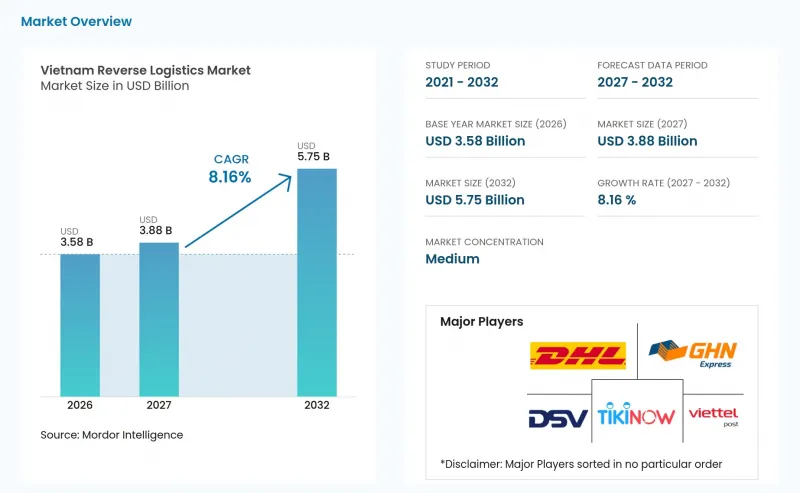
Market expansion is supported by the growth of e-commerce, the country's manufacturing base, and increasing demand for product returns, inspection, recovery, and redistribution services. This report is Segmented by Reverse Logistics Function (Transportation (Road, Air, and Other Modes), Warehousing, Other Value-Added Services), by End-User Industry (Consumer and Retail, Home and Decor, Healthcare and Pharmaceuticals, FMCG, Other End Users), and by Region (Northern Vietnam, Central Vietnam, Southern Vietnam). The Market Forecasts are Provided in Terms of Value (USD).
Vietnam Reverse Logistics Market Trends and Insights
E-Commerce Returns Increasing Reverse Logistics Service Demand
Vietnam's expanding online retail market is increasing the need for structured product collection, returns processing, and disposition services. As online transaction volumes rise, retailers and marketplaces need return processes that enable customers to send products back, track their status, and receive timely decisions on refunds, replacement, or resale. A December 2025 study on electronic reverse logistics service quality in Vietnam found that clear information and convenient return processes improve customer satisfaction, while effective solutions to return-related problems and reliable information help build customer trust. This reinforces the importance of reverse logistics as part of the post-purchase experience. Logistics providers can serve this demand through scheduled pickups, return tracking, centralized inspection, and clear records of product disposition. Providers that integrate these services with forward distribution networks can also improve visibility for retailers managing orders across multiple sales channels.
Circular Economy Adoption Strengthening Product Recovery Activities
Vietnam's logistics development strategy for 2025-2035, with a vision to 2050, was approved in October 2025. The strategy seeks to improve logistics efficiency, increase the sector's value contribution, and support sustainable development. These priorities create a policy context for reverse logistics services that recover value from returned products, reusable packaging, and materials that would otherwise be discarded. Reverse logistics providers can support manufacturers and retailers through repair, refurbishment, restocking, recycling, and documented disposal. Such services help companies determine whether products can be returned to inventory, repaired for continued use, or routed to an appropriate recovery channel. However, the extent to which these activities are adopted depends on product condition, residual value, available processing capacity, and the cost of recovering goods. Providers that combine transportation with inspection and recovery services can offer a broader solution than carriers focused only on moving returned products.
Fragmented Providers Reducing Process Consistency and Efficiency
Reverse logistics involves multiple stages, including pickup, consolidation, inspection, repair, restocking, and disposal. When these stages are managed by different providers without common operating procedures or compatible data systems, service consistency can be difficult to maintain. Differences in inspection criteria, tracking records, and handover processes can increase delays and make it harder for retailers to determine the final status of returned products. However, achieving consistent reverse logistics service requires investment in network coordination, staff training, information systems, and standardized processes. Providers operating across smaller cities and lower-density collection areas may face particular challenges in achieving sufficient volumes to support dedicated return infrastructure. Partnerships, subcontractor standards, and shared processing facilities can help reduce these gaps, although the results depend on implementation and local demand.
Other drivers and restraints analyzed in the detailed report include:
- Electronics Growth Expanding Warranty and Returns Processing
- Digital Visibility Improving Returns Tracking and Processing
- Collection and Inspection Costs Increasing Recovery Expenses
For complete list of drivers and restraints, kindly check the Table Of Contents.
Segment Analysis
Transportation accounts for 46.78% of the Vietnam reverse logistics market share in 2026, making it the largest functional segment. It covers the movement of returned products from customers, retail outlets, collection points, and distribution centers to inspection, repair, restocking, or disposal facilities. Road transportation is particularly relevant to domestic parcel collection and transfers between warehouses, while air and other transport modes can support time-sensitive or high-value shipments. The segment's importance reflects the need for a reliable physical network before returned products can be inspected or recovered. Providers that coordinate return pickups with existing distribution routes can also improve vehicle utilization and limit additional collection costs.
Other value-added services, including return processing, restocking, refurbishment, and disposition, are projected to register at a 10.34% CAGR from 2027 to 2032, the fastest rate among reverse logistics functions. These services allow retailers and manufacturers to assess product condition and determine whether goods can be resold, repaired, returned to suppliers, recycled, or disposed of. Their commercial value depends on the cost of inspection, product condition, residual value, and the availability of suitable recovery facilities. As customers require more complete records of returned goods, providers that combine transportation with processing and recovery services can offer a more integrated solution. NX Vietnam's Dinh Vu Logistics Center Phase II, which entered operation in May 2025 with temperature-controlled and low-humidity storage, illustrates investment in specialized logistics infrastructure.
Complete Report Scope:
- By Reverse Logistics Function
- Transportation
- Road
- Air
- Other Modes
- Warehousing (Storage, Distribution, Consolidation)
- Other Value-added Services (Return Processing, Restocking, Refurbishment, Disposition)
- Transportation
- By End-user Industry
- Consumer and Retail
- Home and Decor
- Healthcare and Pharmaceuticals
- FMCG
- Other End Users
- By Region
- Northern Vietnam
- Central Vietnam
- Southern Vietnam
List of Companies Covered in this Report:
- TikiNOW Smart Logistics Company Limited
- Viettel Post Joint Stock Corporation
- Giao Hang Nhanh (GHN)
- Giao Hang Tiet Kiem (GHTK)
- SPX Express Vietnam
- J&T Express Vietnam
- Vietnam Post Corporation
- DHL Supply Chain Vietnam
- DSV Vietnam
- CEVA Logistics Vietnam
- Kuehne+Nagel Vietnam
- Maersk Vietnam
- Nippon Express Vietnam
- Kerry Logistics Vietnam
- FedEx Vietnam
- UPS Vietnam
- InterLOG
- Gemadept Corporation
- Transimex Corporation
- BEST Express Vietnam
Additional Benefits:
- The market estimate (ME) sheet in Excel format
- 3 months of analyst support
TABLE OF CONTENTS
1 INTRODUCTION
- 1.1 Study Assumptions and Market Definition
- 1.2 Scope of the Study
2 RESEARCH METHODOLOGY
3 EXECUTIVE SUMMARY
- 3.1 Market Size, Growth, and Forecast Outlook
- 3.2 Key Demand Drivers and Reverse Logistics Trends
- 3.3 Major Return Flows and Demand Concentration
- 3.4 Competitive Landscape and Leading Reverse Logistics Providers
4 MARKET LANDSCAPE
- 4.1 Market Overview and Importance of Reverse Logistics
- 4.2 Market Drivers
- 4.2.1 E-Commerce Returns Increasing Reverse Logistics Service Demand
- 4.2.2 Circular Economy Adoption Strengthening Product Recovery Activities
- 4.2.3 Electronics Growth Expanding Warranty and Returns Processing
- 4.2.4 Digital Visibility Improving Returns Tracking and Processing
- 4.2.5 Marketplace Claims Increasing Structured Returns Data Requirements
- 4.2.6 Backhaul Monetization Improving Reverse-Flow Network Economics
- 4.3 Market Restraints
- 4.3.1 Fragmented Providers Reducing Process Consistency and Efficiency
- 4.3.2 Collection and Inspection Costs Increasing Recovery Expenses
- 4.3.3 Uncertain Return Quality Limiting Resale Value Recovery
- 4.3.4 Platform Interoperability Gaps Increasing Returns Processing Complexity
- 4.4 Value Chain Structure and Reverse Logistics Flow Analysis
- 4.5 Regulatory Framework and Reverse Logistics Compliance Analysis
- 4.6 Technology Adoption and Reverse Logistics Digitalization Analysis
- 4.7 Evolution of Reverse Logistics Requirements
- 4.8 Study on Changing Consumer Behavior and Preferences
- 4.9 Impact of Cost of Returns on Retailers - Analyst View
- 4.10 Porter's Five Forces Analysis
- 4.10.1 Threat of New Entrants
- 4.10.2 Bargaining Power of Buyers
- 4.10.3 Bargaining Power of Suppliers
- 4.10.4 Threat of Substitute Services
- 4.10.5 Intensity of Competitive Rivalry
- 4.11 Impact of Geo-Political Events on Supply Chain Shifts
5 MARKET SIZE AND GROWTH FORECASTS
- 5.1 By Reverse Logistics Function
- 5.1.1 Transportation
- 5.1.1.1 Road
- 5.1.1.2 Air
- 5.1.1.3 Other Modes
- 5.1.2 Warehousing (Storage, Distribution, Consolidation)
- 5.1.3 Other Value-added Services (Return Processing, Restocking, Refurbishment, Disposition)
- 5.1.1 Transportation
- 5.2 By End-user Industry
- 5.2.1 Consumer and Retail
- 5.2.2 Home and Decor
- 5.2.3 Healthcare and Pharmaceuticals
- 5.2.4 FMCG
- 5.2.5 Other End Users
- 5.3 By Region
- 5.3.1 Northern Vietnam
- 5.3.2 Central Vietnam
- 5.3.3 Southern Vietnam
6 COMPETITIVE LANDSCAPE
- 6.1 Market Concentration
- 6.2 Strategic Moves
- 6.3 Market Share Analysis
- 6.4 Company Profiles (includes Global Level Overview, Market Level Overview, Core Segments, Financials as available, Strategic Information, Geographic Coverage, Products and Services, Recent Developments)
- 6.4.1 TikiNOW Smart Logistics Company Limited
- 6.4.2 Viettel Post Joint Stock Corporation
- 6.4.3 Giao Hang Nhanh (GHN)
- 6.4.4 Giao Hang Tiet Kiem (GHTK)
- 6.4.5 SPX Express Vietnam
- 6.4.6 J&T Express Vietnam
- 6.4.7 Vietnam Post Corporation
- 6.4.8 DHL Supply Chain Vietnam
- 6.4.9 DSV Vietnam
- 6.4.10 CEVA Logistics Vietnam
- 6.4.11 Kuehne+Nagel Vietnam
- 6.4.12 Maersk Vietnam
- 6.4.13 Nippon Express Vietnam
- 6.4.14 Kerry Logistics Vietnam
- 6.4.15 FedEx Vietnam
- 6.4.16 UPS Vietnam
- 6.4.17 InterLOG
- 6.4.18 Gemadept Corporation
- 6.4.19 Transimex Corporation
- 6.4.20 BEST Express Vietnam
7 MARKET OPPORTUNITIES AND FUTURE OUTLOOK
- 7.1 White-Space Opportunities and Unmet Reverse Logistics Needs
- 7.2 High-Potential End-User Segments and Growth Opportunities
- 7.3 Strategic Growth Priorities Across Reverse Logistics Ecosystem
- 7.4 Future Market Outlook and Emerging Return Demand Pockets
8 APPENDIX

