PUBLISHER: Mordor Intelligence | PRODUCT CODE: 2185250

PUBLISHER: Mordor Intelligence | PRODUCT CODE: 2185250
Middle East Feed Acidifiers - Market Share Analysis, Industry Trends & Statistics, Growth Forecasts (2026 - 2031)
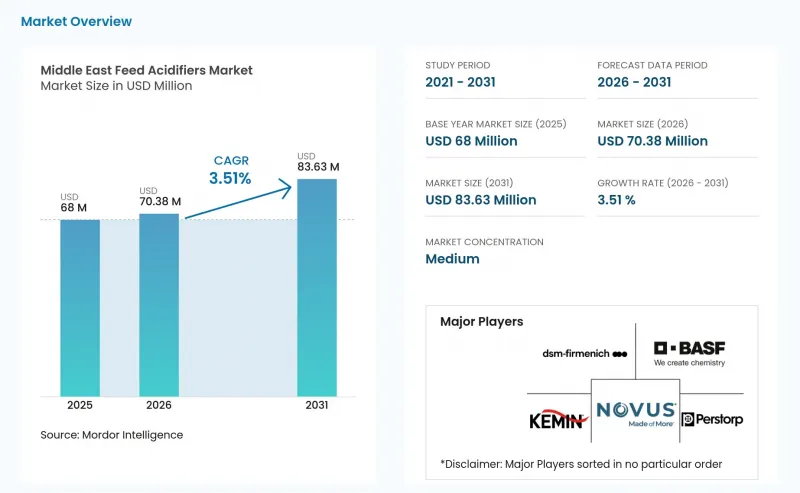
According to Mordor Intelligence, the Middle East feed acidifiers market size was valued at USD 68.0 million in 2025 and is forecast to grow from USD 70.38 million in 2026 to USD 83.63 million by 2031, at a CAGR of 3.51% from 2026 to 2031.
Middle East Feed Acidifiers Market Trends and Insights
Poultry Self-Sufficiency Investments in Saudi Arabia and the Gulf
Saudi Arabia remains a significant demand center for feed acidifiers, driven by continued investments in poultry self-sufficiency and commercial livestock production. According to the United States Department of Agriculture (USDA) Grain and Feed Annual Report 2026, the Ministry of Environment, Water, and Agriculture (MEWA) reported that Saudi Arabia is 90% self-sufficient in chicken meat, with total production reaching 1.3 million metric tons. The expansion of commercial poultry production has increased demand for high-quality compound feed, driving the use of feed acidifiers to improve feed hygiene, enhance nutrient utilization, maintain feed stability, and support animal health and production efficiency in intensive poultry farming systems.
Antibiotic Replacement After Colistin and Growth-Promotion Restrictions
The Middle East feed acidifiers market is experiencing growth due to the increasing use of non-antibiotic feed additives. Livestock producers are adopting these additives to maintain animal performance while adhering to evolving antimicrobial stewardship practices. Acidifiers are being integrated into feed programs to enhance gut health, improve nutrient utilization, and boost production efficiency, particularly in intensive poultry systems. A study published in Research on Animal Production in 2025 revealed that broilers fed diets supplemented with acidifiers and multi-enzyme complexes demonstrated significantly better growth performance and intestinal morphology compared to the control group. These results support the broader commercial use of feed acidifiers as part of preventive nutrition strategies in poultry production.
Imported Acid Raw Materials and Feed-Grain Cost Volatility
The Middle East feed acidifiers market faces challenges due to fluctuations in the costs of imported feed ingredients and additives, which can impact purchasing decisions in commercial feed operations. Many countries in the region depend significantly on imported feed grains and raw materials for feed additives, making them vulnerable to global commodity price changes and supply chain disruptions. As reported in the United States Department of Agriculture Grain and Feed Annual Report 2025, cost and freight (CFR) barley prices in Saudi Arabia ranged between USD 240 and USD 260 per metric ton in March 2025. Variability in feed input costs influences feed production economics, prompting manufacturers to manage additive expenditures carefully, especially in cost-sensitive livestock production systems.
Other drivers and restraints analyzed in the detailed report include:
- Feed Hygiene and Mold-Control Needs in Imported Grains
- Heat-Stress-Driven Water and Feed Acidification in Gulf Cooperation Council Poultry
- Distributor Fragmentation and Price Sensitivity Outside Saudi Arabia and the United Arab Emirates
For complete list of drivers and restraints, kindly check the Table Of Contents.
Segment Analysis
The Middle East feed acidifiers market share for propionic acid accounted for the largest 33.3% in 2025. This dominance is attributed to its versatile functionality in feed preservation, mold inhibition, and extending shelf life within commercial livestock production systems. Its widespread adoption is further supported by its compatibility with large-scale feed manufacturing processes and its proven effectiveness in maintaining feed quality under challenging storage conditions. Demand remains particularly robust in poultry and compound feed applications, where maintaining feed hygiene is a critical operational requirement. The product's cost-effectiveness and established performance profile continue to drive its use among both integrated producers and independent feed manufacturers.
The Middle East feed acidifiers market size for fumaric acid is forecast to grow at the fastest CAGR of 4.0% from 2026 to 2031. This growth is driven by increasing interest in feed additives that enhance digestive health and nutrient utilization, aligning with evolving livestock nutrition strategies. Fumaric acid is gaining traction in poultry, aquaculture, and selected ruminant applications, where improving feed efficiency and gut performance is becoming a priority. Beyond its preservation functions, fumaric acid is being positioned within broader animal health programs, reflecting the rising demand for specialized acidifier solutions that provide both nutritional and operational benefits.
Complete Report Scope:
- By Sub-Additive
- Fumaric Acid
- Lactic Acid
- Propionic Acid
- Other Acidifiers
- By Animal Type
- Aquaculture
- Fish
- Shrimp
- Other Aquaculture Species
- Poultry
- Broiler
- Layer
- Other Poultry Birds
- Ruminants
- Beef Cattle
- Dairy Cattle
- Other Ruminants
- Swine
- Other Animals
- Aquaculture
- By Geography
- Iran
- Saudi Arabia
- Rest of Middle East
List of Companies Covered in this Report:
- BASF SE
- Kemin Industries, Inc.
- NOVUS International, Inc. (Mitsui & Co., Ltd.)
- Perstorp Holding AB (PETRONAS Chemicals Group Berhad)
- Corbion N.V.
- Impextraco NV
- DSM-Firmenich AG
- Cargill, Incorporated
- Archer-Daniels-Midland Company
- Nutreco N.V. (SHV Holdings N.V.)
- Bluestar Adisseo Company (China National BlueStar (Group) Co., Ltd.)
- Phibro Animal Health Corporation
- Nutrex NV
- Eastman Chemical Company
- Yara International ASA
Additional Benefits:
- The market estimate (ME) sheet in Excel format
- 3 months of analyst support
TABLE OF CONTENTS
1 INTRODUCTION
- 1.1 Study Assumptions and Market Definition
- 1.2 Scope of the Study
- 1.3 Research Methodology
2 REPORT OFFERS
3 EXECUTIVE SUMMARY AND KEY FINDINGS
4 KEY INDUSTRY TRENDS
- 4.1 Animal Headcount
- 4.1.1 Poultry
- 4.1.2 Ruminants
- 4.1.3 Swine
- 4.2 Feed Production
- 4.2.1 Aquaculture
- 4.2.2 Poultry
- 4.2.3 Ruminants
- 4.2.4 Swine
- 4.3 Regulatory Framework
- 4.3.1 Iran
- 4.3.2 Saudi Arabia
- 4.4 Value Chain and Distribution Channel Analysis
- 4.5 Market Drivers
- 4.5.1 Poultry Self-Sufficiency Investments in Saudi Arabia and the Gulf
- 4.5.2 Antibiotic Replacement After Colistin and Growth-Promotion Restrictions
- 4.5.3 Feed-Mill Modernization and Higher Compound-Feed Penetration
- 4.5.4 Feed Hygiene and Mold-Control Needs in Imported Grains
- 4.5.5 Heat-Stress-Driven Water and Feed Acidification in Gulf Cooperation Council Poultry
- 4.5.6 Red Sea Aquaculture Expansion and Species-Specific Feed Programs
- 4.6 Market Restraints
- 4.6.1 Imported Acid Raw Materials and Feed-Grain Cost Volatility
- 4.6.2 Distributor Fragmentation and Price Sensitivity Outside Saudi Arabia and the United Arab Emirates
- 4.6.3 Red Sea and Strait of Hormuz Shipping Disruption Risk
- 4.6.4 Tighter Feed-Additive Compliance and Impurity-Control Rules
- 4.7 Porter's Five Forces Analysis
- 4.7.1 Bargaining Power of Suppliers
- 4.7.2 Bargaining Power of Buyers
- 4.7.3 Threat of New Entrants
- 4.7.4 Threat of Substitutes
- 4.7.5 Intensity of Competitive Rivalry
5 MARKET SIZE AND GROWTH FORECASTS (VALUE AND VOLUME)
- 5.1 By Sub-Additive
- 5.1.1 Fumaric Acid
- 5.1.2 Lactic Acid
- 5.1.3 Propionic Acid
- 5.1.4 Other Acidifiers
- 5.2 By Animal Type
- 5.2.1 Aquaculture
- 5.2.1.1 Fish
- 5.2.1.2 Shrimp
- 5.2.1.3 Other Aquaculture Species
- 5.2.2 Poultry
- 5.2.2.1 Broiler
- 5.2.2.2 Layer
- 5.2.2.3 Other Poultry Birds
- 5.2.3 Ruminants
- 5.2.3.1 Beef Cattle
- 5.2.3.2 Dairy Cattle
- 5.2.3.3 Other Ruminants
- 5.2.4 Swine
- 5.2.5 Other Animals
- 5.2.1 Aquaculture
- 5.3 By Geography
- 5.3.1 Iran
- 5.3.2 Saudi Arabia
- 5.3.3 Rest of Middle East
6 COMPETITIVE LANDSCAPE
- 6.1 Market Concentration
- 6.2 Strategic Moves
- 6.3 Market Share Analysis
- 6.4 Company Profiles (includes Global level Overview, Market level overview, Core Business Segments, Financials, Headcount, Key Information, Market Rank, Market Share, Products and Services, and analysis of Recent Developments)
- 6.4.1 BASF SE
- 6.4.2 Kemin Industries, Inc.
- 6.4.3 NOVUS International, Inc. (Mitsui & Co., Ltd.)
- 6.4.4 Perstorp Holding AB (PETRONAS Chemicals Group Berhad)
- 6.4.5 Corbion N.V.
- 6.4.6 Impextraco NV
- 6.4.7 DSM-Firmenich AG
- 6.4.8 Cargill, Incorporated
- 6.4.9 Archer-Daniels-Midland Company
- 6.4.10 Nutreco N.V. (SHV Holdings N.V.)
- 6.4.11 Bluestar Adisseo Company (China National BlueStar (Group) Co., Ltd.)
- 6.4.12 Phibro Animal Health Corporation
- 6.4.13 Nutrex NV
- 6.4.14 Eastman Chemical Company
- 6.4.15 Yara International ASA
7 KEY STRATEGIC QUESTIONS FOR FEED ADDITIVE CEOS

