PUBLISHER: Mordor Intelligence | PRODUCT CODE: 2185822

PUBLISHER: Mordor Intelligence | PRODUCT CODE: 2185822
India Diaper - Market Share Analysis, Industry Trends & Statistics, Growth Forecasts (2027 - 2032)
According to Mordor Intelligence, the India diaper market is expected to grow from USD 2.01 billion in 2026 to USD 2.14 billion by 2027 and USD 2.92 billion by 2032, at a 6.42% CAGR over 2027-2032.
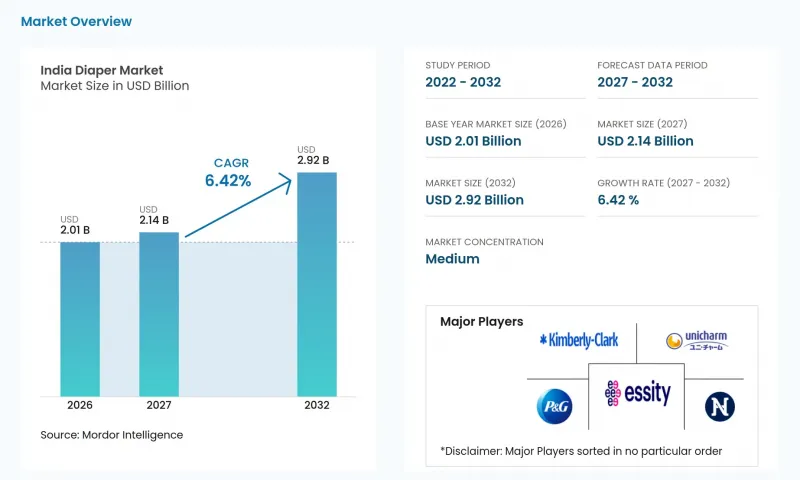
India Diaper Market Trends and Insights
Rising Awareness of Infant Hygiene Practices
India records an annual birth cohort of 23 million, which provides a large base for infant diaper demand. Awareness remains uneven, leaving considerable room for adoption in India's diaper market. An urban-rural study reported adequate knowledge of correct diaper use among 40.6% of urban mothers and 14.5% of rural mothers . National Health Mission and Poshan Abhiyaan programs support a wider hygiene environment, even though diapers are not provided at scale through these programs . The GST rate cut in September 2025 gives manufacturers a clearer price point when reaching first-time buyers outside the largest cities, according to the Press Information Bureau. Companies can build use of diapers more effectively when education, pack sizes, and price points are aligned with local household budgets.
Growing Prevalence of Adult Urinary Incontinence
Adult diaper demand has a wider clinical base than care for bedridden patients alone. A 2025 study found urinary incontinence among 42.1% of perimenopausal women in its Kerala sample, according to the Asian Journal of Biomedical and Pharmaceutical Sciences. Another 2025 study examined urinary incontinence among women aged 50 years and older in an urban Chennai locality, according to the International Journal of Healthcare Sciences. The India diaper market can therefore serve people managing varying degrees of continence needs in daily life. Greater acceptance of discreet purchasing and self-care can reduce reliance on caregiver-led purchase decisions. Brands that use clear and nonjudgmental language can make adult products more relevant to active users as well as to institutional care settings.
High Costs of Premium Diaper Products
Premium product prices continue to limit routine diaper use for many households. Branded disposable diapers cost INR 8 to INR 20 per unit, which can make frequent use difficult for lower-income families. Material costs for superabsorbent polymers and nonwoven fabrics can further restrict manufacturers' ability to lower prices while protecting margins. The GST reduction to 5% provides relief, but it does not remove the price difference between branded products and low-cost alternatives, according to the Press Information Bureau. In the India diaper market, households may reserve diapers for travel or nighttime rather than use them every day. This pattern reduces consumption even when families recognize the product's convenience or hygiene benefits.
Other drivers and restraints analyzed in the detailed report include:
- Increasing Awareness of Postpartum Incontinence Management
- Increasing Preference for Sustainable Diaper Alternatives
- Cultural Stigma Surrounding Adult Diaper Usage
For complete list of drivers and restraints, kindly check the Table Of Contents.
Segment Analysis
Disposable Diapers held a 62.31% share in 2026, giving the format a clear position in household purchasing. Pampers, MamyPoko, and Huggies support that position through broad recognition and distribution. Disposable products remain suited to households that prioritize convenience, travel use, and simple changes. Pants-style designs are important because they respond to the needs of mobile children and caregivers. The format still faces competition from cloth alternatives where price and washing routines remain familiar.
Reusable Diapers are forecast to grow at an 8.20% CAGR through 2032, which is the highest product type growth rate. This part of the India diaper market appeals to households that consider repeated use and material choice. Reusables can lower the need for repeated purchases, but their practical value depends on access to washing and drying facilities. That requirement keeps the category more relevant to urban users than to households with constrained home infrastructure. The segment and disposable products serve different needs rather than replacing each other in every household. Product quality and clear usage guidance will remain important for companies seeking repeat purchase in reusable formats.
Adult Diapers accounted for 52.78% of the India diaper market size in 2026. Adult Diapers are forecast to grow at a 7.54% CAGR through 2032, the fastest end-user growth rate. The segment is supported by continence needs that affect more than just elderly and bedridden users. A Kerala study reported a 42.1% prevalence rate among perimenopausal women in its sample, according to the Asian Journal of Biomedical and Pharmaceutical Sciences. This gives the India diaper market a broader potential user base, although stigma remains a major constraint. Products that offer comfort, discretion, and easy access can make the category more suitable for active adults. Continued education will be needed before clinical need translates into regular usage for more consumers.
The baby diapers category benefits from a large annual birth cohort and established consumer brands. Pampers, MamyPoko, and Huggies remain visible in this segment, while Indian suppliers also compete through value-oriented products. Infant hygiene awareness and lower retail prices can support wider use among first-time buyers. The segment has stable demand characteristics because product needs are linked to early childhood care. Yet adoption remains uneven between urban and rural households.
Complete Report Scope:
- By Product Type
- Disposable Diapers
- Reusable Diapers
- By End-User
- Baby Diaper
- Adult Diaper
- By Category
- Premium
- Mass
- By Distribution Channel
- Supermarkets and Hypermarkets
- Pharmacies and Drugstores
- Online Retail Stores
- Other Distribution Channels
List of Companies Covered in this Report:
- Procter & Gamble
- Kimberly-Clark Corporation
- Unicharm Corporation
- Essity Aktiebolag (publ)
- Nobel Hygiene Limited
- Torunskie Zaklady Materialow Opatrunkowych S.A.
- PAN Health Care Private Limited
- Millennium Babycares Limited
- Swara Baby Products Limited
- Romsons Group Private Limited
- Himalaya Wellness Company
- Walmark Meditech Private Limited
- Realcare Hygienic Products Private Limited
- Navi Hygiene & Healthcare Private Limited
- Kamal Healthcare Products Private Limited
- Litewave Healthcare Private Limited
- MD Hygiene
- Care4 Hygiene
- Navashya Consumer Products Private Limited
- Nibhana Consumer Private Limited
Additional Benefits:
- The market estimate (ME) sheet in Excel format
- 3 months of analyst support
TABLE OF CONTENTS
1 INTRODUCTION
- 1.1 Study Assumptions and Market Definition
- 1.2 Scope of the Study
2 RESEARCH METHODOLOGY
3 EXECUTIVE SUMMARY
4 MARKET LANDSCAPE
- 4.1 Market Overview
- 4.2 Market Drivers
- 4.2.1 Rising Awareness of Infant Hygiene Practices
- 4.2.2 Growing Prevalence of Adult Urinary Incontinence
- 4.2.3 Increasing Awareness of Postpartum Incontinence Management
- 4.2.4 Rising Adoption of Convenient Disposable Diapers
- 4.2.5 Growing Elderly Population Requiring Continence Care
- 4.2.6 Increasing Preference for Sustainable Diaper Alternatives
- 4.3 Market Restraints
- 4.3.1 High Costs of Premium Diaper Products
- 4.3.2 Cultural Stigma Surrounding Adult Diaper Usage
- 4.3.3 Skin Irritation Concerns From Prolonged Usage
- 4.3.4 Low Penetration of Diapers in Rural Markets
- 4.4 Consumer Demand Analysis
- 4.5 Regulatory Outlook
- 4.6 Porter's Five Forces Analysis
- 4.6.1 Threat of New Entrants
- 4.6.2 Bargaining Power of Buyers
- 4.6.3 Bargaining Power of Suppliers
- 4.6.4 Threat of Substitutes
- 4.6.5 Competitive Rivalry
5 MARKET SIZE AND GROWTH FORECASTS (VALUE)
- 5.1 By Product Type
- 5.1.1 Disposable Diapers
- 5.1.2 Reusable Diapers
- 5.2 By End-User
- 5.2.1 Baby Diaper
- 5.2.2 Adult Diaper
- 5.3 By Category
- 5.3.1 Premium
- 5.3.2 Mass
- 5.4 By Distribution Channel
- 5.4.1 Supermarkets and Hypermarkets
- 5.4.2 Pharmacies and Drugstores
- 5.4.3 Online Retail Stores
- 5.4.4 Other Distribution Channels
6 COMPETITIVE LANDSCAPE
- 6.1 Market Concentration
- 6.2 Strategic Moves
- 6.3 Market Share Analysis
- 6.4 Company Profiles (includes Global level Overview, Market level overview, Core Segments, Financials as available, Strategic Information, Market Rank/Share for key companies, Products and Services, and Recent Developments)
- 6.4.1 Procter & Gamble
- 6.4.2 Kimberly-Clark Corporation
- 6.4.3 Unicharm Corporation
- 6.4.4 Essity Aktiebolag (publ)
- 6.4.5 Nobel Hygiene Limited
- 6.4.6 Torunskie Zaklady Materialow Opatrunkowych S.A.
- 6.4.7 PAN Health Care Private Limited
- 6.4.8 Millennium Babycares Limited
- 6.4.9 Swara Baby Products Limited
- 6.4.10 Romsons Group Private Limited
- 6.4.11 Himalaya Wellness Company
- 6.4.12 Walmark Meditech Private Limited
- 6.4.13 Realcare Hygienic Products Private Limited
- 6.4.14 Navi Hygiene & Healthcare Private Limited
- 6.4.15 Kamal Healthcare Products Private Limited
- 6.4.16 Litewave Healthcare Private Limited
- 6.4.17 MD Hygiene
- 6.4.18 Care4 Hygiene
- 6.4.19 Navashya Consumer Products Private Limited
- 6.4.20 Nibhana Consumer Private Limited
7 MARKET OPPORTUNITIES AND FUTURE OUTLOOK

