PUBLISHER: Mordor Intelligence | PRODUCT CODE: 2185825

PUBLISHER: Mordor Intelligence | PRODUCT CODE: 2185825
Stainless Steel Powder - Market Share Analysis, Industry Trends & Statistics, Growth Forecasts (2027 - 2032)
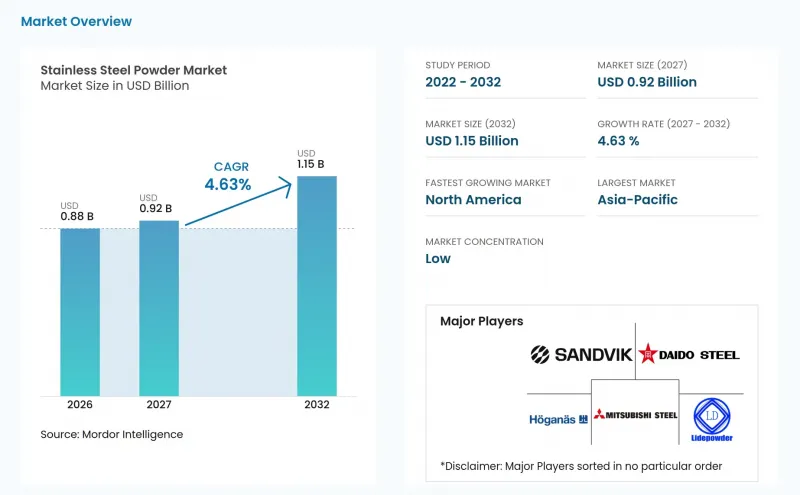
According to Mordor Intelligence, the stainless steel powder market size was valued at USD 0.88 billion in 2026 and is estimated to grow from USD 0.92 billion in 2027 to reach USD 1.15 billion by 2032, at a CAGR of 4.63% during the forecast period (2027-2032).
Global Stainless Steel Powder Market Trends and Insights
Expansion of Metal Additive Manufacturing
Metal additive manufacturing is moving into serial production, which is raising demand for gas-atomized stainless grades with consistent quality. Qualified programs tend to require a stable, grade-specific supply over the life of a part design, which benefits the stainless steel powder market. In May 2025, Outokumpu delivered a new austenitic stainless powder for an aerospace heat-exchange component, positioning the material as an alternative to nickel-based alloys in laser powder bed fusion applications. This development supports the demand for spherical powders with documented lot history. ISO/ASTM 52953:2025 also establishes requirements for data registration in laser powder bed fusion process monitoring and quality control.
Rising Demand for Lightweight, Corrosion-Resistant Components
Applications requiring lower weight, corrosion resistance, and complex component geometry are driving demand in the stainless steel powder market. High-strength austenitic formulations can support weight reduction in body structures when paired with suitable manufacturing routes. Stainless steel and aluminum composite battery casings can reduce weight by 20-30% relative to pure stainless designs while meeting impact requirements. Aperam has introduced 316A, a molybdenum-reduced material intended to maintain corrosion resistance while addressing input-cost considerations in electric-vehicle applications. These applications favor fine, gas-atomized powder when a complex powder-based component is required, and the choice of material can support longer component life in corrosive operating environments.
Nickel and Chromium Price Volatility
Nickel and chromium costs influence the economics of austenitic and duplex powder production. Changes in the availability and pricing of these alloying metals can affect producer margins and customer purchasing decisions. Fine-particle powder production can intensify cost pressure because a narrow particle-size range limits the salable yield from atomization. The stainless steel powder market is more exposed to this issue in premium grades that require tight size control. Producers must balance material surcharges, metal availability, and customer expectations for consistent quality.
Other drivers and restraints analyzed in the detailed report include:
- Growth of Metal Injection Molding in Miniaturized Components
- Increasing Aerospace and Defense Production
- High Production, Classification, and Quality-Control Costs
For complete list of drivers and restraints, kindly check the Table Of Contents.
Segment Analysis
Austenitic grades held 59.17% of the stainless steel powder market share in 2026. Grades such as 316L and 304L combine corrosion resistance, biocompatibility, and formability. These properties support their use in powder metallurgy, metal injection molding, and additive manufacturing. Martensitic grades are used for cutting tools and bearing components where hardness is a priority. Ferritic grades are used for cost-sensitive sintered components, while precipitation-hardening grades, including 17-4PH, are used in high-strength aerospace parts.
Duplex grades are forecast to grow at a 5.25% CAGR through 2032. Their strength-to-weight properties support structural applications in aerospace and offshore industries. A 2025 additive manufacturing study reported a balanced austenite-ferrite microstructure and a yield strength of 735 MPa in optimized laser powder bed fusion 2507 duplex stainless steel. The same study reported pitting resistance in 3.5% sodium chloride. The stainless steel powder market supports this segment through alloy design, morphology control, and process documentation.
Water atomization accounted for 39.74% of global revenue in 2026. It is widely used in powder metallurgy compaction where cost per kilogram and compressibility are more important than particle sphericity. The process supports high-quantity production of conventional automotive and industrial components. Water-atomized powders remain relevant where stable chemistry, suitable particle size, and dependable supply are required. This manufacturing route provides a large and established demand base for the stainless steel powder market.
Gas atomization is forecast to grow at a 5.58% CAGR through 2032. It supports applications that require spherical morphology, low satellite content, and narrow particle-size distributions. A 2025 study compared nitrogen- and argon-atomized super-duplex stainless steel powders for additive manufacturing. Nitrogen atomization produced a finer particle-size distribution, while both gases delivered adequate flowability. Plasma atomization and electrode induction melting gas atomization are used in applications requiring high purity and low contamination.
Complete Report Scope:
- By Type
- Austenitic
- Martensitic
- Duplex
- Ferritic
- Precipitation-Hardening
- By Manufacturing Process
- Water Atomization
- Gas Atomization
- Other Manufacturing Processes
- By Application
- Powder Metallurgy
- Metal Injection Molding
- Additive Manufacturing
- Other Applications
- By End-User Industry
- Automotive
- Aerospace and Defense
- Medical and Dental
- Consumer Goods and Electronics
- Other End-Use Industries
- By Geography
- Asia-Pacific
- China
- India
- Japan
- South Korea
- ASEAN Countries
- Rest of Asia-Pacific
- North America
- United States
- Canada
- Mexico
- Europe
- Germany
- United Kingdom
- France
- Italy
- NORDIC Countries
- Rest of Europe
- South America
- Brazil
- Argentina
- Rest of South America
- Middle East and Africa
- Saudi Arabia
- South Africa
- Rest of Middle East and Africa
- Asia-Pacific
Geography Analysis
Asia-Pacific held 43.89% of the stainless steel powder market share in 2026. China accounts for the majority of regional demand, driven by powder metallurgy and metal injection molding across the automotive, consumer electronics, and construction sectors. Japan supplies high-precision demand for watches, medical instruments, and electronics. South Korea benefits from electric vehicle and semiconductor clusters, while India is developing its automotive and defense production. ASEAN countries see incremental demand for powder as industrial activity expands, although additive manufacturing remains in its early stages across much of Southeast Asia.
North America is forecast to grow at a 5.77% CAGR through 2032. Defense-related additive manufacturing and near-shoring of specialty powder supply support this outlook. Canada adds aerospace demand, while Mexico supports conventional automotive powder metallurgy output. The region combines a growing need for documented specialty grades with continued demand for conventional materials.
Europe is a market for aerospace, industrial tooling, and medical device applications. The DECSAM program connects domestic powder supply, digital manufacturing, and in-process quality assurance for laser powder bed fusion aerospace parts. South Africa's Council for Scientific and Industrial Research began developing domestic 316L stainless steel gas-atomization capability in 2025 for aerospace, medical, and oil-and-gas applications.
- AMETEK Inc.
- ArcelorMittal
- Atlantic Equipment Engineers
- Carpenter Technology Corporation
- Centurion Material Innovation Inc.
- Daido Steel Co., Ltd.
- EOS GmbH
- GKN Powder Metallurgy
- Hoganas AB
- Hunan Fushel Technology Limited
- INDO-MIM
- MITSUBISHI STEEL MFG. CO., LTD.
- Outokumpu
- Sandvik AB
- Shijiazhuang Lide Powder Material Co.,Ltd.
Additional Benefits:
- The market estimate (ME) sheet in Excel format
- 3 months of analyst support
TABLE OF CONTENTS
1 Introduction
- 1.1 Study Assumptions and Market Definition
- 1.2 Scope of the Study
2 Research Methodology
3 Executive Summary
4 Market Landscape
- 4.1 Market Overview
- 4.2 Market Drivers
- 4.2.1 Expansion of Metal Additive Manufacturing
- 4.2.2 Rising Demand for Lightweight, Corrosion-Resistant Components
- 4.2.3 Growth of Metal Injection Molding in Miniaturized Components
- 4.2.4 Increasing Aerospace and Defense Production
- 4.2.5 Digital Qualification of Powder-to-Part Manufacturing Chains
- 4.3 Market Restraints
- 4.3.1 Nickel and Chromium Price Volatility
- 4.3.2 High Production, Classification, and Quality-Control Costs
- 4.3.3 Powder Traceability Requirements Across Distributed Printing Networks
- 4.4 Value Chain Analysis
- 4.5 Porter's Five Forces Analysis
- 4.5.1 Bargaining Power of Suppliers
- 4.5.2 Bargaining Power of Buyers
- 4.5.3 Threat of New Entrants
- 4.5.4 Threat of Substitutes
- 4.5.5 Competitive Rivalry
5 Market Size and Growth Forecasts (Value)
- 5.1 By Type
- 5.1.1 Austenitic
- 5.1.2 Martensitic
- 5.1.3 Duplex
- 5.1.4 Ferritic
- 5.1.5 Precipitation-Hardening
- 5.2 By Manufacturing Process
- 5.2.1 Water Atomization
- 5.2.2 Gas Atomization
- 5.2.3 Other Manufacturing Processes
- 5.3 By Application
- 5.3.1 Powder Metallurgy
- 5.3.2 Metal Injection Molding
- 5.3.3 Additive Manufacturing
- 5.3.4 Other Applications
- 5.4 By End-User Industry
- 5.4.1 Automotive
- 5.4.2 Aerospace and Defense
- 5.4.3 Medical and Dental
- 5.4.4 Consumer Goods and Electronics
- 5.4.5 Other End-Use Industries
- 5.5 By Geography
- 5.5.1 Asia-Pacific
- 5.5.1.1 China
- 5.5.1.2 India
- 5.5.1.3 Japan
- 5.5.1.4 South Korea
- 5.5.1.5 ASEAN Countries
- 5.5.1.6 Rest of Asia-Pacific
- 5.5.2 North America
- 5.5.2.1 United States
- 5.5.2.2 Canada
- 5.5.2.3 Mexico
- 5.5.3 Europe
- 5.5.3.1 Germany
- 5.5.3.2 United Kingdom
- 5.5.3.3 France
- 5.5.3.4 Italy
- 5.5.3.5 NORDIC Countries
- 5.5.3.6 Rest of Europe
- 5.5.4 South America
- 5.5.4.1 Brazil
- 5.5.4.2 Argentina
- 5.5.4.3 Rest of South America
- 5.5.5 Middle East and Africa
- 5.5.5.1 Saudi Arabia
- 5.5.5.2 South Africa
- 5.5.5.3 Rest of Middle East and Africa
- 5.5.1 Asia-Pacific
6 Competitive Landscape
- 6.1 Market Concentration
- 6.2 Strategic Moves
- 6.3 Market Share (%)/Ranking Analysis
- 6.4 Company Profiles (includes Global Overview, Market Overview, Core Segments, Financials as available, Strategic Information, Products and Services, and Recent Developments)
- 6.4.1 AMETEK Inc.
- 6.4.2 ArcelorMittal
- 6.4.3 Atlantic Equipment Engineers
- 6.4.4 Carpenter Technology Corporation
- 6.4.5 Centurion Material Innovation Inc.
- 6.4.6 Daido Steel Co., Ltd.
- 6.4.7 EOS GmbH
- 6.4.8 GKN Powder Metallurgy
- 6.4.9 Hoganas AB
- 6.4.10 Hunan Fushel Technology Limited
- 6.4.11 INDO-MIM
- 6.4.12 MITSUBISHI STEEL MFG. CO., LTD.
- 6.4.13 Outokumpu
- 6.4.14 Sandvik AB
- 6.4.15 Shijiazhuang Lide Powder Material Co.,Ltd.
7 Market Opportunities and Future Outlook
- 7.1 White-Space and Unmet-Need Assessment

