PUBLISHER: Mordor Intelligence | PRODUCT CODE: 2185862

PUBLISHER: Mordor Intelligence | PRODUCT CODE: 2185862
IoT ESIM Remote Provisioning - Market Share Analysis, Industry Trends & Statistics, Growth Forecasts (2027 - 2032)
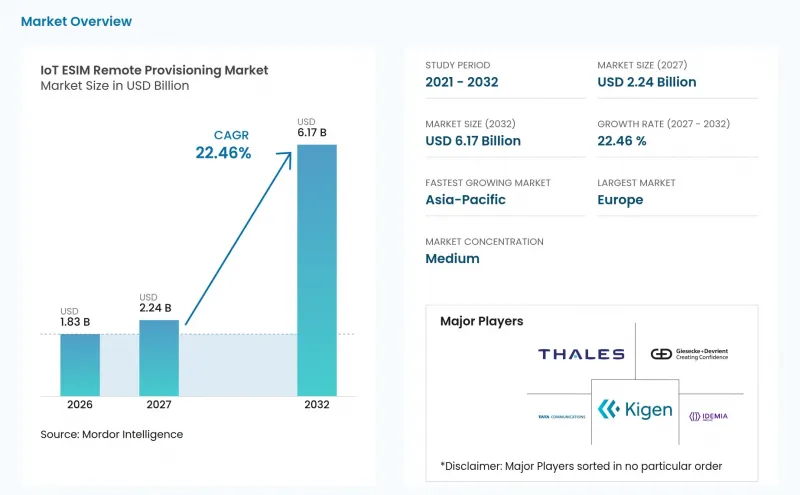
According to Mordor Intelligence, the IoT eSIM Remote Provisioning Market size is projected to expand from USD 1.83 billion in 2026 and USD 2.24 billion in 2027 to USD 6.17 billion by 2032, registering a CAGR of 22.46% between 2027 and 2032.
Global IoT ESIM Remote Provisioning Market Trends and Insights
SGP.32 Standardization and Certification Momentum
The SGP.32 specification is a central driver of the IoT eSIM remote provisioning market because it establishes a standardized link between eSIM and SM-DP+ systems. It replaces proprietary, bilateral SM-SR integrations that limited interoperability across vendors. Secure Transactions became the first company to certify both an eUICC and an eIM under the GSMA IoT Compliance Scheme in August 2025. Valid received GSMA eSA certification for its SGP.32 IoT eUICC in August 2026, using Infineon's TEGRION SLx22 secure element. As more products achieve certification, MNOs face greater pressure to open SM-DP+ access to compatible eIM providers. This makes the IoT eSIM remote provisioning market more accessible to operators and device makers seeking multi-vendor deployment options.
Growth of Cross-Border Cellular IoT Deployments
Cross-border deployments support the IoT eSIM remote provisioning market because physical SIM logistics become difficult when fleets operate across national boundaries. Long-lived assets can encounter permanent roaming limits that require a local connectivity profile or a different commercial arrangement. GSMA expects IoT connections to increase from 4 billion to 6 billion by 2030, with more than half of new connections using eSIM and remote SIM provisioning. Locally hosted profile management has gained relevance in countries where data residency rules affect connectivity design, including Brazil. BICS launched its eSIM Hub in April 2025 to manage connectivity across 190 countries and 700+ operators. Such platforms allow fleet managers to treat profile selection as an operational task rather than a device-replacement project.
Certification and Commercial Agreement Bottlenecks
Certification and commercial agreements limit the speed of adoption in the IoT eSIM remote provisioning market. Technical readiness alone does not grant an eUICC vendor access to an operator's SM-DP+ platform. GSMA reported in 2025 that only a small number of eUICC products had completed eSA certification, while many more remained in the process. The scheme requires rigorous evaluation and relies on a limited set of accredited laboratories. Vendors must also negotiate profile-download terms with individual platform operators after certification. This can favor larger suppliers that have the legal resources, established relationships with operators, and commercial scale to manage many parallel agreements.
Other drivers and restraints analyzed in the detailed report include:
- Remote Lifecycle Management Reducing Truck Rolls and Total Cost of Ownership
- Expansion of Connected Vehicles and Industrial IoT Fleets
- Fragmented Operator Support and Buyer Concern About Vendor Lock-In
For complete list of drivers and restraints, kindly check the Table Of Contents.
Segment Analysis
The platform segment held 61.84% of the market in 2026. This position reflects the investment required to develop and maintain certified SM-DP+, eIM, and orchestration capabilities. Enterprises increasingly favor full-stack platforms that combine eUICC lifecycle control, profile orchestration, and analytics. That preference reduces the appeal of managed-service offerings that only sit around the provisioning layer. The IoT eSIM remote provisioning market size for platforms is projected to expand at a 24.13% CAGR through 2032. This indicates that platform deployments are still accelerating as SGP.32 commercial use widens.
Managed services continue to serve customers without dedicated IoT connectivity teams. Their role is important for buyers who need operational support but do not wish to manage provisioning tools directly. At the same time, easier access to cloud platforms is enabling more self-service implementations. Aeris introduced eIM-as-a-Service capabilities in October 2026 for MNOs, OEMs, and enterprises that need SGP.32 orchestration without having to build bespoke infrastructure. G+D expanded its cloud collaboration in March 2025 to support eSIM services through its AirOn360 platform. These offerings can lower entry barriers while retaining the importance of secure, certified platform operations.
Large enterprises accounted for 69.37% of the IoT eSIM remote provisioning market in 2026. Automotive OEMs, multinational logistics companies, and global utilities were early users because their fleet sizes could justify integration costs. Many of these organizations also operated legacy SGP.02 and SGP.22 fleets that require coordinated management. SMEs are projected to expand at a 24.08% CAGR through 2032. Platform-as-a-service and eIM-as-a-Service models are making remote provisioning more accessible to smaller product companies. The IoT eSIM remote provisioning industry is therefore reaching customers that may not have negotiated direct MNO integrations in the past.
Cloud-native service models can support fleets of 1,000 to 10,000 devices without the earlier burden of custom backend work. This changes the commercial threshold for connected-product companies that need multi-country service. Tata Communications' MOVE platform is integrated with Cisco's IoT Control Center, which supports more than 270 million SIM IoT devices across 32,000 enterprises. The example shows how existing enterprise platforms can add SGP.32 capabilities without requiring a separate procurement path. Larger organizations, meanwhile, are seeking a common interface for several eSIM standards. This puts a premium on orchestration tools that can work across old and new device fleets. The IoT eSIM remote provisioning market is therefore broadening beyond early adopters with large connectivity teams.
Complete Report Scope:
- By Component
- Platform
- Managed Services
- By Enterprise Size
- Large Enterprises
- Small and Medium Enterprises
- By Deployment
- Cloud
- On-Premises
- Hybrid
- By Application
- Automotive and Connected Mobility
- Industrial Manufacturing
- Logistics and Transportation
- Energy and Utilities
- Healthcare and Medical Devices
- Other Applications
- By End-User
- Mobile Network Operators
- MVNOs and IoT Connectivity Providers
- Device OEMs
- IoT Solution Providers and System Integrators
- Enterprises
- By Geography
- North America
- United States
- Canada
- Mexico
- South America
- Brazil
- Argentina
- Rest of South America
- Europe
- Germany
- United Kingdom
- France
- Italy
- Russia
- Rest of Europe
- Asia-Pacific
- China
- Japan
- South Korea
- India
- Australia
- Rest of Asia-Pacific
- Middle East
- United Arab Emirates
- Saudi Arabia
- Rest of Middle East
- Africa
- South Africa
- Nigeria
- Rest of Africa
- North America
Geography Analysis
Europe held 34.82% of the market in 2026. The region benefits from a regulatory environment that places greater weight on security, product lifecycle management, and data portability. European connected-product requirements raise the compliance burden for proprietary or non-upgradeable connectivity stacks. They make certified, lifecycle-managed architectures more relevant to manufacturers. Germany, the United Kingdom, France, and Italy have large concentrations of industrial IoT and automotive activity. Telenor IoT announced in February 2026 that it would begin commercial deliveries of SGP.32 SIM cards on April 17, 2026.
Asia-Pacific is projected to expand at a 24.36% CAGR through 2032. China's domestic eSIM module ecosystem, India's digital infrastructure agenda, and the region's permanent-roaming constraints support adoption. In 2025, Tata Communications stated that it was supporting BSNL's pan-India eSIM services. South Korea, Japan, and Australia have established MNO roadmaps for SGP.32. Southeast Asian markets are also responding to national data-residency requirements that favor locally hosted eSIM profiles. The IoT eSIM remote provisioning market in the region, therefore, depends on both fleet expansion and the ability to meet local connectivity rules.
North America remains a large, technologically advanced segment of the IoT eSIM remote provisioning market, driven by demand from automotive, utilities, and industrial automation. Suppliers in the region are developing SGP.32 platforms that support globally shipped devices and local profile activation without physical access. Canada and Mexico extend demand from United States-based IoT programs, while Mexico's manufacturing exports support automotive supply-chain use cases. South America, the Middle East, and Africa remain smaller opportunity areas. Brazil's locally hosted SGP.32 eIM arrangement illustrates how national requirements shape platform adoption. Utility smart-meter deployments in the Gulf Cooperation Council also provide a near-term entry point for suppliers with energy-focused offerings.
- Thales S.A.
- Giesecke+Devrient GmbH
- IDEMIA Secure Transactions
- Kigen (UK) Limited
- Tata Communications Limited
- 1NCE GmbH
- Aeris Communications, Inc.
- Valid Solucoes S.A.
- Workz Group Limited
- Redtea Mobile Pte. Ltd.
- 1GLOBAL Limited
- BICS SA/NV
- Eseye Limited
- emnify GmbH
- Soracom, Inc.
- Cisco Systems, Inc.
- KORE Group Holdings, Inc.
- Eastcompeace Technology Co., Ltd.
- Transatel S.A.S.
- Vodafone Group Plc
Additional Benefits:
- The market estimate (ME) sheet in Excel format
- 3 months of analyst support
TABLE OF CONTENTS
1 INTRODUCTION
- 1.1 Study Assumptions and Market Definition
- 1.2 Scope of the Study
2 RESEARCH METHODOLOGY
3 EXECUTIVE SUMMARY
4 MARKET LANDSCAPE
- 4.1 Market Overview
- 4.2 Market Drivers
- 4.2.1 SGP.32 Standardization and Certification Momentum
- 4.2.2 Growth of Cross-Border Cellular IoT Deployments
- 4.2.3 Remote Lifecycle Management Reducing Truck Rolls and Total Cost of Ownership
- 4.2.4 Expansion of Connected Vehicles and Industrial IoT Fleets
- 4.2.5 Legacy SGP.02 Fleet Replacement Window
- 4.2.6 Indirect Profile Download for NB-IoT and LPWAN Devices
- 4.3 Market Restraints
- 4.3.1 Certification and Commercial Agreement Bottlenecks
- 4.3.2 Fragmented Operator Support and Buyer Concern About Vendor Lock-In
- 4.3.3 Interoperability Gaps at eUICC, eIM, and SM-DP+ Seams
- 4.3.4 Fixed eUICC Operating Systems Preventing Over-the-Air Migration to SGP.32
- 4.4 Industry Value Chain Analysis
- 4.5 Regulatory Landscape
- 4.6 Technological Outlook
- 4.7 Porter's Five Forces Analysis
- 4.7.1 Threat of New Entrants
- 4.7.2 Bargaining Power of Suppliers
- 4.7.3 Bargaining Power of Buyers
- 4.7.4 Threat of Substitutes
- 4.7.5 Competitive Rivalry
- 4.8 Impact of Macroeconomic Factors on the Market
5 MARKET SIZE AND GROWTH FORECASTS (VALUE)
- 5.1 By Component
- 5.1.1 Platform
- 5.1.2 Managed Services
- 5.2 By Enterprise Size
- 5.2.1 Large Enterprises
- 5.2.2 Small and Medium Enterprises
- 5.3 By Deployment
- 5.3.1 Cloud
- 5.3.2 On-Premises
- 5.3.3 Hybrid
- 5.4 By Application
- 5.4.1 Automotive and Connected Mobility
- 5.4.2 Industrial Manufacturing
- 5.4.3 Logistics and Transportation
- 5.4.4 Energy and Utilities
- 5.4.5 Healthcare and Medical Devices
- 5.4.6 Other Applications
- 5.5 By End-User
- 5.5.1 Mobile Network Operators
- 5.5.2 MVNOs and IoT Connectivity Providers
- 5.5.3 Device OEMs
- 5.5.4 IoT Solution Providers and System Integrators
- 5.5.5 Enterprises
- 5.6 By Geography
- 5.6.1 North America
- 5.6.1.1 United States
- 5.6.1.2 Canada
- 5.6.1.3 Mexico
- 5.6.2 South America
- 5.6.2.1 Brazil
- 5.6.2.2 Argentina
- 5.6.2.3 Rest of South America
- 5.6.3 Europe
- 5.6.3.1 Germany
- 5.6.3.2 United Kingdom
- 5.6.3.3 France
- 5.6.3.4 Italy
- 5.6.3.5 Russia
- 5.6.3.6 Rest of Europe
- 5.6.4 Asia-Pacific
- 5.6.4.1 China
- 5.6.4.2 Japan
- 5.6.4.3 South Korea
- 5.6.4.4 India
- 5.6.4.5 Australia
- 5.6.4.6 Rest of Asia-Pacific
- 5.6.5 Middle East
- 5.6.5.1 United Arab Emirates
- 5.6.5.2 Saudi Arabia
- 5.6.5.3 Rest of Middle East
- 5.6.6 Africa
- 5.6.6.1 South Africa
- 5.6.6.2 Nigeria
- 5.6.6.3 Rest of Africa
- 5.6.1 North America
6 COMPETITIVE LANDSCAPE
- 6.1 Market Concentration
- 6.2 Strategic Moves
- 6.3 Market Share Analysis
- 6.4 Company Profiles (includes Global Level Overview, Market Level Overview, Core Segments, Financials as available, Strategic Information, Market Rank/Share, Products and Services, Recent Developments)
- 6.4.1 Thales S.A.
- 6.4.2 Giesecke+Devrient GmbH
- 6.4.3 IDEMIA Secure Transactions
- 6.4.4 Kigen (UK) Limited
- 6.4.5 Tata Communications Limited
- 6.4.6 1NCE GmbH
- 6.4.7 Aeris Communications, Inc.
- 6.4.8 Valid Solucoes S.A.
- 6.4.9 Workz Group Limited
- 6.4.10 Redtea Mobile Pte. Ltd.
- 6.4.11 1GLOBAL Limited
- 6.4.12 BICS SA/NV
- 6.4.13 Eseye Limited
- 6.4.14 emnify GmbH
- 6.4.15 Soracom, Inc.
- 6.4.16 Cisco Systems, Inc.
- 6.4.17 KORE Group Holdings, Inc.
- 6.4.18 Eastcompeace Technology Co., Ltd.
- 6.4.19 Transatel S.A.S.
- 6.4.20 Vodafone Group Plc
7 MARKET OPPORTUNITIES AND FUTURE OUTLOOK
- 7.1 White-Space and Unmet-Need Assessment

