PUBLISHER: Mordor Intelligence | PRODUCT CODE: 2185897

PUBLISHER: Mordor Intelligence | PRODUCT CODE: 2185897
Vietnam Project Cargo Logistics - Market Share Analysis, Industry Trends & Statistics, Growth Forecasts (2027 - 2032)
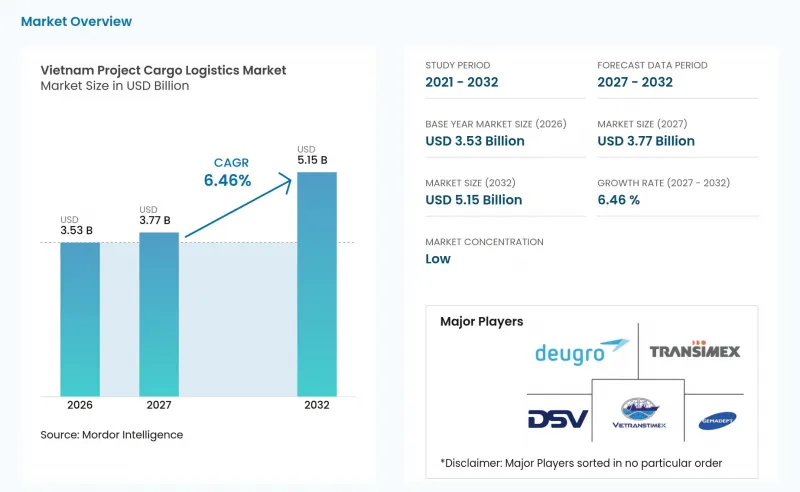
According to Mordor Intelligence, the Vietnam project cargo logistics market size is valued at USD 3.53 billion in 2026 and is estimated to grow from USD 3.77 billion in 2027 to reach USD 5.15 billion by 2032, at a CAGR of 6.46% during the forecast period 2027-2032.
Vietnam Project Cargo Logistics Market Trends and Insights
Manufacturing FDI Raising Specialized Cargo Demand
Manufacturing investment supports demand for project logistics by creating requirements to transport production machinery, industrial equipment, precision components, and complete production-line modules. In the first half of 2026, Vietnam recorded USD 34.65 billion in total registered FDI across all reported investment categories. Investment in electronics and other capital-intensive industries can generate demand for specialized handling, protective packaging, route surveys, permits, and coordinated delivery to industrial facilities. Northern Vietnam is an important area for electronics manufacturing, while Southern Vietnam supports a broad industrial and manufacturing base. These requirements favor providers that can coordinate international freight, port handling, inland transport, and site delivery.
Renewable Energy Projects Raising Oversized Cargo Movements
Onshore wind, offshore wind, and utility-scale solar projects require the movement of equipment that may exceed standard container dimensions or conventional road transport limits. Turbine blades, tower sections, transformers, and electrical infrastructure may require specialized trailers, lifting equipment, escorts, route engineering, and carefully planned staging areas. Vietnam's energy-policy framework continued to develop in 2026. Decree 272/2026/ND-CP, effective July 4, 2026, provides implementation details for the mechanisms under Resolution 253/2025/QH15 concerning national energy development during 2026-2030. In June 2025, PPL completed the site movement and load-out of an offshore substation topside weighing nearly 4,000 tons at Vung Tau. The project demonstrates the importance of specialized engineering and heavy-lift capability in supporting offshore energy infrastructure.
Fragmented Specialized Capacity Limiting Complex Project Execution
Project cargo operations require a combination of engineering, specialized transport equipment, lifting expertise, route planning, and on-site coordination. These capabilities are not interchangeable with ordinary freight forwarding or general road transport. When several energy, industrial, or infrastructure projects require the same specialized equipment or technical personnel at the same time, capacity constraints can complicate scheduling and increase subcontracting requirements. Providers may also need to coordinate local execution with international project owners, engineering contractors, and equipment suppliers. The market's ability to handle increasingly complex shipments therefore depends on access to qualified personnel, suitable equipment, and reliable local partners.
Other drivers and restraints analyzed in the detailed report include:
- Offshore Wind Development Raising Heavy-Lift Port Requirements
- Infrastructure Investment Raising Heavy Transport Requirements
- Infrastructure Constraints Restricting Oversized Cargo Movement Efficiency
For complete list of drivers and restraints, kindly check the Table Of Contents.
Segment Analysis
Transportation accounts for 63.27% of the Vietnam project cargo logistics market share in 2026. This segment covers the physical movement of oversized, heavy, or otherwise specialized cargo between manufacturing locations, ports, storage yards, and project sites. Ocean freight and inland waterways can be important for moving large structures and equipment, while specialized road transport is often required for the final delivery leg. Execution involves cargo securing, equipment selection, route assessment, permits, and coordination with loading and unloading teams. The segment's leading share reflects the central role of physical cargo movement within project logistics.
Value-added services & others are projected to register an 8.23% CAGR through 2032. This category includes services such as cargo engineering, route surveys, lifting plans, project coordination, temporary storage, and specialized handling. Engineering, procurement, and construction contractors may benefit from coordinating these activities through a single logistics provider. In July 2026, Portcoast reported deploying a digital twin for the Cai Mep-Thi Vai port system, providing an example of how digital tools can support port planning and operational coordination.
Complete Report Scope:
- By Service
- Transportation
- Road
- Rail
- Air
- Sea / Barge
- Warehousing, Distribution and Inventory Management
- Value-Added Services and Others
- Transportation
- By Cargo Type
- Oversized / Out-of-Gauge Cargo
- Heavy-Lift Cargo
- Breakbulk Project Cargo
- Other Specialized Project Cargo
- By End-User Industry
- Oil and Gas, Mining and Quarrying
- Energy Generation and Transmission (Includes Renewable Energy)
- Construction and Infrastructure
- Manufacturing and Industrial Plants
- Aerospace and Defense
- Others (Maritime and Shipbuilding, Telecommunications, etc.)
- By Region
- Northern Vietnam
- Central Vietnam
- Southern Vietnam
List of Companies Covered in this Report:
- Vietranstimex Multimodal Transport Joint Stock Company
- Gemadept Corporation
- Transimex Corporation
- South Logistics Joint Stock Company (SOTRANS)
- Saigon Newport Corporation
- deugro Vietnam
- DHL Global Forwarding Vietnam
- Kuehne+Nagel Vietnam
- DSV
- CEVA Logistics Vietnam
- Yusen Logistics Vietnam
- KCTC Vietnam
- A.P. Moller - Maersk
- Nippon Express Vietnam
- Rhenus Logistics Vietnam
- Bao Tin Trading and Logistics (PPL)
- SMC Services and Engineering Joint Stock Company
- Vantage Logistics
- Hai Dang Global Logistics
- Tri Dung Transportation Joint Stock Company
- Prefer Logistics
Additional Benefits:
- The market estimate (ME) sheet in Excel format
- 3 months of analyst support
TABLE OF CONTENTS
1 INTRODUCTION
- 1.1 Study Assumptions and Market Definition
- 1.2 Scope of the Study
2 RESEARCH METHODOLOGY
3 EXECUTIVE SUMMARY
- 3.1 Market Size, Growth, and Forecast Outlook
- 3.2 Key Demand Drivers and Project Logistics Trends
- 3.3 Major Project Corridors and Cargo Concentration
- 3.4 Competitive Landscape and Leading Project Logistics Providers
4 MARKET LANDSCAPE
- 4.1 Market Overview and Importance of Project Cargo Logistics
- 4.2 Market Drivers
- 4.2.1 Manufacturing FDI Increasing Specialized Project Cargo Demand
- 4.2.2 Infrastructure Investment Expanding Heavy Transport Requirements
- 4.2.3 Renewable Energy Projects Driving Oversized Cargo Movements
- 4.2.4 Multimodal Integration Strengthening Complex Project Logistics Demand
- 4.2.5 Offshore Wind Development Expanding Heavy-Lift Port Requirements
- 4.2.6 Digital Route Engineering Improving Project Cargo Visibility
- 4.3 Market Restraints
- 4.3.1 Fragmented Specialized Capacity Limiting Complex Project Execution
- 4.3.2 Infrastructure Constraints Restricting Oversized Cargo Movement Efficiency
- 4.3.3 Permitting Complexity Increasing Project Coordination and Delays
- 4.3.4 Skilled Workforce Shortages Constraining Heavy-Lift Operations
- 4.4 Value Chain Structure and Project Cargo Flow Analysis
- 4.5 Regulatory Framework and Project Cargo Compliance Analysis
- 4.6 Technology Adoption and Project Logistics Digitalization Analysis
- 4.7 Port Infrastructure and Project Cargo Handling Analysis
- 4.8 Multimodal Project Cargo Corridor Development Analysis
- 4.9 Project Cargo Freight Rate and Cost Analysis
- 4.10 Porter's Five Forces Analysis
- 4.10.1 Threat of New Entrants
- 4.10.2 Bargaining Power of Buyers
- 4.10.3 Bargaining Power of Suppliers
- 4.10.4 Threat of Substitute Services
- 4.10.5 Intensity of Competitive Rivalry
- 4.11 Impact of Geo-Political Events on Supply Chain Shifts
5 MARKET SIZE AND GROWTH FORECASTS
- 5.1 By Service
- 5.1.1 Transportation
- 5.1.1.1 Road
- 5.1.1.2 Rail
- 5.1.1.3 Air
- 5.1.1.4 Sea / Barge
- 5.1.2 Warehousing, Distribution and Inventory Management
- 5.1.3 Value-Added Services and Others
- 5.1.1 Transportation
- 5.2 By Cargo Type
- 5.2.1 Oversized / Out-of-Gauge Cargo
- 5.2.2 Heavy-Lift Cargo
- 5.2.3 Breakbulk Project Cargo
- 5.2.4 Other Specialized Project Cargo
- 5.3 By End-User Industry
- 5.3.1 Oil and Gas, Mining and Quarrying
- 5.3.2 Energy Generation and Transmission (Includes Renewable Energy)
- 5.3.3 Construction and Infrastructure
- 5.3.4 Manufacturing and Industrial Plants
- 5.3.5 Aerospace and Defense
- 5.3.6 Others (Maritime and Shipbuilding, Telecommunications, etc.)
- 5.4 By Region
- 5.4.1 Northern Vietnam
- 5.4.2 Central Vietnam
- 5.4.3 Southern Vietnam
6 COMPETITIVE LANDSCAPE
- 6.1 Market Concentration
- 6.2 Strategic Moves
- 6.3 Market Share Analysis
- 6.4 Company Profiles (includes Global Level Overview, Market Level Overview, Core Segments, Financials as available, Strategic Information, Geographic Coverage, Products and Services, Recent Developments)
- 6.4.1 Vietranstimex Multimodal Transport Joint Stock Company
- 6.4.2 Gemadept Corporation
- 6.4.3 Transimex Corporation
- 6.4.4 South Logistics Joint Stock Company (SOTRANS)
- 6.4.5 Saigon Newport Corporation
- 6.4.6 deugro Vietnam
- 6.4.7 DHL Global Forwarding Vietnam
- 6.4.8 Kuehne+Nagel Vietnam
- 6.4.9 DSV
- 6.4.10 CEVA Logistics Vietnam
- 6.4.11 Yusen Logistics Vietnam
- 6.4.12 KCTC Vietnam
- 6.4.13 A.P. Moller - Maersk
- 6.4.14 Nippon Express Vietnam
- 6.4.15 Rhenus Logistics Vietnam
- 6.4.16 Bao Tin Trading and Logistics (PPL)
- 6.4.17 SMC Services and Engineering Joint Stock Company
- 6.4.18 Vantage Logistics
- 6.4.19 Hai Dang Global Logistics
- 6.4.20 Tri Dung Transportation Joint Stock Company
- 6.4.21 Prefer Logistics
7 MARKET OPPORTUNITIES AND FUTURE OUTLOOK
- 7.1 White-Space Opportunities and Unmet Project Logistics Needs
- 7.2 High-Potential End-User Segments and Project Opportunities
- 7.3 Strategic Growth Priorities Across Project Logistics Ecosystem
- 7.4 Future Market Outlook and Emerging Project Demand Pockets
8 APPENDIX

