PUBLISHER: Mordor Intelligence | PRODUCT CODE: 2185916

PUBLISHER: Mordor Intelligence | PRODUCT CODE: 2185916
Battery Power Tools - Market Share Analysis, Industry Trends & Statistics, Growth Forecasts (2027 - 2032)
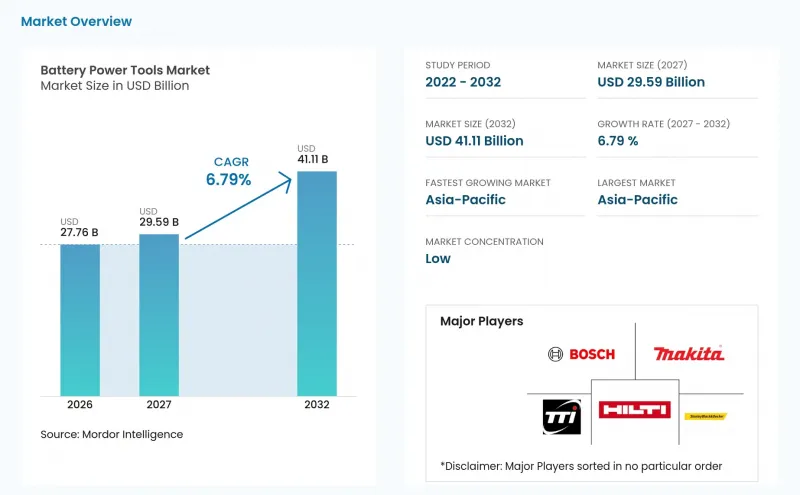
According to Mordor Intelligence, the battery power tools market size is expected to grow from USD 27.76 billion in 2026 to USD 29.59 billion in 2027 and is forecast to reach USD 41.11 billion by 2032 at 6.79% CAGR over 2027-2032.
Global Battery Power Tools Market Trends and Insights
Cordless Replacement of Corded Tools in Professional Workflows
Professional trades have moved beyond early adoption of cordless tools. Battery products reduce setup work and help crew's complete tasks in locations without convenient access to power. These benefits matter when contractors face limited labor availability and tight project schedules. Techtronic Industries reported that MILWAUKEE revenue grew 7.9% in local currency during 2025, with 10.3% underlying growth after temporary tariff-related product suspensions were excluded. The result indicates sustained demand for professional cordless platforms rather than a one-time replacement cycle. The Battery Power Tools market therefore benefits from workflow changes that favor mobility, faster task changes, and fewer cables on active sites.
Lithium-Ion Energy Density and Fast-Charging Improvements
Improved cells are expanding the range of applications suitable for cordless equipment. Bosch introduced its Expert 18 V battery range in September 2025 with tabless-cell technology for 18 V cordless tools. Bosch stated that the 8.0 Ah EXBA18 V-80 can reach a full charge in 39 minutes in Power Boost mode. Faster charging reduces idle time for users who rely on a limited number of packs during a shift. Research published in ACS Nano found that patterned cathode nanostructures can improve energy and power density at the same time. The Battery Power Tools market gains when charging and runtime become less restrictive in demanding work.
High Replacement-Pack Cost and Total Cost of Ownership
Battery replacement costs remain a barrier for small contractors and occasional users. A user with only one or two tools may find it difficult to spread the cost of packs across a large tool fleet. This issue is more acute in markets where corded products remain the lower-cost option. The economy improves as a user adds compatible products within one battery family. Right to Repair Europe raised concerns in its May 2026 feedback on the EU Batteries Regulation that expanded exemptions could limit practical access to aftermarket service channels. Replacement availability, repairability, and pack pricing will shape the pace of Battery Power Tools market adoption among value-focused users.
Other drivers and restraints analyzed in the detailed report include:
- Expansion of Cross-Tool Battery Platforms
- Industrial Electrification, Automation, and Traceable Assembly
- Thermal Safety, Counterfeit Packs, and Charger Compatibility Risk
For complete list of drivers and restraints, kindly check the Table Of Contents.
Segment Analysis
Drills and Drivers held 36.6% of the Battery Power Tools market share in 2026. Their leading position reflects their use in fastening, drilling, installation, repair, and routine maintenance. They are often the first cordless tool purchased by professional and home users. That role introduces buyers to a manufacturer's battery platform and related tool range. Impact Wrenches and Impact Drivers are projected to expand at a 6.9% CAGR through 2032. Their growth is tied to the replacement of pneumatic products in automotive service and industrial assembly.
High-torque cordless tools are becoming more credible in heavy-duty fastening applications. This supports demand in workshops, fleet maintenance, and production environments that previously relied on air-powered equipment. Saws and cutting tools remain important for wood framing, structural steel, concrete work, and general construction. Grinders serve metal fabrication and surface preparation, while hammers, demolition tools, and nailers address work that still needs high output or specialized attachments. Hilti expanded its Nuron range with more than 60 heavy-duty tools and accessories in October 2025, covering applications including breaking, concrete cutting, wood cutting, and soil compaction. The Battery Power Tools market also gains platform loyalty from measurement, thermal imaging, and site-lighting products.
Complete Report Scope:
- By Product Type
- Drills and Drivers
- Saws and Cutting Tools
- Grinders
- Sanders and Polishers
- Impact Wrenches and Impact Drivers
- Hammers and Demolition Tools
- Nailers and Staplers
- Other Battery-Powered Tools
- By Battery Type
- Lithium-Ion (Li-ion) Batteries
- Nickel-Cadmium (Ni-Cd) Batteries
- Nickel-Metal Hydride (Ni-MH) Batteries
- Other Battery Technologies
- By End User
- Residential and DIY Users
- Commercial and Professional Contractors
- Industrial Users
- By Geography
- North America
- United States
- Canada
- Mexico
- Europe
- Germany
- France
- Italy
- Spain
- United Kingdom
- Poland
- Russia
- Rest of Europe
- Asia-Pacific
- China
- India
- Japan
- South Korea
- Australia
- Indonesia
- Vietnam
- Thailand
- Rest of Asia-Pacific
- South America
- Brazil
- Argentina
- Chile
- Rest of South America
- Middle East and Africa
- Saudi Arabia
- United Arab Emirates
- Egypt
- South Africa
- Morocco
- Rest of Middle East and Africa
- North America
Geography Analysis
Asia-Pacific held 33.4% revenue share in 2026 and is projected to grow at a 7.5% CAGR through 2032. The region combines manufacturing capacity with growing domestic use of cordless equipment. China remains central to global electric power tool production, according to the China Hardware, Electronics and Chemical Trading Association. The shift from corded and pneumatic products to lithium-ion tools creates Battery Power Tools market demand beyond export manufacturing. India, Vietnam, and Indonesia also add construction, industrialization, and supply-chain investment to the regional outlook.
North America remains a major demand center because of construction activity, professional contractor use, and broad retail access. Contractors value cordless systems that reduce setup time and support work across dispersed job locations. Stanley Black & Decker reported USD 13.2 billion in 2025 revenue for its Tools & Outdoor segment and noted volume pressure in North American retail during the fourth quarter. The result shows that housing and retail cycles can affect Battery Power Tools market demand even when cordless adoption remains established. Europe benefits from manufacturing expertise, cross-brand platform development, and attention to battery safety and repairability.
South America is smaller and remains sensitive to tool price and infrastructure spending. Brazil and Argentina support regional demand, although premium battery platforms face affordability constraints. Middle East and Africa show early-stage potential from construction programs and growing distribution coverage. Einhell stated that it planned its first substantial revenues from the Middle East, Africa, and the Indian subcontinent in the second half of 2026. The Battery Power Tools market offers expansion opportunities for brands that balance ecosystem investment with local price expectations.
- Adolf Wurth GmbH & Co. KG
- Apex Tool Group, LLC
- Atlas Copco AB
- Chervon Holdings Limited
- Dongcheng Power Tools
- Einhell Germany AG
- Festool GmbH
- Hilti Corporation
- Ingersoll Rand Inc.
- Jiangsu Guoqiang Tools Co., Ltd.
- Koki Holdings Co., Ltd.
- Mafell AG
- Makita Corporation
- Panasonic Corporation
- Positec Group Limited
- Robert Bosch GmbH
- Snap-on Incorporated
- Stanley Black & Decker, Inc.
- Techtronic Industries Company Limited
- Zhejiang Crown Tools Manufacturing Co., Ltd.
Additional Benefits:
- The market estimate (ME) sheet in Excel format
- 3 months of analyst support
TABLE OF CONTENTS
1 INTRODUCTION
- 1.1 Study Assumptions and Market Definition
- 1.2 Scope of the Study
2 RESEARCH METHODOLOGY
3 EXECUTIVE SUMMARY
4 MARKET LANDSCAPE
- 4.1 Market Overview
- 4.2 Market Drivers
- 4.2.1 Cordless Replacement of Corded Tools in Professional Workflows
- 4.2.2 Lithium-Ion Energy Density and Fast-Charging Improvements
- 4.2.3 Expansion of Cross-Tool Battery Platforms
- 4.2.4 Industrial Electrification, Automation and Traceable Assembly
- 4.2.5 Infrastructure, Renovation and Skilled-Labor Productivity Requirements
- 4.2.6 Battery-Powered Outdoor Equipment Electrification
- 4.3 Market Restraints
- 4.3.1 High Replacement-Pack Cost and Total Cost of Ownership
- 4.3.2 Thermal Safety, Counterfeit Packs and Charger Compatibility Risk
- 4.3.3 Brand-Locked Ecosystems and Battery Interoperability Friction
- 4.3.4 Raw-Material, Cell-Supply and Recycling Constraints
- 4.4 Supply-Chain Analysis
- 4.5 Porter's Five Forces Analysis
- 4.5.1 Bargaining Power of Suppliers
- 4.5.2 Bargaining Power of Buyers
- 4.5.3 Threat of New Entrants
- 4.5.4 Threat of Substitutes
- 4.5.5 Competitive Rivalry
- 4.6 Technology Outlook
- 4.7 Regulatory Landscape
- 4.8 Investment Analysis
5 MARKET SIZE AND GROWTH FORECASTS
- 5.1 By Product Type
- 5.1.1 Drills and Drivers
- 5.1.2 Saws and Cutting Tools
- 5.1.3 Grinders
- 5.1.4 Sanders and Polishers
- 5.1.5 Impact Wrenches and Impact Drivers
- 5.1.6 Hammers and Demolition Tools
- 5.1.7 Nailers and Staplers
- 5.1.8 Other Battery-Powered Tools
- 5.2 By Battery Type
- 5.2.1 Lithium-Ion (Li-ion) Batteries
- 5.2.2 Nickel-Cadmium (Ni-Cd) Batteries
- 5.2.3 Nickel-Metal Hydride (Ni-MH) Batteries
- 5.2.4 Other Battery Technologies
- 5.3 By End User
- 5.3.1 Residential and DIY Users
- 5.3.2 Commercial and Professional Contractors
- 5.3.3 Industrial Users
- 5.4 By Geography
- 5.4.1 North America
- 5.4.1.1 United States
- 5.4.1.2 Canada
- 5.4.1.3 Mexico
- 5.4.2 Europe
- 5.4.2.1 Germany
- 5.4.2.2 France
- 5.4.2.3 Italy
- 5.4.2.4 Spain
- 5.4.2.5 United Kingdom
- 5.4.2.6 Poland
- 5.4.2.7 Russia
- 5.4.2.8 Rest of Europe
- 5.4.3 Asia-Pacific
- 5.4.3.1 China
- 5.4.3.2 India
- 5.4.3.3 Japan
- 5.4.3.4 South Korea
- 5.4.3.5 Australia
- 5.4.3.6 Indonesia
- 5.4.3.7 Vietnam
- 5.4.3.8 Thailand
- 5.4.3.9 Rest of Asia-Pacific
- 5.4.4 South America
- 5.4.4.1 Brazil
- 5.4.4.2 Argentina
- 5.4.4.3 Chile
- 5.4.4.4 Rest of South America
- 5.4.5 Middle East and Africa
- 5.4.5.1 Saudi Arabia
- 5.4.5.2 United Arab Emirates
- 5.4.5.3 Egypt
- 5.4.5.4 South Africa
- 5.4.5.5 Morocco
- 5.4.5.6 Rest of Middle East and Africa
- 5.4.1 North America
6 COMPETITIVE LANDSCAPE
- 6.1 Market Concentration
- 6.2 Strategic Moves
- 6.3 Market Share Analysis
- 6.4 Company Profiles (includes Global Level Overview, Market Level Overview, Core Segments, Financials as available, Strategic Information, Market Rank/Share, Products and Services, Recent Developments)
- 6.4.1 Adolf Wurth GmbH & Co. KG
- 6.4.2 Apex Tool Group, LLC
- 6.4.3 Atlas Copco AB
- 6.4.4 Chervon Holdings Limited
- 6.4.5 Dongcheng Power Tools
- 6.4.6 Einhell Germany AG
- 6.4.7 Festool GmbH
- 6.4.8 Hilti Corporation
- 6.4.9 Ingersoll Rand Inc.
- 6.4.10 Jiangsu Guoqiang Tools Co., Ltd.
- 6.4.11 Koki Holdings Co., Ltd.
- 6.4.12 Mafell AG
- 6.4.13 Makita Corporation
- 6.4.14 Panasonic Corporation
- 6.4.15 Positec Group Limited
- 6.4.16 Robert Bosch GmbH
- 6.4.17 Snap-on Incorporated
- 6.4.18 Stanley Black & Decker, Inc.
- 6.4.19 Techtronic Industries Company Limited
- 6.4.20 Zhejiang Crown Tools Manufacturing Co., Ltd.
7 MARKET OPPORTUNITIES AND FUTURE OUTLOOK
- 7.1 White-Space and Unmet-Need Assessment

