PUBLISHER: Mordor Intelligence | PRODUCT CODE: 2187758

PUBLISHER: Mordor Intelligence | PRODUCT CODE: 2187758
Power Tools - Market Share Analysis, Industry Trends & Statistics, Growth Forecasts (2027 - 2032)
According to Mordor Intelligence, the power tools market size is projected to expand from USD 81.73 billion in 2026 and USD 87.29 billion in 2027 to USD 119.9 billion by 2032, registering a CAGR of 6.55% between 2027 and 2032.
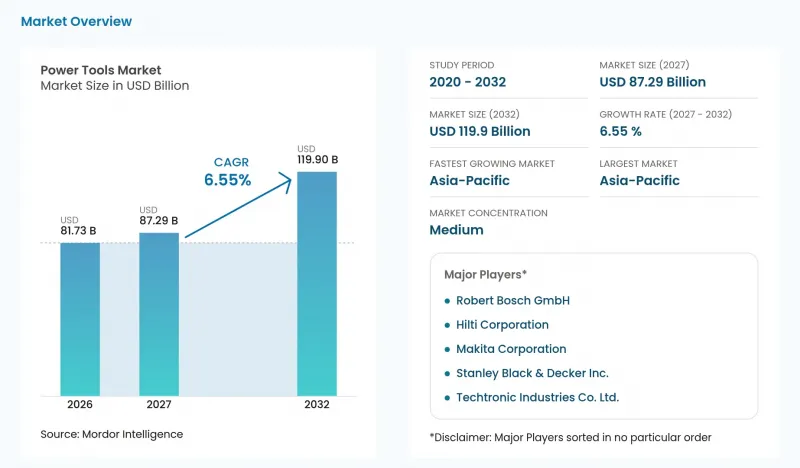
This report is segmented by Mode of Operation (Electric, Pneumatic, and more), Product (Drilling & Fastening Tools, Sawing & Cutting Tools, and more), End-user (Construction & Infrastructure, Manufacturing, and more), Sales Channel (Offline and Online), and Geography (Asia-Pacific, North America, and more). The market forecasts are provided in terms of value (USD), based on availability.
Global Power Tools Market Trends and Insights
Surging Public-Infrastructure Capex in India & Tier-2/3 City Projects Lifting Pro-Tool Demand
India budgeted higher public capital expenditure for FY2026-27 than the FY2025-26 revised estimate. The Urban Challenge Fund was designed to mobilize nearly INR 4 trillion (USD 42.83 billion) through market-based financing. Its credit-guarantee sub-scheme supports smaller cities, including Tier-II and Tier-III cities, in accessing that financing. Central assistance is limited to 25% of project cost, while at least 50% of funding is to be mobilized through municipal bonds, bank loans and public-private partnerships. For professional-tool suppliers, this structure connects a broader pool of urban projects with prospective demand for construction and installation equipment. The commercial opening therefore depends on projects securing their financing, since a larger allocation becomes tool demand only when funded work proceeds.
CHIPS-Act Semiconductor Megafab Build-outs in US Requiring High-Precision Installation Tools
Semiconductor construction connects professional-tool demand to precision work across interconnected utility and building systems. The CHIPS Program Office awarded Micron funding through Micron New York Semiconductor Manufacturing LLC for the first 2 fabs in its planned 4-fab Clay complex for leading-edge DRAM production. Following the January 2026 groundbreaking in New York, Bechtel is delivering engineering, procurement and construction services for the initial fab and critical campus infrastructure. The work spans cleanroom systems, advanced electrical and mechanical systems, vibration-sensitive foundations and tightly controlled manufacturing environments. For tool suppliers, accessible demand follows the execution of these construction packages before semiconductor production begins, making progress through the build a more immediate commercial trigger than future chip output.
Cobalt-Price Spikes from DRC Export Quotas Inflating Li-ion Battery Pack Costs
The Democratic Republic of the Congo's temporary cobalt export ban, announced in February 2025 to protect national economic interests, gave way to quotas on October 16, 2025. Benchmark's cobalt hydroxide CIF Asia assessment stood at USD 17.25 per pound at the close of Q3 2026, against its mid-February 2025 delivered-to-China reading of USD 5.65 per pound, even after a 31% quarterly decline. DRC customs processes and quota implementation nevertheless remained a swing factor for cobalt inflows into China at quarter-end. LG Energy Solution includes nickel-cobalt-manganese chemistry among its materials for power-tool batteries. Battery suppliers using that chemistry therefore face exposure to material prices and supply timing that may move independently of finished-tool demand. The remaining constraint is uncertainty over material availability and cost, which can complicate pricing of new tools supplied with batteries even after benchmark prices ease.
Other drivers and restraints analyzed in the detailed report include:
- Rapid Electrification of Heavy Construction Fleets Accelerating Shift to High-Voltage Cordless Platforms
- Job-Site Productivity Gains from AI-Enabled Smart Tools Expected to Drive Contractor Upgrades
- Skilled-Labor Shortages at North-American Megafab Sites Causing Build Delays and Tool Fleet Idle Time
For complete list of drivers and restraints, kindly check the Table Of Contents.
Segment Analysis
Electric tools accounted for a 62.78% share of the power tools market size in 2026 and are forecast to register a 7.15% CAGR between 2027 and 2032, making them the largest and fastest-growing segment. DEWALT's 2025 survey found 94% of surveyed U.S. concrete and masonry construction workers were confident their sites were adequately fitted for the transition to fully electric-powered tools. Such confidence lowers the perceived site-readiness barrier for buyers evaluating electric replacements within concrete and masonry work. The commercial opportunity centers on converting that readiness into purchases when existing equipment reaches a replacement decision.
For the fiscal year ended March 31, 2026, Makita reported 1.5% year-on-year growth in Oceania revenue, attributing the result to expanded cordless-product sales focused on its XGT series. That regional business covers power tools and outdoor power equipment. Makita achieved the increase amid a sluggish construction and building market in Oceania.
Drilling and fastening tools represented a 31.33% power tools market share in 2026, making them the largest product segment. A cordless drill-driver combines hole preparation and screw installation, allowing a contractor to handle successive installation steps with one powered tool. Where both operations recur, that dual use can spread the equipment cost across more tasks than a dedicated tool covers. A contractor can therefore justify the initial purchase through repeated installation work before needing a wider range of specialized equipment.
Impact drivers and wrenches are forecast to register a 7.8% CAGR between 2027 and 2032, making them the fastest-growing product segment. VMAC's 2026 North American survey found pneumatic impact wrenches were the most-used pneumatic tool among mobile-service respondents. TTI describes Milwaukee's M18 FUEL Controlled Torque Compact Impact Wrench with ONE-KEY as using AI sensors and machine learning to learn from past use and control bolt tightness. Sawing and cutting tools also have a mobile-service application, with pneumatic saws appearing in the same survey. For buyers needing repeatable bolt installation, controlled tightening offers a reason to upgrade before mechanical failure, adding a demand trigger beyond equipping existing field-service work.
Complete Report Scope:
- By Mode of Operation
- Electric
- Cordless
- Corded
- Pneumatic
- Hydraulic
- Engine-Driven
- Electric
- By Product
- Drilling & Fastening Tools
- Sawing & Cutting Tools
- Grinding & Polishing Tools
- Material Removal Tools (sanders, etc.)
- Demolition Tools (Breakers, Jackhammers)
- Impact Drivers & Wrenches
- Nailers & Staplers
- Others (heat guns, glue guns, mixers, specialty tools)
- By End-user
- Construction & Infrastructure
- Automotive
- Aerospace & Defense
- Energy & Power Generation
- Shipbuilding, Marine & Railways
- Manufacturing (Electronics, Metalworking, Wood Work, etc.)
- Residential / DIY
- Others (Utilities, Mining, etc.)
- By Sales Channel
- Offline
- Direct Industrial/ Distributor
- Mass Retail / Home Centers
- Online
- E-commerce Marketplaces
- Brand-Owned Digital Stores
- Offline
- By Geography
- North America
- United States
- Canada
- Mexico
- South America
- Brazil
- Argentina
- Peru
- Rest of South America
- Europe
- United Kingdom
- Germany
- France
- Italy
- Spain
- BENELUX (Belgium, Netherlands, and Luxembourg)
- NORDICS (Denmark, Finland, Iceland, Norway, and Sweden)
- Rest of Europe
- Asia-Pacific
- China
- India
- Japan
- Australia
- South Korea
- ASEAN (Indonesia, Thailand, Philippines, Malaysia, Vietnam)
- Rest of Asia-Pacific
- Middle East and Africa
- Saudi Arabia
- United Arab Emirates
- Qatar
- Kuwait
- Turkey
- Egypt
- South Africa
- Nigeria
- Rest of Middle East and Africa
- North America
Geography Analysis
Asia-Pacific accounted for a 39.23% share of the power tools market size in 2026 and is forecast to register a 7.6% CAGR between 2027 and 2032, making it the largest and fastest-growing region. A 2025 NITI Aayog report put India's power-tool exports at USD 425 million. On April 16, 2025, the Asian Development Bank approved USD 1.45 billion as the final financing tranche for the Philippines' 53.1-kilometer Malolos-Clark Railway. Taiwan reported fewer residential units starting construction in 2025 than in 2024. India's power-tool exports and the financing of the Philippines' Malolos-Clark Railway are examples of supply and demand activity in the region, from export manufacturing to publicly financed rail construction.
In North America, Stanley Black & Decker attributed its Tools & Outdoor segment's 3% organic revenue growth in Q2 2026 primarily to power-tool strength in U.S. retail and commercial and industrial channels. That combination makes both consumer-facing and industrial routes relevant to suppliers seeking access to the country's tool users. In Europe, EU civil-engineering investment grew 3.8% in 2025 with transport, energy and water infrastructure investment and public funding, while Poland issued more building permits in 2025 than in 2024. The resulting commercial priorities differ, with U.S. channel execution connecting suppliers to demonstrated demand and EU infrastructure programs directing attention toward the contractors executing funded construction work.
In South America, Brazil's National Index of Civil Construction rose 5.63% in 2025, while Uruguay's 2025-29 budget, effective from January 1, 2026, prioritizes road rehabilitation and railway modernization. Brazil's higher project costs make tool productivity commercially relevant when equipment can reduce the time needed to complete construction tasks. The Middle East and Africa include Saudi Arabia, where the Saudi Contractors Authority counted 365,120 construction-sector establishments in 2025, while Kenya's construction activity returned to growth in 2025 after contracting in 2024. Saudi Arabia's extensive business base creates a potential customer pool extending beyond the contractors involved in a few prominent projects. Suppliers serving Saudi contractors therefore face a challenge of account reach, while a Brazilian proposition gains relevance when it demonstrates a credible reduction in work time.
- Stanley Black & Decker Inc.
- Robert Bosch GmbH
- Techtronic Industries Co. Ltd.
- Makita Corporation
- Hilti Corporation
- Atlas Copco AB
- Ingersoll Rand Inc.
- Snap-on Incorporated
- Apex Tool Group
- Emerson Electric Co.
- Husqvarna AB
- Honeywell International Inc.
- KYOCERA Corporation
- Festool GmbH
- Cummins Inc. (Tool segment)
- Koki Holdings Co., Ltd. (HiKOKI)
- Illinois Tool Works (ITW)
- Ridgid (Emerson)
- Baier Power Tools
- Positec Tool Corporation
- Panasonic Life Solutions
- CEMBRE S.p.A.
- CSUN Power Tools
Additional Benefits:
- The market estimate (ME) sheet in Excel format
- 3 months of analyst support
TABLE OF CONTENTS
1 INTRODUCTION
- 1.1 Study Assumptions and Market Definition
- 1.2 Scope of the Study
2 RESEARCH METHODOLOGY
3 EXECUTIVE SUMMARY
4 MARKET LANDSCAPE
- 4.1 Market Overview
- 4.2 Market Drivers
- 4.2.1 Surging Public-Infrastructure Capex in India & Tier-2/3 City Projects Lifting Pro-Tool Demand
- 4.2.2 CHIPS-Act Semiconductor Megafab Build-outs in US Requiring High-Precision Installation Tools
- 4.2.3 Rapid Electrification of Heavy Construction Fleets Accelerating Shift to High-Voltage Cordless Platforms
- 4.2.4 Job-Site Productivity Gains from AI-Enabled Smart Tools Expected to Drive Contractor Upgrades
- 4.2.5 Government-Funded Hi-Tech Tool Rooms in India Catalyzing Indigenous Precision-Tool Manufacturing
- 4.2.6 Community-Centric Construction Wave in Indonesia's Nusantara (Multi-Faith Complexes, Civic Amenities) Spurring Specialty Finishing-Tool Sales
- 4.3 Market Restraints
- 4.3.1 Cobalt-Price Spikes from DRC Export Quotas Inflating Li-ion Battery Pack Costs
- 4.3.2 Skilled-Labor Shortages at North-American Megafab Sites Causing Build Delays and Tool Fleet Idle Time
- 4.3.3 Stricter Hand-Arm Vibration Exposure Limits Rolling Out Across ASEAN Curbing Heavy-Duty Tool Adoption
- 4.3.4 Fiscal Tightening & Political Apathy Slowing Indonesia's Nusantara Megaproject, Dampening Regional Tool Demand
- 4.4 Industry Value Chain Analysis
- 4.5 Regulatory Landscape
- 4.6 Technological Outlook
- 4.7 Porter's Five Forces Analysis
- 4.7.1 Threat of New Entrants
- 4.7.2 Bargaining Power of Suppliers
- 4.7.3 Bargaining Power of Buyers
- 4.7.4 Threat of Substitutes
- 4.7.5 Competitive Rivalry
- 4.8 Distribution Channel Analysis
5 MARKET SIZE AND GROWTH FORECASTS (VALUE)
- 5.1 By Mode of Operation
- 5.1.1 Electric
- 5.1.1.1 Cordless
- 5.1.1.2 Corded
- 5.1.2 Pneumatic
- 5.1.3 Hydraulic
- 5.1.4 Engine-Driven
- 5.1.1 Electric
- 5.2 By Product
- 5.2.1 Drilling & Fastening Tools
- 5.2.2 Sawing & Cutting Tools
- 5.2.3 Grinding & Polishing Tools
- 5.2.4 Material Removal Tools (sanders, etc.)
- 5.2.5 Demolition Tools (Breakers, Jackhammers)
- 5.2.6 Impact Drivers & Wrenches
- 5.2.7 Nailers & Staplers
- 5.2.8 Others (heat guns, glue guns, mixers, specialty tools)
- 5.3 By End-user
- 5.3.1 Construction & Infrastructure
- 5.3.2 Automotive
- 5.3.3 Aerospace & Defense
- 5.3.4 Energy & Power Generation
- 5.3.5 Shipbuilding, Marine & Railways
- 5.3.6 Manufacturing (Electronics, Metalworking, Wood Work, etc.)
- 5.3.7 Residential / DIY
- 5.3.8 Others (Utilities, Mining, etc.)
- 5.4 By Sales Channel
- 5.4.1 Offline
- 5.4.1.1 Direct Industrial/ Distributor
- 5.4.1.2 Mass Retail / Home Centers
- 5.4.2 Online
- 5.4.2.1 E-commerce Marketplaces
- 5.4.2.2 Brand-Owned Digital Stores
- 5.4.1 Offline
- 5.5 By Geography
- 5.5.1 North America
- 5.5.1.1 United States
- 5.5.1.2 Canada
- 5.5.1.3 Mexico
- 5.5.2 South America
- 5.5.2.1 Brazil
- 5.5.2.2 Argentina
- 5.5.2.3 Peru
- 5.5.2.4 Rest of South America
- 5.5.3 Europe
- 5.5.3.1 United Kingdom
- 5.5.3.2 Germany
- 5.5.3.3 France
- 5.5.3.4 Italy
- 5.5.3.5 Spain
- 5.5.3.6 BENELUX (Belgium, Netherlands, and Luxembourg)
- 5.5.3.7 NORDICS (Denmark, Finland, Iceland, Norway, and Sweden)
- 5.5.3.8 Rest of Europe
- 5.5.4 Asia-Pacific
- 5.5.4.1 China
- 5.5.4.2 India
- 5.5.4.3 Japan
- 5.5.4.4 Australia
- 5.5.4.5 South Korea
- 5.5.4.6 ASEAN (Indonesia, Thailand, Philippines, Malaysia, Vietnam)
- 5.5.4.7 Rest of Asia-Pacific
- 5.5.5 Middle East and Africa
- 5.5.5.1 Saudi Arabia
- 5.5.5.2 United Arab Emirates
- 5.5.5.3 Qatar
- 5.5.5.4 Kuwait
- 5.5.5.5 Turkey
- 5.5.5.6 Egypt
- 5.5.5.7 South Africa
- 5.5.5.8 Nigeria
- 5.5.5.9 Rest of Middle East and Africa
- 5.5.1 North America
6 COMPETITIVE LANDSCAPE
- 6.1 Market Concentration
- 6.2 Strategic Moves
- 6.3 Market Share Analysis
- 6.4 Company Profiles (includes Global level Overview, Market level overview, Core Segments, Financials as available, Strategic Information, Market Rank/Share for key companies, Products and Services, and Recent Developments)
- 6.4.1 Stanley Black & Decker Inc.
- 6.4.2 Robert Bosch GmbH
- 6.4.3 Techtronic Industries Co. Ltd.
- 6.4.4 Makita Corporation
- 6.4.5 Hilti Corporation
- 6.4.6 Atlas Copco AB
- 6.4.7 Ingersoll Rand Inc.
- 6.4.8 Snap-on Incorporated
- 6.4.9 Apex Tool Group
- 6.4.10 Emerson Electric Co.
- 6.4.11 Husqvarna AB
- 6.4.12 Honeywell International Inc.
- 6.4.13 KYOCERA Corporation
- 6.4.14 Festool GmbH
- 6.4.15 Cummins Inc. (Tool segment)
- 6.4.16 Koki Holdings Co., Ltd. (HiKOKI)
- 6.4.17 Illinois Tool Works (ITW)
- 6.4.18 Ridgid (Emerson)
- 6.4.19 Baier Power Tools
- 6.4.20 Positec Tool Corporation
- 6.4.21 Panasonic Life Solutions
- 6.4.22 CEMBRE S.p.A.
- 6.4.23 CSUN Power Tools
7 MARKET OPPORTUNITIES AND FUTURE OUTLOOK
- 7.1 White-Space and Unmet-Need Assessment

