PUBLISHER: Mordor Intelligence | PRODUCT CODE: 2185976

PUBLISHER: Mordor Intelligence | PRODUCT CODE: 2185976
Keystroke Dynamics Biometrics - Market Share Analysis, Industry Trends & Statistics, Growth Forecasts (2027 - 2032)
According to Mordor Intelligence, the keystroke dynamics biometrics market size is expected to increase from USD 0.87 billion in 2026 to USD 2.26 billion by 2032, advancing at a CAGR of 16.79% over 2027-2032.
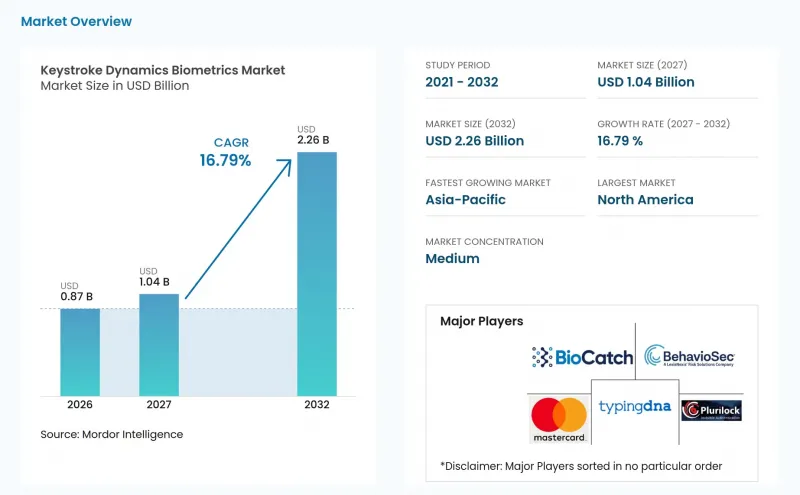
Global Keystroke Dynamics Biometrics Market Trends and Insights
Increasing Account-Takeover and Digital-Transaction Fraud
Account-takeover fraud is increasing the need for controls that identify the person operating an account after credentials are compromised. The FBI received more than 5,100 account-takeover complaints from January through November 2025, with reported losses exceeding USD 262 million and targets including financial, payroll, and health savings accounts. LexisNexis Risk Solutions reported that login-stage account-takeover attacks rose 89% in 2025, with desktop attacks increasing by more than 200%. Typing cadence, keystroke latency, and hold times can provide a behavioral signal before funds leave an account. BioCatch reported that its network analyzed 18 billion user sessions each month across more than 357 financial institutions in Q1 2026. This scale makes fraud prevention the central commercial application for the Keystroke Dynamics Biometrics Market.
Growing Adoption of Continuous and Passive Authentication
Continuous authentication addresses the weakness of verifying identity only at login and then trusting the session. NIST SP 800-63B Revision 4 includes session monitoring requirements that support periodic identity reassertion for federal use cases. Keyboard activity provides a recurring signal without requiring an extra step from the user. This approach can identify changes caused by session hijacking, device sharing, or unauthorized access after login. TypingDNA stated that ActiveLock 3.5 processes behavioral verification on the device rather than sending raw keystrokes for real-time authentication. That design can help regulated organizations address privacy concerns while applying continuous controls.
Privacy, Consent, and Biometric-Data Governance Requirements
European data protection rules can treat typing-pattern data used for identification as special-category personal data. The European Commission explains that processing special-category data requires a valid Article 9 condition, including explicit consent in specified cases. The UK Information Commissioner's Office states that biometric recognition needs a lawful basis and an Article 9 condition, with consent requiring a freely given and specific choice. CEN/TR 18241:2025 sets out biometric privacy management practices across the product lifecycle. These requirements favor local processing and data-minimization designs over centrally stored behavioral templates. Compliance work can raise entry barriers and lengthen deployment schedules in the Keystroke Dynamics Biometrics Market.
Other drivers and restraints analyzed in the detailed report include:
- Expansion of Cloud, Mobile, and Remote-Work Security
- Integration With FIDO2, Passwordless Authentication, and Zero-Trust Architectures
- False Rejections Across Diverse Typing Behaviors and User Populations
For complete list of drivers and restraints, kindly check the Table Of Contents.
Segment Analysis
Software held 57.73% of Keystroke Dynamics Biometrics Market revenue in 2026. Enterprises generally license behavioral analytics engines because typing-based authentication uses existing keyboard infrastructure. A 2025 IEEE study of the Type2Branch model reported equal error rates as low as 0.77% in desktop evaluation sets covering 15,000 subjects. These results support the use of software platforms in enterprise identity and fraud settings. The component does not require a dedicated fingerprint scanner, facial camera, or iris reader. This lowers provisioning needs for organizations with remote or hybrid workforces.
Services are projected to expand at a 17.22% CAGR through 2032, faster than the overall market. Implementation, integration, managed analytics, and post-deployment support create recurring work for providers. Large banking and healthcare customers often need customized integration across cloud, hybrid, and legacy systems. They also need audit records and service-level commitments that internal teams may not be prepared to manage. A 2025 study of the KeyRecs dataset found that gradient-boosting models achieved an 80% F1 score for binary typing-behavior classification. The result supports software productization, while deployment complexity supports sustained services demand.
Static authentication accounted for 52.89% of the Keystroke Dynamics Biometrics Market share in 2026. Most deployed systems verify a user during a login event through a fixed text entry or passphrase. This approach has lower integration complexity than continuous session monitoring. It also fits established identity-proofing workflows where one enrollment action creates a behavioral reference. Static verification remains useful where the main requirement is stronger login assurance. It does not, however, independently identify a change in the person using an already authenticated session.
Continuous authentication is projected to expand at a 17.34% CAGR through 2032. It monitors behavioral patterns throughout an active session to identify session hijacking, device sharing, and post-login impersonation. A 2025 IEEE paper found that a genetic-algorithm approach combined with Isolation Forest detection improved mobile continuous-authentication performance across behavioral tasks. NIST session monitoring requirements also support periodic identity reassertion in relevant federal environments. Hospitals can apply these controls to shared workstations, while privileged-access teams can use them to identify unusual behavior. These uses extend keystroke verification beyond login-focused security.
Complete Report Scope:
- By Component
- Software
- Services
- By Authentication Type
- Static Authentication
- Continuous Authentication
- By Deployment Model
- Cloud-Based
- On-Premises
- Hybrid Deployment
- By Application
- Identity Proofing
- Fraud Detection and Prevention
- Risk and Compliance Management
- Access Control and Privileged Access Monitoring
- Insider-Threat Detection
- By End User
- Banking, Financial Services, and Insurance
- Retail and E-Commerce
- Healthcare
- Government and Defense
- Education
- Information Technology and Telecommunications
- Consumer Services
- Other End Users
- By Geography
- North America
- United States
- Canada
- Mexico
- Rest of North America
- South America
- Brazil
- Argentina
- Rest of South America
- Europe
- Germany
- United Kingdom
- France
- Italy
- Spain
- Russia
- Rest of Europe
- Asia-Pacific
- China
- Japan
- India
- South Korea
- Australia and New Zealand
- Rest of Asia-Pacific
- Middle East
- Saudi Arabia
- United Arab Emirates
- Israel
- Rest of Middle East
- Africa
- South Africa
- Egypt
- Rest of Africa
- North America
Geography Analysis
North America held 36.27% of Keystroke Dynamics Biometrics Market revenue in 2026. Advanced financial-services infrastructure and early enterprise adoption support the region's leading position. The FBI's 2025 account-takeover alert increased attention on fraud losses and digital-account security. NIST session-monitoring guidance is also relevant to federal agencies and their supply chains. Europe combines banking regulation with critical-infrastructure requirements, including Germany's NIS-2 guidance on multi-factor authentication.
Asia-Pacific is projected to expand at a 17.58% CAGR through 2032, the fastest regional rate. Japan reported JPY 690 billion (USD 4.44 billion) in 2025 account-takeover losses, and Sumitomo Mitsui Trust Bank deployed a cloud-based FIDO authentication solution with SCSK Corporation and OneSpan in January 2026. India and China add volume through expanding digital-finance and mobile-payment ecosystems. A July 2026 BioCatch survey of 100 Singapore banking fraud and compliance leaders found that 91% considered behavioral biometrics a priority investment.
The Middle East is developing through banking modernization and fraud-prevention programs in Saudi Arabia and the UAE. South American adoption is concentrated in Brazil and Argentina, where mobile banking and digital fraud both remain relevant to buyer demand. A University of Lodz study documented a tenfold increase in Polish banking fraud value from 2019 to 2024, with behavioral biometrics identified as a potential mitigation measure. Africa remains earlier in adoption, although mobile-first banking in South Africa, Kenya, and Nigeria creates a hardware-independent opportunity. Limited vendor distribution and implementation skills constrain near-term scale across several of these countries.
- BioCatch Ltd.
- Mastercard Incorporated
- LexisNexis Risk Solutions Inc.
- BehavioSec, Inc.
- TypingDNA Inc.
- Plurilock Security Inc.
- Zighra Inc.
- ID Control BV
- KeyTrac GmbH
- AuthenWare Corporation
- Daon, Inc.
- Deepnet Security Ltd.
- Delfigo Security
- Intensity Analytics Corporation
- SERBAN Biometrics
- OneSpan Inc.
- IBM Corporation
- Microsoft Corporation
- NEC Corporation
- Fujitsu Limited
- ThreatMark S.R.O.
- Callsign Inc.
- Experian PLC
- Aware, Inc.
Additional Benefits:
- The market estimate (ME) sheet in Excel format
- 3 months of analyst support
TABLE OF CONTENTS
1 INTRODUCTION
- 1.1 Study Assumptions and Market Definition
- 1.2 Scope of the Study
2 RESEARCH METHODOLOGY
3 EXECUTIVE SUMMARY
4 MARKET LANDSCAPE
- 4.1 Market Overview
- 4.2 Market Drivers
- 4.2.1 Increasing Account-Takeover and Digital-Transaction Fraud
- 4.2.2 Growing Adoption of Continuous and Passive Authentication
- 4.2.3 Expansion of Cloud, Mobile, and Remote-Work Security
- 4.2.4 Integration With FIDO2, Passwordless Authentication, and Zero-Trust Architectures
- 4.2.5 Rising Regulatory Requirements for Strong Customer Authentication
- 4.2.6 AI-Enabled Behavioral Pattern Recognition and Edge Inference
- 4.3 Market Restraints
- 4.3.1 Privacy, Consent, and Biometric-Data Governance Requirements
- 4.3.2 False Rejections Across Diverse Typing Behaviors and User Populations
- 4.3.3 Legacy-System Integration and Cross-Device Compatibility Constraints
- 4.3.4 Limited Awareness and Implementation Resources Among Small and Medium Enterprises
- 4.4 Impact of Macroeconomic Factors on the Market
- 4.5 Industry Value Chain Analysis
- 4.6 Regulatory Landscape
- 4.7 Technological Outlook
- 4.8 Porter's Five Forces Analysis
- 4.8.1 Bargaining Power of Suppliers
- 4.8.2 Bargaining Power of Buyers
- 4.8.3 Threat of New Entrants
- 4.8.4 Threat of Substitutes
- 4.8.5 Competitive Rivalry
5 MARKET SIZE AND GROWTH FORECASTS (VALUE)
- 5.1 By Component
- 5.1.1 Software
- 5.1.2 Services
- 5.2 By Authentication Type
- 5.2.1 Static Authentication
- 5.2.2 Continuous Authentication
- 5.3 By Deployment Model
- 5.3.1 Cloud-Based
- 5.3.2 On-Premises
- 5.3.3 Hybrid Deployment
- 5.4 By Application
- 5.4.1 Identity Proofing
- 5.4.2 Fraud Detection and Prevention
- 5.4.3 Risk and Compliance Management
- 5.4.4 Access Control and Privileged Access Monitoring
- 5.4.5 Insider-Threat Detection
- 5.5 By End User
- 5.5.1 Banking, Financial Services, and Insurance
- 5.5.2 Retail and E-Commerce
- 5.5.3 Healthcare
- 5.5.4 Government and Defense
- 5.5.5 Education
- 5.5.6 Information Technology and Telecommunications
- 5.5.7 Consumer Services
- 5.5.8 Other End Users
- 5.6 By Geography
- 5.6.1 North America
- 5.6.1.1 United States
- 5.6.1.2 Canada
- 5.6.1.3 Mexico
- 5.6.1.4 Rest of North America
- 5.6.2 South America
- 5.6.2.1 Brazil
- 5.6.2.2 Argentina
- 5.6.2.3 Rest of South America
- 5.6.3 Europe
- 5.6.3.1 Germany
- 5.6.3.2 United Kingdom
- 5.6.3.3 France
- 5.6.3.4 Italy
- 5.6.3.5 Spain
- 5.6.3.6 Russia
- 5.6.3.7 Rest of Europe
- 5.6.4 Asia-Pacific
- 5.6.4.1 China
- 5.6.4.2 Japan
- 5.6.4.3 India
- 5.6.4.4 South Korea
- 5.6.4.5 Australia and New Zealand
- 5.6.4.6 Rest of Asia-Pacific
- 5.6.5 Middle East
- 5.6.5.1 Saudi Arabia
- 5.6.5.2 United Arab Emirates
- 5.6.5.3 Israel
- 5.6.5.4 Rest of Middle East
- 5.6.6 Africa
- 5.6.6.1 South Africa
- 5.6.6.2 Egypt
- 5.6.6.3 Rest of Africa
- 5.6.1 North America
6 COMPETITIVE LANDSCAPE
- 6.1 Market Concentration
- 6.2 Strategic Moves
- 6.3 Market Share Analysis
- 6.4 Company Profiles (includes Global Level Overview, Market Level Overview, Core Segments, Financials as available, Strategic Information, Market Rank/Share, Products and Services, Recent Developments)
- 6.4.1 BioCatch Ltd.
- 6.4.2 Mastercard Incorporated
- 6.4.3 LexisNexis Risk Solutions Inc.
- 6.4.4 BehavioSec, Inc.
- 6.4.5 TypingDNA Inc.
- 6.4.6 Plurilock Security Inc.
- 6.4.7 Zighra Inc.
- 6.4.8 ID Control BV
- 6.4.9 KeyTrac GmbH
- 6.4.10 AuthenWare Corporation
- 6.4.11 Daon, Inc.
- 6.4.12 Deepnet Security Ltd.
- 6.4.13 Delfigo Security
- 6.4.14 Intensity Analytics Corporation
- 6.4.15 SERBAN Biometrics
- 6.4.16 OneSpan Inc.
- 6.4.17 IBM Corporation
- 6.4.18 Microsoft Corporation
- 6.4.19 NEC Corporation
- 6.4.20 Fujitsu Limited
- 6.4.21 ThreatMark S.R.O.
- 6.4.22 Callsign Inc.
- 6.4.23 Experian PLC
- 6.4.24 Aware, Inc.
7 MARKET OPPORTUNITIES AND FUTURE OUTLOOK
- 7.1 White-Space and Unmet-Need Assessment

