PUBLISHER: Mordor Intelligence | PRODUCT CODE: 2185983

PUBLISHER: Mordor Intelligence | PRODUCT CODE: 2185983
Gait Biometrics - Market Share Analysis, Industry Trends & Statistics, Growth Forecasts (2027 - 2032)
According to Mordor Intelligence, the gait biometrics market size is expected to increase from USD 1.43 billion in 2026 to USD 1.59 billion in 2027 and reach USD 2.81 billion by 2032, growing at a CAGR of 11.64% over 2027-2032.
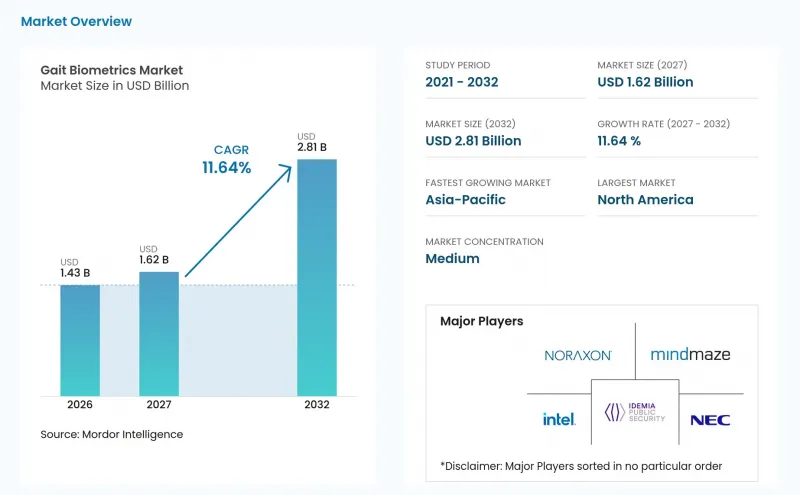
Global Gait Biometrics Market Trends and Insights
Rising Demand for Contactless, Long-Distance Identity Verification
Gait analysis changes the usual requirement for a person to stand close to a sensor or cooperate with a check. This makes the Gait Biometrics Market relevant for facilities where movement cannot be paused for a standard biometric scan. Border crossings, airports, transit hubs, and large public venues need identity methods that fit existing movement patterns. Contactless systems can complement face, iris, and fingerprint tools when masks, distance, or limited cooperation complicate verification. NEC developed walk-through face and iris recognition technology for people moving at up to 6 km/h, indicating a broader shift toward recognition in motion. Such deployments favor platforms that combine several identity signals within a single operating process.
Expansion of AI-Enabled Video Surveillance and Smart-City Infrastructure
Smart-city programs create a continuing demand base for video analytics and identity infrastructure. Their value to suppliers comes from multi-year installations rather than isolated equipment purchases. Camera networks also give providers a practical route to deploy computer vision tools without replacing every endpoint. The Gait Biometrics Market can benefit when cities seek functions that use their established surveillance networks more effectively. Large suppliers can create high switching costs when analytics, storage, access controls, and maintenance are delivered as one platform. This structure can divide regional opportunities because public procurement rules and approved vendor lists differ widely.
Privacy, Consent, and Biometric-Surveillance Compliance Burden
Privacy law can materially affect where and how gait recognition systems are used. The EU AI Act places strict limits on real-time remote biometric identification for law enforcement and establishes requirements for high-risk uses. The European Union Agency for Fundamental Rights has also called for legal authorization, independent oversight, and protection for people in lawful assemblies. GDPR treats biometric data used for unique identification as special-category personal data, requiring a valid legal basis and safeguards. Organizations in the United States must also consider state and local biometric privacy obligations. These conditions add review time, governance work, and system-design requirements for Gait Biometrics Market participants.
Other drivers and restraints analyzed in the detailed report include:
- Growth in Remote Gait Monitoring for Neurological and Aging-Related Care
- Smartphone and Wearable Sensor Ubiquity Enabling Low-Friction Capture
- Accuracy Degradation From Clothing, Footwear, Occlusion, and Viewpoint Changes
For complete list of drivers and restraints, kindly check the Table Of Contents.
Segment Analysis
Hardware held 45.44% of the Gait Biometrics Market share in 2026. The segment includes camera arrays, depth sensors, floor pressure grids, and inertial measurement units. Large surveillance systems need many endpoints, which creates considerable initial equipment demand. Clinical and sports users also buy wearable tracking devices for repeated movement measurement. Hardware suppliers benefit when organizations update facilities or add sites. These installations can require calibration, integration, and support before operations begin. The installed base gives established equipment vendors an important role in procurement decisions. It also creates an entry point for analytics providers that can work with existing devices.
Software is projected to expand at an 11.92% CAGR through 2032 within the Gait Biometrics Market. Recognition algorithms can be licensed without requiring customers to replace every camera or sensor. This model supports recurring revenue through analytics subscriptions and software updates. Government and healthcare customers may prefer contracts that combine software, integration, maintenance, and data governance services. Services also benefit from complex installations that use more than 1 sensor type. Compliance documentation can become a meaningful part of delivery where sensitive biometric data is involved. Software-led offerings can shorten refresh cycles because model upgrades do not require a complete physical rebuild. The balance of value may therefore move toward algorithm quality, workflow design, and deployment support.
Computer vision techniques accounted for 54.27% of the Gait Biometrics Market share in 2026. Their position reflects the wide installed base of IP cameras in security environments. Suppliers use silhouette, skeleton, pose estimation, and depth imaging methods to extract movement features. Standard cameras can support some pose-based workflows without additional sensing equipment. This compatibility helps buyers extend existing video infrastructure. Machine learning algorithms operate across both camera-led and sensor-led methods. They should be viewed as a capability that supports several technology approaches. The segment remains closely tied to public security and identity uses.
Sensor fusion and multimodal analytics are projected to expand at an 11.86% CAGR through 2032. These approaches combine data from modalities such as RGB video, depth, thermal sensing, and wearable motion sensors. Their main purpose is to reduce errors caused by lighting, viewpoint, and changing personal conditions. The Gait Biometrics Market size for sensor fusion benefits when buyers need more dependable operation outside controlled settings. Research on thermal-array recognition highlights an alternative that can reduce dependence on high-definition RGB imagery. Cross-sensor learning is relevant when an organization must work across different sites and device types. These systems need stronger integration and testing than single-modality products. Their appeal rests on accuracy, privacy considerations, and operational resilience.
Complete Report Scope:
- By Component
- Hardware
- Software
- Services
- By Technology
- Computer Vision Techniques
- Machine Learning Algorithms
- Sensor Fusion and Multimodal Analytics
- By Deployment
- Cloud
- On-Premises
- Edge
- By Authentication Mode
- Active Authentication
- Passive and Continuous Authentication
- Identification and Re-Identification
- By Application
- Security and Surveillance
- Access Control and Identity Management
- Healthcare Monitoring and Rehabilitation
- Sports and Fitness Analytics
- Research and Development
- Automotive and Human-Machine Interaction
- By End User
- Government and Law Enforcement
- Defense and Military
- Healthcare Providers and Hospitals
- Commercial and Industrial Enterprises
- Sports and Fitness Institutions
- Research Institutes
- By Geography
- North America
- United States
- Canada
- Mexico
- South America
- Brazil
- Argentina
- Rest of South America
- Europe
- Germany
- United Kingdom
- France
- Italy
- Rest of Europe
- Asia-Pacific
- China
- Japan
- South Korea
- India
- Rest of Asia-Pacific
- Middle East and Africa
- Saudi Arabia
- United Arab Emirates
- South Africa
- Egypt
- Rest of Middle East and Africa
- North America
Geography Analysis
North America held 33.26% of the Gait Biometrics Market share in 2026. The region benefits from federal investment in border security, airport systems, and law enforcement identity infrastructure. It also has research hospitals, rehabilitation networks, and professional sports organizations that use movement analysis. These groups support demand beyond security applications. Privacy frameworks in the United States shape how commercial providers collect, store, and use biometric information.
Asia-Pacific is projected to expand at a 12.16% CAGR through 2032. Large government surveillance programs and smart-city investment support the region's demand profile. Japan's immigration agency completed the installation of NEC walkthrough gates at 3 airports in 2025. The Gait Biometrics Market benefits from a diverse regional base, including China, Japan, Singapore, South Korea, India, and Australia. Regional buyers use different operating models, from border modernization to urban security and digital public services. This diversity reduces dependence on a single public procurement cycle.
Europe holds a significant position in the Gait Biometrics Market, although its regulatory framework limits certain surveillance uses. The EU AI Act and GDPR require careful assessment of biometric applications. IDEMIA and Sopra Steria completed the shared Biometric Matching System go-live for eu-LISA in August 2025. Clinical gait analysis remains relevant in Germany, France, and the United Kingdom. South America, the Middle East, and Africa are smaller opportunities where camera-network investment can support later analytics deployment.
- NEC Corporation
- IDEMIA Group
- Intel Corporation
- Hangzhou Hikvision Digital Technology Co., Ltd.
- Zhejiang Dahua Technology Co., Ltd.
- MindMaze SA
- BioSensics LLC
- CIR Systems Inc.
- Motek Medical BV
- Noraxon U.S.A. Inc.
- Qualisys AB
- Tekscan Inc.
- zebris Medical GmbH
- Vicon Motion Systems Ltd.
- Motion Analysis Corporation
- ProtoKinetics LLC
- Xsens Technologies B.V.
- DIH Group
- Aratek Innovation Private Limited
- Watrix Technology Ltd.
- GaitBetter
Additional Benefits:
- The market estimate (ME) sheet in Excel format
- 3 months of analyst support
TABLE OF CONTENTS
1 INTRODUCTION
- 1.1 Study Assumptions and Market Definition
- 1.2 Scope of the Study
2 RESEARCH METHODOLOGY
3 EXECUTIVE SUMMARY
4 MARKET LANDSCAPE
- 4.1 Market Overview
- 4.2 Market Drivers
- 4.2.1 Rising Demand for Contactless, Long-Distance Identity Verification
- 4.2.2 Expansion of AI-Enabled Video Surveillance and Smart-City Infrastructure
- 4.2.3 Growth in Remote Gait Monitoring for Neurological and Aging-Related Care
- 4.2.4 Smartphone and Wearable Sensor Ubiquity Enabling Low-Friction Capture
- 4.2.5 Edge Computing Reducing Latency and Raw-Video Transfer Requirements
- 4.2.6 Privacy-Preserving Gait Representations Enabling New Deployments
- 4.3 Market Restraints
- 4.3.1 Privacy, Consent, and Biometric-Surveillance Compliance Burden
- 4.3.2 Accuracy Degradation from Clothing, Footwear, Occlusion, and Viewpoint Changes
- 4.3.3 High Total Cost of Ownership for Multi-Camera and Edge Infrastructure
- 4.3.4 Limited Interoperability and Standardization Across Sensors and Models
- 4.4 Industry Value Chain Analysis
- 4.5 Impact of Macroeconomic Factors on the Market
- 4.6 Regulatory Landscape
- 4.7 Technological Outlook
- 4.8 Porter's Five Forces Analysis
- 4.8.1 Bargaining Power of Suppliers
- 4.8.2 Bargaining Power of Buyers
- 4.8.3 Threat of New Entrants
- 4.8.4 Threat of Substitutes
- 4.8.5 Intensity of Competitive Rivalry
5 MARKET SIZE AND GROWTH FORECASTS (VALUE)
- 5.1 By Component
- 5.1.1 Hardware
- 5.1.2 Software
- 5.1.3 Services
- 5.2 By Technology
- 5.2.1 Computer Vision Techniques
- 5.2.2 Machine Learning Algorithms
- 5.2.3 Sensor Fusion and Multimodal Analytics
- 5.3 By Deployment
- 5.3.1 Cloud
- 5.3.2 On-Premises
- 5.3.3 Edge
- 5.4 By Authentication Mode
- 5.4.1 Active Authentication
- 5.4.2 Passive and Continuous Authentication
- 5.4.3 Identification and Re-Identification
- 5.5 By Application
- 5.5.1 Security and Surveillance
- 5.5.2 Access Control and Identity Management
- 5.5.3 Healthcare Monitoring and Rehabilitation
- 5.5.4 Sports and Fitness Analytics
- 5.5.5 Research and Development
- 5.5.6 Automotive and Human-Machine Interaction
- 5.6 By End User
- 5.6.1 Government and Law Enforcement
- 5.6.2 Defense and Military
- 5.6.3 Healthcare Providers and Hospitals
- 5.6.4 Commercial and Industrial Enterprises
- 5.6.5 Sports and Fitness Institutions
- 5.6.6 Research Institutes
- 5.7 By Geography
- 5.7.1 North America
- 5.7.1.1 United States
- 5.7.1.2 Canada
- 5.7.1.3 Mexico
- 5.7.2 South America
- 5.7.2.1 Brazil
- 5.7.2.2 Argentina
- 5.7.2.3 Rest of South America
- 5.7.3 Europe
- 5.7.3.1 Germany
- 5.7.3.2 United Kingdom
- 5.7.3.3 France
- 5.7.3.4 Italy
- 5.7.3.5 Rest of Europe
- 5.7.4 Asia-Pacific
- 5.7.4.1 China
- 5.7.4.2 Japan
- 5.7.4.3 South Korea
- 5.7.4.4 India
- 5.7.4.5 Rest of Asia-Pacific
- 5.7.5 Middle East and Africa
- 5.7.5.1 Saudi Arabia
- 5.7.5.2 United Arab Emirates
- 5.7.5.3 South Africa
- 5.7.5.4 Egypt
- 5.7.5.5 Rest of Middle East and Africa
- 5.7.1 North America
6 COMPETITIVE LANDSCAPE
- 6.1 Market Concentration
- 6.2 Strategic Moves
- 6.3 Market Share Analysis
- 6.4 Company Profiles (includes Global Level Overview, Market Level Overview, Core Segments, Financials as available, Strategic Information, Market Rank/Share, Products and Services, Recent Developments)
- 6.4.1 NEC Corporation
- 6.4.2 IDEMIA Group
- 6.4.3 Intel Corporation
- 6.4.4 Hangzhou Hikvision Digital Technology Co., Ltd.
- 6.4.5 Zhejiang Dahua Technology Co., Ltd.
- 6.4.6 MindMaze SA
- 6.4.7 BioSensics LLC
- 6.4.8 CIR Systems Inc.
- 6.4.9 Motek Medical BV
- 6.4.10 Noraxon U.S.A. Inc.
- 6.4.11 Qualisys AB
- 6.4.12 Tekscan Inc.
- 6.4.13 zebris Medical GmbH
- 6.4.14 Vicon Motion Systems Ltd.
- 6.4.15 Motion Analysis Corporation
- 6.4.16 ProtoKinetics LLC
- 6.4.17 Xsens Technologies B.V.
- 6.4.18 DIH Group
- 6.4.19 Aratek Innovation Private Limited
- 6.4.20 Watrix Technology Ltd.
- 6.4.21 GaitBetter
7 MARKET OPPORTUNITIES AND FUTURE OUTLOOK
- 7.1 White-Space and Unmet-Need Assessment

