PUBLISHER: Mordor Intelligence | PRODUCT CODE: 2185994

PUBLISHER: Mordor Intelligence | PRODUCT CODE: 2185994
Customer Digital Onboarding Platform - Market Share Analysis, Industry Trends & Statistics, Growth Forecasts (2027 - 2032)
According to Mordor Intelligence, the customer digital onboarding platform market size is projected to expand from USD 3.52 billion in 2026 and USD 4.12 billion in 2027 to USD 9.19 billion by 2032, registering a CAGR of 17.39% between 2027 and 2032.
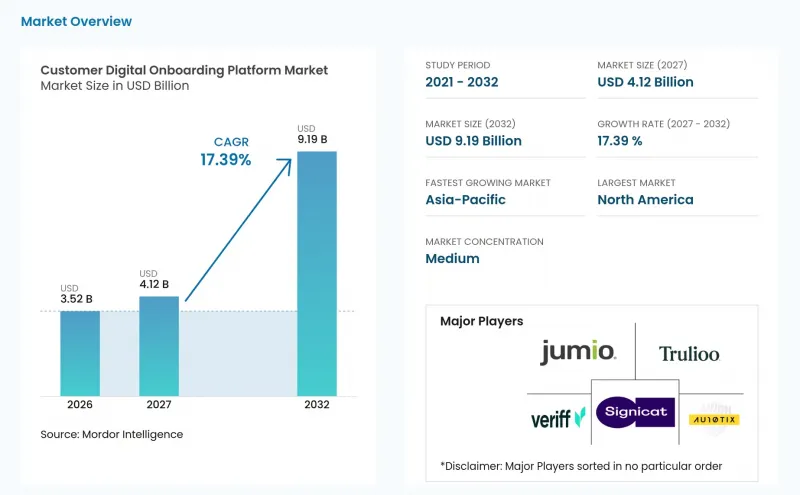
Global Customer Digital Onboarding Platform Market Trends and Insights
Rising Demand for Seamless Digital Customer Acquisition and Account Opening
The customer digital onboarding platform market benefits when organizations can reduce the time and effort needed to open an account. In 2025, 70% of financial institutions reported losing clients due to slow or inefficient onboarding, up from 48% in 2023. Applicants now compare account opening to simpler digital services, making a slow process more likely to lead to abandonment. Many abandoned applications do not become formal complaints, so institutions can miss the full cost of an ineffective process. Providers are responding by implementing workflows that route lower-risk applicants to automated approval and apply additional checks to higher-risk cases. This approach helps the customer digital onboarding platform market by combining fraud control with a smoother entry experience.
Increasing KYC, AML, CDD, and Customer Identification Requirements
The customer digital onboarding platform market is supported by requirements that are becoming more specific across jurisdictions. The United Nations Office on Drugs and Crime has stated that financial crime can cost the global economy up to USD 2 trillion annually. European policy is moving toward more consistent anti-money-laundering requirements across member states. The European Digital Identity Framework also establishes a common basis for digital identity wallets and related trust services. In the United States, beneficial-ownership reporting creates a stronger need to identify changes that can affect a customer risk profile. These conditions make continuous monitoring and re-verification more relevant after the initial onboarding event.
Data Privacy, Biometric Consent, and Cross-Border Data Transfer Requirements
Biometric onboarding can involve facial geometry, liveness sequences, and voice data, all of which receive heightened legal protection in many jurisdictions. The General Data Protection Regulation treats biometric data used for unique identification as a special category of personal data. It can require explicit consent and impact assessments before large-scale processing. Illinois law also establishes notice and consent duties for biometric information, with statutory damages of USD 1,000 for negligent violations and USD 5,000 for intentional violations. Different data transfer and localization rules add operational workload for providers serving multiple countries. These requirements can slow the customer digital onboarding platform market when vendors must configure separate consent, storage, and retention controls.
Other drivers and restraints analyzed in the detailed report include:
- Growing Adoption of Mobile-First and Omnichannel Onboarding
- Increasing Adoption of AI-Powered Identity Verification and Automated Decisioning
- High Implementation Costs and Total Cost of Ownership
For complete list of drivers and restraints, kindly check the Table Of Contents.
Segment Analysis
Software platforms held 67.12% of the customer digital onboarding platform market share in 2026. Organizations use these platforms as orchestration layers connecting identity verification, compliance decisions, document capture, and liveness checks. A configurable platform can bring several checks into a coordinated workflow rather than relying on separate tools. This helps buyers adjust the process for different customer types, risk levels, and regulatory settings. Their revenue position reflects the importance of a central control layer in large deployments.
Services are projected to expand at a 17.79% CAGR from 2027 to 2032. The increase reflects the work required to maintain compliance processes as document requirements, KYC thresholds, and consent rules change. Many organizations prefer to obtain this capacity from a provider rather than build it internally. Managed compliance services can include regulatory monitoring, workflow adjustment, and operational support. The customer digital onboarding platform market is moving from isolated implementation projects toward longer-running service relationships.
Cloud-based deployment held 72.38% of the customer digital onboarding platform market share in 2026 and is projected to expand at a 17.74% CAGR through 2032. Cloud systems can support real-time identity lookups, liveness updates, and ongoing KYC events. They also let buyers use capacity as needed instead of maintaining all infrastructure internally. Continuous platform updates can be delivered more readily in cloud environments. These features explain why cloud deployment leads to both current use and future expansion.
On-premises systems remain relevant where data residency or internal technology policies are strict. Government and financial clients in China, India, and Gulf Cooperation Council states may retain more data within their own environments. Hybrid models combine cloud-based orchestration with locally managed storage. This approach can balance performance needs with local data requirements. The customer digital onboarding platform market continues to favor deployment flexibility because buyer requirements differ across regions.
Complete Report Scope:
- By Component
- Software Platforms
- Services
- By Deployment Model
- Cloud-Based
- On-Premises
- Hybrid
- By Enterprise Size
- Large Enterprises
- Small and Medium-Sized Enterprises
- By End-User Industry
- BFSI
- Healthcare and Life Sciences
- Information Technology and Telecom
- Retail and E-Commerce
- Industrial Manufacturing
- Government and Public Sector
- By Geography
- North America
- United States
- Canada
- Mexico
- South America
- Brazil
- Argentina
- Rest of South America
- Europe
- Germany
- United Kingdom
- France
- Italy
- Spain
- Russia
- Netherlands
- Rest of Europe
- Asia-Pacific
- China
- Japan
- India
- South Korea
- Australia and New Zealand
- Rest of Asia-Pacific
- Middle East
- Saudi Arabia
- United Arab Emirates
- Turkey
- Rest of Middle East
- Africa
- South Africa
- Nigeria
- Rest of Africa
- North America
Geography Analysis
North America held 38.63% of the customer digital onboarding platform market share in 2026. The region combines a mature enterprise buyer base with intense AML enforcement and complex state-level privacy requirements. North America accounted for 94% of global AML fines totaling USD 4.6 billion in 2024. United States biometric rules, including Illinois requirements, increase demand for documented consent and retention processes. Canada and Mexico add demand as open-banking activity and fintech licensing broaden the number of organizations needing structured onboarding.
Europe is being reshaped by the European Digital Identity Framework. All European Union member states are required to provide European Digital Identity Wallets to citizens and businesses by the end of 2026. From December 2027, banks, e-money institutions, and payment service providers will need to accept those wallets where identity verification is legally required. Providers able to ingest verifiable credentials have an advantage over document-capture-only workflows. Germany, the United Kingdom, France, and the Netherlands remain important adoption markets.
Asia-Pacific is projected to expand at an 18.36% CAGR through 2032, the fastest regional rate in the customer digital onboarding platform market. Neobank activity, public digital identity systems, and mobile payment infrastructure support this outlook. India's Aadhaar-based e-KYC infrastructure can streamline account-opening processes for organizations that use it. Singapore firms reported 92% AI adoption in KYC in 2025. South America and the Middle East offer further opportunities, while parts of Africa face limits because reliable government identity data are less available.
- Jumio Corporation
- Trulioo Information Services Inc.
- Signicat AS
- Veriff OU
- Au10tix Ltd.
- IDnow GmbH
- Sum and Substance Ltd.
- Shufti Pro Limited
- Persona Identities, Inc.
- Socure Inc.
- First Mile Group, Inc. d/b/a Alloy
- Mitek Systems, Inc.
- Ondato UAB
- UAB iDenfy
- PXL Vision AG
- Innovatrics, s.r.o.
- Incode Technologies, Inc.
- ID.me, LLC
- Intellicheck, Inc.
- HyperVerge Technologies Private Limited
Additional Benefits:
- The market estimate (ME) sheet in Excel format
- 3 months of analyst support
TABLE OF CONTENTS
1 INTRODUCTION
- 1.1 Study Assumptions and Market Definition
- 1.2 Scope of the Study
2 RESEARCH METHODOLOGY
3 EXECUTIVE SUMMARY
4 MARKET LANDSCAPE
- 4.1 Market Overview
- 4.2 Market Drivers
- 4.2.1 Rising Demand for Seamless Digital Customer Acquisition and Account Opening
- 4.2.2 Increasing KYC, AML, CDD, and Customer Identification Requirements
- 4.2.3 Growing Adoption of Mobile-First and Omnichannel Onboarding
- 4.2.4 Increasing Adoption of AI-Powered Identity Verification and Automated Decisioning
- 4.2.5 Expansion of Digital Banking, Fintech, Embedded Finance, and Digital Commerce
- 4.2.6 Adoption of Digital Identity Wallets and Reusable Credentials
- 4.3 Market Restraints
- 4.3.1 Data Privacy, Biometric Consent, and Cross-Border Data Transfer Requirements
- 4.3.2 High Implementation Costs and Total Cost of Ownership
- 4.3.3 False Rejections, Manual Review Queues, and AI Model Governance Challenges
- 4.3.4 Limited Access to Reliable Identity Data in Emerging Markets
- 4.4 Impact of Macroeconomic Factors on the Market
- 4.5 Industry Value Chain Analysis
- 4.6 Regulatory Landscape
- 4.7 Technological Outlook
- 4.8 Porter's Five Forces Analysis
- 4.8.1 Bargaining Power of Suppliers
- 4.8.2 Bargaining Power of Buyers
- 4.8.3 Threat of New Entrants
- 4.8.4 Threat of Substitutes
- 4.8.5 Competitive Rivalry
5 MARKET SIZE AND GROWTH FORECASTS (VALUE)
- 5.1 By Component
- 5.1.1 Software Platforms
- 5.1.2 Services
- 5.2 By Deployment Model
- 5.2.1 Cloud-Based
- 5.2.2 On-Premises
- 5.2.3 Hybrid
- 5.3 By Enterprise Size
- 5.3.1 Large Enterprises
- 5.3.2 Small and Medium-Sized Enterprises
- 5.4 By End-User Industry
- 5.4.1 BFSI
- 5.4.2 Healthcare and Life Sciences
- 5.4.3 Information Technology and Telecom
- 5.4.4 Retail and E-Commerce
- 5.4.5 Industrial Manufacturing
- 5.4.6 Government and Public Sector
- 5.5 By Geography
- 5.5.1 North America
- 5.5.1.1 United States
- 5.5.1.2 Canada
- 5.5.1.3 Mexico
- 5.5.2 South America
- 5.5.2.1 Brazil
- 5.5.2.2 Argentina
- 5.5.2.3 Rest of South America
- 5.5.3 Europe
- 5.5.3.1 Germany
- 5.5.3.2 United Kingdom
- 5.5.3.3 France
- 5.5.3.4 Italy
- 5.5.3.5 Spain
- 5.5.3.6 Russia
- 5.5.3.7 Netherlands
- 5.5.3.8 Rest of Europe
- 5.5.4 Asia-Pacific
- 5.5.4.1 China
- 5.5.4.2 Japan
- 5.5.4.3 India
- 5.5.4.4 South Korea
- 5.5.4.5 Australia and New Zealand
- 5.5.4.6 Rest of Asia-Pacific
- 5.5.5 Middle East
- 5.5.5.1 Saudi Arabia
- 5.5.5.2 United Arab Emirates
- 5.5.5.3 Turkey
- 5.5.5.4 Rest of Middle East
- 5.5.6 Africa
- 5.5.6.1 South Africa
- 5.5.6.2 Nigeria
- 5.5.6.3 Rest of Africa
- 5.5.1 North America
6 COMPETITIVE LANDSCAPE
- 6.1 Market Concentration
- 6.2 Strategic Moves
- 6.3 Market Share Analysis
- 6.4 Company Profiles (includes Global Level Overview, Market Level Overview, Core Segments, Financials as available, Strategic Information, Market Rank/Share, Products and Services, Recent Developments)
- 6.4.1 Jumio Corporation
- 6.4.2 Trulioo Information Services Inc.
- 6.4.3 Signicat AS
- 6.4.4 Veriff OU
- 6.4.5 Au10tix Ltd.
- 6.4.6 IDnow GmbH
- 6.4.7 Sum and Substance Ltd.
- 6.4.8 Shufti Pro Limited
- 6.4.9 Persona Identities, Inc.
- 6.4.10 Socure Inc.
- 6.4.11 First Mile Group, Inc. d/b/a Alloy
- 6.4.12 Mitek Systems, Inc.
- 6.4.13 Ondato UAB
- 6.4.14 UAB iDenfy
- 6.4.15 PXL Vision AG
- 6.4.16 Innovatrics, s.r.o.
- 6.4.17 Incode Technologies, Inc.
- 6.4.18 ID.me, LLC
- 6.4.19 Intellicheck, Inc.
- 6.4.20 HyperVerge Technologies Private Limited
7 MARKET OPPORTUNITIES AND FUTURE OUTLOOK
- 7.1 White-Space and Unmet-Need Assessment

