PUBLISHER: Mordor Intelligence | PRODUCT CODE: 2186024

PUBLISHER: Mordor Intelligence | PRODUCT CODE: 2186024
User Profile Management - Market Share Analysis, Industry Trends & Statistics, Growth Forecasts (2027 - 2032)
According to Mordor Intelligence, the user profile management market size is projected to expand from USD 10.53 billion in 2026 to USD 12.62 billion in 2027 and to USD 31.06 billion by 2032, registering a CAGR of 19.85% between 2027 and 2032.
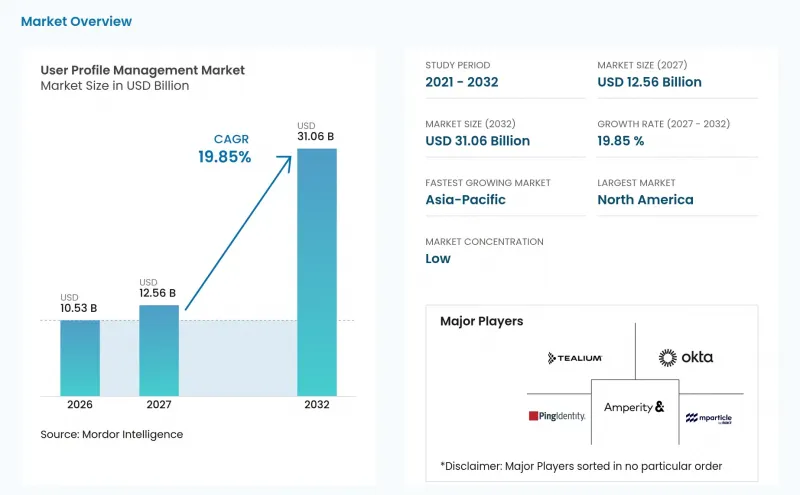
Global User Profile Management Market Trends and Insights
Demand for Unified Cross-Channel User Profiles
The User profile management market is driven by the need to integrate data from loyalty programs, mobile apps, physical stores, and digital storefronts. Fragmented records can limit personalization because a business cannot recognize the same customer across channels. Shopify reported that brands using unified customer profiles can increase average order value by up to 20%. This use case is moving profile management beyond marketing departments and into data, technology, and security functions. Salesforce Agentforce and Amperity's Model Context Protocol server demonstrated that AI applications can consume resolved profiles directly, reducing the need for manual data pipeline work. As AI-supported customer interactions increase, poor record quality becomes harder to ignore because it can affect every interaction that depends on customer context.
Rising Adoption of Passwordless Authentication and Customer Identity Platforms
Passwordless authentication is widening the functional role of user profile platforms. FIDO standards such as FIDO2 and WebAuthn support passkeys across major operating systems and browsers, while the FIDO Alliance has promoted passkeys as a replacement for passwords in consumer and enterprise sign-in flows. Passkeys can reduce account recovery work and reduce abandonment when users must remember a password. This makes authentication data a useful part of an active user record rather than a separate security event. Developer-focused customer identity tools are also making advanced authentication more accessible to smaller organizations. The User profile management market can therefore extend beyond large identity programs as managed tools reduce the technical work needed to offer secure sign-in.
Integration Complexity Across Legacy and Cloud Systems
The User profile management market may see slower adoption when organizations must integrate older identity stores with modern cloud tools. Many legacy systems were designed for static, separate user directories rather than for real-time profile resolution. Integration projects can require changes to data structures, application interfaces, and access rules before a unified record is available. During a long transition, companies may operate old and new systems in parallel, which can create duplicate records and reduce confidence in the result. The problem is more acute in regulated sectors where core banking platforms and public-sector systems have rigid technical constraints. RudderStack introduced infrastructure-as-code governance capabilities in February 2026 to help organizations manage trusted customer context and data controls in complex deployments.
Other drivers and restraints analyzed in the detailed report include:
- Intensifying Privacy, Consent, and Identity Governance Requirements
- Growth of AI Agent Identity and Machine-to-Machine User Context
- Data Residency, Cross-Border Transfer, and Regulatory Fragmentation
For complete list of drivers and restraints, kindly check the Table Of Contents.
Segment Analysis
Software held 67.89% of the User profile management market in 2026. This position reflects enterprise spending on identity resolution, profile unification, authentication, authorization, analytics, and consent management modules. Organizations use the software layer to create and maintain a profile that can be recognized across business systems. It also supports the rules that determine whether a user or application can access a service. Identity resolution and profile unification attract high-value projects because enterprises view the identity graph as a durable operating infrastructure. The User profile management market needs these functions to work together, especially where customer, employee, and application identities overlap.
Services are projected to grow at a 21.74% CAGR through 2032, the fastest component rate in the supplied data. Implementation, advisory, integration, and support remain important because profile unification can require extensive work across source systems. Tealium launched the Context API in June 2026 to enable AI agents, applications, and experiences to use governed, real-time customer context without having to rebuild data pipelines. Authentication software is also evolving with passkey adoption, while consent tools are moving from static form collection to jurisdiction-aware controls. Service demand can remain high after license purchase because organizations must keep their data models, integrations, and consent rules up to date. This creates an opportunity for providers that can shorten implementation without reducing governance quality.
On-premises deployment accounted for 66.15% of the User profile management market in 2026. Regulated industries and public institutions often retain local deployment because they must manage data residency, sector-specific rules, or national security requirements. Financial services organizations may also prefer closer control over sensitive identity stores. The existing on-premises base is not only a technology choice because long-term contracts and established operating procedures can make migration difficult. Organizations can continue using on-premises systems when a cloud transition does not satisfy internal risk requirements. This installed base keeps local deployment important even as broader enterprise infrastructure moves toward cloud delivery.
Cloud deployment is projected to grow at a 21.02% CAGR through 2032. Managed infrastructure can reduce operational costs for smaller businesses without large IT teams. Private and sovereign cloud options can also help address concerns over where sensitive information is stored. The User profile management market is moving toward modular architectures that allow selected functions to be delivered in the cloud without an immediate full migration. This approach can support gradual modernization while maintaining control over high-risk records. The pace of cloud adoption will depend on trust certifications, integration quality, and the availability of cloud locations that meet local requirements.
Complete Report Scope:
- By Component
- Software
- Identity Resolution and Profile Unification
- Authentication and Authorization
- Consent and Preference Management
- Profile Analytics and Enrichment
- Other Software
- Services
- Implementation and Integration Services
- Consulting and Advisory Services
- Support and Maintenance Services
- Software
- By Deployment Mode
- On-Premises
- Cloud
- By Organization Size
- Large Enterprises
- Small and Medium-Sized Enterprises
- By End-User Industry
- Banking, Financial Services, and Insurance (BFSI)
- Government and Public Administration
- Healthcare and Life Sciences
- IT and Telecommunication
- Industrial Manufacturing
- Retail and E-commerce
- Energy and Utilities
- Other End-User Industries
- By Geography
- North America
- United States
- Canada
- South America
- Brazil
- Argentina
- Mexico
- Rest of South America
- Europe
- Germany
- United Kingdom
- France
- Italy
- Russia
- Rest of Europe
- Asia-Pacific
- China
- Japan
- India
- South Korea
- Rest of Asia-Pacific
- Middle East
- Saudi Arabia
- United Arab Emirates
- Rest of Middle East
- Africa
- South Africa
- Nigeria
- Rest of Africa
- North America
Geography Analysis
North America held 35.18% of the User profile management market in 2026. The United States has a mature base of customer identity vendors and enterprise buyers, and regional businesses continue to invest in first-party data, authentication, consent controls, and digital customer experiences. California privacy requirements keep consent management relevant for organizations that process consumer data. Canada also contributes to demand as privacy rules and corporate data practices evolve. The region's vendor concentration and established technology spending support its leading position.
Europe was the second-largest regional position in the supply analysis. Germany, the United Kingdom, and France are major demand centers because cross-border processing and regulated services require controlled identity records. The GDPR provides a consistent legal foundation for data protection across the European Union. Germany is moving toward mobile credentials and biometric multifactor authentication, according to HID's 2026 security and identity report. Russia's localization requirements can limit foreign cloud deployment, making regional configuration and local hosting important for suppliers.
Asia-Pacific is projected to grow at a 20.67% CAGR through 2032. The User profile management market size for Asia-Pacific is supported by digital payments, national identity programs, mobile use, and data sovereignty policies. India combines new personal-data rules with risk-based authentication requirements for payments. Japan and South Korea provide demand for real-time, device-aware authentication in mobile environments, while Brazil, Saudi Arabia, and the United Arab Emirates offer future opportunities as identity and consent frameworks mature.
- Okta, Inc.
- Ping Identity Corporation
- Tealium Inc.
- mParticle, Inc.
- Amperity, Inc.
- Treasure Data, Inc.
- BlueConic, Inc.
- Lytics, Inc.
- ActionIQ, Inc.
- RedPoint Global Inc.
- RudderStack, Inc.
- Hightouch, Inc.
- Zeotap GmbH
- Bluecore, Inc.
- Blueshift, Inc.
- Simon Data, Inc.
- FusionAuth, Inc.
- Frontegg, Inc.
- Stytch, Inc.
- Clerk, Inc.
Additional Benefits:
- The market estimate (ME) sheet in Excel format
- 3 months of analyst support
TABLE OF CONTENTS
1 INTRODUCTION
- 1.1 Study Assumptions and Market Definition
- 1.2 Scope of the Study
2 RESEARCH METHODOLOGY
3 EXECUTIVE SUMMARY
4 MARKET LANDSCAPE
- 4.1 Market Overview
- 4.2 Market Drivers
- 4.2.1 Demand for Unified Cross-Channel User Profiles
- 4.2.2 Rising Adoption of Passwordless Authentication and Customer Identity Platforms
- 4.2.3 Intensifying Privacy, Consent, and Identity Governance Requirements
- 4.2.4 Growth of AI Agent Identity and Machine-to-Machine User Context
- 4.2.5 Need for Portable Consent-Aware Identity Graphs
- 4.2.6 Real-Time Fraud Prevention Through Continuous Profile Signals
- 4.3 Market Restraints
- 4.3.1 Integration Complexity Across Legacy and Cloud Systems
- 4.3.2 Data Residency, Cross-Border Transfer, and Regulatory Fragmentation
- 4.3.3 False Matches and Profile Fragmentation in Identity Resolution
- 4.3.4 Vendor Lock-In and Usage-Based Cost Volatility
- 4.4 Industry Value Chain Analysis
- 4.5 Regulatory Landscape
- 4.6 Technological Outlook
- 4.7 Porter's Five Forces Analysis
- 4.7.1 Threat of New Entrants
- 4.7.2 Bargaining Power of Suppliers
- 4.7.3 Bargaining Power of Buyers
- 4.7.4 Threat of Substitutes
- 4.7.5 Competitive Rivalry
- 4.8 Impact of Macroeconomic Factors on the Market
5 MARKET SIZE AND GROWTH FORECASTS (VALUE)
- 5.1 By Component
- 5.1.1 Software
- 5.1.1.1 Identity Resolution and Profile Unification
- 5.1.1.2 Authentication and Authorization
- 5.1.1.3 Consent and Preference Management
- 5.1.1.4 Profile Analytics and Enrichment
- 5.1.1.5 Other Software
- 5.1.2 Services
- 5.1.2.1 Implementation and Integration Services
- 5.1.2.2 Consulting and Advisory Services
- 5.1.2.3 Support and Maintenance Services
- 5.1.1 Software
- 5.2 By Deployment Mode
- 5.2.1 On-Premises
- 5.2.2 Cloud
- 5.3 By Organization Size
- 5.3.1 Large Enterprises
- 5.3.2 Small and Medium-Sized Enterprises
- 5.4 By End-User Industry
- 5.4.1 Banking, Financial Services, and Insurance (BFSI)
- 5.4.2 Government and Public Administration
- 5.4.3 Healthcare and Life Sciences
- 5.4.4 IT and Telecommunication
- 5.4.5 Industrial Manufacturing
- 5.4.6 Retail and E-commerce
- 5.4.7 Energy and Utilities
- 5.4.8 Other End-User Industries
- 5.5 By Geography
- 5.5.1 North America
- 5.5.1.1 United States
- 5.5.1.2 Canada
- 5.5.2 South America
- 5.5.2.1 Brazil
- 5.5.2.2 Argentina
- 5.5.2.3 Mexico
- 5.5.2.4 Rest of South America
- 5.5.3 Europe
- 5.5.3.1 Germany
- 5.5.3.2 United Kingdom
- 5.5.3.3 France
- 5.5.3.4 Italy
- 5.5.3.5 Russia
- 5.5.3.6 Rest of Europe
- 5.5.4 Asia-Pacific
- 5.5.4.1 China
- 5.5.4.2 Japan
- 5.5.4.3 India
- 5.5.4.4 South Korea
- 5.5.4.5 Rest of Asia-Pacific
- 5.5.5 Middle East
- 5.5.5.1 Saudi Arabia
- 5.5.5.2 United Arab Emirates
- 5.5.5.3 Rest of Middle East
- 5.5.6 Africa
- 5.5.6.1 South Africa
- 5.5.6.2 Nigeria
- 5.5.6.3 Rest of Africa
- 5.5.1 North America
6 COMPETITIVE LANDSCAPE
- 6.1 Market Concentration
- 6.2 Strategic Moves
- 6.3 Market Share Analysis
- 6.4 Company Profiles (includes Global Level Overview, Market Level Overview, Core Segments, Financials as available, Strategic Information, Market Rank/Share, Products and Services, Recent Developments)
- 6.4.1 Okta, Inc.
- 6.4.2 Ping Identity Corporation
- 6.4.3 Tealium Inc.
- 6.4.4 mParticle, Inc.
- 6.4.5 Amperity, Inc.
- 6.4.6 Treasure Data, Inc.
- 6.4.7 BlueConic, Inc.
- 6.4.8 Lytics, Inc.
- 6.4.9 ActionIQ, Inc.
- 6.4.10 RedPoint Global Inc.
- 6.4.11 RudderStack, Inc.
- 6.4.12 Hightouch, Inc.
- 6.4.13 Zeotap GmbH
- 6.4.14 Bluecore, Inc.
- 6.4.15 Blueshift, Inc.
- 6.4.16 Simon Data, Inc.
- 6.4.17 FusionAuth, Inc.
- 6.4.18 Frontegg, Inc.
- 6.4.19 Stytch, Inc.
- 6.4.20 Clerk, Inc.
7 MARKET OPPORTUNITIES AND FUTURE OUTLOOK
- 7.1 White-Space and Unmet-Need Assessment

