PUBLISHER: Mordor Intelligence | PRODUCT CODE: 2186002

PUBLISHER: Mordor Intelligence | PRODUCT CODE: 2186002
Middle East and Africa Data Center Optical Connectivity - Market Share Analysis, Industry Trends & Statistics, Growth Forecasts (2027 - 2032)
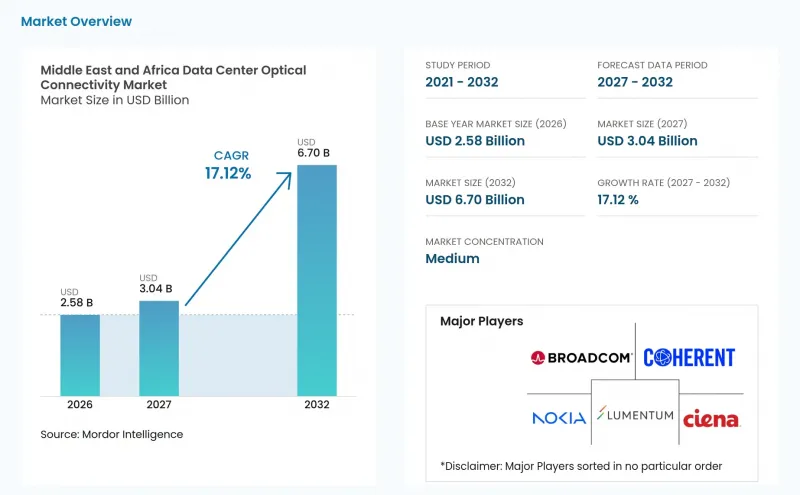
According to Mordor Intelligence, the Middle East and Africa data center optical connectivity market size is expected to grow from USD 2.58 billion in 2026 to USD 3.04 billion in 2027 and is forecast to reach USD 6.70 billion by 2032 at 17.12% CAGR over 2027-2032.
Middle East and Africa Data Center Optical Connectivity Market Trends and Insights
AI Cluster and Hyperscale Data Center Expansion
AI-focused data center programs are creating direct demand for denser optical fabrics across the Middle East and Africa data center optical connectivity market. AI training requires frequent exchanges between accelerators, switches, and storage, which increases the number of high-speed links compared with conventional cloud workloads. The same shift supports inter-campus connections when power limits or site design require computing to be distributed across locations. Vendors that can support both local fabrics and long-distance data center links are therefore better positioned for large AI campus projects. This demand gives the Middle East and Africa data center optical connectivity market a longer procurement cycle because network capacity must be installed before AI clusters can operate at scale.
400G, 800G, and 1.6T Fabric Upgrades
The move from 400G to 800G and 1.6T interfaces is changing equipment specifications in the Middle East and Africa data center optical connectivity market. AI racks can exceed 100 kW, which places pressure on switching capacity and makes higher-speed interfaces more relevant. Broadcom introduced its Taurus BCM83640 as a 3 nm 400G-per-lane optical PAM-4 DSP designed for 1.6T transceivers and 102.4T switching systems. Marvell also expanded its optical DSP portfolio for 1.6T links, which strengthens the component supply base for large AI fabric deployments. These upgrades require operators to assess fiber type, thermal design, testing capacity, and interoperability before they change a production fabric. The transition will favor facilities that are being built for AI workloads and can specify high-speed optics at the design stage.
Unreliable Power and Backup-Energy Requirements
Power reliability remains a practical constraint on data center development in several African markets. Operators must budget for backup generation and fuel when grid service cannot support continuous high-density compute. The International Energy Agency expects global data center electricity demand to more than double by 2030, with AI being a major source of additional demand. This pressure is more difficult to manage where transmission systems and local generation do not expand with digital infrastructure. It can delay new facilities and lead operators to limit port density or defer high-cost optical upgrades. Power planning is therefore part of the purchasing decision for the Middle East and Africa data center optical connectivity market, rather than a separate site-level issue.
Other drivers and restraints analyzed in the detailed report include:
- Sovereign Cloud and Data Residency Deployments
- Subsea Cable Landing and Data Center Interconnection Growth
- High Installation, Qualification, and Maintenance Costs
For complete list of drivers and restraints, kindly check the Table Of Contents.
Segment Analysis
Optical transceivers held 42.17% of the Middle East and Africa data center optical connectivity market size in 2026. This position reflects the large installed base of 100G and 400G pluggable modules across Gulf and African facilities. Active optical cables, cable assemblies, connectors, and interconnect assemblies support rack, row, and structured-cabling requirements. Their demand increases with the size of new facilities and the number of ports deployed. Optical circuit switches are projected to expand at a 24.71% CAGR through 2032. They can change paths between endpoints without conventional packet switching at every step. This makes them relevant to AI systems that need flexible, high-bandwidth connections among many GPUs. Marvell and Lumentum demonstrated optical circuit switching with 1.6T, coherent-lite, and 800G modules at OFC 2026. The demonstration supports the technical readiness of this approach for future AI fabrics.
The product mix will remain broad because no single component category serves every connection in a data center. Transceivers will continue to support most switch ports because they are replaceable and supported by mature supply channels. Optical circuit switches address a different requirement, which is rapid reconfiguration across AI clusters. Coherent introduced OCS-optimized transceivers that provide additional insertion-loss headroom for 400G and 800G applications. This gives operators a product path for switch architectures that include an optical circuit switching layer. Procurement teams must still test these combinations with their selected servers, switches, and network software. The Middle East and Africa data center optical connectivity market will therefore continue to use conventional products while specialized AI projects introduce advanced switching designs. Suppliers with validated interoperability data can reduce the qualification burden for regional operators.
Conventional pluggable optics accounted for 78.34% of revenue in 2026. Their lead comes from serviceability, well-established supply channels, and compatibility with front-panel switching equipment. Operators can replace a failed module without changing the switchboard or wider system. Linear pluggable optics, near-packaged optics, and co-packaged optics address rising power and bandwidth needs through closer integration. Co-packaged optics are projected to expand at a 23.87% CAGR through 2032. NVIDIA has described co-packaged optics as a way to improve power efficiency in AI factory networks. These systems reduce electrical path lengths between switching silicon and optical engines. Their deployment is most relevant to new high-density facilities that can plan cooling and service processes from the beginning.
The change in architecture does not mean that pluggable optics will quickly lose their installed-base advantage. Existing data centers need field-replaceable parts and familiar maintenance practices. Ciena introduced the Vesta 200 6.4T CPX in February 2026 and stated that the pluggable optical engine can reduce power consumption by up to 70% in certain applications. This type of offering can provide a step toward more integrated optical designs without a full redesign of the switching system. Near-packaged designs may also be considered when operators want better density but need more serviceability than a full co-packaged design. The Middle East and Africa data center optical connectivity market will likely have a mixed architecture base because AI campuses and older enterprise facilities have different requirements. Vendor support, repair procedures, and local technical capability will influence which architectures move into production. This gives systems integrators an important role in helping operators manage several technology generations at once.
The up-to-400 Gbps tier held 53.41% of the Middle East and Africa data center optical connectivity market size in 2026. It serves many existing enterprise, colocation, and cloud facilities that are not yet built around dense AI clusters. These systems use established 100G, 200G, and 400G connections for leaf-spine and server access networks. The 800 Gbps tier is becoming more relevant for high-capacity spine layers in Gulf hyperscale projects. The 1.6 Tbps tier is projected to expand at a 22.97% CAGR through 2032. Its adoption is tied to higher switch ASIC capacity and the need to reduce the number of ports required for a given fabric bandwidth. Broadcom's 400G-per-lane DSP supports 1.6T transceiver designs that can connect to 102.4T switches. These technical advances make the 1.6T tier more practical for operators planning large AI clusters.
The regional data-rate mix will differ between advanced Gulf campuses and many African enterprise facilities. Saudi Arabia and the United Arab Emirates are likely to specify 800G and 1.6T interfaces in new AI-oriented designs. Other facilities will retain 100G to 400G infrastructure where workloads and power availability do not justify a full fabric change. Above-1.6T products remain an early roadmap category rather than a broad deployment category within the forecast period. Marvell stated that its 1.6T optical DSP portfolio supports the next stage of AI data center connectivity. These products create a component supply path for systems that will need even higher speeds later. The Middle East and Africa data center optical connectivity market must therefore support two operating realities, one centered on high-speed AI fabrics and another centered on mature cloud and enterprise networks. Suppliers will need different commercial and support models for these customer groups.
Complete Report Scope:
- By Product Type
- Optical Transceivers
- Active Optical Cables
- Fiber-Optic Cable Assemblies
- Optical Connectors
- Optical Interconnect Assemblies
- Optical Circuit Switches
- By Connectivity Architecture
- Conventional Pluggable Optics
- Linear Pluggable Optics (LPO/LRO)
- Near-Packaged Optics (NPO)
- Co-Packaged Optics (CPO)
- By Data Rate
- Up to 400 Gbps
- 800 Gbps
- 1.6 Tbps
- Above 1.6 Tbps
- By Reach
- Up to 3 Meters
- 3-5 Meters
- 5-7 Meters
- 7-100 Meters
- 100-500 Meters
- Above 500 Meters
- By Application
- GPU-to-Switch
- GPU-to-GPU
- Switch-to-Switch
- Server-to-Switch
- Storage Connectivity
- Data Center Interconnect
- By Network Architecture
- Scale-Up
- Scale-Out
- By Data Center Type
- Hyperscale
- Colocation
- Enterprise
- Edge and Micro Data Centers
- By Country
- Saudi Arabia
- United Arab Emirates
- South Africa
- Nigeria
- Egypt
- Rest of Middle East and Africa
List of Companies Covered in this Report:
- Coherent Corp.
- Cisco Systems, Inc.
- Broadcom Inc.
- Nokia Corporation
- Ciena Corporation
- Lumentum Holdings Inc.
- Marvell Technology, Inc.
- Intel Corporation
- Amphenol Corporation
- TE Connectivity plc
- Molex LLC
- Corning Incorporated
- CommScope Holding Company, Inc.
- Sumitomo Electric Industries, Ltd.
- FURUKAWA ELECTRIC CO., LTD.
- Huawei Technologies Co., Ltd.
- Arista Networks, Inc.
- InnoLight Technology Corporation
- Accelink Technologies Co., Ltd.
- Yangtze Optical Fibre and Cable Joint Stock Limited Company
Additional Benefits:
- The market estimate (ME) sheet in Excel format
- 3 months of analyst support
TABLE OF CONTENTS
1 INTRODUCTION
- 1.1 Study Assumptions and Market Definition
- 1.2 Scope of the Study
2 RESEARCH METHODOLOGY
3 EXECUTIVE SUMMARY
4 MARKET LANDSCAPE
- 4.1 Market Overview
- 4.2 Market Drivers
- 4.2.1 AI Cluster and Hyperscale Data Center Expansion
- 4.2.2 Sovereign Cloud and Data Residency Deployments
- 4.2.3 400G, 800G, and 1.6T Fabric Upgrades
- 4.2.4 Subsea Cable Landing and Data Center Interconnection Growth
- 4.2.5 5G, Cloud, and Digital Transformation Investment
- 4.2.6 Regional Energy-Efficient Optical Transport Modernization
- 4.3 Market Restraints
- 4.3.1 Unreliable Power and Backup-Energy Requirements
- 4.3.2 High Installation, Qualification, and Maintenance Costs
- 4.3.3 Signal Integrity and Thermal Constraints at 800G and Above
- 4.3.4 Import Dependence, Tariffs, and Long Qualification Cycles
- 4.4 Industry Value Chain Analysis
- 4.5 Regulatory Landscape
- 4.6 Technological Outlook
- 4.7 Porter's Five Forces Analysis
- 4.7.1 Bargaining Power of Suppliers
- 4.7.2 Bargaining Power of Buyers
- 4.7.3 Threat of New Entrants
- 4.7.4 Threat of Substitutes
- 4.7.5 Intensity of Competitive Rivalry
- 4.8 Impact of Macroeconomic Factors on the Market
5 MARKET SIZE AND GROWTH FORECASTS (VALUE)
- 5.1 By Product Type
- 5.1.1 Optical Transceivers
- 5.1.2 Active Optical Cables
- 5.1.3 Fiber-Optic Cable Assemblies
- 5.1.4 Optical Connectors
- 5.1.5 Optical Interconnect Assemblies
- 5.1.6 Optical Circuit Switches
- 5.2 By Connectivity Architecture
- 5.2.1 Conventional Pluggable Optics
- 5.2.2 Linear Pluggable Optics (LPO/LRO)
- 5.2.3 Near-Packaged Optics (NPO)
- 5.2.4 Co-Packaged Optics (CPO)
- 5.3 By Data Rate
- 5.3.1 Up to 400 Gbps
- 5.3.2 800 Gbps
- 5.3.3 1.6 Tbps
- 5.3.4 Above 1.6 Tbps
- 5.4 By Reach
- 5.4.1 Up to 3 Meters
- 5.4.2 3-5 Meters
- 5.4.3 5-7 Meters
- 5.4.4 7-100 Meters
- 5.4.5 100-500 Meters
- 5.4.6 Above 500 Meters
- 5.5 By Application
- 5.5.1 GPU-to-Switch
- 5.5.2 GPU-to-GPU
- 5.5.3 Switch-to-Switch
- 5.5.4 Server-to-Switch
- 5.5.5 Storage Connectivity
- 5.5.6 Data Center Interconnect
- 5.6 By Network Architecture
- 5.6.1 Scale-Up
- 5.6.2 Scale-Out
- 5.7 By Data Center Type
- 5.7.1 Hyperscale
- 5.7.2 Colocation
- 5.7.3 Enterprise
- 5.7.4 Edge and Micro Data Centers
- 5.8 By Country
- 5.8.1 Saudi Arabia
- 5.8.2 United Arab Emirates
- 5.8.3 South Africa
- 5.8.4 Nigeria
- 5.8.5 Egypt
- 5.8.6 Rest of Middle East and Africa
6 COMPETITIVE LANDSCAPE
- 6.1 Market Concentration
- 6.2 Strategic Moves
- 6.3 Market Share Analysis
- 6.4 Company Profiles (includes Global Level Overview, Market Level Overview, Core Segments, Financials as available, Strategic Information, Market Rank/Share, Products and Services, Recent Developments)
- 6.4.1 Coherent Corp.
- 6.4.2 Cisco Systems, Inc.
- 6.4.3 Broadcom Inc.
- 6.4.4 Nokia Corporation
- 6.4.5 Ciena Corporation
- 6.4.6 Lumentum Holdings Inc.
- 6.4.7 Marvell Technology, Inc.
- 6.4.8 Intel Corporation
- 6.4.9 Amphenol Corporation
- 6.4.10 TE Connectivity plc
- 6.4.11 Molex LLC
- 6.4.12 Corning Incorporated
- 6.4.13 CommScope Holding Company, Inc.
- 6.4.14 Sumitomo Electric Industries, Ltd.
- 6.4.15 FURUKAWA ELECTRIC CO., LTD.
- 6.4.16 Huawei Technologies Co., Ltd.
- 6.4.17 Arista Networks, Inc.
- 6.4.18 InnoLight Technology Corporation
- 6.4.19 Accelink Technologies Co., Ltd.
- 6.4.20 Yangtze Optical Fibre and Cable Joint Stock Limited Company
7 MARKET OPPORTUNITIES AND FUTURE OUTLOOK
- 7.1 White-Space and Unmet-Need Assessment

