PUBLISHER: Mordor Intelligence | PRODUCT CODE: 2186079

PUBLISHER: Mordor Intelligence | PRODUCT CODE: 2186079
United States Current Transformer - Market Share Analysis, Industry Trends & Statistics, Growth Forecasts (2027 - 2032)
According to Mordor Intelligence, the United States current transformer market size is expected to increase from USD 1.55 billion in 2026 to USD 1.68 billion in 2027 and reach USD 2.57 billion by 2032, growing at a CAGR of 8.86% over 2027-2032.
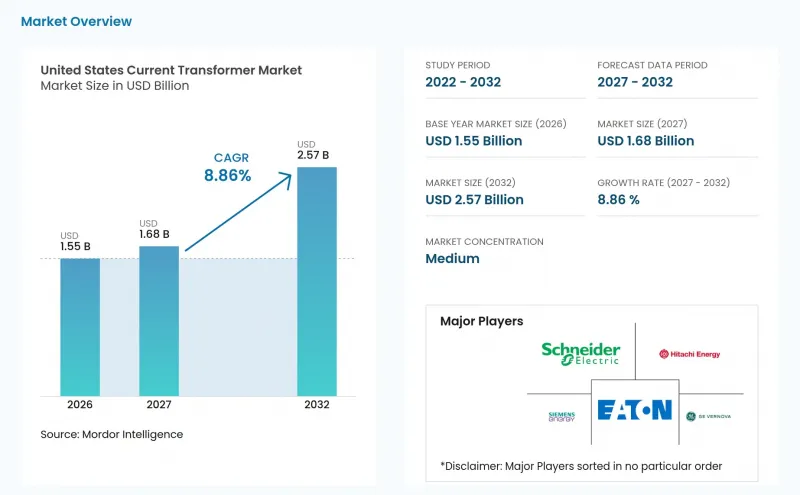
United States Current Transformer Market Trends and Insights
Grid Modernization and Substation Replacement
The United States current transformer market benefits from utility investment in substation replacement and grid modernization. Aging transmission and distribution assets support replacement demand for protection and metering equipment. Current transformer replacements often accompany upgrades to relays, breakers, and control systems at existing substations. These projects can require higher accuracy classes than those installed under older protection practices. FirstEnergy announced a USD 950 million PJM-selected modernization project in Ohio and Pennsylvania during March 2026, covering substation rebuilds and high-voltage line upgrades. Reliability requirements also sustain investment because utilities must maintain safe and dependable system operation while they replace aging assets.
Renewable and Battery Interconnection Metering
The United States current transformer market receives additional demand from renewable generation and battery projects entering utility interconnection processes. The national queue of 2,061 GW at the end of 2025 indicates that large volumes of proposed generation and storage still require connection studies, construction, or both. Interconnection points need current transformers for revenue metering, protection, and control functions. Battery projects also need metering that can accurately distinguish charging and discharging conditions. Cluster processing reduces the time between completed agreements and construction activity for selected projects, which can tighten delivery schedules for equipment manufacturers. Withdrawn projects may still have supported limited equipment demand during feasibility work or partial site development.
High Retrofit, Certification, and Calibration Costs
Retrofit costs limit some demand within the United States current transformer market. Replacing an instrument transformer in an energized substation can require either a split-core installation or a planned outage with circuit changes. Split-core options can involve accuracy tradeoffs, while planned outages require coordination among utilities, contractors, and customers. Calibration against recognized standards adds cost and may extend the project schedule. Smaller commercial and industrial users are more sensitive to these costs because their projects have fewer units over which to spread planning expenses. Utility projects are less exposed because qualifying investments can often be recovered through regulated rate structures.
Other drivers and restraints analyzed in the detailed report include:
- Digital Substations and Advanced Metering Adoption
- Data Center and Industrial Load Monitoring
- Copper, Electrical-Steel, and Insulation-Material Volatility
For complete list of drivers and restraints, kindly check the Table Of Contents.
Segment Analysis
Medium voltage held 49.8% of the United States current transformer market size in 2026. The segment supports distribution substations, automated feeder systems, advanced metering infrastructure, and industrial facilities using 12 kV to 35 kV switchgear. Large utility metering programs in California, Texas, and New York support replacement demand across this installed base. Distribution projects increasingly require more precise current measurements for billing and system management. Low voltage products serve residential submetering and distributed energy monitoring, where compact designs and simple installation are important. Compliance with International Electrotechnical Commission (IEC) 61869-2 and American National Standards Institute (ANSI) C57.13 remains important across voltage classes because utilities and industrial buyers require qualified products and credible calibration arrangements.
High voltage is projected to grow at a 9.5% CAGR through 2032, exceeding the overall United States current transformer market rate. This segment serves transmission substations and large generation interconnections that require equipment for 115 kV to 765 kV systems. New transmission projects and the replacement cycle for station-class equipment support this demand. Grid operators are also seeking products that can meet modern measurement and protection needs in wide-area monitoring systems. GE Vernova updated its RevenueSense and SUPERBUTE product materials during 2025, including specified Institute of Electrical and Electronics Engineers (IEEE) C57.13 Class 0.15 performance for revenue-metering applications. Suppliers able to meet tighter accuracy specifications can compete for projects where legacy equipment no longer meets updated operating practices.
Complete Report Scope:
- By Voltage
- Low Voltage
- Medium Voltage
- High Voltage
- By End User
- Power Utilities
- Industrial
- Commercial
- Residential
List of Companies Covered in this Report:
- ABB Ltd.
- AMRAN LLC
- Coilcraft, Inc.
- Continental Control Systems, LLC
- CR Magnetics, Inc.
- Dongan Electric Manufacturing Company
- Eaton Corporation plc
- GE Vernova Inc.
- Hitachi Energy Ltd.
- Instrument Transformer Equipment Corporation
- Meramec Instrument Transformer Company
- Midwest Current Transformer
- MPS Industries, Inc.
- Pearson Electronics, Inc.
- RITZ Instrument Transformers, Inc.
- Schneider Electric SE
- Siemens Energy AG
- Stangenes Industries, Inc.
- Triad Magnetics
- V&F Transformer Corporation
Additional Benefits:
- The market estimate (ME) sheet in Excel format
- 3 months of analyst support
TABLE OF CONTENTS
1 INTRODUCTION
- 1.1 Study Assumptions and Market Definition
- 1.2 Scope of the Study
2 RESEARCH METHODOLOGY
3 EXECUTIVE SUMMARY
4 MARKET LANDSCAPE
- 4.1 Market Overview
- 4.2 Market Drivers
- 4.2.1 Grid Modernization and Substation Replacement
- 4.2.2 Renewable and Battery Interconnection Metering
- 4.2.3 Digital Substations and Advanced Metering Adoption
- 4.2.4 Data-Center and Industrial Load Monitoring
- 4.2.5 Retrofit Demand for No-Outage Split-Core Installation
- 4.2.6 Wide-Bandwidth Measurement for Inverter-Rich Fault Profiles
- 4.3 Market Restraints
- 4.3.1 High Retrofit, Certification, and Calibration Costs
- 4.3.2 Copper, Electrical-Steel, and Insulation-Material Volatility
- 4.3.3 CT Saturation Under Inverter-Dominated Fault Conditions
- 4.3.4 Long Utility Qualification Cycles and Limited Calibration Capacity
- 4.4 Supply-Chain Analysis
- 4.5 Porter's Five Forces Analysis
- 4.5.1 Bargaining Power of Suppliers
- 4.5.2 Bargaining Power of Buyers
- 4.5.3 Threat of New Entrants
- 4.5.4 Threat of Substitutes
- 4.5.5 Competitive Rivalry
- 4.6 Technology Outlook
- 4.7 Regulatory Landscape
- 4.8 Investment Analysis
- 4.9 PESTLE Analysis
5 MARKET SIZE AND GROWTH FORECASTS, VALUE AND VOLUME
- 5.1 By Voltage
- 5.1.1 Low Voltage
- 5.1.2 Medium Voltage
- 5.1.3 High Voltage
- 5.2 By End User
- 5.2.1 Power Utilities
- 5.2.2 Industrial
- 5.2.3 Commercial
- 5.2.4 Residential
6 COMPETITIVE LANDSCAPE
- 6.1 Market Concentration
- 6.2 Strategic Moves
- 6.3 Market Share Analysis
- 6.4 Company Profiles (includes Global Level Overview, Market Level Overview, Core Segments, Financials as available, Strategic Information, Market Rank/Share, Products and Services, Recent Developments)
- 6.4.1 ABB Ltd.
- 6.4.2 AMRAN LLC
- 6.4.3 Coilcraft, Inc.
- 6.4.4 Continental Control Systems, LLC
- 6.4.5 CR Magnetics, Inc.
- 6.4.6 Dongan Electric Manufacturing Company
- 6.4.7 Eaton Corporation plc
- 6.4.8 GE Vernova Inc.
- 6.4.9 Hitachi Energy Ltd.
- 6.4.10 Instrument Transformer Equipment Corporation
- 6.4.11 Meramec Instrument Transformer Company
- 6.4.12 Midwest Current Transformer
- 6.4.13 MPS Industries, Inc.
- 6.4.14 Pearson Electronics, Inc.
- 6.4.15 RITZ Instrument Transformers, Inc.
- 6.4.16 Schneider Electric SE
- 6.4.17 Siemens Energy AG
- 6.4.18 Stangenes Industries, Inc.
- 6.4.19 Triad Magnetics
- 6.4.20 V&F Transformer Corporation
7 MARKET OPPORTUNITIES AND FUTURE OUTLOOK
- 7.1 White-Space and Unmet-Need Assessment

