PUBLISHER: Mordor Intelligence | PRODUCT CODE: 2186112

PUBLISHER: Mordor Intelligence | PRODUCT CODE: 2186112
Milled Carbon Fiber - Market Share Analysis, Industry Trends & Statistics, Growth Forecasts (2027 - 2032)
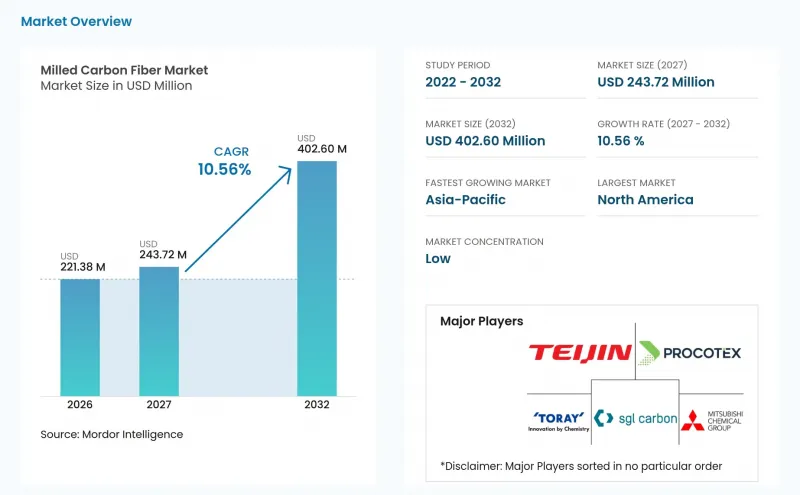
According to Mordor Intelligence, the milled carbon fiber market size was valued at USD 221.38 million in 2026 and is estimated to grow from USD 243.72 million in 2027 to reach USD 402.60 million by 2032, at a CAGR of 10.56% during the forecast period (2027-2032).
Global Milled Carbon Fiber Market Trends and Insights
Lightweighting for Vehicle Efficiency and EV Range
Electric vehicle platforms need lower mass outside the battery pack because heavier components reduce the range available from a fixed battery capacity. The milled carbon fiber market serves this requirement in injection-molded battery brackets, motor housings, and structural panels. A 2025 study found that polypropylene filaments with 9.09 weight percent (wt%) milled carbon fiber had 74% higher tensile strength and 99% higher flexural strength than unfilled polymer. These results support the use of carbon-fiber-filled compounds where manufacturers want greater stiffness without metal inserts or heavier mineral fillers. The milled format can run through standard injection-molding screws, which reduces the equipment barrier for high-volume vehicle programs. Component-level weight reduction can therefore be introduced without a full redesign of the molding process.
Recycled Fiber Cost and Embodied-Carbon Advantage
Recycled milled fiber offers both lower material emissions and a lower energy requirement than virgin fiber routes. A 2025 review reported an embodied greenhouse-gas footprint of 2.0 kg CO2-equivalent per kilogram for recycled carbon fiber, compared with 12.6 kg CO2-equivalent per kilogram for virgin carbon fiber. The same review reported that recycled-fiber production can use 50% to 70% less energy than virgin production. This makes recycled feedstock relevant to buyers in the milled carbon fiber market that must document material-level emissions in their supply chains. The milled carbon fiber market can also gain from lower procurement costs when recovered feedstock is available at a suitable quality. The commercial value of recycled grades depends on consistent properties, since a lower carbon footprint does not remove the need for reliable compound performance.
High Energy and Processing Cost for Consistent Particle-Size Distribution
Narrow particle-size specifications require shredding, milling, classification, and quality checks that use energy and equipment time. A 2025 study reported mechanical milling energy of 2.03 MJ per kilogram of processed composite material. Energy use rises when customers require tighter particle distributions or when feedstock has a high fiber volume fraction. This creates pressure on margins in applications where processors compete primarily on price. Smaller recyclers can face wider batch variation than operators with continuous grinding and air-classification systems. Investment in continuous equipment can improve consistency, but it can also be difficult in regions with high energy prices or limited financing.
Other drivers and restraints analyzed in the detailed report include:
- Demand for Conductive and Thermally Stable Fillers
- Aerospace and Wind-Industry Composite Scrap Availability
- Variable Fiber Length and Surface Chemistry in Recycled Feedstock
For complete list of drivers and restraints, kindly check the Table Of Contents.
Segment Analysis
Recycled fiber held 52.45% of the milled carbon fiber market share in 2026 and is projected to advance at an 11.06% CAGR through 2032. Its position reflects lower input costs and lower emissions associated with recovery routes. A 2025 review found an embodied greenhouse-gas footprint of 2.0 kg CO2-equivalent per kilogram for recycled carbon fiber, compared with 12.6 kg CO2-equivalent per kilogram for virgin carbon fiber. The review also found that recycling can use 50% to 70% less energy than virgin production. These characteristics support procurement programs that measure product-level emissions and use recycled material in reinforcement, coating, conductive, and thermal applications.
Virgin fiber held 47.55% of the milled carbon fiber market share in 2026 and continues to serve applications requiring precise geometry and verified surface chemistry. Aerospace interiors, defense electronics, and demanding power-electronics applications can place greater weight on controlled properties than on material cost. The boundary between recycled and virgin material will depend on progress in fiber recovery and specification practices. Pyrolysis-recovered fiber can supply broader compound applications, while solvolysis-recovered material can serve higher-value coatings and thermal-management uses. ISO 19350:2025 supports the assessment of recycled filament properties, helping buyers compare materials during qualification.
Complete Report Scope:
- By Fiber Type
- Recycled Fiber
- Virgin Fiber
- By Application
- Reinforcements
- Coatings and Adhesives
- Electrically Conductive Fillers
- Thermal Management Materials
- Electromagnetic Shielding
- Additive Manufacturing Feedstock
- Other Applications
- By End-Use Industry
- Automotive
- Electrical and Electronics
- Sporting Goods
- Aerospace and Defense
- Other End-Use Industries
- By Geography
- Asia-Pacific
- China
- India
- Japan
- South Korea
- ASEAN Countries
- Rest of Asia-Pacific
- North America
- United States
- Canada
- Mexico
- Europe
- Germany
- United Kingdom
- France
- Italy
- NORDIC Countries
- Rest of Europe
- South America
- Brazil
- Argentina
- Rest of South America
- Middle East and Africa
- Saudi Arabia
- South Africa
- Rest of Middle East and Africa
- Asia-Pacific
Geography Analysis
North America held 32.78% of the milled carbon fiber market share in 2026. The region combines a large automotive base, recycling activity, and early use of milled fiber in structural and functional applications. Demand includes injection-molded compounds, additive manufacturing materials, and components that need lower weight or electrical performance. Automotive qualification programs give milled carbon fiber market suppliers a path to higher-volume use when recovered fiber properties are consistent. Research on milled-fiber-filled polypropylene filament also supports functional automotive part fabrication.
Asia-Pacific is projected to advance at an 11.49% CAGR through 2032. China's electric vehicle production, Japan's composites base, and South Korea's fiber-producer capacity support regional demand. Japan has a role in recycled carbon-fiber qualification through work on testing and fiber recovery. ISO 19350:2025 provides a method for assessing tensile-strength distribution and interfacial shear strength of recycled carbon-fiber filaments. India and the Association of Southeast Asian Nations (ASEAN) countries can provide further demand as electric vehicle adoption grows outside China.
Europe benefits from aerospace scrap availability, recycling investment, and buyer interest in lower-carbon composite materials. Westlake Epoxy and Alpha Recyclage Composites announced a 2025 collaboration for a French recycling operation targeting 1,000 metric tons of annual composite-waste processing by 2027. South America, the Middle East, and Africa remain earlier-stage demand areas for imported material in automotive and aerospace maintenance, repair, and overhaul applications. Their progress depends on import economics, local recycling capacity, and original equipment manufacturer investment.
- Carbon Fiber Recycling, Inc.
- Formosa Plastics Corporation
- Gen 2 Carbon Limited
- Hexcel Corporation
- HS HYOSUNG ADVANCED MATERIALS
- KUREHA CORPORATION
- Mitsubishi Chemical Group Corporation
- Nippon Graphite Fiber Co., Ltd.
- Procotex
- SGL Carbon
- Shocker Composites LLC
- Syensqo
- Teijin Limited
- TORAY INDUSTRIES, INC.
- Vartega Inc.
Additional Benefits:
- The market estimate (ME) sheet in Excel format
- 3 months of analyst support
TABLE OF CONTENTS
1 Introduction
- 1.1 Study Assumptions and Market Definition
- 1.2 Scope of the Study
2 Research Methodology
3 Executive Summary
4 Market Landscape
- 4.1 Market Overview
- 4.2 Market Drivers
- 4.2.1 Lightweighting for Vehicle Efficiency and EV Range
- 4.2.2 Recycled Fiber Cost and Embodied-Carbon Advantage
- 4.2.3 Demand for Conductive and Thermally Stable Fillers
- 4.2.4 Aerospace and Wind-Industry Composite Scrap Availability
- 4.2.5 Qualification of Milled Fiber in Additive Manufacturing Feedstock
- 4.3 Market Restraints
- 4.3.1 High Energy and Processing Cost for Consistent Particle-Size Distribution
- 4.3.2 Variable Fiber Length and Surface Chemistry in Recycled Feedstock
- 4.3.3 Qualification and Test-Standard Gaps for Recycled Composite Grades
- 4.4 Value Chain Analysis
- 4.5 Porter's Five Forces Analysis
- 4.5.1 Bargaining Power of Suppliers
- 4.5.2 Bargaining Power of Buyers
- 4.5.3 Threat of New Entrants
- 4.5.4 Threat of Substitutes
- 4.5.5 Competitive Rivalry
5 Market Size and Growth Forecasts (Value)
- 5.1 By Fiber Type
- 5.1.1 Recycled Fiber
- 5.1.2 Virgin Fiber
- 5.2 By Application
- 5.2.1 Reinforcements
- 5.2.2 Coatings and Adhesives
- 5.2.3 Electrically Conductive Fillers
- 5.2.4 Thermal Management Materials
- 5.2.5 Electromagnetic Shielding
- 5.2.6 Additive Manufacturing Feedstock
- 5.2.7 Other Applications
- 5.3 By End-Use Industry
- 5.3.1 Automotive
- 5.3.2 Electrical and Electronics
- 5.3.3 Sporting Goods
- 5.3.4 Aerospace and Defense
- 5.3.5 Other End-Use Industries
- 5.4 By Geography
- 5.4.1 Asia-Pacific
- 5.4.1.1 China
- 5.4.1.2 India
- 5.4.1.3 Japan
- 5.4.1.4 South Korea
- 5.4.1.5 ASEAN Countries
- 5.4.1.6 Rest of Asia-Pacific
- 5.4.2 North America
- 5.4.2.1 United States
- 5.4.2.2 Canada
- 5.4.2.3 Mexico
- 5.4.3 Europe
- 5.4.3.1 Germany
- 5.4.3.2 United Kingdom
- 5.4.3.3 France
- 5.4.3.4 Italy
- 5.4.3.5 NORDIC Countries
- 5.4.3.6 Rest of Europe
- 5.4.4 South America
- 5.4.4.1 Brazil
- 5.4.4.2 Argentina
- 5.4.4.3 Rest of South America
- 5.4.5 Middle East and Africa
- 5.4.5.1 Saudi Arabia
- 5.4.5.2 South Africa
- 5.4.5.3 Rest of Middle East and Africa
- 5.4.1 Asia-Pacific
6 Competitive Landscape
- 6.1 Market Concentration
- 6.2 Strategic Moves
- 6.3 Market Share (%)/Ranking Analysis
- 6.4 Company Profiles (includes Global Overview, Market Overview, Core Segments, Financials as available, Strategic Information, Products and Services, and Recent Developments)
- 6.4.1 Carbon Fiber Recycling, Inc.
- 6.4.2 Formosa Plastics Corporation
- 6.4.3 Gen 2 Carbon Limited
- 6.4.4 Hexcel Corporation
- 6.4.5 HS HYOSUNG ADVANCED MATERIALS
- 6.4.6 KUREHA CORPORATION
- 6.4.7 Mitsubishi Chemical Group Corporation
- 6.4.8 Nippon Graphite Fiber Co., Ltd.
- 6.4.9 Procotex
- 6.4.10 SGL Carbon
- 6.4.11 Shocker Composites LLC
- 6.4.12 Syensqo
- 6.4.13 Teijin Limited
- 6.4.14 TORAY INDUSTRIES, INC.
- 6.4.15 Vartega Inc.
7 Market Opportunities and Future Outlook
- 7.1 White-Space and Unmet-Need Assessment

