PUBLISHER: Mordor Intelligence | PRODUCT CODE: 2187241

PUBLISHER: Mordor Intelligence | PRODUCT CODE: 2187241
Carbon Fiber - Market Share Analysis, Industry Trends & Statistics, Growth Forecasts (2027 - 2032)
According to Mordor Intelligence, the carbon fiber market size is estimated at USD 5.91 billion in 2026 and is projected to be USD 6.74 billion in 2027, reaching USD 13.03 billion by 2032, growing at a CAGR of 14.07% from 2027 to 2032.
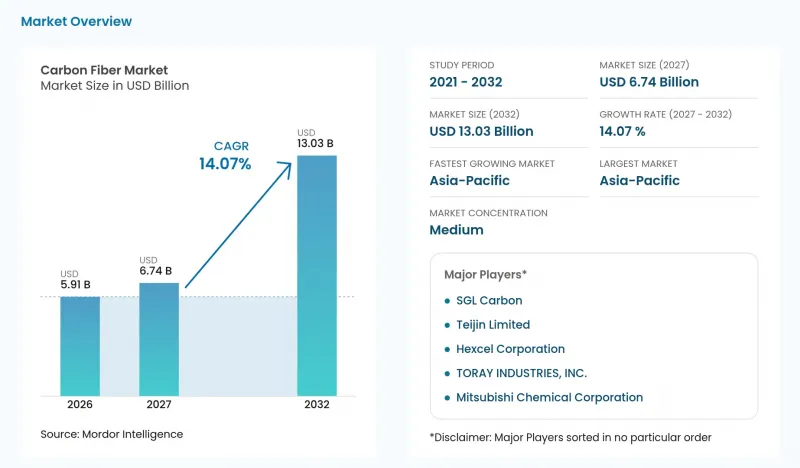
The carbon fiber market volume is estimated at 246.3 kilotons in 2026 and is projected to be 289.7 kilotons in 2027, reaching 651.5 kilotons by 2032, growing at a CAGR of 17.6% from 2027 to 2032. This report is segmented by Raw Material (Polyacrylonitrile and more), Fiber Type (Virgin Carbon Fiber and more), Application (Composite Materials and more), End-User Industry (Alternative Energy and more), and Geography (Asia-Pacific and more). The market forecasts are provided in terms of value (USD) and volume (kilotons), based on availability.
Global Carbon Fiber Market Trends and Insights
Rising production of hydrogen and CNG pressure vessels for commercial mobility
Commercial mobility can increase reinforcement demand when vehicle storage specifications call for carbon-fiber cylinders. Aosheng Hydrogen Energy rolled its first fiber-wound gas cylinder off the production line in Wujiang, China, in February 2025. On September 30, 2025, it obtained a B3 production license for metal-lined fiber-wound gas cylinders there and said it was ready for commercial production. The company described fiber-wound cylinders as used in public transportation and industrial production. Its automotive hydrogen cylinder has an aluminum-alloy liner, full carbon-fiber wrap and glass-fiber protective layer, rated at 35 MPa with capacities of 9 to 450 liters. For carbon-fiber cylinder designs, reinforcement demand would scale with cylinders delivered into transit and industrial programs, rather than license issuance alone.
Rapid deployment of offshore wind turbines requiring high-strength blades
New offshore installations enlarge the addressable project base for suppliers of high-strength blade materials. The Global Wind Energy Council (GWEC) reported that 9.3 GW of new offshore wind capacity was grid-connected worldwide in 2025, 16% more than in 2024 and the third-highest annual total on record. Carbon-fiber producers participate through projects whose blade specifications call for carbon reinforcement. Their demand exposure therefore follows the subset of deployed turbine designs using that material. The expanding installation base gives those suppliers more potential blade programs, making selection into a carbon-reinforced design the step that converts offshore deployment into recurring fiber orders.
Energy-intensive oxidation and carbonization
Energy demand creates a conversion-cost floor that limits how far fiber suppliers can compete on price alone. Production from fossil-based precursors is costly and energy-intensive, according to a 2025 research review. The review identifies stabilization and carbonization as the primary contributors to manufacturing energy demand. For a converter considering a price-sensitive component, this makes the economics of the upstream thermal route relevant alongside the component's performance. Expanding downstream demand therefore cannot by itself remove the energy burden embedded in fiber conversion. Producers serving lower-value applications face a harder commercial trade-off because expensive conversion leaves less room for price reductions.
Other drivers and restraints analyzed in the detailed report include:
- Adoption of battery-pack enclosures and lightweighting in EV platforms
- 3-D automated fiber-placement lines slashing composite cycle times
- Supply-chain risks for recycled carbon fiber feedstock
For complete list of drivers and restraints, kindly check the Table Of Contents.
Segment Analysis
Polyacrylonitrile (PAN) accounted for a 96.25% share of volume in 2026 and is both the largest segment and the fastest-growing segment, with a 17.8% volume CAGR forecast from 2027 to 2032. Zhongfu Shenying Carbon Fiber Co., Ltd. reported annual PAN-based dry-jet wet-spinning capacity of 29,000 metric tons in China in March 2026, with a further 31,000 metric tons under construction. That manufacturing base connects the precursor choice to an established route for producing commercial fiber. The construction program extends that producer's PAN-based manufacturing platform, creating scope to supply more converters through the same precursor route.
Commercial expansion also needs to reach the grades required for particular applications. Toray Carbon Fibers Europe started a unit at Abidos, France, in March 2026 for T300 and high-modulus fibers, with full operation then scheduled for the second half of 2026. Its PAN-based high-modulus Torayca fibers serve rigidity and thermal-expansion requirements in rockets, premium sports equipment and industrial rollers. Those uses distinguish grade expansion from simply adding undifferentiated fiber capacity. The commercial value of the ramp therefore depends on matching the added grades to the applications that need their particular performance characteristics.
Virgin carbon fiber (VCF) represented a 62.66% share of volume in 2026, making it the largest segment. As of March 2026, Toray Group reported annual capacity of 28,770 metric tons for regular-tow TORAYCA carbon fiber and 35,000 metric tons for large-tow carbon fiber under ZOLTEK. This combines substantial virgin-fiber scale with distinct tow formats and brands inside the same supplier group. The separation between TORAYCA regular tow and ZOLTEK large tow makes format-specific capacity the relevant supply measure for a buyer's component program.
Recycled carbon fiber (RCF) is the fastest-growing segment, with a 19.4% volume CAGR forecast from 2027 to 2032. In September 2026, R&M International Sales Corporation acquired Vartega's recovery technology and processing capability for EasyFeed Bundles and reported fulfilling orders for the recycled-fiber product. The transaction connects an existing commercial product with a new technology owner, supporting continued supply to thermoplastic compounders. The transfer makes control of a usable recovery-and-bundle process significant, because supplying compounders requires both recovered fiber and a format they can process.
Complete Report Scope:
- By Raw Material
- Polyacrylonitrile (PAN)
- Petroleum Pitch and Rayon
- By Fiber Type
- Virgin Carbon Fiber (VCF)
- Recycled Carbon Fiber (RCF)
- Others
- By Application
- Composite Materials
- Textiles
- Micro-Electrodes
- Catalysis
- By End-User Industry
- Aerospace and Defense
- Alternative Energy
- Automotive
- Construction and Infrastructure
- Sporting Goods
- Other End-user Industries
- By Geography
- Asia-Pacific
- China
- Japan
- India
- South Korea
- Rest of Asia-Pacific
- North America
- United States
- Canada
- Mexico
- Europe
- Germany
- United Kingdom
- France
- Italy
- Rest of Europe
- South America
- Brazil
- Argentina
- Rest of South America
- Middle-East and Africa
- Saudi Arabia
- United Arab Emirates
- South Africa
- Egypt
- Rest of Middle-East and Africa
- Asia-Pacific
Geography Analysis
Asia-Pacific accounted for a 45.97% share of volume in 2026 and is the fastest-growing geography, with a 20.2% volume CAGR forecast from 2027 to 2032. China's carbon-fiber demand was 132,027 metric tons in 2025, up 57.1% from 84,062 metric tons in 2024. In June 2026, Zhongfu Shenying Carbon Fiber Co., Ltd., a unit of China National Building Material Group, commissioned 3 lines in Lianyungang, Jiangsu, China, and brought them into operation. Japan's carbon-fiber shipments to domestic and overseas markets fell 5.2% in 2025, according to the Japan Carbon Fiber Manufacturers Association. China's demand rise and commissioned lines support further expansion there, while Japan's shipment decline points to uneven conditions across regional producers.
In North America, Toray reported annual US regular-tow carbon-fiber capacity of 9,900 metric tons as of March 2026. In Europe, SGL Carbon attributed its 2025 carbon-fiber restructuring to weak wind demand, global overcapacity and persistently low prices that undermined its European fiber competitiveness. Elsewhere in Europe, Toray's March 2026 capacity table identified Hungary as a ZOLTEK large-tow carbon-fiber production location. Buyers face distinct supply conditions, from US regular-tow capability and Hungarian large-tow production to the continuity risk associated with SGL's restructuring.
Brazil's wind-blade manufacturing base supports South America's downstream demand. Aeris invoiced 17 sets of 3 wind-turbine blades each in Brazil in the second quarter of 2026, with the sets available for customer pickup. In September 2025, the company sought lower Brazilian import duties on pultruded carbon-fiber and resin profiles for blade reinforcement. Within Middle-East and Africa, Cape Town-based South Industries reported 4 carbon-fiber bicycle-rim products in 2025, sold largely through local bike shops and European distributors. Aeris's request makes import duties relevant to blade-reinforcement costs, while South Industries' distribution channels extend the reach of South African rim production into Europe.
- A&P Technology, Inc.
- Anshan Senoda Technology Co., Ltd.
- Aksa Carbon
- Formosa Plastics Corporation
- Hexcel Corporation
- HS HYOSUNG ADVANCED MATERIALS
- Jiangsu Hengshen Co., Ltd.
- KUREHA CORPORATION
- Mitsubishi Chemical Corporation
- Nippon Graphite Fiber Co., Ltd.
- Rock West Composites, Inc.
- SGL Carbon
- Sigmatex (UK) Limited
- Syensqo
- Taekwang Industrial Co., Ltd.
- Teijin Limited
- TORAY INDUSTRIES, INC.
- UMATEX
- Zhongfu Shenying Carbon Fiber Co., Ltd.
Additional Benefits:
- The market estimate (ME) sheet in Excel format
- 3 months of analyst support
TABLE OF CONTENTS
1 INTRODUCTION
- 1.1 Study Assumptions and Market Definition
- 1.2 Scope of the Study
2 RESEARCH METHODOLOGY
3 EXECUTIVE SUMMARY
4 MARKET LANDSCAPE
- 4.1 Market Overview
- 4.2 Market Drivers
- 4.2.1 Rising production of hydrogen and CNG pressure vessels for commercial mobility
- 4.2.2 Rapid deployment of offshore wind turbines requiring high-strength blades
- 4.2.3 Adoption of battery-pack enclosures and lightweighting in EV platforms
- 4.2.4 3-D automated fiber-placement lines slashing composite cycle times
- 4.2.5 Local-content mandates in India and MENA aerospace offset programs
- 4.3 Market Restraints
- 4.3.1 Energy-intensive oxidation and carbonization
- 4.3.2 Supply-chain risks for recycled carbon fiber feedstock
- 4.3.3 Competition from high-performance thermoplastics in sporting goods
- 4.4 Industry Value Chain Analysis
- 4.5 Regulatory Landscape
- 4.6 Technological Outlook
- 4.7 Porter's Five Forces Analysis
- 4.7.1 Threat of New Entrants
- 4.7.2 Bargaining Power of Suppliers
- 4.7.3 Bargaining Power of Buyers
- 4.7.4 Threat of Substitutes
- 4.7.5 Competitive Rivalry
5 MARKET SIZE AND GROWTH FORECASTS (VALUE AND VOLUME)
- 5.1 By Raw Material
- 5.1.1 Polyacrylonitrile (PAN)
- 5.1.2 Petroleum Pitch and Rayon
- 5.2 By Fiber Type
- 5.2.1 Virgin Carbon Fiber (VCF)
- 5.2.2 Recycled Carbon Fiber (RCF)
- 5.2.3 Others
- 5.3 By Application
- 5.3.1 Composite Materials
- 5.3.2 Textiles
- 5.3.3 Micro-Electrodes
- 5.3.4 Catalysis
- 5.4 By End-User Industry
- 5.4.1 Aerospace and Defense
- 5.4.2 Alternative Energy
- 5.4.3 Automotive
- 5.4.4 Construction and Infrastructure
- 5.4.5 Sporting Goods
- 5.4.6 Other End-user Industries
- 5.5 By Geography
- 5.5.1 Asia-Pacific
- 5.5.1.1 China
- 5.5.1.2 Japan
- 5.5.1.3 India
- 5.5.1.4 South Korea
- 5.5.1.5 Rest of Asia-Pacific
- 5.5.2 North America
- 5.5.2.1 United States
- 5.5.2.2 Canada
- 5.5.2.3 Mexico
- 5.5.3 Europe
- 5.5.3.1 Germany
- 5.5.3.2 United Kingdom
- 5.5.3.3 France
- 5.5.3.4 Italy
- 5.5.3.5 Rest of Europe
- 5.5.4 South America
- 5.5.4.1 Brazil
- 5.5.4.2 Argentina
- 5.5.4.3 Rest of South America
- 5.5.5 Middle-East and Africa
- 5.5.5.1 Saudi Arabia
- 5.5.5.2 United Arab Emirates
- 5.5.5.3 South Africa
- 5.5.5.4 Egypt
- 5.5.5.5 Rest of Middle-East and Africa
- 5.5.1 Asia-Pacific
6 COMPETITIVE LANDSCAPE
- 6.1 Market Concentration
- 6.2 Strategic Moves
- 6.3 Market Share Analysis
- 6.4 Company Profiles (includes Global level Overview, Market level overview, Core Segments, Financials as available, Strategic Information, Market Rank/Share for key companies, Products and Services, and Recent Developments)
- 6.4.1 A&P Technology, Inc.
- 6.4.2 Anshan Senoda Technology Co., Ltd.
- 6.4.3 Aksa Carbon
- 6.4.4 Formosa Plastics Corporation
- 6.4.5 Hexcel Corporation
- 6.4.6 HS HYOSUNG ADVANCED MATERIALS
- 6.4.7 Jiangsu Hengshen Co., Ltd.
- 6.4.8 KUREHA CORPORATION
- 6.4.9 Mitsubishi Chemical Corporation
- 6.4.10 Nippon Graphite Fiber Co., Ltd.
- 6.4.11 Rock West Composites, Inc.
- 6.4.12 SGL Carbon
- 6.4.13 Sigmatex (UK) Limited
- 6.4.14 Syensqo
- 6.4.15 Taekwang Industrial Co., Ltd.
- 6.4.16 Teijin Limited
- 6.4.17 TORAY INDUSTRIES, INC.
- 6.4.18 UMATEX
- 6.4.19 Zhongfu Shenying Carbon Fiber Co., Ltd.
7 MARKET OPPORTUNITIES AND FUTURE OUTLOOK
- 7.1 White-Space and Unmet-Need Assessment

