PUBLISHER: Mordor Intelligence | PRODUCT CODE: 2186115

PUBLISHER: Mordor Intelligence | PRODUCT CODE: 2186115
Recycled Terephthalic Acid (rTPA) - Market Share Analysis, Industry Trends & Statistics, Growth Forecasts (2027 - 2032)
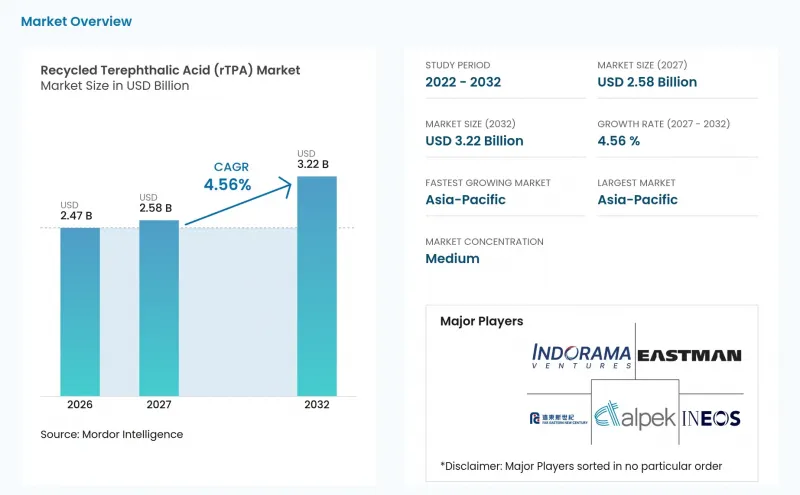
According to Mordor Intelligence, the recycled terephthalic acid market size was valued at USD 2.47 billion in 2026 and is estimated to grow from USD 2.58 billion in 2027 to USD 3.22 billion by 2032, at a CAGR of 4.56% during the forecast period (2027-2032).
Global Recycled Terephthalic Acid (rTPA) Market Trends and Insights
Recycled-Content Mandates and Extended Producer Responsibility
The recycled terephthalic acid market benefits when statutory recycled-content requirements convert voluntary purchasing targets into planned procurement. Regulation (EU) 2025/40 entered into force in January 2025 and sets recycled-content targets for plastic packaging that rise to 30% by 2030 and 65% by 2040, while requiring packaging to be designed for recyclability from 2030. The regulation gives packaging buyers a clearer basis for selecting recycled material with documented origin and verified performance. In July 2025, the European Commission consulted on calculation and verification rules for chemically recycled content in polyethylene terephthalate (PET) beverage bottles under the Single-Use Plastics Directive. Its fuel-use-excluded approach means that material used for energy recovery does not count toward recycled-content claims, which supports demand for material recovery routes. The recycled terephthalic acid market stands to benefit from these rules when producers supply traceable material and brands secure supply ahead of the 2030 deadlines.
Brand Commitments to Circular Polyester and Packaging
Brand commitments are giving chemical recyclers clearer demand signals and helping convert pilot activity into contracted supply. In June 2025, Lululemon and Samsara Eco announced a 10-year agreement for recycled polyester and nylon, with the materials potentially supplying 20% of Lululemon's overall fiber portfolio. Gap Inc. also joined Syre as a launch partner, committing to use 10,000 metric tons of textile-to-textile circular polyester annually. H&M Group reported in June 2025 that all of its polyester use was certified as recycled under the Recycled Content Standard. PUMA and RE&UP signed a multi-year letter of intent in March 2025 to advance a circular textile solution that converts textile waste into recycled polyester chips. The recycled terephthalic acid market benefits when these commitments reduce exposure to short-term virgin purified terephthalic acid (PTA) price movements, as suppliers have identifiable buyers and agreed-upon quantity pathways.
High Capital and Energy Intensity of Chemical Recycling
Chemical recycling plants require specialized reactors, purification equipment, distillation systems, and process controls, which increase capital requirements. Carbios reported that its planned Longlaville enzymatic PET biorecycling plant involved estimated construction costs of EUR 230 million (~USD 258.21 million), with EUR 42.5 million (~USD 47.71 million) in confirmed public funding. The company's financing structure illustrates how project development depends on public support, customer commitments, and private capital. High-temperature hydrolysis may require operating conditions of 200°C or higher, increasing energy demand and operating costs. Eastman has planned a Texas methanolysis facility with groundbreaking targeted for the fourth quarter of 2026 and mechanical completion in 2028, reflecting the multi-year commitment required for large facilities. These requirements favor well-financed companies and can limit smaller operators to partnerships, licensing arrangements, or pilot projects in the recycled terephthalic acid market.
Other drivers and restraints analyzed in the detailed report include:
- Demand for Virgin-Equivalent Recycled Polyester Inputs
- Textile-to-Textile Recycling of Hard-to-Recycle Polyester Waste
- Competition From Virgin PTA and Mechanically Recycled PET
For complete list of drivers and restraints, kindly check the Table Of Contents.
Segment Analysis
Hydrolysis held 48.12% of revenue in 2026, making it the largest process segment in the recycled terephthalic acid market. The process is preferred where high monomer purity is important, particularly for food-contact packaging and demanding fiber applications. Hydrolysis can be optimized by adjusting temperature, pressure, and catalyst selection to improve yields and product quality. A 2025 review of PET hydrolysis described autocatalytic behavior, in which carboxyl end groups can accelerate the reaction as depolymerization progresses. Enzymatic routes broaden the available feedstock pool by processing colored and contaminated PET that is difficult to use in conventional routes. Carbios and Samsara Eco are among the companies developing commercial applications for enzymatic depolymerization. The process plays a significant role in the recycled terephthalic acid market by enabling products that require controlled purity. Its performance depends on reliable feedstock preparation and the cost of operating the required equipment.
Pyrolysis is forecast to grow at a CAGR of 5.05% from 2027 to 2032, the highest rate among process routes. It can accept mixed and contaminated PET streams that would require extensive sorting before many hydrolysis processes. This flexibility can increase the usable supply of post-consumer material in locations with mixed-waste collection systems. However, the thermal environment can produce complex output streams that require further upgrading before achieving monomer-equivalent purity. A 2025 review of polyester-containing textile recycling identified chemical recycling as relevant for materials that cannot be effectively processed through conventional recycling routes. Glycolysis produces bis(2-hydroxyethyl) terephthalate (BHET) for polyester repolymerization, while methanolysis produces dimethyl terephthalate that can be used in high-purity material pathways. Pyrolysis is therefore a complementary option for difficult feedstocks rather than a direct replacement for hydrolysis across all end uses. Its progress in the recycled terephthalic acid market will depend on catalysts, upgrading methods, and the economics of treating heterogeneous waste.
Complete Report Scope:
- By Process
- Hydrolysis
- Pyrolysis
- Other Processes
- By Application
- Fibers
- Films and Sheets
- Resins
- Other Applications
- By End-User Industry
- Packaging
- Textiles
- Automotive
- Construction
- Other End-User Industries
- By Geography
- Asia-Pacific
- China
- India
- Japan
- South Korea
- ASEAN Countries
- Rest of Asia-Pacific
- North America
- United States
- Canada
- Mexico
- Europe
- Germany
- United Kingdom
- France
- Italy
- NORDIC Countries
- Rest of Europe
- South America
- Brazil
- Argentina
- Rest of South America
- Middle East and Africa
- Saudi Arabia
- South Africa
- Rest of Middle East and Africa
- Asia-Pacific
Geography Analysis
Asia-Pacific accounted for 44.51% of regional revenue in 2026 and is projected to grow at a 5.62% CAGR through 2032. The recycled terephthalic acid market in the region encompasses PET production, polyester textile manufacturing, and the development of recycling capacity across China, India, Japan, and Southeast Asia. In India, the planned ELITe facility in Gujarat is intended to process polyester textile waste into virgin-quality recycled material at 70,000 metric tons per year after commissioning by the end of 2027. This development indicates that textile waste is becoming an organized feedstock source rather than solely a disposal issue. Japan also has active company collaboration in chemical recycling, including a 2025 initiative led by Kao to expand non-food PET recycling into beverage-grade bottles. China's large PTA base can create price competition for recycled materials, particularly when virgin materials are readily available. This makes feedstock security, low-energy processes, and compliance-driven demand important regional factors.
Europe is the second-largest regional market and has a relatively stable policy basis for demand. Regulation (EU) 2025/40 requires plastic packaging to contain increasing amounts of post-consumer recycled content, with targets reaching 30% in 2030. The region also has food-contact rules and calculation methods that make traceability important for chemically recycled materials. These standards can favor producers that maintain detailed records of material origin, processing, and allocation. Deposit return systems in Germany and Nordic countries provide clean PET bales that serve as useful inputs for high-quality recycling. France is also developing chemical recycling capacity through projects such as Carbios' planned Longlaville facility. Europe's growth opportunity depends on the consistent implementation of regulations and on producers' ability to finance commercial plants.
North America is positioned for steady growth as state and federal producer responsibility frameworks continue to develop. Eastman's planned Texas methanolysis facility is a significant addition to the regional project pipeline, with groundbreaking targeted for the fourth quarter of 2026 and completion targeted in 2028. Brand agreements in the region can also support demand for chemically recycled polyester, as demonstrated by the Lululemon and Samsara Eco agreement. South America, the Middle East, and Africa hold smaller market positions, as collection systems and formal recycling infrastructure are less developed in these regions. Brazil and Mexico have relatively more established collection and recycling systems within their respective regions. Saudi Arabia and South Africa are at an earlier stage in developing producer responsibility frameworks. The recycled terephthalic acid market in these regions will grow more substantially when collection, feedstock quality, and compliance systems improve.
- Alpek S.A.B. de C.V.
- ALPLA
- Biffa
- Carbios
- DePoly
- Eastman Chemical Company
- Far Eastern New Century Corporation
- Indorama Ventures Public Company Limited
- INEOS
- JEPLAN, INC.
- Loop Industries
- Lotte Chemical Corporation
- Plastipak Holdings, Inc.
- Reliance Industries Limited
- SABIC
- SUEZ
Additional Benefits:
- The market estimate (ME) sheet in Excel format
- 3 months of analyst support
TABLE OF CONTENTS
1 Introduction
- 1.1 Study Assumptions and Market Definition
- 1.2 Scope of the Study
2 Research Methodology
3 Executive Summary
4 Market Landscape
- 4.1 Market Overview
- 4.2 Market Drivers
- 4.2.1 Recycled-Content Mandates and Extended Producer Responsibility
- 4.2.2 Brand Commitments to Circular Polyester and Packaging
- 4.2.3 Growing Demand for Virgin-Equivalent Recycled Polyester Inputs
- 4.2.4 Textile-to-Textile Recycling of Hard-to-Recycle Polyester Waste
- 4.3 Market Restraints
- 4.3.1 High Capital and Energy Intensity of Chemical Recycling
- 4.3.2 Competition From Virgin PTA and Mechanically Recycled PET
- 4.3.3 Inconsistent Feedstock Quality and Traceability in Blended Textile Waste
- 4.4 Value and Supply-Chain Analysis
- 4.5 Porter's Five Forces Analysis
- 4.5.1 Bargaining Power of Suppliers
- 4.5.2 Bargaining Power of Buyers
- 4.5.3 Threat of New Entrants
- 4.5.4 Threat of Substitutes
- 4.5.5 Competitive Rivalry
- 4.6 Regulatory Landscape
- 4.7 Technological Outlook
5 Market Size and Growth Forecasts (Value)
- 5.1 By Process
- 5.1.1 Hydrolysis
- 5.1.2 Pyrolysis
- 5.1.3 Other Processes
- 5.2 By Application
- 5.2.1 Fibers
- 5.2.2 Films and Sheets
- 5.2.3 Resins
- 5.2.4 Other Applications
- 5.3 By End-User Industry
- 5.3.1 Packaging
- 5.3.2 Textiles
- 5.3.3 Automotive
- 5.3.4 Construction
- 5.3.5 Other End-User Industries
- 5.4 By Geography
- 5.4.1 Asia-Pacific
- 5.4.1.1 China
- 5.4.1.2 India
- 5.4.1.3 Japan
- 5.4.1.4 South Korea
- 5.4.1.5 ASEAN Countries
- 5.4.1.6 Rest of Asia-Pacific
- 5.4.2 North America
- 5.4.2.1 United States
- 5.4.2.2 Canada
- 5.4.2.3 Mexico
- 5.4.3 Europe
- 5.4.3.1 Germany
- 5.4.3.2 United Kingdom
- 5.4.3.3 France
- 5.4.3.4 Italy
- 5.4.3.5 NORDIC Countries
- 5.4.3.6 Rest of Europe
- 5.4.4 South America
- 5.4.4.1 Brazil
- 5.4.4.2 Argentina
- 5.4.4.3 Rest of South America
- 5.4.5 Middle East and Africa
- 5.4.5.1 Saudi Arabia
- 5.4.5.2 South Africa
- 5.4.5.3 Rest of Middle East and Africa
- 5.4.1 Asia-Pacific
6 Competitive Landscape
- 6.1 Market Concentration
- 6.2 Strategic Moves
- 6.3 Market Share (%)/Ranking Analysis
- 6.4 Company Profiles (includes Global Overview, Market Overview, Core Segments, Financials as available, Strategic Information, Products and Services, and Recent Developments)
- 6.4.1 Alpek S.A.B. de C.V.
- 6.4.2 ALPLA
- 6.4.3 Biffa
- 6.4.4 Carbios
- 6.4.5 DePoly
- 6.4.6 Eastman Chemical Company
- 6.4.7 Far Eastern New Century Corporation
- 6.4.8 Indorama Ventures Public Company Limited
- 6.4.9 INEOS
- 6.4.10 JEPLAN, INC.
- 6.4.11 Loop Industries
- 6.4.12 Lotte Chemical Corporation
- 6.4.13 Plastipak Holdings, Inc.
- 6.4.14 Reliance Industries Limited
- 6.4.15 SABIC
- 6.4.16 SUEZ
7 Market Opportunities and Future Outlook
- 7.1 White-Space and Unmet-Need Assessment

