PUBLISHER: Mordor Intelligence | PRODUCT CODE: 2186124

PUBLISHER: Mordor Intelligence | PRODUCT CODE: 2186124
Private Tutoring - Market Share Analysis, Industry Trends & Statistics, Growth Forecasts (2027 - 2032)
According to Mordor Intelligence, the global private tutoring market was valued at USD 143.41 billion in 2026 and is estimated to grow from USD 153.59 billion in 2027 to reach USD 216.53 billion by 2032, at a CAGR of 7.11% during the forecast period (2027-2032).
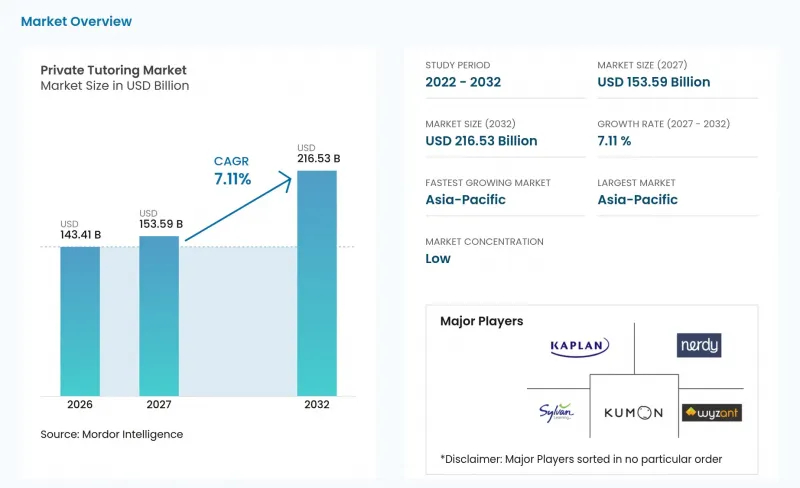
Global Private Tutoring Market Trends and Insights
Rising Academic Competition and High-Stakes Admissions
Competitive admissions systems support demand in the global private tutoring market as families seek instruction to strengthen academic readiness and examination performance. A 2025 United States study associated statewide mandatory college entrance examination policies with a 16% increase in private tutoring prevalence, particularly in high-income and highly educated communities. The SAT Class of 2025 exceeded 2 million test takers, with 97% taking the test digitally, highlighting the relevance of digital test-preparation formats. In South Korea, private education expenditure totaled KRW 27.5 trillion (USD 19.08 billion) in 2025, while participating students spent an average of KRW 604,000 (USD 419.13) monthly. In emerging Asia-Pacific markets, demand for competitive examination preparation and curriculum support remains strong, even as governments tighten coaching center regulations.
Growing Demand for Personalized Learning and Learning-Gap Remediation
The global private tutoring market benefits as families seek targeted support beyond general academic reinforcement. A 2025 Preply and LeanLab Education study found that 96% of surveyed learners considered human tutoring and real conversations essential for progress, while one in three learners who took at least 24 lessons advanced by a full CEFR level within 12 weeks . Parents of children with identified learning needs represent an important demand base because schools may not consistently provide tailored support. The study also found higher tutoring interest among special education families, increasing the importance of diagnostic assessments and tutoring. Human tutors can adapt pacing, explain errors, and sustain engagement beyond what standardized content alone may achieve. In large and diverse education systems, personalized tutoring addresses differences in language, curriculum, teacher access, and readiness for competitive examinations across regions and cities.
High Cost of Premium Human-Led Tutoring
Human-led tutoring can create affordability barriers for households unable to sustain regular sessions. South Korea's 2025 private education expenditure survey found that high school students participating in private education spent an average of KRW 793,000 (USD 550.28) monthly, highlighting the financial commitment associated with supplementary education. In India, tutoring expenses may also challenge households requiring support across multiple subjects or extended examination preparation, although this comparison requires direct affordability evidence. Uncertainty about tutor qualifications, teaching quality, and learning outcomes can further complicate provider selection. Tutoring platforms and centers can help address these concerns through transparent tutor profiles, learner feedback, diagnostic assessments, and parent communication, although these measures may increase operating costs.
Other drivers and restraints analyzed in the detailed report include:
- Expansion of Online, Hybrid, and On-Demand Tutoring
- Cross-Border Demand for Language, International-Curriculum, and Professional Certification Support
- Policy Shocks and Curriculum Misalignment Across National Education Systems
For complete list of drivers and restraints, kindly check the Table Of Contents.
Segment Analysis
Online tutoring held 36.82% of the global private tutoring market share in 2026, making it the largest delivery format. This reflects the convenience of remote sessions, reduced travel, and access to tutors beyond a learner's local area. Hybrid tutoring is forecast to grow at a CAGR of 8.72% through 2032, combining digital flexibility with periodic in-person interaction. In-person tutoring remains relevant for one-to-one instruction, in countries with established tutoring centers, and for younger learners or students who need structured supervision.
Hybrid delivery supports shared learning records across in-person and online sessions. Tutors can identify learning gaps in person and assign digital practice aligned with learner progress. Improved school connectivity in emerging markets supports this approach, including in smaller cities where specialist centers are difficult to access. Online providers must maintain safeguards, responsive support, and consistent tutor quality. Providers serving German learners must consider the 2025 distance-learning decisions when designing asynchronous coaching formats. Effective models use each channel for the learning activities it supports best.
K-12 students accounted for 51.73% of the global private tutoring market size in 2026, driven by demand for supplementary academic support, curriculum reinforcement, and entrance examination preparation. The working professionals segment is forecast to grow at a CAGR of 8.73% through 2032, supported by demand for certifications, career mobility, professional licensing preparation, and language learning. Higher education students use tutoring for subject support, admissions tests, and academic writing. The Others category includes early childhood education, adult literacy, and lifelong learning.
Preply announced in January 2026 that its platform supports individual learners and organizations through more than 100,000 tutors across 180 countries. This model is relevant in emerging markets, where learners and employers seek language skills, professional examination preparation, and international education pathways. K-12 providers must comply with national requirements for coaching center operations and learner welfare. Providers serving school learners and working professionals should differentiate product design, tutor capabilities, and safeguarding standards by age group. Adult learning demand can reduce dependence on school enrollment cycles, examination seasons, and individual student cohorts.
Complete Report Scope:
- By Delivery Mode
- Online Tutoring
- In-Person Tutoring
- Hybrid Tutoring
- By End User
- K-12 Students
- Higher Education Students
- Working Professionals
- Others
- By Tutoring Style
- One-to-One Tutoring
- Group Tutoring
- Others
- By Course Type
- Curriculum-Based Learning
- Test Preparation
- Others
- By Geography
- North America
- United States
- Canada
- Mexico
- South America
- Brazil
- Peru
- Chile
- Argentina
- Rest of South America
- Europe
- United Kingdom
- Germany
- France
- Spain
- Italy
- BENELUX (Belgium, Netherlands, and Luxembourg)
- NORDICS (Denmark, Finland, Iceland, Norway, and Sweden)
- Rest of Europe
- Asia-Pacific
- India
- China
- Japan
- Australia
- South Korea
- South East Asia (Singapore, Malaysia, Thailand, Indonesia, Vietnam, and Philippines)
- Rest of Asia-Pacific
- Middle East and Africa
- United Arab Emirates
- Saudi Arabia
- South Africa
- Nigeria
- Rest of Middle East and Africa
- North America
Geography Analysis
Asia-Pacific accounted for 35.61% of the global private tutoring market in 2026 and is forecast to grow at an 8.62% CAGR through 2032. The region combines academic competition, large learner populations, and expanding digital access. South Korea's 2025 official survey recorded KRW 27.5 trillion (USD 19.08 billion) in private tutoring expenditure, while participating students spent KRW 604,000 (USD 419.13) monthly. In India, greater school access to computers and internet facilities supports platform reach beyond major cities. Demand includes English-language tutoring, curriculum support, entrance preparation, and professional learning. By April 2025, China's Smart Education platform had over 164 million registered users, 61.3 billion cumulative page views, and access from more than 220 countries and regions.
Private providers must complement this content availability with quality tutoring and personalized support. 51Talk reported FY2025 gross billings of USD 127.6 million and 170,300 active students. Across emerging Asia-Pacific markets, organized platforms can expand through local languages, transparent pricing, and reliable tutor standards. North America maintains demand for test preparation and school support, while digital SAT testing shapes preparation. Europe emphasizes cross-border digital-service compliance; Germany's 2025 court decisions increased requirements for online tutoring. The Middle East and Africa offer developing opportunities for curriculum-aligned and English-language tutoring. Providers must balance digital scale with local regulations, curricula, and safeguards for younger learners.
- Kaplan, Inc.
- Sylvan Learning
- Wyzant, Inc.
- Kumon Institute of Education Co., Ltd.
- Nerdy, Inc.
- Huntington Learning Center
- Daekyo Co., Ltd.
- Mathnasium
- Tutor Doctor
- Preply, Inc.
- Superprof
- GoStudent
- New Oriental Education & Technology Group Inc.
- Vedantu Innovations Pvt. Ltd.
- VIPKid
- Revolution Prep
- Tutorful
- Cambly, Inc.
- italki
- Aakash Educational Services Limited
Additional Benefits:
- The market estimate (ME) sheet in Excel format
- 3 months of analyst support
TABLE OF CONTENTS
1 Introduction
- 1.1 Study Assumptions and Market Definition
- 1.2 Scope of the Study
2 Executive Summary
3 Market Landscape
- 3.1 Market Overview
- 3.2 Market Drivers
- 3.2.1 Rising Academic Competition and High-Stakes Admissions
- 3.2.2 Growing Demand for Personalized Learning and Learning-Gap Remediation
- 3.2.3 Expansion of Online, Hybrid, and On-Demand Tutoring
- 3.2.4 Increasing Adoption of AI-Assisted Assessment and Tutor Matching
- 3.2.5 Outcome-Based Tutoring Partnerships with Schools and Public Programs
- 3.2.6 Cross-Border Demand for Language, International-Curriculum, and Professional Certification Support
- 3.3 Market Restraints
- 3.3.1 High Cost of Premium Human-Led Tutoring
- 3.3.2 Uneven Tutor Quality and Outcome Consistency
- 3.3.3 Child-Safety, Data-Privacy, and Trust Risks in Informal and Digital Provision
- 3.3.4 Policy Shocks and Curriculum Misalignment Across National Education Systems
- 3.4 Regulatory Landscape
- 3.5 Technological Outlook
- 3.6 Porter's Five Forces Analysis
- 3.6.1 Bargaining Power of Suppliers Analysis
- 3.6.2 Bargaining Power of Buyers Analysis
- 3.6.3 Threat of New Entrants Analysis
- 3.6.4 Threat of Substitutes Analysis
- 3.6.5 Competitive Rivalry Analysis
4 Education Infrastructure & Development Intelligence
- 4.1 Private Sector Investments in Education Sector
- 4.2 Education Infrastructure Development Initives
5 Education Performance Intelligence
- 5.1 Student Teacher Ratio
- 5.2 Geography Density by Education Institute
6 Student & Learner Behavior Analysis
- 6.1 Student Enrolment
- 6.2 Tuition Fees and Education Spending
7 Market Size & Growth Forecasts (USD, Value)
- 7.1 By Delivery Mode
- 7.1.1 Online Tutoring
- 7.1.2 In-Person Tutoring
- 7.1.3 Hybrid Tutoring
- 7.2 By End User
- 7.2.1 K-12 Students
- 7.2.2 Higher Education Students
- 7.2.3 Working Professionals
- 7.2.4 Others
- 7.3 By Tutoring Style
- 7.3.1 One-to-One Tutoring
- 7.3.2 Group Tutoring
- 7.3.3 Others
- 7.4 By Course Type
- 7.4.1 Curriculum-Based Learning
- 7.4.2 Test Preparation
- 7.4.3 Others
- 7.5 By Geography
- 7.5.1 North America
- 7.5.1.1 United States
- 7.5.1.2 Canada
- 7.5.1.3 Mexico
- 7.5.2 South America
- 7.5.2.1 Brazil
- 7.5.2.2 Peru
- 7.5.2.3 Chile
- 7.5.2.4 Argentina
- 7.5.2.5 Rest of South America
- 7.5.3 Europe
- 7.5.3.1 United Kingdom
- 7.5.3.2 Germany
- 7.5.3.3 France
- 7.5.3.4 Spain
- 7.5.3.5 Italy
- 7.5.3.6 BENELUX (Belgium, Netherlands, and Luxembourg)
- 7.5.3.7 NORDICS (Denmark, Finland, Iceland, Norway, and Sweden)
- 7.5.3.8 Rest of Europe
- 7.5.4 Asia-Pacific
- 7.5.4.1 India
- 7.5.4.2 China
- 7.5.4.3 Japan
- 7.5.4.4 Australia
- 7.5.4.5 South Korea
- 7.5.4.6 South East Asia (Singapore, Malaysia, Thailand, Indonesia, Vietnam, and Philippines)
- 7.5.4.7 Rest of Asia-Pacific
- 7.5.5 Middle East and Africa
- 7.5.5.1 United Arab Emirates
- 7.5.5.2 Saudi Arabia
- 7.5.5.3 South Africa
- 7.5.5.4 Nigeria
- 7.5.5.5 Rest of Middle East and Africa
- 7.5.1 North America
8 North America Market Size & Growth Forecasts (USD, Value) 2022- 2032
- 8.1 By Delivery Mode
- 8.2 By End User
- 8.3 By Tutoring Style
- 8.4 By Course Type
- 8.5 By Country
9 South America Market Size & Growth Forecasts (USD, Value) 2022- 2032
- 9.1 By Delivery Mode
- 9.2 By End User
- 9.3 By Tutoring Style
- 9.4 By Course Type
- 9.5 By Country
10 Europe Market Size & Growth Forecasts (USD, Value) 2022- 2032
- 10.1 By Delivery Mode
- 10.2 By End User
- 10.3 By Tutoring Style
- 10.4 By Course Type
- 10.5 By Country
11 Asia-Pacific Market Size & Growth Forecasts (USD, Value) 2022- 2032
- 11.1 By Delivery Mode
- 11.2 By End User
- 11.3 By Tutoring Style
- 11.4 By Course Type
- 11.5 By Country
12 Middle East and Africa Market Size & Growth Forecasts (USD, Value) 2022- 2032
- 12.1 By Delivery Mode
- 12.2 By End User
- 12.3 By Tutoring Style
- 12.4 By Course Type
- 12.5 By Country
13 Competitive Landscape
- 13.1 Market Concentration
- 13.2 Strategic Moves
- 13.3 Market Share Analysis
- 13.4 Company Profiles (includes Global Level Overview, Market Level Overview, Core Segments, Financials as available, Strategic Information, Market Rank/Share, Products and Services, and Recent Developments)
- 13.4.1 Kaplan, Inc.
- 13.4.2 Sylvan Learning
- 13.4.3 Wyzant, Inc.
- 13.4.4 Kumon Institute of Education Co., Ltd.
- 13.4.5 Nerdy, Inc.
- 13.4.6 Huntington Learning Center
- 13.4.7 Daekyo Co., Ltd.
- 13.4.8 Mathnasium
- 13.4.9 Tutor Doctor
- 13.4.10 Preply, Inc.
- 13.4.11 Superprof
- 13.4.12 GoStudent
- 13.4.13 New Oriental Education & Technology Group Inc.
- 13.4.14 Vedantu Innovations Pvt. Ltd.
- 13.4.15 VIPKid
- 13.4.16 Revolution Prep
- 13.4.17 Tutorful
- 13.4.18 Cambly, Inc.
- 13.4.19 italki
- 13.4.20 Aakash Educational Services Limited
14 Market Opportunities & Future Outlook
- 14.1 White-Space and Unmet-Need Assessment
- 14.2 Market Opportunities
- 14.2.1 AI-Enabled Personalized Tutoring with Human Tutor Oversight
- 14.2.2 Affordable Online Tutoring for Underserved and Geographically Dispersed Learners
- 14.3 Future Outlook
15 Research Methodology

