PUBLISHER: Mordor Intelligence | PRODUCT CODE: 2186131

PUBLISHER: Mordor Intelligence | PRODUCT CODE: 2186131
Vietnam Ocean Freight Transport - Market Share Analysis, Industry Trends & Statistics, Growth Forecasts (2027 - 2032)
According to Mordor Intelligence, the Vietnam ocean freight transport market size is valued at USD 6.32 billion in 2026 and is estimated to grow from USD 6.70 billion in 2027 to reach USD 8.86 billion by 2032, at a CAGR of 5.76% during the forecast period from 2027 to 2032.
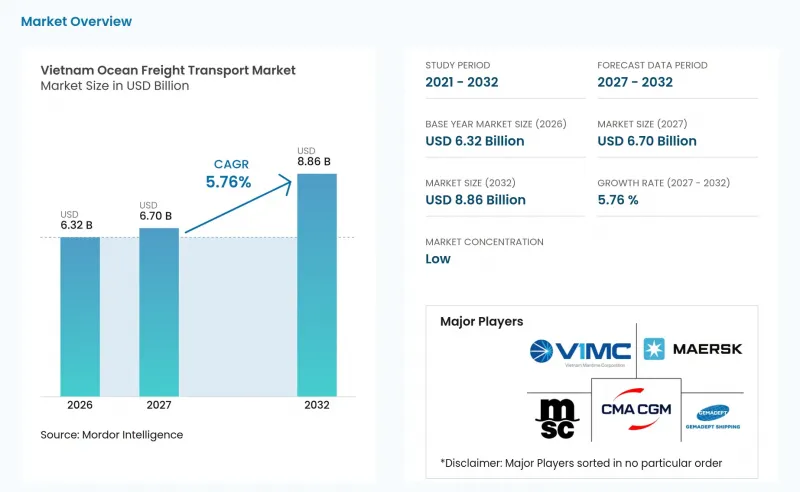
Trade and investment are increasing the volume of export cargo routed through Vietnam, while the country remains closely linked to regional component supply chains. This report is Segmented by Cargo Type (Containerized Cargo, Non-Containerized Cargo), by End-User Industry (Electronics and Semiconductors, Chemicals and Petrochemicals, Food and Beverage, Pharmaceuticals and Healthcare, Retail and E-Commerce, Others), and by Region (Northern Vietnam, Central Vietnam, Southern Vietnam). The Market Forecasts are Provided in Terms of Value (USD).
Vietnam Ocean Freight Transport Market Trends and Insights
Manufacturing Relocation Increasing Export-Oriented Cargo Volumes
The Vietnam ocean freight transport market is supported by the continued relocation of export manufacturing into Vietnam. Realized foreign direct investment disbursements reached USD 13.03 billion in the first half of 2026, the highest first-half level in 5 years. New plants add exports of finished goods and inbound shipments of machinery, components, and production materials before export operations mature. The Federal Reserve reported that Chinese-owned firms moving production to Vietnam continued to source inputs through Chinese supply networks. This structure creates two-way container movement between Vietnam and regional supply centers, rather than demand based solely on final exports to the United States or Europe. Electronics, machinery, and textiles all depend on imported inputs before finished products leave Vietnamese ports, so shipping demand spans several stages of the manufacturing cycle.
Electronics Production Strengthening International Shipping Demand
Electronics production remains a major cargo source for the Vietnam ocean freight transport market. The shift from consumer-electronics assembly into higher-value semiconductor work raises the importance of dependable schedules, controlled handling, and direct connections to major destination markets. Foxconn's Shunsin subsidiary began trial integrated-circuit production in Bac Giang in June 2026, while another Foxconn facility in Quang Ninh was expected to begin operations later in 2026. These investments add cargo from equipment installation and components, as well as the finished semiconductor and electronics products that will later be exported. They also connect the growth of Hai Phong and Lach Huyen more closely to the manufacturing activity inland from the coast.
Vessel Overcapacity Pressuring Freight Rates and Margins
Global vessel capacity can limit revenue growth in the Vietnam ocean freight transport market even when cargo volumes rise. A large increase in container fleet capacity between 2023 and 2025 intensified supply on major east-west routes. Transpacific rates fell sharply during mid-2025 before recovering by July 2026. Carriers responded by using blank sailings to manage active capacity, but this action does not remove the underlying risk of excess tonnage. Volatile freight rates make it harder for ports, carriers, and logistics providers to plan investments and contracts. The effect is most visible for operators that depend on spot rates or leased vessel space rather than integrated terminal and network operations.
Other drivers and restraints analyzed in the detailed report include:
- Deep-Water Port Expansion Increasing Vessel Handling Capacity
- Customs Digitalization Improving Cargo Clearance and Visibility
- Port-Hinterland Congestion Increasing Inland Transit Delays
For complete list of drivers and restraints, kindly check the Table Of Contents.
Segment Analysis
Containerized cargo accounts for 63.67% of the Vietnam ocean freight transport market share in 2026, supported by exports of electronics, furniture, garments, and footwear. Standard dry containers handle general export shipments, while refrigerated containers serve seafood and other temperature-sensitive goods. Vietnam's container exports to the United States showed strong momentum from January through early August 2026, supported by sustained demand and consistently high weekly booking volumes. The extended period of elevated shipments indicates resilient trade flows and reinforces Vietnam's growing importance as a manufacturing and export hub for the U.S. market. Growing volumes support demand for direct long-haul port calls, while Gemalink Phase 2 and additional Lach Huyen berths are expected to improve quay availability after 2027. In 2026, VASEP recommended developing a domestic refrigerated container fleet, highlighting continued reliance on foreign carriers for specialized equipment.
Non-containerized cargo is projected to register at a CAGR of 6.34% through 2031, supported by industrial diversification and demand for dry bulk, liquid bulk, breakbulk, and general cargo transportation. However, specialized project-cargo facilities and weak inland connections continue to constrain near-term efficiency. Improving port infrastructure and inland connectivity will be important to support the movement of these cargo types and accommodate evolving industrial freight requirements.
Complete Report Scope:
- By Cargo Type
- Containerized Cargo
- Dry
- Reefer
- Non-Containerized Cargo
- Dry Bulk Cargo
- Liquid Bulk Cargo
- Breakbulk and General Cargo
- Containerized Cargo
- By End-User Industry
- Electronics and Semiconductors
- Chemicals and Petrochemicals
- Food and Beverage
- Pharmaceuticals and Healthcare
- Retail and E-commerce
- Others
- By Region
- Northern Vietnam
- Central Vietnam
- Southern Vietnam
List of Companies Covered in this Report:
- Mediterranean Shipping Company (MSC)
- A.P. Moller - Maersk
- CMA CGM
- COSCO SHIPPING Lines
- Hapag-Lloyd AG
- Ocean Network Express (ONE)
- Evergreen Marine Corporation
- HMM Co., Ltd
- Yang Ming Marine Transport Corporation
- Pacific International Lines (PIL)
- ZIM Integrated Shipping Services
- Wan Hai Lines
- SITC International Holdings
- Regional Container Lines (RCL)
- KMTC Line
- TS Lines
- Vietnam Maritime Corporation (VIMC)
- Gemadept Corporation
- Hai An Transport and Stevedoring JSC
- Vietnam Container Shipping JSC (VICONSHIP)
- Transimex Corporation
- Transport and Chartering Corporation (Vietfracht)
Additional Benefits:
- The market estimate (ME) sheet in Excel format
- 3 months of analyst support
TABLE OF CONTENTS
1 INTRODUCTION
- 1.1 Study Assumptions and Market Definition
- 1.2 Scope of the Study
2 RESEARCH METHODOLOGY
3 EXECUTIVE SUMMARY
- 3.1 Market Size, Growth, and Forecast Outlook
- 3.2 Key Demand Drivers and Ocean Freight Trends
- 3.3 Major Maritime Trade Corridors and Cargo Concentration
- 3.4 Competitive Landscape and Leading Ocean Freight Providers
4 MARKET LANDSCAPE
- 4.1 Market Overview and Importance of Ocean Freight Transport
- 4.2 Market Drivers
- 4.2.1 Manufacturing Relocation Increasing Export-Oriented Cargo Volumes
- 4.2.2 Electronics Production Strengthening International Shipping Demand
- 4.2.3 Deep-Water Port Expansion Increasing Vessel Handling Capacity
- 4.2.4 Customs Digitalization Improving Cargo Clearance and Visibility
- 4.2.5 Industrial Specialization Increasing Higher-Value Cargo Movements
- 4.2.6 Cold-Chain Growth Expanding Specialized Maritime Cargo Demand
- 4.3 Market Restraints
- 4.3.1 Vessel Overcapacity Pressuring Freight Rates and Margins
- 4.3.2 Port-Hinterland Congestion Increasing Inland Transit Delays
- 4.3.3 Container Imbalances Increasing Equipment Repositioning Costs
- 4.3.4 Inland Connectivity Gaps Limiting Port Network Efficiency
- 4.4 Value Chain Structure and Maritime Cargo Flow Analysis
- 4.5 Regulatory Framework for Ocean Freight Operations
- 4.6 Technology Adoption in Port and Shipping Operations
- 4.7 Port Throughput and Container Traffic Development Trends
- 4.8 Major Ports and Maritime Gateway Performance Assessment
- 4.9 Ocean Freight Rates and Shipping Cost Dynamics
- 4.10 Fuel Costs and Vessel Operating Expense Trends
- 4.11 Port Hinterland and Multimodal Connectivity Analysis
- 4.12 Porter's Five Forces Analysis
- 4.12.1 Threat of New Entrants
- 4.12.2 Bargaining Power of Buyers and Consumers
- 4.12.3 Bargaining Power of Suppliers
- 4.12.4 Threat of Substitute Services
- 4.12.5 Intensity of Competitive Rivalry
- 4.13 Impact of Geo-Political Events on Supply Chain Shifts
5 MARKET SIZE AND GROWTH FORECASTS
- 5.1 By Cargo Type
- 5.1.1 Containerized Cargo
- 5.1.1.1 Dry
- 5.1.1.2 Reefer
- 5.1.2 Non-Containerized Cargo
- 5.1.2.1 Dry Bulk Cargo
- 5.1.2.2 Liquid Bulk Cargo
- 5.1.2.3 Breakbulk and General Cargo
- 5.1.1 Containerized Cargo
- 5.2 By End-User Industry
- 5.2.1 Electronics and Semiconductors
- 5.2.2 Chemicals and Petrochemicals
- 5.2.3 Food and Beverage
- 5.2.4 Pharmaceuticals and Healthcare
- 5.2.5 Retail and E-commerce
- 5.2.6 Others
- 5.3 By Region
- 5.3.1 Northern Vietnam
- 5.3.2 Central Vietnam
- 5.3.3 Southern Vietnam
6 COMPETITIVE LANDSCAPE
- 6.1 Market Concentration
- 6.2 Strategic Moves
- 6.3 Market Share Analysis
- 6.4 Company Profiles (includes Global Level Overview, Market Level Overview, Core Segments, Financials as available, Strategic Information, Geographic Coverage, Products and Services, Recent Developments)
- 6.4.1 Mediterranean Shipping Company (MSC)
- 6.4.2 A.P. Moller - Maersk
- 6.4.3 CMA CGM
- 6.4.4 COSCO SHIPPING Lines
- 6.4.5 Hapag-Lloyd AG
- 6.4.6 Ocean Network Express (ONE)
- 6.4.7 Evergreen Marine Corporation
- 6.4.8 HMM Co., Ltd
- 6.4.9 Yang Ming Marine Transport Corporation
- 6.4.10 Pacific International Lines (PIL)
- 6.4.11 ZIM Integrated Shipping Services
- 6.4.12 Wan Hai Lines
- 6.4.13 SITC International Holdings
- 6.4.14 Regional Container Lines (RCL)
- 6.4.15 KMTC Line
- 6.4.16 TS Lines
- 6.4.17 Vietnam Maritime Corporation (VIMC)
- 6.4.18 Gemadept Corporation
- 6.4.19 Hai An Transport and Stevedoring JSC
- 6.4.20 Vietnam Container Shipping JSC (VICONSHIP)
- 6.4.21 Transimex Corporation
- 6.4.22 Transport and Chartering Corporation (Vietfracht)
7 MARKET OPPORTUNITIES AND FUTURE OUTLOOK
- 7.1 White-Space Opportunities and Unmet Maritime Logistics Needs
- 7.2 High-Potential Cargo Segments and Regional Growth Opportunities
- 7.3 Strategic Growth Priorities Across Ocean Freight Ecosystem
- 7.4 Future Market Outlook and Emerging Trade Demand Pockets
8 APPENDIX

