PUBLISHER: Mordor Intelligence | PRODUCT CODE: 2186136

PUBLISHER: Mordor Intelligence | PRODUCT CODE: 2186136
India Technical Textile Manufacturing - Market Share Analysis, Industry Trends & Statistics, Growth Forecasts (2027 - 2032)
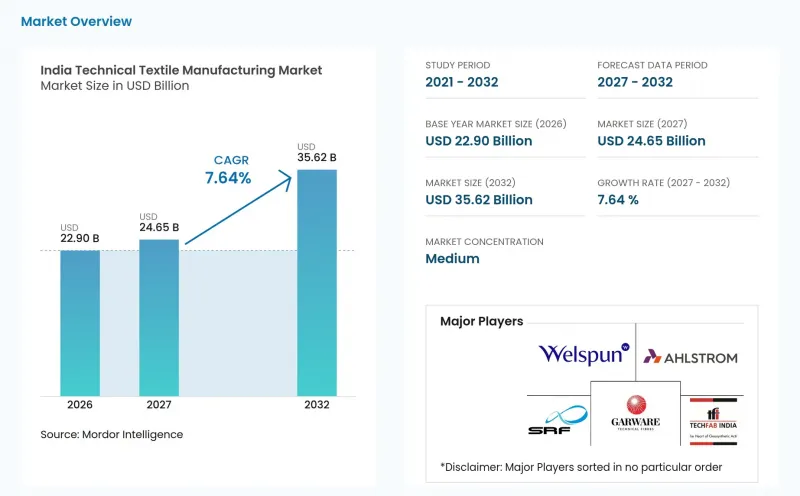
According to Mordor Intelligence, the India technical textile manufacturing market size is expected to increase from USD 22.90 billion in 2026 to USD 24.65 billion in 2027 and reach USD 35.62 billion by 2032, growing at a CAGR of 7.64% over 2027-2032.
India Technical Textile Manufacturing Market Trends and Insights
Infrastructure and Geosynthetic Adoption
India's Union Budget for 2025-26 allocated INR 11.21 lakh crore (USD 124.8 billion) for capital expenditure, including INR 2.65 lakh crore (USD 29.5 billion) for railways and INR 3.9 lakh crore (USD 43.4 billion) for the road program. These allocations sustain demand for geotextiles used in subgrade stabilization, drainage, and mechanically stabilized earth structures. The Ministry of Textiles coordinated with road and water agencies on codal provisions for geocells, geocomposites, and geogrids used in highway construction. Such provisions make project specifications more influential than short-term changes in raw-material prices. The India technical textile manufacturing market benefits when highway, rail, airport, and port projects require certified materials at the design stage. Product approval and installation records can also increase the advantage of suppliers with application-engineering capabilities.
Government-Mandated Use and National Technical Textiles Mission
The National Technical Textiles Mission had approved 168 research projects and sanctioned 16 further projects in February 2026. The additional projects cover high-performance fibers, smart textiles, and composite systems for infrastructure and defense. During the first 9 months of FY2025-26, technical textile exports reached INR 21,970 crore (USD 2,445.2 million) and imports totaled INR 18,953 crore (USD 2,109.4 million), producing an INR 3,017 crore (USD 335.8 million) trade surplus. The GREAT scheme approved 31 technical textile startups, each receiving INR 50 lakh (USD 0.06 million) for product development. Mandatory-use notifications for geotextiles and procurement preferences for certified medical nonwovens provide recurring demand support for the India technical textile manufacturing market. As of 2026, 96 companies had been approved in the PLI Scheme Round 3, with INR 12,822.67 crore (USD 1,427.1 million) in committed investment.
Fragmented Supplier Base and Uneven Standards Enforcement
India has many technical textile manufacturers, but a large proportion are MSMEs with limited access to certification, testing, and long-term capital. Quality control orders establish a common compliance framework for technical materials used in regulated procurement. Field verification remains difficult where suppliers are dispersed, and product performance is assessed after installation or purchase. The withdrawal of quality control orders on selected polymer and fiber intermediates during November 2025 improved raw-material access for downstream manufacturers. Differing procurement practices can still make it harder for certified suppliers to earn consistent premiums. The India technical textile manufacturing market remains constrained, where informal pricing competes directly with compliant products.
Other drivers and restraints analyzed in the detailed report include:
- Industrialization, Automotive Output, and Mobility Demand
- Import Substitution in Specialty Fibers and High-Performance Products
- Specialty Fiber, Machinery, and Testing Capability Gaps
For complete list of drivers and restraints, kindly check the Table Of Contents.
Segment Analysis
Synthetic fiber commanded 69% of the India technical textile manufacturing market size in 2026, while regenerated and other fibers are forecast to expand at 8.5% CAGR through 2032. Polyester, polypropylene, and nylon continue to support large-volume applications in infrastructure, automotive, and industrial uses. Their established supply chains support converters producing geotextiles, agricultural nets, and tyre-cord materials. Domestic polyester and nylon availability supports local processing of these products. The India technical textile manufacturing market depends on these materials because they combine established processing routes with broad end-use acceptance.
Regenerated fiber growth reflects rising use of lyocell and modal constructions in Medtech and Clothtech applications, where buyers seek biobased inputs and verifiable sustainability credentials. Inorganic fibers such as glass, carbon, and basalt remain supply-constrained because critical inputs and specialist processing remain import-dependent. The approved CSIR-NAL carbon fiber project is a domestic capability-building step for this group. Natural fibers such as jute and cotton retain demand in Agrotech and Packtech, where biodegradability and cost remain procurement considerations. August 2025 PLI eligibility reforms can bring more entrants into synthetic conversion, increasing competition in commodity products.
Complete Report Scope:
- By Material Type
- Natural Fiber
- Cotton
- Jute
- Others - Flex, Wool, Hemp, Coir, etc.
- Synthetic Fiber
- Polyester
- Polyamide / Nylon
- Polypropylene
- Polyethylene / UHMWPE
- Aramid and Other Specialty Synthetic Fibers
- Regenerated Fiber - Viscose, Lyocell, and Modal
- Inorganic Fibers (Glass, Carbon, Basalt, etc.)
- Others (Metallic, Conductive, and Other Specialty Fibers)
- Natural Fiber
- By Form and Structure
- Woven Technical Textiles
- Nonwoven Technical Textiles
- Knitted Technical Textiles
- Braided Technical Textiles
- Other Engineered Textile Structures (Technical Yarns, Cords, Rovings, etc.)
- By Application
- Mobiltech - Automotive, Transportation, and Mobility
- Indutech - Industrial and Manufacturing Applications
- Buildtech - Building and Construction
- Medtech - Medical and Hygiene
- Protech - Personal and Property Protection
- Agrotech - Agriculture, Horticulture, Forestry, and Fishing
- Geotech - Geotextiles and Civil Engineering
- Packtech - Packaging and Containment
- Oekotech - Environmental Protection
- Hometech - Furniture, Floor Coverings, and Domestic Technical Applications
- Clothtech - Functional Components for Clothing and Footwear
- Sporttech - Sports and Leisure Applications
List of Companies Covered in this Report:
- SRF Limited
- Garware Technical Fibres Limited
- Techfab India Industries Limited
- Welspun Living Limited
- Ahlstrom India Private Limited
- Strata Geosystems (India) Private Limited
- Maccaferri Environmental Solutions Private Limited
- Techno Fabrics (India) Limited
- Hindustan Technical Fabrics Private Limited
- Ginni Filaments Limited
- Unitex India Private Limited
- Ashika Group
- Kusumgar Corporates Private Limited
- Markwell India Private Limited
- Supreme Nonwoven Industries Private Limited
- Gartex India
- NUFAB Technical Textiles Private Limited
- PAN Tex Nonwoven Private Limited
- Mahavir Spinfab Private Limited
- Mewar Polytex Limited
- Alok Industries Limited
- Reliance Industries Limited
- The Supreme Industries Limited
Additional Benefits:
- The market estimate (ME) sheet in Excel format
- 3 months of analyst support
TABLE OF CONTENTS
1 Introduction
- 1.1 Study Assumptions and Market Definition
- 1.2 Scope of the Study
2 Research Methodology
3 Executive Summary
4 Market Landscape
- 4.1 Market Overview
- 4.2 Market Drivers
- 4.2.1 Infrastructure and Geosynthetic Adoption
- 4.2.2 Government-Mandated Use and National Technical Textiles Mission
- 4.2.3 Industrialization, Automotive Output, and Mobility Demand
- 4.2.4 Import Substitution in Specialty Fibers and High-Performance Products
- 4.2.5 Export Market Expansion and Global Supply Chain Realignment
- 4.2.6 Specification-Led Procurement and Digital Traceability
- 4.3 Market Restraints
- 4.3.1 Fragmented Supplier Base and Uneven Standards Enforcement
- 4.3.2 Specialty Fiber, Machinery, and Testing Capability Gaps
- 4.3.3 Skilled Workforce Shortage and Technical Talent Gap in High-Performance Manufacturing
- 4.3.4 Tender Price Pressure and Low Value Capture in Commodity Categories
- 4.4 Value / Supply-Chain Analysis
- 4.4.1 Polymer, Natural Fiber, and Specialty Fiber Inputs
- 4.4.2 Yarn, Filament, Nonwoven, Woven, Knitted, and Composite Formation
- 4.4.3 Coating, Lamination, Dipping, Finishing, and Conversion
- 4.4.4 Testing, Certification, Distribution, and Installation
- 4.4.5 Customer Value Capture and Margin Pools
- 4.5 Regulatory Landscape
- 4.5.1 National Technical Textiles Mission
- 4.5.2 Quality Control Orders and Bureau of Indian Standards
- 4.5.3 HSN Classification and Trade Monitoring
- 4.5.4 Central Government Mandatory-Use Notifications
- 4.5.5 Medical Device and Healthcare Product Regulation
- 4.5.6 Road, Rail, Water, Waste, and Defence Procurement Rules
- 4.6 Government Policies and Industrial Schemes
- 4.6.1 Production Linked Incentive Scheme for Textiles
- 4.6.2 PM Mega Integrated Textile Regions and Apparel Parks
- 4.6.3 Scheme for Growth and Development of Technical Textiles
- 4.6.4 Research, Entrepreneurship, and Start-up Support
- 4.6.5 SAMARTH and Technical Textile Skill Development
- 4.7 Technological Outlook
- 4.7.1 High-Performance Fibers and Advanced Composites
- 4.7.2 Smart, Sensor-Embedded, and Connected Textiles
- 4.7.3 Recycled, Bio-Based, and Circular Technical Textiles
- 4.7.4 Advanced Nonwoven and Spunmelt Platforms
- 4.7.5 Computer-Aided Design, Automation, and Digital Quality Control
- 4.8 Technical Textile Clusters and Regional Manufacturing Footprint
- 4.9 Porter's Five Forces
- 4.9.1 Bargaining Power of Suppliers
- 4.9.2 Bargaining Power of Buyers
- 4.9.3 Threat of New Entrants
- 4.9.4 Threat of Substitutes
- 4.9.5 Rivalry Among Existing Competitors
- 4.10 Impact of Geopolitical Development on the Market
5 Market Size and Growth Forecasts
- 5.1 By Material Type
- 5.1.1 Natural Fiber
- 5.1.1.1 Cotton
- 5.1.1.2 Jute
- 5.1.1.3 Others - Flex, Wool, Hemp, Coir, etc.
- 5.1.2 Synthetic Fiber
- 5.1.2.1 Polyester
- 5.1.2.2 Polyamide / Nylon
- 5.1.2.3 Polypropylene
- 5.1.2.4 Polyethylene / UHMWPE
- 5.1.2.5 Aramid and Other Specialty Synthetic Fibers
- 5.1.3 Regenerated Fiber - Viscose, Lyocell, and Modal
- 5.1.4 Inorganic Fibers (Glass, Carbon, Basalt, etc.)
- 5.1.5 Others (Metallic, Conductive, and Other Specialty Fibers)
- 5.1.1 Natural Fiber
- 5.2 By Form and Structure
- 5.2.1 Woven Technical Textiles
- 5.2.2 Nonwoven Technical Textiles
- 5.2.3 Knitted Technical Textiles
- 5.2.4 Braided Technical Textiles
- 5.2.5 Other Engineered Textile Structures (Technical Yarns, Cords, Rovings, etc.)
- 5.3 By Application
- 5.3.1 Mobiltech - Automotive, Transportation, and Mobility
- 5.3.2 Indutech - Industrial and Manufacturing Applications
- 5.3.3 Buildtech - Building and Construction
- 5.3.4 Medtech - Medical and Hygiene
- 5.3.5 Protech - Personal and Property Protection
- 5.3.6 Agrotech - Agriculture, Horticulture, Forestry, and Fishing
- 5.3.7 Geotech - Geotextiles and Civil Engineering
- 5.3.8 Packtech - Packaging and Containment
- 5.3.9 Oekotech - Environmental Protection
- 5.3.10 Hometech - Furniture, Floor Coverings, and Domestic Technical Applications
- 5.3.11 Clothtech - Functional Components for Clothing and Footwear
- 5.3.12 Sporttech - Sports and Leisure Applications
6 Competitive Landscape
- 6.1 Market Concentration
- 6.2 Strategic Moves
- 6.3 Market Share Analysis
- 6.4 Company Profiles (Includes Global Level Overview, Market Level Overview, Core Segments, Financials as available, Strategic Information, Products and Services, Recent Developments)
- 6.4.1 SRF Limited
- 6.4.2 Garware Technical Fibres Limited
- 6.4.3 Techfab India Industries Limited
- 6.4.4 Welspun Living Limited
- 6.4.5 Ahlstrom India Private Limited
- 6.4.6 Strata Geosystems (India) Private Limited
- 6.4.7 Maccaferri Environmental Solutions Private Limited
- 6.4.8 Techno Fabrics (India) Limited
- 6.4.9 Hindustan Technical Fabrics Private Limited
- 6.4.10 Ginni Filaments Limited
- 6.4.11 Unitex India Private Limited
- 6.4.12 Ashika Group
- 6.4.13 Kusumgar Corporates Private Limited
- 6.4.14 Markwell India Private Limited
- 6.4.15 Supreme Nonwoven Industries Private Limited
- 6.4.16 Gartex India
- 6.4.17 NUFAB Technical Textiles Private Limited
- 6.4.18 PAN Tex Nonwoven Private Limited
- 6.4.19 Mahavir Spinfab Private Limited
- 6.4.20 Mewar Polytex Limited
- 6.4.21 Alok Industries Limited
- 6.4.22 Reliance Industries Limited
- 6.4.23 The Supreme Industries Limited
7 Market Opportunities and Future Outlook
- 7.1 White-Space and Unmet-Need Assessment
- 7.1.1 Indigenous Carbon Fiber and UHMWPE Supply
- 7.1.2 Certified Geosynthetics for Climate-Resilient Infrastructure
- 7.1.3 High-Barrier Medical and Hygiene Nonwovens
- 7.1.4 Recycled and Bio-Based Technical Textile Platforms
- 7.1.5 Smart Protective and Condition-Monitoring Textiles

