PUBLISHER: Mordor Intelligence | PRODUCT CODE: 2186139

PUBLISHER: Mordor Intelligence | PRODUCT CODE: 2186139
China Technical Textile Manufacturing - Market Share Analysis, Industry Trends & Statistics, Growth Forecasts (2027 - 2032)
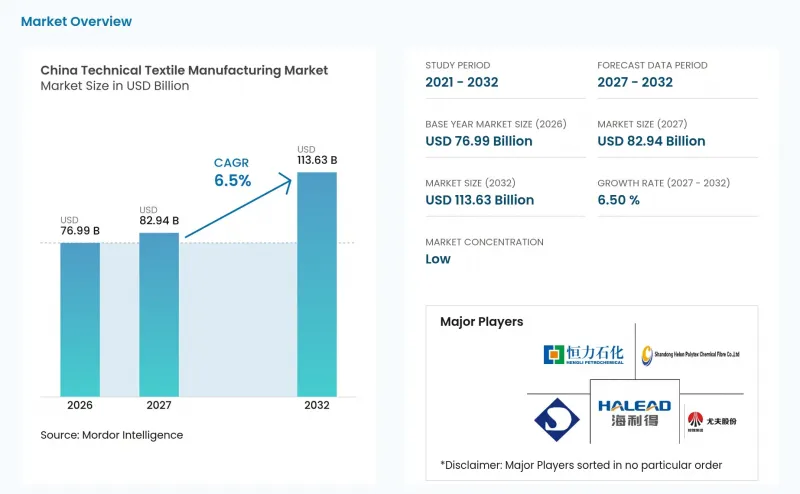
According to Mordor Intelligence, the China technical textile manufacturing market size is projected to expand from USD 76.99 billion in 2026 and USD 82.94 billion in 2027 to USD 113.63 billion by 2032, registering a CAGR of 6.5% between 2027 and 2032.
China Technical Textile Manufacturing Market Trends and Insights
New-Energy Vehicle, Battery, and Mobility Material Demand
China's new-energy vehicle expansion is raising both the volume and performance requirements for technical textiles. Materials used in battery packs need thermal protection, insulation, separation, acoustic control, and lightweight structural performance. The China technical textile manufacturing market benefits as vehicle makers require more material content in electric vehicles than in conventional vehicles. Vehicle makers are also placing more attention on traceable materials and consistent life-cycle information. Domestic aramid insulation paper can provide a cost advantage over imported alternatives. The opportunity, therefore, remains strongest for suppliers that can qualify battery-grade products and document their material performance.
Infrastructure Modernization and Geotechnical Demand
Transportation, water management, and urban construction continue to support demand for geotextiles and related materials. The first year of the 15th Five-Year Plan is 2026, sustaining the policy setting for road, high-speed rail, flood control, and municipal drainage investment. China Industrial Textile Association reported that demand for wiping products, automotive supporting products, and wind power applications each grew by more than 10% in 2025. The China technical textile manufacturing market can gain from higher procurement requirements for durable and certified geocomposites. More than 1,200 producers operate in geotechnical construction materials, which keeps price competition intense in standard products. Suppliers that meet recyclable or bio-based product requirements can be better placed as infrastructure buyers raise material standards.
Overcapacity and Margin Compression in Commodity Nonwovens
Commodity nonwovens carry the strongest margin risk in the China technical textile manufacturing market. National Bureau of Statistics data showed that profits in China's textile sector fell 12% in 2025. China Industrial Textile Association survey data put sector operating margins at 4.1% in 2025, down 0.2 percentage points from 2024, while revenue and total profit among enterprises above the designated size fell 2.4% and 7%. More than 700,000 tons of nonwoven capacity was contracted in 2025, including 140 needle-punched lines and 70 spunbond or meltblown lines. Only 36% of surveyed enterprises operated above 80% utilization, while average utilization was 73.5%. This environment favors consolidation and makes differentiated applications more important for sustaining profitability.
Other drivers and restraints analyzed in the detailed report include:
- Healthcare, Hygiene, and Medical Nonwoven Expansion
- Export Competitiveness and Integrated Fiber-to-Article Supply Chains
- Volatility in Polymer, Energy, and Chemical Input Costs
For complete list of drivers and restraints, kindly check the Table Of Contents.
Segment Analysis
Synthetic fiber accounted for 78% of the sector value in 2026. It provides the volume base for polyester, polyamide, UHMWPE, inorganic fibers, and other performance materials used in transport, protection, construction, aerospace, and filtration. The China technical textile manufacturing market continues to depend on synthetic materials for scale, while certification requirements increasingly separate specialized products from standard grades. Polyamide and UHMWPE are gaining importance where protective and defense applications require verified performance.
Regenerated and other fibers are the fastest-growing material category, with a forecast CAGR of 7.4% through 2032. This group includes Lyocell, bio-based fibers, recycled inputs, and other specialty alternatives that can address sustainability and traceability requirements. China Chemical Fiber Association data showed that bio-based chemical fiber profits rose 88.28% in 2025. Green factory evaluation and circularity programs encourage export-oriented producers to use traceable and bio-derived inputs, particularly for demanding overseas buyers. Synthetic fibers will remain essential for many end uses, but suppliers that combine performance, documented feedstocks, and consistent quality have a stronger proposition.
Complete Report Scope:
- By Material Type
- Natural Fiber
- Cotton
- Jute
- Others - Flex, Wool, Hemp, Coir, etc.
- Synthetic Fiber
- Polyester
- Polyamide / Nylon
- Polypropylene
- Polyethylene / UHMWPE
- Aramid and Other Specialty Synthetic Fibers
- Regenerated Fiber - Viscose, Lyocell, and Modal
- Inorganic Fibers (Glass, Carbon, Basalt, etc.)
- Others (Metallic, Conductive, and Other Specialty Fibers)
- Natural Fiber
- By Form and Structure
- Woven Technical Textiles
- Nonwoven Technical Textiles
- Knitted Technical Textiles
- Braided Technical Textiles
- Other Engineered Textile Structures (Technical Yarns, Cords, Rovings, etc.)
- By Application
- Mobiltech - Automotive, Transportation, and Mobility
- Indutech - Industrial and Manufacturing Applications
- Buildtech - Building and Construction
- Medtech - Medical and Hygiene
- Protech - Personal and Property Protection
- Agrotech - Agriculture, Horticulture, Forestry, and Fishing
- Geotech - Geotextiles and Civil Engineering
- Packtech - Packaging and Containment
- Oekotech - Environmental Protection
- Hometech - Furniture, Floor Coverings, and Domestic Technical Applications
- Clothtech - Functional Components for Clothing and Footwear
- Sporttech - Sports and Leisure Applications
List of Companies Covered in this Report:
- Jiangsu Hengli Chemical Fiber Co., Ltd.
- Zhejiang Hailide New Material Co., Ltd.
- Shanghai Shenda Co., Ltd.
- Zhejiang Unifull Industrial Fibre Co., Ltd.
- Shandong Helon Polytex Chemical Fibre Co., Ltd.
- Zhejiang Jinda New Materials Co., Ltd.
- Anhui Jinchun Nonwoven Co., Ltd.
- Fujian Nanfang Nonwovens Co., Ltd.
- Hubei Botao Nonwoven Fabric Co., Ltd.
- Shandong Tianli Nonwoven Co., Ltd.
- Xinxiang Zhuocheng Special Textile Co., Ltd.
- Zhejiang Guxiandao Polyester Dope Dyed Yarn Co., Ltd.
- Nantong Jinlong Glass Fiber Co., Ltd.
- Suzhou Long Special Fiber Co., Ltd.
- Zhejiang Yongning Filter Material Co., Ltd.
- Beijing Tongyizhong New Material Tech Co., Ltd.
- Zhejiang Kingsafe Fireproof Technology Co., Ltd.
- Tianjin TEDA Clean Materials Co., Ltd.
- Dalian Huayan Nonwoven Co., Ltd.
- Chongqing Kanghao Nonwoven Co., Ltd.
- TORAY INDUSTRIES, INC.
- Asahi Kasei Corporation
- Freudenberg Group
- Ahlstrom
- Berry Global Inc.
- DuPont
Additional Benefits:
- The market estimate (ME) sheet in Excel format
- 3 months of analyst support
TABLE OF CONTENTS
1 Introduction
- 1.1 Study Assumptions and Market Definition
- 1.2 Scope of the Study
2 Research Methodology
3 Executive Summary
4 Market Landscape
- 4.1 Market Overview
- 4.2 Market Drivers
- 4.2.1 New-Energy Vehicle, Battery, and Mobility Material Demand
- 4.2.2 Infrastructure Modernization and Geotechnical Demand
- 4.2.3 Healthcare, Hygiene, and Medical Nonwoven Expansion
- 4.2.4 Export Competitiveness and Integrated Fiber-to-Article Supply Chains
- 4.2.5 Domestic Substitution of Imported High-Specification Technical Materials
- 4.2.6 Digital Traceability and Small-Batch Customization for Industrial Buyers
- 4.3 Market Restraints
- 4.3.1 Overcapacity and Margin Compression in Commodity Nonwovens
- 4.3.2 Volatility in Polymer, Energy, and Chemical Input Costs
- 4.3.3 Uneven Qualification Cycles for High-Specification Applications
- 4.3.4 Export Tariffs, Trade Fragmentation, and Compliance Cost
- 4.4 Value and Supply-Chain Analysis
- 4.4.1 Raw Material and Specialty Fiber Suppliers
- 4.4.2 Technical and Industrial Yarn Producers
- 4.4.3 Fabric and Nonwoven Manufacturers
- 4.4.4 Coating, Lamination, and Functional Finishing Providers
- 4.4.5 Converters and Component Manufacturers
- 4.4.6 Distributors and Institutional Procurement Channels
- 4.4.7 End-User Industries
- 4.5 Regulatory Landscape
- 4.5.1 Industrial-Use Textile Industry High-Quality Development Guidance
- 4.5.2 Textile Industry Quality Improvement and Upgrading Implementation Plan
- 4.5.3 Product Safety, Fire Resistance, Medical, and Occupational Protection Standards
- 4.5.4 Environmental, Energy, Wastewater, and Emissions Requirements
- 4.5.5 Recycled Fiber, Biobased Fiber, and Circularity Requirements
- 4.5.6 Export Market Product Compliance and Traceability
- 4.6 Regulatory Landscape
- 4.6.1 Product safety and medical-device requirements
- 4.6.2 Geosynthetic, construction, and infrastructure standards
- 4.6.3 Chemical management, EPR, and digital-product-passport requirements
- 4.6.4 Carbon border and export-compliance requirements
- 4.6.5 Country incentives and technical-textile missions
- 4.7 Industry and Supply-Chain Trends
- 4.7.1 Regionalization and Localization of Technical Textile Manufacturing
- 4.7.2 Supplier Consolidation and Vertical Integration
- 4.7.3 Capacity Expansion and Manufacturing Investment
- 4.7.4 Changing Procurement and Performance-Specification Requirements
- 4.7.5 Impact of Trade and Geopolitical Developments
- 4.8 Woven, Knitted, and Braided Manufacturing Technologies
- 4.8.1 High-Speed and Technical Weaving
- 4.8.2 3D Weaving
- 4.8.3 Warp and Weft Knitting
- 4.8.4 3D Knitting
- 4.9 Emerging Manufacturing Technologies
- 4.9.1 Nanotechnology and Nanofiber Structures
- 4.9.2 Additive and Digital Textile Manufacturing
- 4.9.3 Smart and Connected Textile Integration
- 4.9.4 Conductive and Sensor-Integrated Textiles
- 4.9.5 Automated Inspection and Quality Control
- 4.9.6 AI, Digital Manufacturing, and Industry 4.0
- 4.10 Sustainability and Circularity Landscape
- 4.10.1 Recycled Fiber Adoption
- 4.10.2 Bio-Based and Renewable Raw Materials
- 4.10.3 Textile-to-Textile Recycling
- 4.10.4 Mono-Material and Design-for-Recycling Approaches
- 4.10.5 PFAS-Free and Lower-Impact Functional Finishes
- 4.10.6 Waste Reduction and Manufacturing Resource Efficiency
- 4.10.7 Traceability and Sustainability Certification
- 4.11 Spotlight on High-Growth Technical Textile Applications
- 4.11.1 EV and Next-Generation Mobility Textiles
- 4.11.2 Advanced Filtration Materials
- 4.11.3 Medical and Healthcare Textiles
- 4.11.4 Protective and Defense Textiles
- 4.11.5 Infrastructure and Geosynthetics
- 4.11.6 Renewable-Energy and Environmental Applications
5 Market Size & Growth Forecasts
- 5.1 By Material Type
- 5.1.1 Natural Fiber
- 5.1.1.1 Cotton
- 5.1.1.2 Jute
- 5.1.1.3 Others - Flex, Wool, Hemp, Coir, etc.
- 5.1.2 Synthetic Fiber
- 5.1.2.1 Polyester
- 5.1.2.2 Polyamide / Nylon
- 5.1.2.3 Polypropylene
- 5.1.2.4 Polyethylene / UHMWPE
- 5.1.2.5 Aramid and Other Specialty Synthetic Fibers
- 5.1.3 Regenerated Fiber - Viscose, Lyocell, and Modal
- 5.1.4 Inorganic Fibers (Glass, Carbon, Basalt, etc.)
- 5.1.5 Others (Metallic, Conductive, and Other Specialty Fibers)
- 5.1.1 Natural Fiber
- 5.2 By Form and Structure
- 5.2.1 Woven Technical Textiles
- 5.2.2 Nonwoven Technical Textiles
- 5.2.3 Knitted Technical Textiles
- 5.2.4 Braided Technical Textiles
- 5.2.5 Other Engineered Textile Structures (Technical Yarns, Cords, Rovings, etc.)
- 5.3 By Application
- 5.3.1 Mobiltech - Automotive, Transportation, and Mobility
- 5.3.2 Indutech - Industrial and Manufacturing Applications
- 5.3.3 Buildtech - Building and Construction
- 5.3.4 Medtech - Medical and Hygiene
- 5.3.5 Protech - Personal and Property Protection
- 5.3.6 Agrotech - Agriculture, Horticulture, Forestry, and Fishing
- 5.3.7 Geotech - Geotextiles and Civil Engineering
- 5.3.8 Packtech - Packaging and Containment
- 5.3.9 Oekotech - Environmental Protection
- 5.3.10 Hometech - Furniture, Floor Coverings, and Domestic Technical Applications
- 5.3.11 Clothtech - Functional Components for Clothing and Footwear
- 5.3.12 Sporttech - Sports and Leisure Applications
6 Competitive Landscape
- 6.1 Market Concentration
- 6.2 Strategic Moves
- 6.3 Market Share Analysis
- 6.4 Company Profiles (Includes Global Level Overview, Market Level Overview, Core Segments, Financials as available, Strategic Information, Products and Services, Recent Developments)
- 6.4.1 Jiangsu Hengli Chemical Fiber Co., Ltd.
- 6.4.2 Zhejiang Hailide New Material Co., Ltd.
- 6.4.3 Shanghai Shenda Co., Ltd.
- 6.4.4 Zhejiang Unifull Industrial Fibre Co., Ltd.
- 6.4.5 Shandong Helon Polytex Chemical Fibre Co., Ltd.
- 6.4.6 Zhejiang Jinda New Materials Co., Ltd.
- 6.4.7 Anhui Jinchun Nonwoven Co., Ltd.
- 6.4.8 Fujian Nanfang Nonwovens Co., Ltd.
- 6.4.9 Hubei Botao Nonwoven Fabric Co., Ltd.
- 6.4.10 Shandong Tianli Nonwoven Co., Ltd.
- 6.4.11 Xinxiang Zhuocheng Special Textile Co., Ltd.
- 6.4.12 Zhejiang Guxiandao Polyester Dope Dyed Yarn Co., Ltd.
- 6.4.13 Nantong Jinlong Glass Fiber Co., Ltd.
- 6.4.14 Suzhou Long Special Fiber Co., Ltd.
- 6.4.15 Zhejiang Yongning Filter Material Co., Ltd.
- 6.4.16 Beijing Tongyizhong New Material Tech Co., Ltd.
- 6.4.17 Zhejiang Kingsafe Fireproof Technology Co., Ltd.
- 6.4.18 Tianjin TEDA Clean Materials Co., Ltd.
- 6.4.19 Dalian Huayan Nonwoven Co., Ltd.
- 6.4.20 Chongqing Kanghao Nonwoven Co., Ltd.
- 6.4.21 TORAY INDUSTRIES, INC.
- 6.4.22 Asahi Kasei Corporation
- 6.4.23 Freudenberg Group
- 6.4.24 Ahlstrom
- 6.4.25 Berry Global Inc.
- 6.4.26 DuPont
7 Market Opportunities and Future Outlook
- 7.1 White-Space and Unmet-Need Assessment
- 7.1.1 Locally Produced High-Temperature and Chemical-Resistant Filtration Media
- 7.1.2 Recyclable and Bio-Based Geotechnical Materials
- 7.1.3 Lightweight Textile Composites for New-Energy Vehicles
- 7.1.4 Clinically Qualified Medical Textiles
- 7.1.5 Digital Product Passports and Export-Ready Traceability
- 7.2 Future Outlook
- 7.2.1 Base-Case Manufacturing Growth
- 7.2.2 Upside Case from High-Performance Applications
- 7.2.3 Downside Case from Trade and Overcapacity Pressures

