PUBLISHER: Mordor Intelligence | PRODUCT CODE: 2186146

PUBLISHER: Mordor Intelligence | PRODUCT CODE: 2186146
India Cloud Computing - Market Share Analysis, Industry Trends & Statistics, Growth Forecasts (2027 - 2032)
According to Mordor Intelligence, the India cloud computing market size is expected to increase from USD 26.43 billion in 2026 to USD 32.01 billion in 2027 and reach USD 85.46 billion by 2032, growing at a CAGR of 21.7% over 2027-2032.
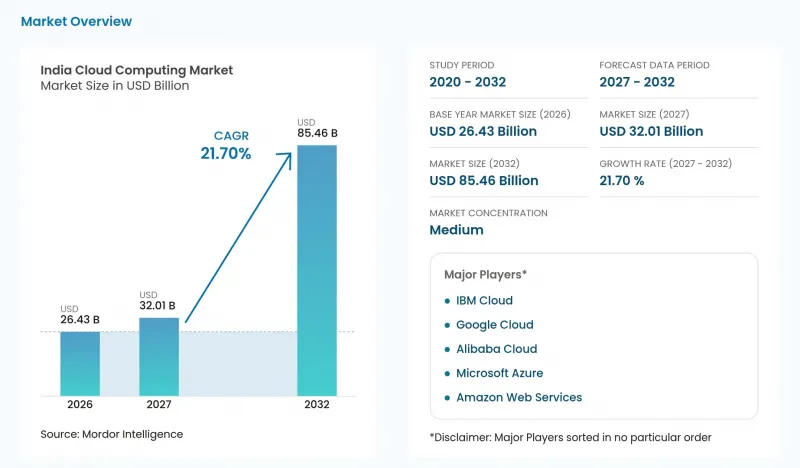
This report is segmented by Deployment Model (Public Cloud and more), Service Type (Software-as-a-Service and more), Organization Size (Small and Medium-sized Enterprises and more), Industry Vertical (BFSI and more), and Workload (Core Compute and Storage and more). The market forecasts are provided in terms of value (USD), based on availability.
India Cloud Computing Market Trends and Insights
Government cloud-first and Digital India policies
Government cloud policies can increase demand by extending a shared platform across departmental services. By June 2026, government departments' adoption of India's MeghRaj cloud platform had risen to 2,323 from 342 in 2015-16. MeghRaj powered platforms including DigiLocker, MyGov, and the National Scholarship Portal. Department-level adoption gives the platform an organizational reach beyond any single flagship application. The nearly sevenfold increase in adopting departments broadens the public-service base that needs continuing operation after launch, making sustained availability the demand consequence of adoption.
Digital transformation boom across enterprises
Enterprise digital transformation creates an operational cloud customer when a core application moves into a production cloud environment. GAIL completed a transition from its legacy ECC system to SAP S/4HANA Cloud on a cloud platform and went live on June 25, 2025. The implementation and migration were completed within the scheduled one-year period. SAP supplied the ERP software, while GAIL operated the enterprise system. Standalone migration fees fall outside the cloud-service spending measured here, so the continuing cloud access that runs the live ERP system is the relevant demand after go-live.
Escalating cyber-attack surface and data-sovereignty risks
Data sovereignty can restrict a cloud provider's addressable demand before its technical performance enters consideration. In Everpure's June 2026 survey of 300 Indian large-enterprise leaders, 39% said they were already limiting their use of SaaS providers reliant on non-domestic infrastructure. Aviatrix's April 2025 survey of 407 Indian enterprise IT professionals at organizations with over 2,000 employees found that 85% reported a cloud security incident in the prior 12 months. Infrastructure location therefore affects the services these enterprise buyers will use, while security exposure adds a separate operating burden. For providers reliant on non-domestic infrastructure, functional improvements alone may leave a material obstacle to winning these enterprise workloads.
Other drivers and restraints analyzed in the detailed report include:
- Explosive build-out of hyperscale and edge datacenters
- Sovereign-cloud push by RBI for regulated sectors
- Legacy-IT migration complexity and skills deficit
For complete list of drivers and restraints, kindly check the Table Of Contents.
Segment Analysis
Public cloud accounted for a 73.64% share of the India cloud computing market size in 2026. HDFC Bank's Enterprise Payment Hub is deployed across Google Cloud Platform and Amazon Web Services for mission-critical payment processing. HDFC Bank co-developed the hub with FynDNA, combining its role as the banking operator with an application-development partner. This deployment places a specific core banking function on public-cloud infrastructure, linking demand to payment-processing continuity. Suppliers serving this application must support operation across providers, so reliability at the application boundary matters alongside the capabilities of each cloud platform.
Hybrid cloud is the fastest-growing segment, with a 27.8% CAGR over 2027-2032. In Q1 2026, 44% of surveyed developers in India reported using hybrid cloud, the most widely used cloud deployment approach among developers there. The survey linked India's legislative environment to both the motivation for hybrid adoption and its practicality. An offer that works only when an application sits wholly in the cloud therefore misses the deployment approach these developers report using most often.
Software as a service (SaaS) represented a 53.15% India cloud computing market share in 2026. By April 1, 2026, around 1.67 million Government of India ministry and department user accounts had migrated to the cloud-based email solution selected through NIC and operated by Zoho. Payments were based on the actual number of email accounts migrated to the Zoho platform. Under this arrangement, migrating additional ministry or department accounts would expand Zoho's billable base, linking revenue opportunities to completed account transfers.
Platform as a service (PaaS) is the fastest-growing segment, with a 30.9% CAGR over 2027-2032. In August 2025, Bharti Airtel subsidiary Xtelify offered Airtel Cloud to telecom operators through a PaaS model and reported signed contracts with Singtel, Airtel Africa, and Globe Telecom. These counterparties are telecom operators in Singapore, Africa, and the Philippines, respectively. The Ministry of Steel hosted its web applications and services on NIC Cloud using PaaS through March 2025 and later moved some of them to TCL Cloud. For PaaS suppliers, the ministry's move separates initial platform adoption from retention of the underlying workloads, because applications can later move to another cloud provider.
Complete Report Scope:
- By Deployment Model
- Public Cloud
- Private Cloud
- Hybrid Cloud
- By Service Type
- Infrastructure-as-a-Service (IaaS)
- Platform-as-a-Service (PaaS)
- Software-as-a-Service (SaaS)
- Function-as-a-Service (FaaS)
- By Organization Size
- Small and Medium-sized Enterprises (SMEs)
- Large Enterprises
- By Industry Vertical
- BFSI
- Manufacturing
- Retail and E-commerce
- Healthcare and Life-Sciences
- Telecom and IT
- Government and Public Sector
- Transportation and Logistics
- Others
- By Workload
- Core Compute and Storage
- Analytics and Big-Data
- AI / ML and Gen-AI
- Business Applications (ERP/CRM/HR)
- Disaster Recovery and Backup
- Collaboration and Productivity
List of Companies Covered in this Report:
- Amazon Web Services
- Microsoft Azure
- Google Cloud
- IBM Cloud
- Oracle Cloud
- Alibaba Cloud
- Salesforce
- SAP SE
- VMware
- Tata Consultancy Services
- Wipro
- Infosys
- HCLTech
- Bharti Airtel (Nxtra / Airtel Cloud)
- Reliance Jio Cloud
- Zoho Corporation
- CtrlS Datacenters
- NTT (Netmagic)
- Lumen Technologies India
- Rackspace Technology India
Additional Benefits:
- The market estimate (ME) sheet in Excel format
- 3 months of analyst support
TABLE OF CONTENTS
1 INTRODUCTION
- 1.1 Study Assumptions and Market Definition
- 1.2 Scope of the Study
2 RESEARCH METHODOLOGY
3 EXECUTIVE SUMMARY
4 MARKET LANDSCAPE
- 4.1 Market Overview
- 4.2 Market Drivers
- 4.2.1 Government cloud-first and Digital India policies
- 4.2.2 Digital transformation boom across enterprises
- 4.2.3 Explosive build-out of hyperscale and edge datacenters
- 4.2.4 Sovereign-cloud push by RBI for regulated sectors
- 4.2.5 Generative-AI workloads demanding GPU-rich instances
- 4.2.6 Rise of industry-cloud platforms for compliance-heavy verticals
- 4.3 Market Restraints
- 4.3.1 Escalating cyber-attack surface and data-sovereignty risks
- 4.3.2 Legacy-IT migration complexity and skills deficit
- 4.3.3 Grid-power unreliability driving up datacenter opex
- 4.3.4 Restricted domestic semiconductor supply chain
- 4.4 Industry Value Chain Analysis
- 4.5 Regulatory Landscape
- 4.6 Technological Outlook
- 4.7 Porter's Five Forces Analysis
- 4.7.1 Threat of New Entrants
- 4.7.2 Bargaining Power of Suppliers
- 4.7.3 Bargaining Power of Buyers
- 4.7.4 Threat of Substitutes
- 4.7.5 Competitive Rivalry
- 4.8 Number of Datacentres in India
- 4.9 Case-Study Analysis
5 MARKET SIZE AND GROWTH FORECASTS (VALUE)
- 5.1 By Deployment Model
- 5.1.1 Public Cloud
- 5.1.2 Private Cloud
- 5.1.3 Hybrid Cloud
- 5.2 By Service Type
- 5.2.1 Infrastructure-as-a-Service (IaaS)
- 5.2.2 Platform-as-a-Service (PaaS)
- 5.2.3 Software-as-a-Service (SaaS)
- 5.2.4 Function-as-a-Service (FaaS)
- 5.3 By Organization Size
- 5.3.1 Small and Medium-sized Enterprises (SMEs)
- 5.3.2 Large Enterprises
- 5.4 By Industry Vertical
- 5.4.1 BFSI
- 5.4.2 Manufacturing
- 5.4.3 Retail and E-commerce
- 5.4.4 Healthcare and Life-Sciences
- 5.4.5 Telecom and IT
- 5.4.6 Government and Public Sector
- 5.4.7 Transportation and Logistics
- 5.4.8 Others
- 5.5 By Workload
- 5.5.1 Core Compute and Storage
- 5.5.2 Analytics and Big-Data
- 5.5.3 AI / ML and Gen-AI
- 5.5.4 Business Applications (ERP/CRM/HR)
- 5.5.5 Disaster Recovery and Backup
- 5.5.6 Collaboration and Productivity
6 COMPETITIVE LANDSCAPE
- 6.1 Market Concentration
- 6.2 Strategic Moves
- 6.3 Market Share Analysis
- 6.4 Company Profiles (includes Global level Overview, Market level overview, Core Segments, Financials as available, Strategic Information, Market Rank/Share for key companies, Products and Services, and Recent Developments)
- 6.4.1 Amazon Web Services
- 6.4.2 Microsoft Azure
- 6.4.3 Google Cloud
- 6.4.4 IBM Cloud
- 6.4.5 Oracle Cloud
- 6.4.6 Alibaba Cloud
- 6.4.7 Salesforce
- 6.4.8 SAP SE
- 6.4.9 VMware
- 6.4.10 Tata Consultancy Services
- 6.4.11 Wipro
- 6.4.12 Infosys
- 6.4.13 HCLTech
- 6.4.14 Bharti Airtel (Nxtra / Airtel Cloud)
- 6.4.15 Reliance Jio Cloud
- 6.4.16 Zoho Corporation
- 6.4.17 CtrlS Datacenters
- 6.4.18 NTT (Netmagic)
- 6.4.19 Lumen Technologies India
- 6.4.20 Rackspace Technology India
7 MARKET OPPORTUNITIES AND FUTURE OUTLOOK
- 7.1 White-Space and Unmet-Need Assessment

