PUBLISHER: Mordor Intelligence | PRODUCT CODE: 2187711

PUBLISHER: Mordor Intelligence | PRODUCT CODE: 2187711
Cloud Computing - Market Share Analysis, Industry Trends & Statistics, Growth Forecasts (2027 - 2032)
According to Mordor Intelligence, the cloud computing market size is estimated at USD 1.04 trillion in 2026 and is projected to be USD 1.25 trillion in 2027, reaching USD 3.16 trillion by 2032, growing at a CAGR of 20.35% from 2027 to 2032.
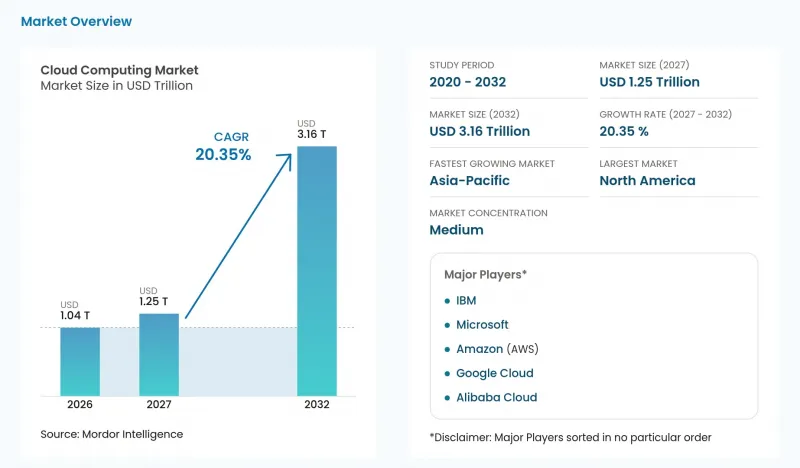
This report is segmented by Service Model (SaaS, IaaS, and more), Deployment Model (Private Cloud, Public Cloud, and more), End-user Vertical (BFSI, IT and Telecom, and more), Organization Size (Large Enterprises and Small and Mid-Sized Enterprises), and Geography (North America, Asia-Pacific, and more). The market forecasts are provided in terms of value (USD), based on availability.
Global Cloud Computing Market Trends and Insights
Explosive SaaS adoption in core enterprise software
Core business applications give cloud suppliers an expansion route inside an already substantial software customer base. In 2025, 96.44% of EU enterprises using paid cloud services purchased at least one SaaS service, including email, office, finance, accounting, ERP, CRM or security software. Within the same paid-cloud population, use of cloud enterprise resource planning applications rose from 25.89% in 2023 to 30.12% in 2025. Application vendors can pursue the gap between basic SaaS use and cloud ERP adoption by selling additional functions into customers already using hosted software.
Proliferation of Gen-AI workloads demanding elastic compute
Elastic delivery gives cloud suppliers a way to serve AI workloads whose capacity requirements change over time. AWS reported an annualized AI revenue run rate above USD 15 billion in Q1 2026. Microsoft Cloud revenue reached USD 59.3 billion in its fiscal fourth quarter ended June 2026, up 27% year over year, reflecting demand across Azure and first-party AI applications and services. For a buyer using variable capacity, additional service consumption can create supplier revenue without another fixed infrastructure purchase. AI-related demand creates revenue opportunities in both supplying compute capacity and delivering the applications that put it to use.
Data-localization laws fragmenting global footprints
A geographically broad cloud service becomes harder to scale when residency requirements constrain the locations from which it can operate. In its 2025 annual report, Akamai said localization and residency rules in certain jurisdictions could reduce its addressable market, raise costs and complexity, and lengthen sales cycles. For a provider facing those risks, a larger geographic footprint cannot automatically translate into a larger pool of serviceable customers. Additional compliance complexity can absorb resources before a contract generates revenue, weakening the economics of entering a smaller jurisdiction.
Other drivers and restraints analyzed in the detailed report include:
- Industry-specific cloud platforms (compliance-ready blueprints)
- Sovereign-cloud procurement and regulatory initiatives in EU and GCC
- Run-rate cost overruns vs on-prem TCO
For complete list of drivers and restraints, kindly check the Table Of Contents.
Segment Analysis
SaaS accounted for a 52.63% share of the cloud computing market size in 2026, making it the largest segment. Salesforce's subscription and support revenue grew 10% to USD 39.4 billion in its fiscal year ended January 31, 2026. The category primarily comprised enterprise cloud-service fees and included support, updates and term software licenses, with term licenses representing approximately 6%. Salesforce attributed the increase mainly to new customers, upgrades and added subscriptions, with pricing not a significant driver, linking its revenue growth to sales volume rather than higher prices.
PaaS is forecast to be the fastest-growing segment, with a 22.55% CAGR from 2027 to 2032. Tuya reported PaaS revenue of USD 67.9 million in Q2 2026, up 16.9% year over year. It attributed the increase primarily to higher demand, customer focus and product enhancements, despite tariff-related headwinds since April 2025. Its 318 premium PaaS customers in the 12 months ended June 30, 2026, each contributed more than USD 100,000 of PaaS revenue. Premium customers contributed approximately 89.5% of Tuya's Q2 2026 PaaS revenue, making retention of this cohort commercially important alongside new customer acquisition.
Private cloud represented a 46.18% cloud computing market share in 2026, making it the largest segment. Broadcom's 2026 survey covered 1,800 senior IT decision-makers at organizations with at least 1,000 employees across 8 countries, with 600 participants each from North America, Europe, and Asia-Pacific and Japan. It found that 50% of enterprise respondents had repatriated some workloads from public to private cloud, up 15 percentage points from 2025. Security and compliance led reported repatriation motives at 51%, followed by cost predictability at 39%, making workload suitability and predictable costs separate sources of demand for private infrastructure.
Hybrid cloud is forecast to be the fastest-growing segment, with a 21.95% CAGR from 2027 to 2032. On February 26, 2026, NTT DOCOMO and NEC launched a commercial 5G core in Japan combining DOCOMO's virtualization platform with AWS public cloud. NEC contributed core software and architecture, and the partners implemented fault tolerance and redundancy for commercial operation. For an operator, the value of this configuration depends on preserving network service through an integrated deployment across both environments. In this launch, NEC's architecture and the fault-tolerance and redundancy work formed part of the supplier scope alongside the AWS public-cloud capacity.
Complete Report Scope:
- By Service Model
- IaaS
- PaaS
- SaaS
- By Deployment Model
- Public Cloud
- Private Cloud
- Hybrid Cloud
- By End-user Vertical
- IT and Telecom
- BFSI
- Manufacturing
- Retail and Consumer Goods
- Healthcare and Life Sciences
- Others
- By Organization Size
- Large Enterprises
- Small and Mid-Sized Enterprises (SMEs)
- By Geography
- North America
- United States
- Canada
- Mexico
- South America
- Brazil
- Argentina
- Rest of South America
- Europe
- Germany
- United Kingdom
- France
- Italy
- Spain
- Rest of Europe
- Asia-Pacific
- China
- Japan
- India
- South Korea
- Southeast Asia
- Rest of Asia-Pacific
- Middle East and Africa
- Middle East
- Saudi Arabia
- United Arab Emirates
- Turkey
- Rest of Middle East
- Africa
- South Africa
- Nigeria
- Egypt
- Rest of Africa
- Middle East
- North America
Geography Analysis
North America held a 24.05% share of the cloud computing market size in 2026, making it the largest geography. The Government Accountability Office (GAO) reported in 2026 that United States federal cloud-services contract spending had risen from USD 2.3 billion to more than USD 10 billion annually over the preceding 10 years. Those contracts covered virtual machines, database hosting, cloud storage, and application development and deployment. That spread of contract types gives suppliers a federal application-development opportunity alongside infrastructure provision, extending the revenue base beyond hosting and storage.
Asia-Pacific is forecast to be the fastest-growing geography, with a 21.4% CAGR from 2027 to 2032. Google Cloud launched its Bangkok region in January 2026, adding local infrastructure with in-country data residency and low-latency service for Thai customers. In its fiscal 2024/25 report, GovTech Singapore said it had completed a migration of 213 systems across 41 agencies to Government on Commercial Cloud Plus and Government on Commercial Cloud. The work took more than 2 years and responded to the Government Private Cloud's planned retirement. New local supply supports workloads constrained by residency or latency, while the completed Singapore transition establishes a commercial-cloud base for further applications.
In Europe, surveyed EU paid-cloud users favored email (85.2%), office software (71.7%) and file storage (71.5%) in 2025, and 73% of Irish enterprises used paid cloud, including email, software or data storage. In 2025, 36% of internet-connected Brazilian enterprises paid for cloud processing, while on June 18, 2025, Microsoft reported Chile Central operating through 3 independent physical locations serving businesses and public organizations in Chile and other South American countries. In Africa, AWS and Sonatel, an Orange affiliate, made on-demand compute and storage available in Dakar, Senegal, in April 2025 for West African customers. In Saudi Arabia, financial institutions regulated by the Saudi Central Bank (SAMA) should obtain SAMA approval before hybrid or public cloud use or contracting, include cybersecurity terms before use, and use Saudi hosting in principle, with explicit approval for foreign services. Saudi hosting and approval rules shape financial-sector access, while Chile Central and Dakar place capacity closer to regional buyers.
- Amazon (AWS)
- Microsoft
- Google Cloud
- Alibaba Cloud
- IBM
- Oracle
- Salesforce
- SAP SE
- Adobe
- Tencent Cloud
- Huawei Cloud
- Rackspace Technology
- VMware
- Snowflake
- Workday
- ServiceNow
- DigitalOcean
- OVHcloud
- Linode
- Nutanix
Additional Benefits:
- The market estimate (ME) sheet in Excel format
- 3 months of analyst support
TABLE OF CONTENTS
1 INTRODUCTION
- 1.1 Study Assumptions and Market Definition
- 1.2 Scope of the Study
2 RESEARCH METHODOLOGY
3 EXECUTIVE SUMMARY
4 MARKET LANDSCAPE
- 4.1 Market Overview
- 4.2 Market Drivers
- 4.2.1 Explosive SaaS adoption in core enterprise software
- 4.2.2 Proliferation of Gen-AI workloads demanding elastic compute
- 4.2.3 Industry-specific cloud platforms (compliance-ready blueprints)
- 4.2.4 Sovereign-cloud procurement and regulatory initiatives in EU and GCC
- 4.2.5 Rise of edge-cloud zones for XR and autonomous ops
- 4.2.6 Green-cloud buying criteria tied to Scope-3 targets
- 4.3 Market Restraints
- 4.3.1 Data-localization laws fragmenting global footprints
- 4.3.2 Run-rate cost overruns vs on-prem TCO
- 4.3.3 Advanced chip export controls limiting GPU supply
- 4.3.4 Scarcity of low-carbon power for hyperscale DCs
- 4.4 Industry Value Chain Analysis
- 4.5 Regulatory Landscape
- 4.6 Technological Outlook
- 4.7 Porter's Five Forces Analysis
- 4.7.1 Threat of New Entrants
- 4.7.2 Bargaining Power of Suppliers
- 4.7.3 Bargaining Power of Buyers
- 4.7.4 Threat of Substitutes
- 4.7.5 Competitive Rivalry
- 4.8 Assessment of Macroeconomic Factors on the market
5 MARKET SIZE AND GROWTH FORECASTS (VALUE)
- 5.1 By Service Model
- 5.1.1 IaaS
- 5.1.2 PaaS
- 5.1.3 SaaS
- 5.2 By Deployment Model
- 5.2.1 Public Cloud
- 5.2.2 Private Cloud
- 5.2.3 Hybrid Cloud
- 5.3 By End-user Vertical
- 5.3.1 IT and Telecom
- 5.3.2 BFSI
- 5.3.3 Manufacturing
- 5.3.4 Retail and Consumer Goods
- 5.3.5 Healthcare and Life Sciences
- 5.3.6 Others
- 5.4 By Organization Size
- 5.4.1 Large Enterprises
- 5.4.2 Small and Mid-Sized Enterprises (SMEs)
- 5.5 By Geography
- 5.5.1 North America
- 5.5.1.1 United States
- 5.5.1.2 Canada
- 5.5.1.3 Mexico
- 5.5.2 South America
- 5.5.2.1 Brazil
- 5.5.2.2 Argentina
- 5.5.2.3 Rest of South America
- 5.5.3 Europe
- 5.5.3.1 Germany
- 5.5.3.2 United Kingdom
- 5.5.3.3 France
- 5.5.3.4 Italy
- 5.5.3.5 Spain
- 5.5.3.6 Rest of Europe
- 5.5.4 Asia-Pacific
- 5.5.4.1 China
- 5.5.4.2 Japan
- 5.5.4.3 India
- 5.5.4.4 South Korea
- 5.5.4.5 Southeast Asia
- 5.5.4.6 Rest of Asia-Pacific
- 5.5.5 Middle East and Africa
- 5.5.5.1 Middle East
- 5.5.5.1.1 Saudi Arabia
- 5.5.5.1.2 United Arab Emirates
- 5.5.5.1.3 Turkey
- 5.5.5.1.4 Rest of Middle East
- 5.5.5.2 Africa
- 5.5.5.2.1 South Africa
- 5.5.5.2.2 Nigeria
- 5.5.5.2.3 Egypt
- 5.5.5.2.4 Rest of Africa
- 5.5.5.1 Middle East
- 5.5.1 North America
6 COMPETITIVE LANDSCAPE
- 6.1 Market Concentration
- 6.2 Strategic Moves
- 6.3 Market Share Analysis
- 6.4 Company Profiles (includes Global level Overview, Market level overview, Core Segments, Financials as available, Strategic Information, Market Rank/Share for key companies, Products and Services, and Recent Developments)
- 6.4.1 Amazon (AWS)
- 6.4.2 Microsoft
- 6.4.3 Google Cloud
- 6.4.4 Alibaba Cloud
- 6.4.5 IBM
- 6.4.6 Oracle
- 6.4.7 Salesforce
- 6.4.8 SAP SE
- 6.4.9 Adobe
- 6.4.10 Tencent Cloud
- 6.4.11 Huawei Cloud
- 6.4.12 Rackspace Technology
- 6.4.13 VMware
- 6.4.14 Snowflake
- 6.4.15 Workday
- 6.4.16 ServiceNow
- 6.4.17 DigitalOcean
- 6.4.18 OVHcloud
- 6.4.19 Linode
- 6.4.20 Nutanix
7 MARKET OPPORTUNITIES AND FUTURE OUTLOOK
- 7.1 White-Space and Unmet-Need Assessment

