PUBLISHER: Mordor Intelligence | PRODUCT CODE: 2186157

PUBLISHER: Mordor Intelligence | PRODUCT CODE: 2186157
Online Music Education - Market Share Analysis, Industry Trends & Statistics, Growth Forecasts (2027 - 2032)
According to Mordor Intelligence, the online music education market size is projected to expand from USD 4.61 billion in 2026 and USD 5.31 billion in 2027 to USD 10.62 billion by 2032, registering a CAGR of 14.86% between 2027 and 2032.
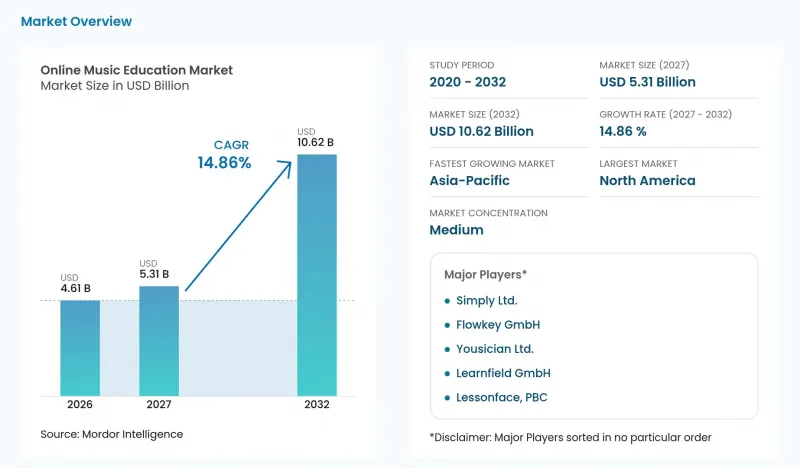
This report is segmented by Instrument Type (Piano and more), Platform (App-Based and more), End-user (Individual Learners and more), Learning Model (Self-Paced Asynchronous Courses and more), Session Format (One-to-One and more), and Geography (North America and more). The market forecasts are provided in terms of value (USD), based on availability.
Global Online Music Education Market Trends and Insights
Growing adoption of interactive e-learning platforms
Interactive platforms can distribute instrument-specific teaching to a substantial learner base. On September 1, 2026, Learnfield GmbH said its Trala violin app had more than 800,000 users. Its portfolio includes the Skoove piano-learning platform and Trala violin-learning app. An established app audience gives the provider a route to offer additional instruction without first introducing learners to an unfamiliar delivery channel. For paid instruction, the commercial task is to give those learners a structured sequence that remains useful as their playing develops. The resulting opportunity centers on follow-on instruction within Trala's reported audience, extending the sales proposition beyond initial app discovery.
Rising demand for personalized, adaptive learning experiences
Learner interest in immediate correction gives personalized instruction a specific service proposition around which to build paid courses. A 2025 study of 650 Chinese undergraduate music majors with generative-AI music-learning experience found that immediate feedback's perceived usefulness averaged 4.6 out of 5. For a provider, feedback that ties each correction to the next assignment makes personalization concrete in the course design. Respondents rated anthropomorphic generative AI's usefulness for rhythm, ear training, and theory at 4.5 out of 5. Their openness to advanced AI features also averaged 4.6 out of 5, signaling receptiveness to AI-assisted correction within this experienced student group.
Data security and privacy concerns on cloud lesson archives
Schools weigh student-data safeguards when deciding whether to adopt a cloud-based lesson service. The U.S. Department of Education advises teachers to check school approval and consult IT because online educational applications may introduce security or privacy vulnerabilities. For applications collecting education-record information under FERPA's school-official exception, the guidance requires school control over its use and maintenance. These conditions make access and data-use terms part of the institutional adoption decision. In its August 2026 privacy policy, IWantToPractice LLC's Muzie platform described recording notifications and access-controlled storage of recordings, transcripts, and summaries in the United States. Such controls address handling risks, but leave schools with the cost of reviewing whether the service meets their obligations.
Other drivers and restraints analyzed in the detailed report include:
- Expansion of high-speed internet and smartphone penetration
- Post-COVID normalization of remote skill-building
- Freely available tutorial content diluting paid platform value
For complete list of drivers and restraints, kindly check the Table Of Contents.
Segment Analysis
Piano accounted for a 38.75% share of the online music education market size in 2026. In July 2026, Oxford University Press made selected piano-method sheet music available to millions of Simply Piano learners worldwide. The content included Piano Time and Tunes for Ten Fingers inside the app's interactive learning environment. Published method material gives the largest segment's app operators a structured curriculum resource that can extend instruction within the existing practice environment.
Ukulele is forecast to be the fastest-growing segment, with a CAGR of 15.4% between 2027 and 2032. On January 13, 2026, Samsung Electronics announced a Fender partnership that included a ukulele learning path in a TV edition of the multi-instrument Fender Play service. Samsung's announcement planned release for the first half of 2026 on 2025-and-later TVs in 49 countries across the Americas, Europe, Australia, New Zealand, and South Korea. Samsung offered owners of eligible TV models in Hungary a Fender Play trial from August 1, 2026 to March 31, 2027.
App-based platforms represented a 50.76% online music education market share in 2026. Simply Piano had more than 50 million cumulative Google Play downloads at the time of its October 13, 2026 update. In-app purchases let the supplier offer paid instruction inside the distributed app, connecting consumer discovery with a purchase route in the installed product.
Hybrid (app + web) delivery is forecast to be the fastest-growing segment, with a CAGR of 16.3% between 2027 and 2032. Musora delivers lessons across web, tablet, and mobile and reported a global learning community of more than 100,000 musicians in October 2026. In an October 2026 app update, its Duo plan allowed one additional person and its Family plan up to 4, each with a separate account. Individual accounts give the provider a way to separate learner progression within a shared membership. Musora can package a household membership around several individual learning paths instead of selling access separately to every learner.
Complete Report Scope:
- By Instrument Type
- Piano
- Guitar
- Violin
- Ukulele
- Drums and Percussion
- Wind and Brass
- Other Instruments
- By Platform
- App-Based
- Web-Based
- Hybrid (App + Web)
- By End-user
- Individual Learners
- K-12 Institutions
- Higher Education
- Music Schools and Conservatories
- Corporate/Professional Development
- By Learning Model
- Self-Paced Asynchronous Courses
- Live Instructor-Led One-to-One
- Live Instructor-Led Group Classes
- Blended (Live + Self-Paced)
- By Session Format
- One-to-One
- Small Group (2-5 Learners)
- Large Group/Webinar
- Masterclass/Workshop
- By Geography
- North America
- United States
- Canada
- Mexico
- South America
- Brazil
- Argentina
- Chile
- Rest of South America
- Europe
- Germany
- United Kingdom
- France
- Italy
- Spain
- Russia
- Rest of Europe
- Asia-Pacific
- China
- India
- Japan
- South Korea
- Singapore
- Malaysia
- Australia
- Rest of Asia-Pacific
- Middle East and Africa
- Middle East
- United Arab Emirates
- Saudi Arabia
- Turkey
- Rest of Middle East
- Africa
- South Africa
- Nigeria
- Rest of Africa
- Middle East
- North America
Geography Analysis
North America accounted for 34.88% of the online music education market size in 2026. Rockstar Music's Canadian roster included 183 active instructors in June 2026, and 70% offered online lessons. That census covered a single school operator's in-home and online roster, showing a supply base that can make digital instruction part of a mixed teaching offer. A locally organized school can add remote teaching through participating instructors, so overall roster expansion alone need not expand online lesson availability.
Asia-Pacific is forecast to be the fastest-growing region, with a CAGR of 16.2% between 2027 and 2032. In India, online music-education provider Artium Academy launched its Globally Recognised Music Programme in March 2025 with a 5-year curriculum comprising 252 lessons. The curriculum offered graded and non-graded paths that could accommodate different approaches to assessment. A multiyear curriculum gives the provider successive levels to sell as learners develop their technique. Offering both assessment paths can widen the audience for that progression without requiring every learner to pursue grades.
In South America, Brazil-based Musixe offered subscriptions to 6,000 recorded lessons across 70 courses by March 2026, while Uruguay's Paula Soiza offers individual online or in-person lessons with private virtual materials. In its 2025/2026 tariff period, Germany's Porte Saz Evi offered national video lessons with primarily in-person ensemble and stage teaching, while Ireland's Waltons New School of Music offers private and group online tuition internationally. New Zealand's Revelation Sound NZ combines live online and small-group lessons with studio teaching and audio engineering. Within Middle East and Africa, Melody Makers delivers weekly UAE lessons through Zoom or Google Meet, while South Africa's PlayMusic provides national live individual video instruction for children and adults. Reusing Musixe's recorded library and extending PlayMusic's live individual teaching therefore have different capacity requirements, because only the latter consumes teacher time for each lesson.
- Yousician Ltd.
- Simply Ltd.
- Flowkey GmbH
- Learnfield GmbH
- Lessonface, PBC
- JamPlay LLC
- TrueFire Studios LLC
- ArtistWorks, LLC
- Tonara Ltd.
- Musika Lessons Inc.
- Music Education Technologies Ltd.
- VIP Peilian Education Technology Co., Ltd.
- Point Blank Ltd.
- Berklee Online (Berklee College of Music)
- Coursera Inc. (Music Segment)
- Udemy Inc. (Music Segment)
- Simply Guitar (by Simply)
- Fender Play (Fender Musical Instruments Corp.)
- Caldecott Music Group / BandLab
- JamKazam Inc.
- Rockschool Online (RSL Awards Ltd.)
- TakeLessons (a Microsoft company)
- MOOSIKO Inc.
- School of Rock LLC (remote programs)
- Melodics Ltd.
Additional Benefits:
- The market estimate (ME) sheet in Excel format
- 3 months of analyst support
TABLE OF CONTENTS
1 INTRODUCTION
- 1.1 Study Assumptions and Market Definition
- 1.2 Scope of the Study
2 RESEARCH METHODOLOGY
3 EXECUTIVE SUMMARY
4 MARKET LANDSCAPE
- 4.1 Market Overview
- 4.2 Market Drivers
- 4.2.1 Growing adoption of interactive e-learning platforms
- 4.2.2 Rising demand for personalized, adaptive learning experiences
- 4.2.3 Expansion of high-speed internet and smartphone penetration
- 4.2.4 Post-COVID normalization of remote skill-building
- 4.2.5 AI-enabled real-time feedback accelerating practice efficiency
- 4.2.6 Corporate creator up-skilling programs fueling B2B demand
- 4.3 Market Restraints
- 4.3.1 Data security and privacy concerns on cloud lesson archives
- 4.3.2 Freely available tutorial content diluting paid platform value
- 4.3.3 Latency and audio-quality limits hamper nuanced instruction
- 4.3.4 Instructor income volatility under revenue-share models
- 4.4 Industry Value Chain Analysis
- 4.5 Regulatory Landscape
- 4.6 Technological Outlook
- 4.7 Porter's Five Forces Analysis
- 4.7.1 Threat of New Entrants
- 4.7.2 Bargaining Power of Suppliers
- 4.7.3 Bargaining Power of Buyers
- 4.7.4 Threat of Substitutes
- 4.7.5 Competitive Rivalry
- 4.8 Impact of Macroeconomic Factors on the Market
5 MARKET SIZE AND GROWTH FORECASTS (VALUE)
- 5.1 By Instrument Type
- 5.1.1 Piano
- 5.1.2 Guitar
- 5.1.3 Violin
- 5.1.4 Ukulele
- 5.1.5 Drums and Percussion
- 5.1.6 Wind and Brass
- 5.1.7 Other Instruments
- 5.2 By Platform
- 5.2.1 App-Based
- 5.2.2 Web-Based
- 5.2.3 Hybrid (App + Web)
- 5.3 By End-user
- 5.3.1 Individual Learners
- 5.3.2 K-12 Institutions
- 5.3.3 Higher Education
- 5.3.4 Music Schools and Conservatories
- 5.3.5 Corporate/Professional Development
- 5.4 By Learning Model
- 5.4.1 Self-Paced Asynchronous Courses
- 5.4.2 Live Instructor-Led One-to-One
- 5.4.3 Live Instructor-Led Group Classes
- 5.4.4 Blended (Live + Self-Paced)
- 5.5 By Session Format
- 5.5.1 One-to-One
- 5.5.2 Small Group (2-5 Learners)
- 5.5.3 Large Group/Webinar
- 5.5.4 Masterclass/Workshop
- 5.6 By Geography
- 5.6.1 North America
- 5.6.1.1 United States
- 5.6.1.2 Canada
- 5.6.1.3 Mexico
- 5.6.2 South America
- 5.6.2.1 Brazil
- 5.6.2.2 Argentina
- 5.6.2.3 Chile
- 5.6.2.4 Rest of South America
- 5.6.3 Europe
- 5.6.3.1 Germany
- 5.6.3.2 United Kingdom
- 5.6.3.3 France
- 5.6.3.4 Italy
- 5.6.3.5 Spain
- 5.6.3.6 Russia
- 5.6.3.7 Rest of Europe
- 5.6.4 Asia-Pacific
- 5.6.4.1 China
- 5.6.4.2 India
- 5.6.4.3 Japan
- 5.6.4.4 South Korea
- 5.6.4.5 Singapore
- 5.6.4.6 Malaysia
- 5.6.4.7 Australia
- 5.6.4.8 Rest of Asia-Pacific
- 5.6.5 Middle East and Africa
- 5.6.5.1 Middle East
- 5.6.5.1.1 United Arab Emirates
- 5.6.5.1.2 Saudi Arabia
- 5.6.5.1.3 Turkey
- 5.6.5.1.4 Rest of Middle East
- 5.6.5.2 Africa
- 5.6.5.2.1 South Africa
- 5.6.5.2.2 Nigeria
- 5.6.5.2.3 Rest of Africa
- 5.6.5.1 Middle East
- 5.6.1 North America
6 COMPETITIVE LANDSCAPE
- 6.1 Market Concentration
- 6.2 Strategic Moves
- 6.3 Market Share Analysis
- 6.4 Company Profiles (includes Global level Overview, Market level overview, Core Segments, Financials as available, Strategic Information, Market Rank/Share for key companies, Products and Services, and Recent Developments)
- 6.4.1 Yousician Ltd.
- 6.4.2 Simply Ltd.
- 6.4.3 Flowkey GmbH
- 6.4.4 Learnfield GmbH
- 6.4.5 Lessonface, PBC
- 6.4.6 JamPlay LLC
- 6.4.7 TrueFire Studios LLC
- 6.4.8 ArtistWorks, LLC
- 6.4.9 Tonara Ltd.
- 6.4.10 Musika Lessons Inc.
- 6.4.11 Music Education Technologies Ltd.
- 6.4.12 VIP Peilian Education Technology Co., Ltd.
- 6.4.13 Point Blank Ltd.
- 6.4.14 Berklee Online (Berklee College of Music)
- 6.4.15 Coursera Inc. (Music Segment)
- 6.4.16 Udemy Inc. (Music Segment)
- 6.4.17 Simply Guitar (by Simply)
- 6.4.18 Fender Play (Fender Musical Instruments Corp.)
- 6.4.19 Caldecott Music Group / BandLab
- 6.4.20 JamKazam Inc.
- 6.4.21 Rockschool Online (RSL Awards Ltd.)
- 6.4.22 TakeLessons (a Microsoft company)
- 6.4.23 MOOSIKO Inc.
- 6.4.24 School of Rock LLC (remote programs)
- 6.4.25 Melodics Ltd.
7 MARKET OPPORTUNITIES AND FUTURE OUTLOOK
- 7.1 White-Space and Unmet-Need Assessment

