PUBLISHER: Mordor Intelligence | PRODUCT CODE: 2187142

PUBLISHER: Mordor Intelligence | PRODUCT CODE: 2187142
Dietary Supplements - Market Share Analysis, Industry Trends & Statistics, Growth Forecasts (2027 - 2032)
According to Mordor Intelligence, the dietary supplements market size is estimated at USD 151.8 billion in 2026 and is projected to be USD 158.3 billion in 2027, reaching USD 198.4 billion by 2032, growing at a CAGR of 4.62% from 2027 to 2032.
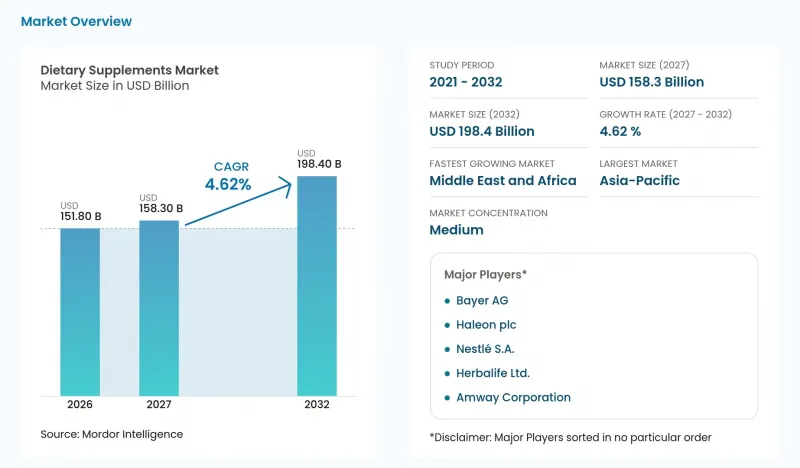
This report is segmented by Product Type (Vitamins and more), Form (Capsules and Softgels and more), Source (Synthetic/Fermentation-derived and more), Consumer Group (Women and more), Health Application (General Health and Wellness and more), Distribution Channel (Online Retail Channels and more), and Geography. The market forecasts are provided in terms of value (USD), based on availability.
Global Dietary Supplements Market Trends and Insights
Increased Focus on Preventive Healthcare
Preventive-health priorities support demand by giving consumers a reason to use supplements for ongoing health maintenance. In July 2026, 78% of U.S. adults reported taking at least one supplement for their health. In a September 2026 Morning Consult poll for the Council for Responsible Nutrition, 52% of U.S. adults said supplements were essential or important to maintaining health and wellness. Taken as separate indicators, widespread use and perceived importance give health-maintenance formulas an audience already familiar with supplement use. The commercial opening is to strengthen health-maintenance offers for existing users, so expansion need not depend entirely on recruiting first-time supplement users.
Supplements Targeting Women Consumers Fueling Growth
Women-focused supplement demand has a concrete clinical-use foundation when a formulation addresses a defined reproductive-health need. The American College of Obstetricians and Gynecologists recommends that most women of reproductive age take a daily supplement containing at least 400 mcg of folic acid to help prevent neural tube defects. Exact dosing is determined through shared decision-making between the patient and their obstetrician-gynecologist. This gives manufacturers a product-design brief built around a specified nutrient, daily use, and a defined female population.
Presence of Counterfeit Products Hampering the Growth
Counterfeit supplements create a competitive problem that combines ingredient failure with demand for cheaper alternatives. South Korea's Trademark Police seized approximately 8,000 counterfeit health and dietary supplement items in 6 raids from July 2025 through January 2026. Seized products included vitamins, probiotics, and joint and bone supplements with none of their advertised active ingredients. Among 75 UK respondents who knowingly purchased counterfeit food supplements in 2025, 49% said they would buy a similar cheaper-brand product if counterfeits were unavailable. For legitimate suppliers, these findings imply that product authenticity and price address different parts of the competitive threat. Demonstrating genuine ingredients can distinguish an offer, but it leaves the cost of competing for explicitly price-sensitive counterfeit buyers unresolved.
Other drivers and restraints analyzed in the detailed report include:
- Growing Preference for Clean-label, Plant-based and Vegan Formulas
- Healthy-aging Focus Accelerating Multivitamin Uptake Among Consumers
- Rising Consumer Skepticism Toward Synthetic Additives and Mega-dose Safety Concerns
For complete list of drivers and restraints, kindly check the Table Of Contents.
Segment Analysis
Vitamins accounted for a 26.8% share of the dietary supplements market size in 2026, making them the largest segment. In 2025, Haleon expanded Centrum Daily Kits across Asia-Pacific and reported over 1 million packs sold since launch. The kits provide a 30-day supply of vitamins tailored to gender and age needs. Haleon also reported that the range delivered market-share gains, indicating that these tailored vitamin kits were winning business in the region.
Prebiotic and probiotic supplements are the fastest-growing segment, with a forecast CAGR of 9.85% from 2027 to 2032. BioGaia sold 715 million doses of its branded finished probiotic products worldwide in 2025, defining a dose as the product-specific recommended intake per occasion. That dose volume comes from branded finished products sold to consumers worldwide, with probiotic cultures supplied to a limited number of business customers as a further source of doses beyond that count. H&H International reported that its combined pediatric probiotic and kids' nutritional supplements sales in mainland China turned around to 2% growth in 2025, helped by portfolio expansion into products such as kids' nutrition powders. Protein and amino acid supplements serve athletic-performance buyers, illustrated by Glanbia's broader Performance Nutrition segment, including protein powders and ready-to-drink and ready-to-eat products, which grew like-for-like revenue 2.8% in 2025.
Capsules and softgels represented a 37.75% dietary supplements market share in 2026, making them the largest segment. In May 2026, Robinson Pharma reported 36 softgel encapsulation machines at its flagship facility, including 15 dedicated to vegetarian softgels. Robinson Pharma is a dietary-supplement contract manufacturer, giving brands an external production route to that installed base. A brand can offer a vegetarian softgel through this production model, extending its formulation choices while retaining the leading dosage form.
Gummies are the fastest-growing segment, with a forecast CAGR of 12.25% from 2027 to 2032. In May 2025, Pharmavite opened a New Albany, Ohio, facility that expanded Nature Made vitamin-gummy production and was already producing products ready for sale. The project also supported research and innovation capabilities for vitamin gummies through Pharmavite's Gummies Innovation Center of Excellence. The facility represented a USD 250 million investment, showing the capital Pharmavite committed to commercial production in the fastest-growing form.
Complete Report Scope:
- By Product Type
- Vitamins
- Vitamin A
- Vitamin C
- Vitamin D
- Vitamin B (Includes B6, B7 / Biotin, B9/ Folic, B12, etc.)
- Other Vitamin Supplements
- Multivitamin Supplements
- Minerals
- Iron Supplements
- Calcium Supplements
- Magnesium and Zinc Supplements
- Multi-Mineral Supplements
- Other Minerals
- Fatty Acids
- Protein and Amino Acids
- Prebiotic and Probiotic Supplements
- Herbal Supplements
- Enzymes
- Blended Supplements
- Others
- Vitamins
- By Form
- Tablets
- Capsules and Softgels
- Powders
- Gummies
- Liquids
- Others
- By Source
- Plant-based
- Animal-based
- Synthetic/Fermentation-derived
- By Consumer Group
- Men
- Women
- Kids/Children
- By Health Application
- General Health and Wellness
- Bone and Joint Health
- Energy and Weight Management
- Gastrointestinal and Gut Health
- Immunity Enhancement
- Cardiovascular Health
- Diabetes Management
- Cognitive and Mental Health
- Skin, Hair and Nail Care
- Eye Health
- Other Health Applications
- By Distribution Channel
- Supermarkets/Hypermarkets
- Specialty Stores
- Online Retail Channels
- Direct Selling
- Other Distribution Channels
- By Geography
- North America
- United States
- Canada
- Mexico
- Rest of North America
- Europe
- Germany
- France
- United Kingdom
- Spain
- Netherlands
- Italy
- Sweden
- Poland
- Belgium
- Rest of Europe
- Asia-Pacific
- China
- India
- Japan
- Australia
- South Korea
- Indonesia
- Thailand
- Singapore
- Rest of Asia-Pacific
- South America
- Brazil
- Argentina
- Chile
- Colombia
- Peru
- Rest of South America
- Middle East and Africa
- United Arab Emirates
- South Africa
- Nigeria
- Saudi Arabia
- Egypt
- Morocco
- Turkey
- Rest of Middle East and Africa
- North America
Geography Analysis
Asia-Pacific accounted for a 49.55% share of the dietary supplements market size in 2026, making it the largest geography. In 2025, Herbalife reported USD 1.73 billion in net sales across its broader nutrition-products portfolio in its Asia Pacific reporting region, which excludes China, up 0.3% from 2024. Herbalife distributes and markets its nutrition products through a global network of independent members using a direct-selling model. An entrant in these markets therefore faces a sizable incumbent with member relationships, even though Herbalife's regional sales expanded only modestly.
Middle East and Africa is the fastest-growing geography, with a forecast CAGR of 8.1% from 2027 to 2032. In September 2025, Aster DM Healthcare's myAster platform expanded 24/7 express delivery of medicines, health supplements, and beauty products from Dubai to Abu Dhabi, Sharjah, Ajman, and Ras Al Khaimah in the United Arab Emirates. For supplement suppliers, this completed expansion illustrates a route into additional local markets through a service that combines pharmacy fulfillment with a broader health-products assortment.
In North America, 31% of U.S. adults reported taking protein supplements, including powders, drinks, or bars, for health in July 2026. In Europe, 34% of vitamin- or mineral-supplement users surveyed in Belgium, Germany, Italy, Poland, and Sweden in 2025 reported recommendations from healthcare practitioners, including doctors and nurses. In South America, Brazil required Anvisa notification by September 1, 2026 for transition-covered supplements communicated to local health authorities by August 31, 2024. Qualifying products in Brazil manufactured by September 1, 2026 may be sold through expiration even without that notification. The exception lets a Brazilian supplier manage eligible existing batches separately from notification regularization, instead of treating the deadline as an automatic withdrawal date.
- Amway Corporation
- Herbalife Ltd.
- Nestle S.A.
- Bayer AG
- Haleon plc
- Abbott Laboratories
- Suntory Holdings Ltd.
- Otsuka Holdings Co., Ltd.
- Glanbia PLC
- Church & Dwight Co., Inc.
- NOW Health Group, Inc.
- Vitabiotics Ltd.
- H&H Group (Swisse)
- Reckitt Benckiser Group PLC
- Vital Health Foods (Pty) Ltd
- 21st Century HealthCare, Inc.
- Kirin Holdings Company, Limited
- Jamieson Wellness Inc.
- Harbin Pharmaceutical Group
- Dr. Willmar Schwabe GmbH & Co. KG
Additional Benefits:
- The market estimate (ME) sheet in Excel format
- 3 months of analyst support
TABLE OF CONTENTS
1 INTRODUCTION
- 1.1 Study Assumptions and Market Definition
- 1.2 Scope of the Study
2 RESEARCH METHODOLOGY
3 EXECUTIVE SUMMARY
4 MARKET LANDSCAPE
- 4.1 Market Overview
- 4.2 Market Drivers
- 4.2.1 Increased Focus on Preventive Healthcare
- 4.2.2 Supplements Targeting Women Consumers Fueling Growth
- 4.2.3 Growing Preference for Clean-label, Plant-based and Vegan Formulas
- 4.2.4 Healthy-aging Focus Accelerating Multivitamin Uptake Among Consumers
- 4.2.5 E-commerce Growth Enhances Supplement Accessibility and Market Reach
- 4.2.6 Research and Development Investments Drive Innovative Product Development and Targeted Solutions
- 4.3 Market Restraints
- 4.3.1 Presence of Counterfeit Products Hampering the Growth
- 4.3.2 Rising Consumer Skepticism Toward Synthetic Additives and Mega-dose Safety Concerns
- 4.3.3 Tighter Regulations on Dietary Supplements and Borderline Products
- 4.3.4 Price Wars from Local Producers Reduce Profit Margins
- 4.4 Industry Value Chain Analysis
- 4.5 Regulatory Landscape
- 4.6 Technological Outlook
- 4.7 Porter's Five Forces Analysis
- 4.7.1 Threat of New Entrants
- 4.7.2 Bargaining Power of Suppliers
- 4.7.3 Bargaining Power of Buyers
- 4.7.4 Threat of Substitutes
- 4.7.5 Competitive Rivalry
5 MARKET SIZE AND GROWTH FORECASTS (VALUE)
- 5.1 By Product Type
- 5.1.1 Vitamins
- 5.1.1.1 Vitamin A
- 5.1.1.2 Vitamin C
- 5.1.1.3 Vitamin D
- 5.1.1.4 Vitamin B (Includes B6, B7 / Biotin, B9/ Folic, B12, etc.)
- 5.1.1.5 Other Vitamin Supplements
- 5.1.1.6 Multivitamin Supplements
- 5.1.2 Minerals
- 5.1.2.1 Iron Supplements
- 5.1.2.2 Calcium Supplements
- 5.1.2.3 Magnesium and Zinc Supplements
- 5.1.2.4 Multi-Mineral Supplements
- 5.1.2.5 Other Minerals
- 5.1.3 Fatty Acids
- 5.1.4 Protein and Amino Acids
- 5.1.5 Prebiotic and Probiotic Supplements
- 5.1.6 Herbal Supplements
- 5.1.7 Enzymes
- 5.1.8 Blended Supplements
- 5.1.9 Others
- 5.1.1 Vitamins
- 5.2 By Form
- 5.2.1 Tablets
- 5.2.2 Capsules and Softgels
- 5.2.3 Powders
- 5.2.4 Gummies
- 5.2.5 Liquids
- 5.2.6 Others
- 5.3 By Source
- 5.3.1 Plant-based
- 5.3.2 Animal-based
- 5.3.3 Synthetic/Fermentation-derived
- 5.4 By Consumer Group
- 5.4.1 Men
- 5.4.2 Women
- 5.4.3 Kids/Children
- 5.5 By Health Application
- 5.5.1 General Health and Wellness
- 5.5.2 Bone and Joint Health
- 5.5.3 Energy and Weight Management
- 5.5.4 Gastrointestinal and Gut Health
- 5.5.5 Immunity Enhancement
- 5.5.6 Cardiovascular Health
- 5.5.7 Diabetes Management
- 5.5.8 Cognitive and Mental Health
- 5.5.9 Skin, Hair and Nail Care
- 5.5.10 Eye Health
- 5.5.11 Other Health Applications
- 5.6 By Distribution Channel
- 5.6.1 Supermarkets/Hypermarkets
- 5.6.2 Specialty Stores
- 5.6.3 Online Retail Channels
- 5.6.4 Direct Selling
- 5.6.5 Other Distribution Channels
- 5.7 By Geography
- 5.7.1 North America
- 5.7.1.1 United States
- 5.7.1.2 Canada
- 5.7.1.3 Mexico
- 5.7.1.4 Rest of North America
- 5.7.2 Europe
- 5.7.2.1 Germany
- 5.7.2.2 France
- 5.7.2.3 United Kingdom
- 5.7.2.4 Spain
- 5.7.2.5 Netherlands
- 5.7.2.6 Italy
- 5.7.2.7 Sweden
- 5.7.2.8 Poland
- 5.7.2.9 Belgium
- 5.7.2.10 Rest of Europe
- 5.7.3 Asia-Pacific
- 5.7.3.1 China
- 5.7.3.2 India
- 5.7.3.3 Japan
- 5.7.3.4 Australia
- 5.7.3.5 South Korea
- 5.7.3.6 Indonesia
- 5.7.3.7 Thailand
- 5.7.3.8 Singapore
- 5.7.3.9 Rest of Asia-Pacific
- 5.7.4 South America
- 5.7.4.1 Brazil
- 5.7.4.2 Argentina
- 5.7.4.3 Chile
- 5.7.4.4 Colombia
- 5.7.4.5 Peru
- 5.7.4.6 Rest of South America
- 5.7.5 Middle East and Africa
- 5.7.5.1 United Arab Emirates
- 5.7.5.2 South Africa
- 5.7.5.3 Nigeria
- 5.7.5.4 Saudi Arabia
- 5.7.5.5 Egypt
- 5.7.5.6 Morocco
- 5.7.5.7 Turkey
- 5.7.5.8 Rest of Middle East and Africa
- 5.7.1 North America
6 COMPETITIVE LANDSCAPE
- 6.1 Market Concentration
- 6.2 Strategic Moves
- 6.3 Market Share Analysis
- 6.4 Company Profiles (includes Global level Overview, Market level overview, Core Segments, Financials as available, Strategic Information, Market Rank/Share for key companies, Products and Services, and Recent Developments)
- 6.4.1 Amway Corporation
- 6.4.2 Herbalife Ltd.
- 6.4.3 Nestle S.A.
- 6.4.4 Bayer AG
- 6.4.5 Haleon plc
- 6.4.6 Abbott Laboratories
- 6.4.7 Suntory Holdings Ltd.
- 6.4.8 Otsuka Holdings Co., Ltd.
- 6.4.9 Glanbia PLC
- 6.4.10 Church & Dwight Co., Inc.
- 6.4.11 NOW Health Group, Inc.
- 6.4.12 Vitabiotics Ltd.
- 6.4.13 H&H Group (Swisse)
- 6.4.14 Reckitt Benckiser Group PLC
- 6.4.15 Vital Health Foods (Pty) Ltd
- 6.4.16 21st Century HealthCare, Inc.
- 6.4.17 Kirin Holdings Company, Limited
- 6.4.18 Jamieson Wellness Inc.
- 6.4.19 Harbin Pharmaceutical Group
- 6.4.20 Dr. Willmar Schwabe GmbH & Co. KG
7 MARKET OPPORTUNITIES AND FUTURE OUTLOOK
- 7.1 White-Space and Unmet-Need Assessment

