PUBLISHER: Mordor Intelligence | PRODUCT CODE: 2187145

PUBLISHER: Mordor Intelligence | PRODUCT CODE: 2187145
Electric Motors For Electric Vehicles - Market Share Analysis, Industry Trends & Statistics, Growth Forecasts (2026 - 2031)
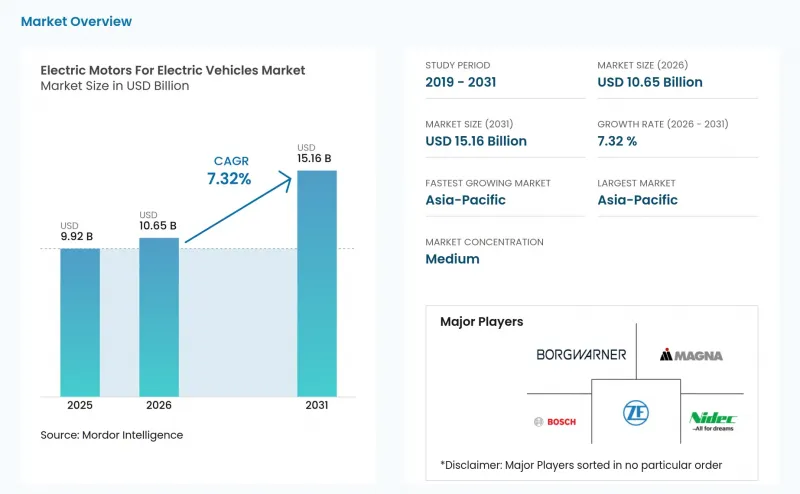
According to Mordor Intelligence, the electric motors for electric vehicles market size was valued at USD 9.92 billion in 2025, is estimated at USD 10.65 billion in 2026, and is projected to reach USD 15.16 billion by 2031, growing at a CAGR of 7.32% from 2026 to 2031.
Global Electric Motors For Electric Vehicles Market Trends and Insights
Ramping Electric Vehicle Sales and Regional Policies
Global electric vehicle sales exceeded 20 million units in 2025 and represented 20% of new passenger car sales, according to the International Energy Agency . China accounted for more than 55% of global EV sales, giving the country the largest pool of motor purchasing demand. The EV motors market also has a separate source of demand in India and Southeast Asia, where two-wheelers and three-wheelers use lower-power motor systems. This demand does not follow the same product requirements as European passenger car programs. India's electric two-wheeler retail sales surpassed 1.4 million units in FY2026, supported by FAME III and PM E-Drive measures. Suppliers, therefore, need portfolios that cover both hub motors below 5 kW and high-power commercial e-axle systems above 400 kW.
Tightening Emissions Regulations and Electrification Incentives
EU regulations establish fleet-average emissions targets for new passenger cars over the near and longer term. Under the EU climate framework, regulations require complete emissions reductions for new passenger cars . China's Dual Credit Policy links new energy vehicle credits to internal-combustion vehicle production rights, supporting EV production volumes. A planned EU revision would allow limited flexibility in meeting future emissions targets through low-carbon fuels, thereby preserving a commercial role for PHEV drivetrains in the near term. This policy environment supports compact motor configurations and aligns with the projected growth of PHEVs. Established Tier-1 suppliers also benefit, as functional safety requirements increase the engineering threshold for motor control systems.
Rare-Earth Magnet Price and Supply Volatility Constraining PMSM Scale
China's export controls on key rare-earth materials disrupted supplies of high-temperature PMSM magnets. Chinese magnet exports subsequently declined significantly, affecting production at Ford, BMW, Suzuki, and Stellantis. China dominates global sintered permanent magnet production, while rare-earth-containing designs account for the majority of global EV motors. Buyers sourcing magnets outside China faced premiums above Chinese benchmark prices, and NdPr oxide prices increased substantially in some cases. Energy Fuels validated U.S.-mined NdPr oxide for use in high-temperature EV drivetrain magnets; however, downstream processing and sintering capacity remain concentrated in China.
Other drivers and restraints analyzed in the detailed report include:
- Demand for Higher Efficiency, Power Density, and Vehicle Range
- Growth of Integrated E-Axles and Multi-Motor Platforms
- High Capital Intensity Limiting Competitive Entry in Precision Motor Segments
For complete list of drivers and restraints, kindly check the Table Of Contents.
Segment Analysis
Permanent magnet synchronous motors held 59.24% of the EV motors market share in 2025. Their lead reflects high power density and strong efficiency in passenger car applications. Brushless DC motors are used in many two-wheeler and auxiliary-system applications. They use simpler control electronics and retain a cost advantage below 10 kW. Switched reluctance motors and other types remain smaller categories. Torque ripple and acoustic concerns have limited their use in premium passenger cabins.
AC induction motors are the fastest-growing motor type, with a projected 9.92% CAGR through 2031. Export controls have prompted OEMs and Tier-1 suppliers to reassess motor designs that rely on NdFeB magnets. Induction motors eliminate direct dependence on these magnets, although they may deliver lower efficiency under partial-load conditions. Magnet-free motor technologies offer an alternative for heavy-duty applications. Rare-earth-free drive designs can also support cost-effective electrification. Consequently, the EV motors market may see more magnet-free platform awards, particularly in commercial vehicles and emerging markets.
Passenger cars held 51.12% of the EV motor market share in 2025. Their motor choices generally prioritize performance, range, and efficient operation. Two-wheelers are the fastest-growing vehicle class at a 15.22% CAGR through 2031. India, Vietnam, and Indonesia are the leading sources of this demand in the supplied research. In the sub-5 kW range, EV ownership costs can undercut comparable internal-combustion models. Commercial vehicles are also becoming more important as fleet buyers move to electric buses and trucks.
EU regulations support the transition of city buses toward zero-emission operation. Three-wheelers are in high demand in South Asia and Southeast Asia, where policy support promotes commercial electric vehicles. Hub motors are widely used in two-wheelers because they eliminate the mechanical transmission and reduce overall system weight. They also enable the retrofit electrification of internal-combustion-engine two-wheelers. Off-road and specialty vehicles provide suppliers with an additional application area for high-torque commercial motor designs. The EV motors industry requires dedicated hub-motor engineering, as these requirements do not readily carry over from passenger-car e-axle programs.
Complete Report Scope:
- By Motor Type
- Brushless DC Motor
- Permanent Magnet Synchronous Motor
- AC Induction Motor
- Switched Reluctance Motor
- Other Motor Types
- By Vehicle Class
- Two-Wheelers
- Three-Wheelers
- Passenger Cars
- Commercial Vehicles
- Off Road and Others
- By Propulsion
- Battery Electric Vehicle
- Hybrid Electric Vehicle
- Plug-In Hybrid Electric Vehicle
- Fuel-Cell Electric Vehicle
- By Power Output
- Less Than 100 kW
- 100 kW to 200 kW
- 200 kW to 400 kW
- Above 400 kW
- By Geography
- North America
- United States
- Canada
- Mexico
- Rest of North America
- South America
- Brazil
- Rest of South America
- Europe
- Germany
- United Kingdom
- France
- Italy
- Russia
- Rest of Europe
- Asia-Pacific
- China
- India
- Japan
- South Korea
- Australia
- Rest of Asia-Pacific
- Middle East and Africa
- South Africa
- Saudi Arabia
- United Arab Emirates
- Rest of Middle East and Africa
- North America
Geography Analysis
Asia-Pacific held 52.53% of the EV motors market share in 2025 and is projected to grow at a 9.11% CAGR through 2031. China serves as both a major consumption center and a key supplier of rare-earth materials and permanent magnets. Its export policies can affect the costs and availability of permanent magnet synchronous motors (PMSMs) across the EV motor market. China also leads global sales of electric medium- and heavy-duty trucks. India represents an important secondary growth center, supported by the expansion of its two- and three-wheeler segments and localized manufacturing programs.
Nidec has established its Orchard Hub campus in Hubli. India has extended the PM E-Drive program and relaxed traction motor localization timelines in response to a magnet shortage. Japan and South Korea support demand for premium vehicles and advanced motor technologies. BorgWarner has received a stator assembly award for a South Korean B-segment SUV. Europe follows a more regulation-driven demand pattern, as EU CO2 regulations require OEMs to expand their BEV and PHEV offerings, thereby supporting sustained motor procurement.
BMW's Steyr facility has become a high-voltage supply hub following the start of Gen6 motor production. YASA has opened an upgraded facility in Yarnton, expanding its production capacity. North America is expanding commercial EV motor production capacity and developing domestic rare-earth supply capabilities. BorgWarner has secured an award for an integrated drive module for REEV trucks and large SUVs. South America, the Middle East, and Africa remain early-stage markets. These regions primarily source imported motor assemblies and remain price-sensitive, while Brazil demonstrates interest in PHEVs, and Middle Eastern fleet programs generate initial demand from the logistics sector.
- NIDEC CORPORATION
- BorgWarner Inc.
- ZF Friedrichshafen AG
- Magna International Inc.
- Robert Bosch GmbH
- BYD Company Limited
- DENSO CORPORATION
- AISIN CORPORATION
- Schaeffler AG
- Valeo
- Continental AG
- Hitachi Astemo, Ltd.
- Mitsubishi Electric Corporation
- Toshiba Corporation
- Johnson Electric Holdings Limited
- Magna Powertrain
- MAHLE GmbH
- Jing-Jin Electric Technologies Co., Ltd.
- Shenzhen Inovance Technology Co., Ltd.
- Shanghai Edrive Co., Ltd.
- Tesla, Inc.
- YASA Limited
- Equipmake Ltd.
- Protean Electric Limited
Additional Benefits:
- The market estimate (ME) sheet in Excel format
- 3 months of analyst support
TABLE OF CONTENTS
1 Introduction
- 1.1 Study Assumptions and Market Definition
- 1.2 Scope of the Study
2 Research Methodology
3 Executive Summary
4 Market Landscape
- 4.1 Market Overview
- 4.2 Market Drivers
- 4.2.1 Rising EV Production and Sales
- 4.2.2 Tightening Emissions Regulations and Electrification Incentives
- 4.2.3 Demand for Higher Efficiency, Power Density, and Vehicle Range
- 4.2.4 Growth of Integrated E-Axles and Multi-Motor Platforms
- 4.2.5 Rare-Earth-Reduced Motor Design and Localized Supply Chains
- 4.2.6 Commercial-EV Duty-Cycle Electrification
- 4.3 Market Restraints
- 4.3.1 High Capital Intensity for Precision Motor Manufacturing
- 4.3.2 Rare-Earth Magnet Price and Supply Volatility
- 4.3.3 NVH, Thermal-Derating, and Durability Trade-Offs at High Power
- 4.3.4 Platform Integration and Interoperability Constraints
- 4.4 Value and Supply-Chain Analysis
- 4.4.1 Critical Materials and Magnet Supply
- 4.4.2 Electrical Steel, Copper, and Lamination Supply
- 4.4.3 Motor Core, Winding, Rotor, and Stator Manufacturing
- 4.4.4 Inverter, Gearbox, and E-Axle Integration
- 4.4.5 OEM and Tier-1 Procurement Relationships
- 4.4.6 Aftermarket, Remanufacturing, and Recycling
- 4.5 Regulatory Landscape
- 4.5.1 Zero-Emission Vehicle Mandates
- 4.5.2 Vehicle CO2 and Fuel-Economy Standards
- 4.5.3 Critical-Mineral, Local-Content, and Battery-Origin Rules
- 4.5.4 Functional Safety, EMC, and Automotive Quality Requirements
- 4.6 Technological Outlook
- 4.6.1 Permanent Magnet Synchronous Motors
- 4.6.2 Brushless DC Motors
- 4.6.3 AC Induction Motors
- 4.6.4 Synchronous Reluctance and Wound-Rotor Motors
- 4.6.5 Axial-Flux Motors
- 4.6.6 In-Wheel Motors
- 4.6.7 Silicon Carbide Inverter-Integrated Drives
- 4.6.8 Oil Cooling and Direct Winding Cooling
- 4.7 Porter's Five Forces Analysis
- 4.7.1 Bargaining Power of Suppliers
- 4.7.2 Bargaining Power of Buyers
- 4.7.3 Threat of New Entrants
- 4.7.4 Threat of Substitutes
- 4.7.5 Competitive Rivalry
5 Market Size and Growth Forecasts (Value (USD) and Volume (Units))
- 5.1 By Motor Type
- 5.1.1 Brushless DC Motor
- 5.1.2 Permanent Magnet Synchronous Motor
- 5.1.3 AC Induction Motor
- 5.1.4 Switched Reluctance Motor
- 5.1.5 Other Motor Types
- 5.2 By Vehicle Class
- 5.2.1 Two-Wheelers
- 5.2.2 Three-Wheelers
- 5.2.3 Passenger Cars
- 5.2.4 Commercial Vehicles
- 5.2.5 Off Road and Others
- 5.3 By Propulsion
- 5.3.1 Battery Electric Vehicle
- 5.3.2 Hybrid Electric Vehicle
- 5.3.3 Plug-In Hybrid Electric Vehicle
- 5.3.4 Fuel-Cell Electric Vehicle
- 5.4 By Power Output
- 5.4.1 Less Than 100 kW
- 5.4.2 100 kW to 200 kW
- 5.4.3 200 kW to 400 kW
- 5.4.4 Above 400 kW
- 5.5 By Geography
- 5.5.1 North America
- 5.5.1.1 United States
- 5.5.1.2 Canada
- 5.5.1.3 Mexico
- 5.5.1.4 Rest of North America
- 5.5.2 South America
- 5.5.2.1 Brazil
- 5.5.2.2 Rest of South America
- 5.5.3 Europe
- 5.5.3.1 Germany
- 5.5.3.2 United Kingdom
- 5.5.3.3 France
- 5.5.3.4 Italy
- 5.5.3.5 Russia
- 5.5.3.6 Rest of Europe
- 5.5.4 Asia-Pacific
- 5.5.4.1 China
- 5.5.4.2 India
- 5.5.4.3 Japan
- 5.5.4.4 South Korea
- 5.5.4.5 Australia
- 5.5.4.6 Rest of Asia-Pacific
- 5.5.5 Middle East and Africa
- 5.5.5.1 South Africa
- 5.5.5.2 Saudi Arabia
- 5.5.5.3 United Arab Emirates
- 5.5.5.4 Rest of Middle East and Africa
- 5.5.1 North America
6 Competitive Landscape
- 6.1 Market Concentration
- 6.2 Strategic Moves
- 6.2.1 Capacity Expansions
- 6.2.2 Joint Ventures and Partnerships
- 6.2.3 Vertical Integration
- 6.2.4 Product Launches and Platform Wins
- 6.3 Market Share Analysis
- 6.4 Company Profiles (Includes Global Level Overview, Market Level Overview, Core Segments, Financials as available, Strategic Information, Market Rank/Share, Products and Services, Recent Developments)
- 6.4.1 NIDEC CORPORATION
- 6.4.2 BorgWarner Inc.
- 6.4.3 ZF Friedrichshafen AG
- 6.4.4 Magna International Inc.
- 6.4.5 Robert Bosch GmbH
- 6.4.6 BYD Company Limited
- 6.4.7 DENSO CORPORATION
- 6.4.8 AISIN CORPORATION
- 6.4.9 Schaeffler AG
- 6.4.10 Valeo
- 6.4.11 Continental AG
- 6.4.12 Hitachi Astemo, Ltd.
- 6.4.13 Mitsubishi Electric Corporation
- 6.4.14 Toshiba Corporation
- 6.4.15 Johnson Electric Holdings Limited
- 6.4.16 Magna Powertrain
- 6.4.17 MAHLE GmbH
- 6.4.18 Jing-Jin Electric Technologies Co., Ltd.
- 6.4.19 Shenzhen Inovance Technology Co., Ltd.
- 6.4.20 Shanghai Edrive Co., Ltd.
- 6.4.21 Tesla, Inc.
- 6.4.22 YASA Limited
- 6.4.23 Equipmake Ltd.
- 6.4.24 Protean Electric Limited
7 Market Opportunities and Future Outlook
- 7.1 White-Space and Unmet-Need Assessment
- 7.1.1 Rare-Earth-Free High-Torque Motors
- 7.1.2 Affordable Integrated Drives for Emerging Markets
- 7.1.3 High-Efficiency Motors for Heavy-Duty Fleets
- 7.1.4 Localized Motor-Core and Magnet Recycling Capacity
- 7.1.5 Compact High-Speed Motors for 800-Volt Platforms

