PUBLISHER: Mordor Intelligence | PRODUCT CODE: 2187159

PUBLISHER: Mordor Intelligence | PRODUCT CODE: 2187159
Enterprise Resource Planning - Market Share Analysis, Industry Trends & Statistics, Growth Forecasts (2027 - 2032)
According to Mordor Intelligence, the enterprise resource planning market size is estimated at USD 78.15 billion in 2026 and is projected to be USD 85.28 billion in 2027, reaching USD 133.3 billion by 2032, growing at a CAGR of 9.35% from 2027 to 2032.
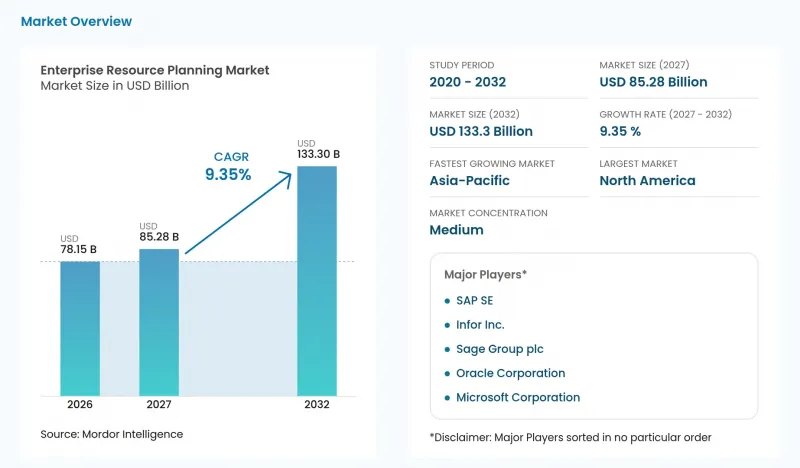
This report is segmented by Offering (Solutions and more), Deployment (Cloud and more), Function (Finance and more), Enterprise Size (Small and Medium-Sized Enterprises and more), End-user Industry (Manufacturing and more), and Geography (North America and more). The market forecasts are provided in terms of value (USD), based on availability.
Global Enterprise Resource Planning Market Trends and Insights
Cloud-First Migration Momentum
By November 12, 2025, Amey had transitioned from a 20-year-old legacy ECC system to SAP Cloud ERP Private Edition hosted on Google Cloud Platform. SAP SE reported that Cloud ERP Suite revenue rose 28% in fiscal 2025, or 32% at constant currencies. The suite's revenue growth shows expanding commercial demand for cloud ERP, while Amey illustrates how replacement of an installed system contributes to that demand. The Amey project combined a software transition with a specified hosting environment, making migration expertise relevant to both application and infrastructure choices. Migration can therefore draw cloud ERP demand from installed ECC users, extending the addressable pool beyond organizations adopting ERP for the first time.
AI-Driven Analytics Embedded in ERP
Embedding AI analytics in ERP can make the application a place to interpret a transaction as well as record it. In its Q2 2026 release, SAP described generally available AI-assisted reporting in SAP S/4HANA Cloud Public Edition, letting accounts receivable managers explore localized financial and logistics data through natural-language queries within their workflows. Microsoft reports that generative insights for seasonality, trends and signal correlations have been generally available in Dynamics 365 Supply Chain Management demand planning since August 2026. Natural-language exploration addresses how receivables managers retrieve information, while generative insights address how planners interpret demand signals. ERP suppliers can therefore compete on role-specific analytical capabilities, bringing reporting usability and demand interpretation into application selection.
High Implementation and Switching Costs
Implementation costs can constrain ERP adoption when the delivery expense is difficult to justify alongside the software benefits. In SAPinsider's December 2025 to March 2026 survey, 63% of respondents with no SAP S/4HANA plans identified increased cloud infrastructure and deployment costs as implementation barriers. Within that same group, 50% identified an inability to create a value proposition for SAP S/4HANA. Among these respondents, cost was cited more often than a missing value case, so an investment case would first have to justify infrastructure and deployment spending.
Other drivers and restraints analyzed in the detailed report include:
- SME SaaS Adoption Surge
- Mandatory E-Invoicing Mandates (VAT, CTC)
- Data Integration and Legacy Complexity
For complete list of drivers and restraints, kindly check the Table Of Contents.
Segment Analysis
Solutions accounted for a 57.13% share of the enterprise resource planning market size in 2026. SAP SE reported Cloud ERP Suite revenue of EUR 10.74 billion (USD 12.53 billion) in the first half of 2026, up 24% from the first half of 2025. The largest segment therefore includes substantial spending tied to an identifiable ERP suite, making continuity of that software relationship commercially important for its supplier. The first-half increase made this suite a source of additional application revenue for SAP within an already substantial software business.
Services is forecast to be the fastest-growing segment, with a CAGR of 14.08% from 2027 to 2032. On October 3, 2025, the Netherlands' Ministry of Infrastructure and Water Management signed a 15-year contract naming SAP Nederland Holding B.V. as the supplier. The contract combined SaaS ERP services, on-premises ERP licenses and implementation services. The contract places implementation within an extended ERP relationship encompassing different deployment models. Because the award covers SaaS and installed licenses together, the implementation services in it serve both deployment modes under one supplier contract.
Cloud represented a 56.15% enterprise resource planning market share in 2026. Oracle reported USD 1.1 billion in Q3 fiscal 2026 Fusion Cloud ERP SaaS revenue, up 17% in USD and 14% in constant currency year over year. Such product-specific revenue makes ongoing application service commercially consequential to the provider, beyond the initial decision to select an ERP platform. Oracle's constant-currency growth was 3 percentage points below its USD growth, showing that currency effects amplified the reported increase in this SaaS business.
Hybrid is forecast to be the fastest-growing segment, with a CAGR of 16.31% from 2027 to 2032. In SAPinsider's 2025 survey, 30% of hybrid-majority respondents reported significant acceleration of SAP modernization plans associated with adopting cloud architecture. This ties cloud architecture adoption among hybrid-majority SAP organizations to faster modernization of their existing SAP workloads, making a staged transition a relevant commercial proposition for that customer group. On-premise deployment was the most common arrangement among ERP systems in PMMI's 2025 survey of 57 member respondents, followed by cloud-based deployment. Suppliers can address both needs through transitions that accommodate an established deployment while creating a practical route toward cloud use.
Complete Report Scope:
- By Offering
- Solutions
- Services
- By Deployment
- On-premise
- Cloud
- Hybrid
- By Function
- Human Resources
- Supply Chain
- Finance
- Marketing
- Other Functions
- By Enterprise Size
- Large Enterprises
- Small and Medium-Sized Enterprises
- By End-user Industry
- Manufacturing
- Retail and E-commerce
- BFSI
- IT and Telecom
- Government and Public Sector
- Energy and Utilities
- Healthcare
- Other End-user Industries
- By Geography
- North America
- United States
- Canada
- Mexico
- South America
- Brazil
- Argentina
- Rest of South America
- Europe
- United Kingdom
- Germany
- France
- Italy
- Spain
- Rest of Europe
- Asia-Pacific
- China
- Japan
- India
- South Korea
- Rest of Asia-Pacific
- Middle East and Africa
- Middle East
- United Arab Emirates
- Saudi Arabia
- Rest of Middle East
- Africa
- South Africa
- Egypt
- Rest of Africa
- Middle East
- North America
Geography Analysis
North America accounted for a 33.63% share of the enterprise resource planning market size in 2026. By February 3, 2026, Clorox had completed the full rollout of its SAP ERP system across the United States and Canada. Separately, 50% of 158 manufacturing leaders surveyed across North America listed ERP and MES modernization as a 2026 technology priority. Clorox's completed cross-border ERP program and the manufacturers' stated priorities give suppliers distinct opportunities in multinational deployment and potential modernization work.
Asia-Pacific is forecast to be the fastest-growing region, with a CAGR of 12.15% from 2027 to 2032. In July 2026, SAP announced that BMW Brilliance Automotive Ltd. in Greater China had chosen SAP Cloud ERP Private. The same update identified India's Agrawal Metal Works Pvt. Ltd. and Electrosteel Castings Ltd. as industrial and manufacturing buyers of the private-cloud ERP product. In 2025, Singapore-headquartered OCBC was using Oracle Fusion Cloud ERP to unify its global finance platform. Demand therefore spans industrial transformation and multinational finance unification, with private-cloud selections creating potential projects alongside an operating banking platform.
In South America, Brazil's automotive-wheel manufacturer Iochpe-Maxion migrated SAP S/4HANA to SAP Cloud ERP Private in June 2025, and Peru's AOPSA put SAP Business One into operation on September 11, 2025. In Europe, 61.28% of EU information and communication enterprises with at least 10 employees or self-employed persons used ERP software in 2025, supporting an installed-customer proposition for application extensions or replacements. In the Middle East and Africa, Transnet Port Terminals, a division of South Africa's state-owned Transnet, completed its ECC 6.0 to SAP S/4HANA migration across all 16 sea-cargo terminals by September 25, 2025. By January 3, 2026, Saudi Arabia's National Center for the Development of the Non-Profit Sector had completed an ERP implementation using SAP S/4HANA and SAP SuccessFactors. The commercial scope varies from installed-system changes in Brazil and EU ICT businesses to terminal-wide migration and public-sector deployment, requiring propositions matched to each operating footprint.
- SAP SE
- Oracle Corporation
- Microsoft Corporation
- Infor Inc.
- Sage Group plc
- Epicor Software Corporation
- IFS AB
- Unit4 NV
- Acumatica, Inc.
- Odoo SA
- QAD Inc.
- Plex Systems, Inc.
- Deltek, Inc.
- Priority Software Ltd.
- Ramco Systems
- Syspro
- TOTVS
- Yonyou
- HashMicro
Additional Benefits:
- The market estimate (ME) sheet in Excel format
- 3 months of analyst support
TABLE OF CONTENTS
1 INTRODUCTION
- 1.1 Study Assumptions and Market Definition
- 1.2 Scope of the Study
2 RESEARCH METHODOLOGY
3 EXECUTIVE SUMMARY
4 MARKET LANDSCAPE
- 4.1 Market Overview
- 4.2 Market Drivers
- 4.2.1 Cloud-First Migration Momentum
- 4.2.2 AI-Driven Analytics Embedded in ERP
- 4.2.3 SME SaaS Adoption Surge
- 4.2.4 Mandatory E-Invoicing Mandates (VAT, CTC)
- 4.2.5 ESG Accounting Add-Ons For Scope-3 Tracking
- 4.2.6 Increasing Adoption of Cloud-Based ERP Solutions
- 4.3 Market Restraints
- 4.3.1 High Implementation and Switching Costs
- 4.3.2 Data Integration and Legacy Complexity
- 4.3.3 Rising Data-Sovereignty / Residency Laws
- 4.3.4 Shortage Of Micro-Vertical ERP Talent
- 4.4 Industry Value Chain Analysis
- 4.5 Regulatory Landscape
- 4.6 Technological Outlook
- 4.7 Porter's Five Forces Analysis
- 4.7.1 Threat of New Entrants
- 4.7.2 Bargaining Power of Suppliers
- 4.7.3 Bargaining Power of Buyers
- 4.7.4 Threat of Substitutes
- 4.7.5 Competitive Rivalry
- 4.8 Pricing Analysis
- 4.9 Ecosystem Analysis
5 MARKET SIZE AND GROWTH FORECASTS (VALUE)
- 5.1 By Offering
- 5.1.1 Solutions
- 5.1.2 Services
- 5.2 By Deployment
- 5.2.1 On-premise
- 5.2.2 Cloud
- 5.2.3 Hybrid
- 5.3 By Function
- 5.3.1 Human Resources
- 5.3.2 Supply Chain
- 5.3.3 Finance
- 5.3.4 Marketing
- 5.3.5 Other Functions
- 5.4 By Enterprise Size
- 5.4.1 Large Enterprises
- 5.4.2 Small and Medium-Sized Enterprises
- 5.5 By End-user Industry
- 5.5.1 Manufacturing
- 5.5.2 Retail and E-commerce
- 5.5.3 BFSI
- 5.5.4 IT and Telecom
- 5.5.5 Government and Public Sector
- 5.5.6 Energy and Utilities
- 5.5.7 Healthcare
- 5.5.8 Other End-user Industries
- 5.6 By Geography
- 5.6.1 North America
- 5.6.1.1 United States
- 5.6.1.2 Canada
- 5.6.1.3 Mexico
- 5.6.2 South America
- 5.6.2.1 Brazil
- 5.6.2.2 Argentina
- 5.6.2.3 Rest of South America
- 5.6.3 Europe
- 5.6.3.1 United Kingdom
- 5.6.3.2 Germany
- 5.6.3.3 France
- 5.6.3.4 Italy
- 5.6.3.5 Spain
- 5.6.3.6 Rest of Europe
- 5.6.4 Asia-Pacific
- 5.6.4.1 China
- 5.6.4.2 Japan
- 5.6.4.3 India
- 5.6.4.4 South Korea
- 5.6.4.5 Rest of Asia-Pacific
- 5.6.5 Middle East and Africa
- 5.6.5.1 Middle East
- 5.6.5.1.1 United Arab Emirates
- 5.6.5.1.2 Saudi Arabia
- 5.6.5.1.3 Rest of Middle East
- 5.6.5.2 Africa
- 5.6.5.2.1 South Africa
- 5.6.5.2.2 Egypt
- 5.6.5.2.3 Rest of Africa
- 5.6.5.1 Middle East
- 5.6.1 North America
6 COMPETITIVE LANDSCAPE
- 6.1 Market Concentration
- 6.2 Strategic Moves
- 6.3 Market Share Analysis
- 6.4 Company Profiles (includes Global level Overview, Market level overview, Core Segments, Financials as available, Strategic Information, Market Rank/Share for key companies, Products and Services, and Recent Developments)
- 6.4.1 SAP SE
- 6.4.2 Oracle Corporation
- 6.4.3 Microsoft Corporation
- 6.4.4 Infor Inc.
- 6.4.5 Sage Group plc
- 6.4.6 Epicor Software Corporation
- 6.4.7 IFS AB
- 6.4.8 Unit4 NV
- 6.4.9 Acumatica, Inc.
- 6.4.10 Odoo SA
- 6.4.11 QAD Inc.
- 6.4.12 Plex Systems, Inc.
- 6.4.13 Deltek, Inc.
- 6.4.14 Priority Software Ltd.
- 6.4.15 Ramco Systems
- 6.4.16 Syspro
- 6.4.17 TOTVS
- 6.4.18 Yonyou
- 6.4.19 HashMicro
7 MARKET OPPORTUNITIES AND FUTURE OUTLOOK
- 7.1 White-Space and Unmet-Need Assessment

